How to Clean Kunzite Jewelry Safely
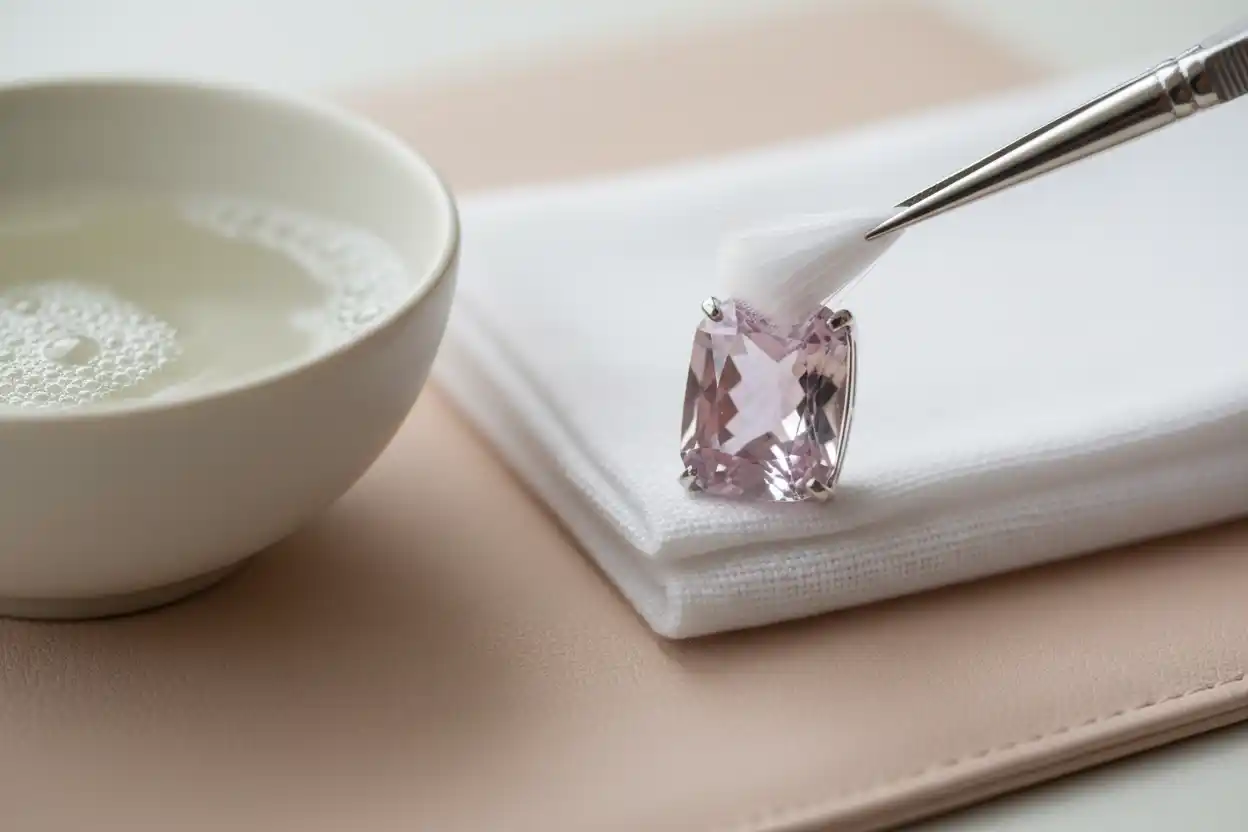
The safest way to clean kunzite jewelry is with lukewarm water, mild liquid soap, and a very soft brush. Steam and ultrasonic cleaners should be avoided because kunzite has perfect cleavage in two directions, limited toughness, and sensitivity to pressure, sharp blows, high heat, and sudden temperature changes.
Kunzite’s pink-to-violet color can also fade after prolonged exposure to intense light or heat. Cleaning and drying should therefore take place indoors at room temperature rather than beneath direct sunlight or concentrated lamps.
Why Kunzite Requires Delicate Care
Kunzite is the pink-to-violet variety of spodumene. Its color is generally associated with manganese, while the mineral’s strong pleochroism can make the same gemstone appear different from separate viewing directions.
The material’s geology, color, sources, symbolism, and uses belong to the broader Kunzite meaning guide.
Kunzite rates approximately 6.5 to 7 on the Mohs scale. Its surface can resist some routine scratches, but the stone’s cleavage produces poor toughness.
| Property | Cleaning implication |
|---|---|
| Mineral species | Spodumene |
| Typical color | Pale pink, lilac, violetish pink, or purple-pink |
| Mohs hardness | Approximately 6.5 to 7 |
| Toughness | Poor |
| Cleavage | Perfect in two directions |
| Safest routine method | Lukewarm water, mild soap, and a very soft brush |
| Ultrasonic cleaning | Avoid |
| Steam cleaning | Avoid |
| Main risks | Cleavage, pressure, sharp blows, thermal shock, heat, and light-related fading |
The distinction between hardness and breakage resistance is explained in the gemstone hardness chart and Gemstone Toughness vs Hardness.
The dedicated gemstone cleavage guide explains why a hard impact can split kunzite despite its respectable Mohs rating.
Inspect the Kunzite Before Cleaning
Examine the jewelry under bright but indirect light. Look for loose prongs, movement in the stone, chipped corners, worn facet junctions, surface-reaching fractures, and damaged metal.
Large kunzites are relatively common because crystals can grow to substantial sizes. However, a large stone also presents a bigger exposed surface and greater leverage against its setting.
Pay special attention to elongated cuts, pointed ends, thin girdles, and raised settings. These areas can be vulnerable to impact and pressure.
Do not clean a loose or visibly damaged stone at home.
Kunzite Treatment and Color Stability
Kunzite may be irradiated and then heated to enhance or modify its color. The resulting color can fade under heat or prolonged bright light, just as naturally colored kunzite may fade.
Treatment is not always identifiable through visual inspection. The broader enhancement categories appear in Gemstone Treatments Explained.
Cleaning should not be used as a treatment test. Deliberate sun exposure, heating, chemicals, scratching, or thermal shock may damage the jewel without providing a reliable answer.
A laboratory report may identify detectable treatment, but daily care should remain conservative whether or not treatment is documented.
Prepare the Cleaning Area
Place a folded towel on the work surface to protect the kunzite if it slips.
Fill a shallow bowl with lukewarm water and add only a few drops of mild liquid dish soap. Prepare a second bowl of clean water at the same approximate temperature.
Use a very soft toothbrush, fine jewelry brush, or clean makeup brush. A lint-free cloth is suitable for blotting.
Avoid cleaning over an uncovered drain. Kunzite earrings and loose accent stones can be difficult to recover if they fall.
Wash Kunzite Gently
Place the jewelry briefly in the mild solution or hold it securely over the bowl.
Brush around the crown, pavilion, girdle, prongs, and gallery using extremely light pressure. Oils beneath a transparent kunzite can make a pale stone look gray or lifeless.
Do not force the brush against a corner, fracture, or exposed girdle. Pressure in an unfavorable direction can stress a cleavage plane.
A short wash is sufficient. Prolonged soaking offers no benefit and may affect glue, repairs, enamel, stringing, plating, or accompanying gemstones.
Rinse Without Temperature Change
Rinse the piece in the second bowl of clean lukewarm water. Avoid moving it from warm water into a cold rinse.
Blot the jewelry with a lint-free cloth. Allow moisture beneath the setting to evaporate indoors at room temperature.
Do not use a hair dryer, radiator, heated cabinet, sunny windowsill, or intense lamp. Added heat increases fracture and fading risks.
Inspect the setting after drying. Stop wearing the piece if the stone moves or a prong catches on fabric.
Never Use an Ultrasonic Cleaner
Kunzite should not go into an ultrasonic cleaner. Vibration can stress cleavage directions, enlarge fractures, loosen settings, and dislodge accent stones.
A stone may appear eye-clean but still contain structural features that are difficult to see without magnification.
The broader equipment comparison belongs to Which Gemstones Can Go in an Ultrasonic Cleaner?. Kunzite belongs on the avoid list.
Never Steam Clean Kunzite
Steam exposes the gemstone to concentrated heat, pressure, and sudden temperature change.
These conditions can cause kunzite to split along cleavage planes or change its color. Steam may also damage glue, enamel, soldered repairs, plating, and accompanying stones.
Warm soapy water removes ordinary residue without imposing those risks.
Protect Kunzite from Sunlight
Kunzite can fade after prolonged exposure to intense light. This sensitivity has led to the informal description “evening stone,” although the gem can still be worn during the day with sensible precautions.
Ordinary short-term wear is different from leaving the jewelry for weeks or months on a sunny windowsill, store display, vehicle dashboard, or beneath powerful lighting.
Do not dry wet kunzite in direct sunlight. Store it in a closed jewelry box, drawer, or opaque pouch away from heat.
The broader light-stability discussion belongs to Which Crystals Can and Can’t Go in the Sun.
Once color has faded, household cleaning cannot restore it.
Cleaning a Kunzite Ring
A Kunzite ring experiences more impact and pressure than earrings or pendants.
Clean around the setting without pushing against the stone. Protective bezels, halos, and low-profile mountings can reduce edge exposure.
Remove the ring before exercise, gardening, household work, swimming, bathing, and using cleaning chemicals.
Kunzite is generally better suited to occasional-wear rings than to unprotected daily-wear designs.
Cleaning Kunzite Earrings
Kunzite earrings usually offer better impact protection than rings.
Clean posts, hooks, backs, baskets, hinges, and areas beneath the stones. Cosmetics and hair products can dull pale kunzite quickly.
Keep alcohol-based disinfectant on compatible metal fittings and away from glue, coatings, plating, or the gemstone.
Cleaning a Kunzite Necklace
A Kunzite necklace or pendant is a practical format because it reduces direct impact.
Apply perfume, sunscreen, and body lotion before putting on the necklace. Allow those products to dry first.
Prevent the chain from rubbing against the kunzite during cleaning and storage. Large pendants should be supported by their settings rather than gripped by the gemstone.
Cleaning a Kunzite Bracelet
A Kunzite bracelet combines repeated movement with impact risk against desks, furniture, and clothing.
Inspect every setting, link, hinge, and clasp before cleaning. Support the bracelet flat and clean one section at a time.
Remove it before activities that repeatedly bring the wrist against hard surfaces.
Kunzite and Hiddenite
Kunzite and hiddenite belong to the spodumene mineral family. Kunzite is pink to violet, while hiddenite is green.
The separate Hiddenite guide owns that material’s geology, identity, color, and symbolism. Purchasing considerations belong to the Hiddenite buying guide.
Shared mineral family does not mean that every specimen has identical fractures, treatments, color stability, or setting requirements.
Kunzite Versus Morganite
Kunzite and morganite can both show pale pink tones, but they are different minerals. Kunzite is spodumene, whereas morganite is beryl.
The full visual and durability comparison belongs to Kunzite vs Morganite.
Cleaning response should not be used as an identification test. Scratching, heat, sunlight exposure, and chemical experiments can permanently damage either stone.
The tracker’s broader Pink Gemstones guide and Pink Engagement Ring Stones page place kunzite among other pink materials without duplicating this care workflow.
Chemicals and Abrasives to Avoid
Do not use toothpaste, baking soda, scouring powder, stiff brushes, polishing paste, or abrasive cloths.
Keep kunzite away from bleach, chlorine, acetone, drain cleaner, oven cleaner, concentrated acids, and aggressive alkaline products.
Vinegar and lemon juice offer no benefit over mild soap and may affect the metal, solder, glue, plating, or companion stones.
Commercial jewelry dips should be used only when every material in the piece is confirmed compatible.
Buying, Value, and Documentation
The Kunzite buying guide covers color intensity, tone, pleochroism, cut orientation, clarity, size, treatment, fading risk, and setting design.
Market considerations belong to the Kunzite price guide. Large size alone does not guarantee high value because color and cut remain central.
For an important stone, a laboratory report may identify the material and detectable treatment. The tracker’s gemstone certification guide explains how identification services differ from commercial quality labels.
Retain invoices, reports, photographs, and treatment disclosures with the jewelry.
Storage and Preventive Care
Store kunzite separately in a padded, light-blocking box or opaque pouch.
Harder gemstones such as diamond, sapphire, ruby, and topaz can scratch it. Kunzite can also scratch softer materials, so mixed jewelry should not be stored loose.
Do not place heavy jewelry on top of a large kunzite. Pressure against the wrong direction can stress its cleavage.
Wipe the piece after wear so cosmetics and skin oils do not accumulate.
Physical Cleaning Versus Cleansing
Physical cleaning removes dust, grease, cosmetics, and soap residue.
Traditional cleansing or charging practices serve a separate personal or symbolic purpose. Those practices belong to How to Cleanse and Charge Kunzite.
Any traditional method should still respect the material’s sensitivity to sunlight, heat, impact, and thermal change.
Frequently Asked Questions
1. What is the safest way to clean kunzite?
Use lukewarm water, mild liquid soap, and a very soft brush, then rinse and dry it indoors at room temperature.
2. Can kunzite get wet?
Brief washing is normally safe for a sound stone. Avoid prolonged soaking when glue, repairs, stringing, fractures, or delicate components are present.
3. Can kunzite go in an ultrasonic cleaner?
No. Ultrasonic vibration may stress cleavage planes, fractures, and settings.
4. Can kunzite be steam cleaned?
No. Steam introduces heat, pressure, and sudden temperature change that can break or fade the stone.
5. Does sunlight fade kunzite?
Prolonged exposure to intense light can fade both natural and treated kunzite color.
6. Is dish soap safe for kunzite?
A few drops of mild liquid dish soap are suitable. Avoid bleach, abrasive particles, strong alkalis, and aggressive degreasers.
7. Can vinegar clean kunzite?
Vinegar is unnecessary and may affect the setting, solder, plating, glue, or accompanying gemstones.
8. Can toothpaste polish kunzite?
No. Toothpaste is abrasive and may damage the polish, facet edges, or metal setting.
9. Why does kunzite look paler from one direction?
Kunzite is pleochroic, so its color changes with viewing direction and cut orientation.
10. Can faded kunzite be restored by washing?
No. Cleaning removes surface residue but cannot restore color lost through prolonged heat or light exposure.
11. Is kunzite suitable for an engagement ring?
It can be used, but its poor toughness, cleavage, and fading sensitivity make protective settings and careful wear essential.
12. When should kunzite be professionally cleaned?
Professional care is appropriate for loose settings, visible fractures, large valuable stones, antique jewelry, pointed cuts, or noticeable color and clarity changes.
Conclusion
Kunzite’s color and size can create dramatic jewelry, yet its cleavage and fading sensitivity demand restrained care. Lukewarm soapy water removes ordinary residue without introducing vibration, pressure, or concentrated heat. When a kunzite appears paler after wear, its light exposure and viewing direction should be evaluated before any stronger cleaning is attempted.