Lavender Crystals: 12 Inspiring Stones, Positive Symbolism & Safe Uses
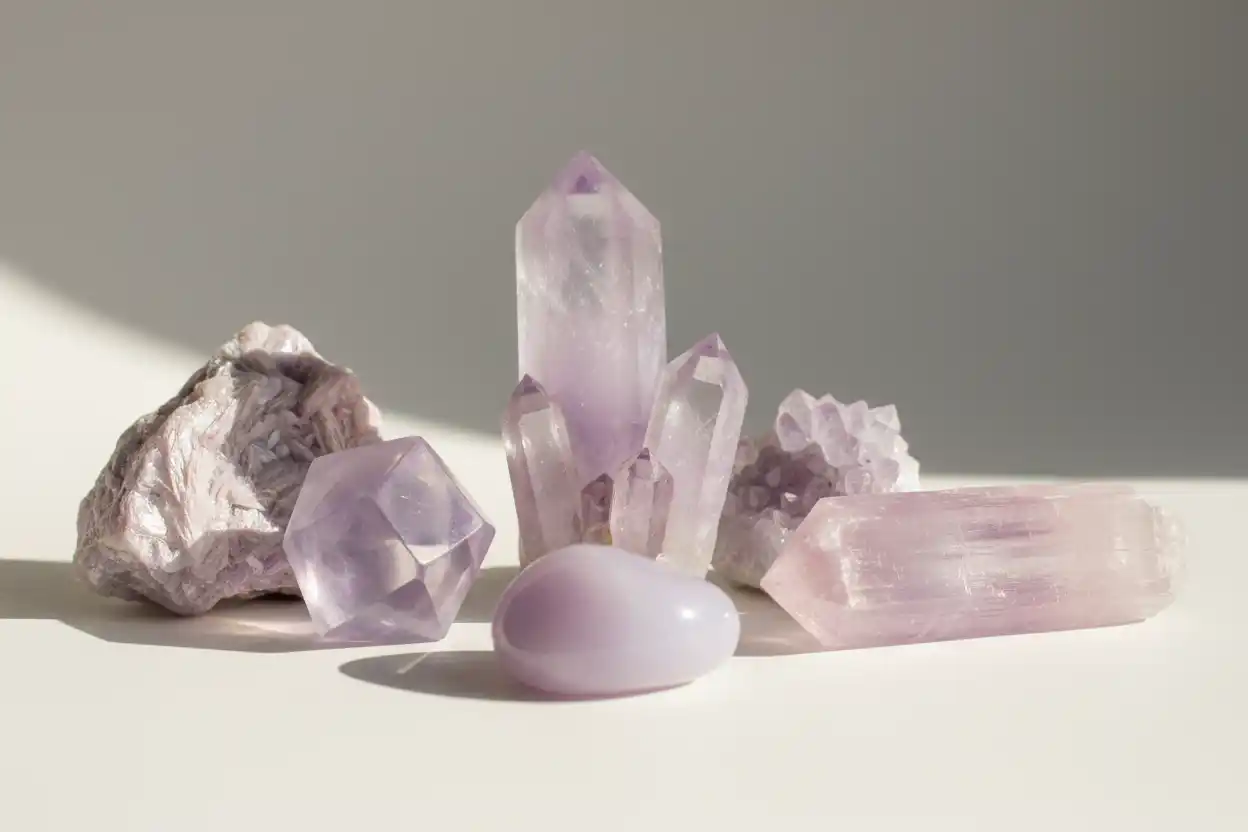
Lavender crystals are traditionally associated with reflection, creativity, emotional calm, imagination, gentle change, intuition, and thoughtful self-expression. Their colors sit between pale pink, cool violet, soft lilac, and muted purple, creating a quieter visual effect than deeply saturated purple gemstones. Some display transparent violet color, others show pearly layers, fibrous texture, sparkling mica, or cloudy bands, so two stones sold as lavender can look completely different.
Twelve attractive choices include pale amethyst, lepidolite, kunzite, lilac fluorite, charoite, iolite, sugilite, ametrine, spirit quartz, lavender jade, lilac chalcedony, and pale violet moonstone. These stones do not belong to one mineral family, and their durability varies significantly. The most useful approach is to enjoy the symbolism while choosing each stone according to its actual physical properties and intended use.
Amethyst, Lepidolite, and Kunzite for Reflection, Calm, and Gentle Change
Pale amethyst provides one of the easiest introductions to lavender crystals. Amethyst is purple quartz, and lighter specimens can show delicate lavender or lilac tones rather than the deep purple associated with premium jewelry. Quartz ranks 7 on the Mohs scale, so polished amethyst works well in pendants, earrings, beads, palm stones, and many rings when normal care is used.
Traditional amethyst healing properties are commonly associated with reflection, calm routines, restraint, and thoughtful decision-making. A pale amethyst point beside a journal can therefore serve as a simple prompt to slow down before making an important choice. Its symbolism does not require an elaborate ritual, and the stone remains interesting even when appreciated only for its crystal structure and violet color.
Lepidolite creates lavender color in a very different way. It is a lithium-bearing mica that can occur in lilac, pinkish violet, gray-purple, and silvery shades. Its layered mica structure often produces a pearly or sparkling appearance, especially in polished stones where tiny reflective surfaces catch the light.
The traditions surrounding lepidolite healing properties often focus on transition, patience, emotional steadiness, and accepting change gradually. These themes fit naturally with a stone made of fine layers. Lepidolite is softer than quartz and has excellent cleavage, so decorative pieces, palm stones, and protected pendants are generally more suitable than exposed rings.
Kunzite brings transparency and brilliance to the lavender group. It is the pink-to-violet variety of spodumene and can range from almost colorless pink through delicate lilac to stronger violet-pink. Fine crystals can become quite large and transparent, which makes kunzite visually striking in faceted jewelry.
Traditional kunzite healing properties commonly center on openness, gentle communication, affection, and emotional reflection. Physically, kunzite needs more care than its hardness might suggest because it has perfect cleavage and poor toughness. Its color can also fade after prolonged exposure to intense light or heat, so valuable lavender kunzite is better kept away from strong display lighting and bright windows for extended periods.
Lilac Fluorite, Charoite, and Iolite for Perspective, Creativity, and Mental Organization
Fluorite occurs in one of the widest color ranges of common collector minerals, including pale lilac, violet, green, blue, yellow, and multicolor zoning. Lavender fluorite can form transparent cubes, octahedra, or polished stones with alternating color bands.
The symbolism attached to purple fluorite healing properties often emphasizes organization, concentration, perspective, and simplifying complicated thoughts. Its geometric crystal forms make those themes visually intuitive, particularly for a study desk or workspace.
Fluorite ranks only about 4 on the Mohs scale and has perfect cleavage, so beautiful crystal specimens should be protected from falls and abrasion. A fluorite cube that looks sturdy can still split along cleavage planes after a sharp impact.
Charoite offers swirling lavender, violet, white, and darker purple patterns unlike almost any other stone. It is strongly associated with Russia and commonly displays fibrous, flowing structures that can produce a silky appearance when polished.
Traditional charoite healing properties are commonly connected with courage during change, imagination, acceptance, and transforming uncertainty into purposeful action. A polished charoite palm stone or pendant can work well for someone who enjoys expressive patterns rather than transparent crystals.
Iolite occupies the cooler edge of the lavender spectrum. Fine iolite can appear violet-blue, blue-violet, grayish blue, or almost colorless depending on viewing direction because the mineral is strongly pleochroic. Rotating a crystal or faceted gem can reveal noticeably different colors.
The themes surrounding iolite healing properties often emphasize direction, self-awareness, and thoughtful navigation through uncertain situations. Its changing color provides an obvious visual reminder that perspective can alter what we notice. Iolite is reasonably suitable for jewelry but should still be protected from strong impact because cleavage can create weaknesses.
Sugilite, Ametrine, and Spirit Quartz for Individuality, Balance, and Creative Expression
Sugilite can range from soft lavender and muted purple to intense grape, reddish violet, and nearly opaque dark purple. Fine examples may show mottled areas or veins of contrasting color, and translucent pieces can be especially attractive.
Traditional sugilite healing properties are often associated with individuality, imagination, emotional boundaries, and expressing personal values. These themes make sugilite appealing for jewelry or pocket stones chosen as reminders to maintain a sense of identity during social pressure or change.
Ametrine combines amethyst and citrine colors within one quartz crystal, usually producing areas of violet beside yellow or golden tones. Some stones include pale lavender sections rather than strongly saturated purple, creating a softer transition between cool and warm color.
The symbolism around ametrine healing properties often focuses on balance, integrating different priorities, and moving between reflection and action. That interpretation comes naturally from a gem that visibly combines two quartz colors in one crystal.
Spirit quartz usually consists of a larger quartz crystal covered by many smaller sparkling quartz points. Lavender spirit quartz often combines pale amethyst color with a dense coating of tiny crystals, producing a textured appearance that reflects light from many directions.
Traditional spirit quartz healing properties commonly center on cooperation, shared purpose, creativity, and reflection. The physical cluster form makes these ideas intuitive because many small crystals grow across one central crystal structure. Clusters should be handled carefully because small points can chip even though quartz itself has useful hardness.
Lavender Jade, Lilac Chalcedony, and Pale Violet Moonstone for Softer Everyday Color
Lavender jade is most strongly associated with jadeite in shades ranging from pale gray-lilac to richer violet. Color can be subtle, and fine translucent jadeite may show an almost glowing appearance when light enters the stone. Treatment matters greatly in valuable jade, since dyeing, bleaching, and polymer impregnation can alter color and transparency.
Traditional jade healing properties commonly include harmony, wisdom, balanced conduct, prosperity, and long-term wellbeing symbolism. Lavender jade adds a softer visual character that many people associate with reflection rather than the growth themes commonly attached to green jade.
Lilac chalcedony provides another understated option. Chalcedony is microcrystalline quartz and can occur in pale grayish violet, mauve, or lavender tones. Its smooth waxy luster makes it especially attractive in cabochons, beads, and polished palm stones.
Because chalcedony belongs to the quartz family, it has useful durability for ordinary jewelry. Pale color should still be protected from strong chemicals and rough wear if the stone has been dyed or otherwise treated.
Pale violet moonstone occupies the final position in this group because some feldspar stones show lilac, gray-violet, or lavender body colors combined with a floating white or silvery sheen. The visual effect changes as the stone moves, giving it a quieter, shifting appearance rather than a uniform purple color.
Moonstone is softer than quartz and has cleavage, so pendants and earrings are usually safer than heavily exposed rings. Traditional symbolism commonly connects moonstone with cycles, reflection, adaptation, and accepting that circumstances change over time.
Lavender Crystal Meanings: Why Gentle Change and Reflection Appear So Often
Lavender sits visually between pink and purple, which helps explain why its symbolism often combines emotional softness with introspection. Pale violet tones are less visually intense than deep purple and less warm than pink, so modern crystal traditions frequently connect them with quiet reflection, creativity, patience, and gradual change.
Different stones add their own visual language. Lepidolite’s layers suggest transition, fluorite’s geometric crystals suggest order, iolite changes visibly with perspective, and ametrine combines contrasting colors in one gem. Charoite’s flowing patterns suit themes of transformation, while kunzite’s transparent lilac-pink appearance fits gentler symbolism.
These meanings do not need to function as fixed rules. A lavender stone inherited from a family member may represent connection, while a pale amethyst purchased during a major project may become associated with that period of work. Personal experience often creates more meaningful symbolism than generic claims.
Lavender crystals can also fit naturally with crystals for creativity when used as prompts for writing, art, planning, or other reflective practices rather than as substitutes for skill, practice, or professional support.
Lavender Crystal Jewelry: Hardness Alone Does Not Determine Durability
Amethyst, ametrine, and chalcedony are among the easier lavender stones to wear frequently because they belong to the quartz family and provide Mohs hardness around 7. Iolite can also work well in jewelry with reasonable protection.
Kunzite has similar surface hardness but much poorer toughness because of its cleavage. A strong blow can split the gem, and long exposure to intense light can weaken its color. Pendants and earrings are therefore safer choices than an exposed everyday ring.
Fluorite is considerably softer and cleaves easily. Charoite is better suited to pendants, beads, and carefully worn pieces than highly exposed settings. Moonstone also requires protection from impact and scratches.
Jade is unusual because toughness can be excellent even though its hardness is lower than sapphire or topaz. This is one reason jade has historically been suitable for carvings and bangles.
The crystal hardness chart helps distinguish scratch resistance from toughness, an important difference when several lavender stones appear equally solid to the eye.
Simple Ways to Use Lavender Crystals in Everyday Routines
Lavender stones work especially well in quiet environments such as reading areas, writing desks, meditation corners, and bedside tables. One pale amethyst beside a notebook can represent reflection, while lepidolite can symbolize patience with gradual change. Fluorite may suit a study area where organization is the main intention.
Meditation can remain straightforward. Hold a polished stone, notice its temperature and texture, and return attention to breathing whenever thoughts wander. The crystal serves as a physical focus point rather than a medical treatment.
Journaling can make the symbolism more concrete. Kunzite might accompany questions about communication, charoite about navigating change, and iolite about considering a situation from several perspectives.
Avoid complicated routines that require soaking unknown stones, preparing crystal drinks, or exposing delicate gems to prolonged sunlight. Gentle external use is easier, safer, and fully compatible with personal symbolism.
Conclusion
Lavender crystals combine pale violet color with diverse geology, optical effects, and traditional symbolism. Amethyst, lepidolite, kunzite, fluorite, charoite, iolite, sugilite, ametrine, spirit quartz, lavender jade, lilac chalcedony, and pale violet moonstone offer different ways to represent reflection, creativity, patience, adaptability, and gentle change. Choosing well means matching the appearance and symbolism you enjoy with the durability and care requirements of the actual stone.
FAQs
What do lavender crystals traditionally symbolize?
Lavender crystals are commonly associated with reflection, creativity, gentle change, imagination, patience, intuition, and calm self-expression.
Is lavender amethyst real amethyst?
Yes. Amethyst can occur in very pale violet or lilac shades as well as deeper purple.
Is lepidolite naturally lavender?
Yes. Lepidolite commonly occurs in lilac, lavender, pinkish violet, gray-purple, and related shades.
Does kunzite fade in sunlight?
Kunzite color can fade after prolonged exposure to intense light or heat, so valuable stones should not be left continuously in strong sunlight.
Is lavender fluorite suitable for rings?
Fluorite is relatively soft and has perfect cleavage, making it vulnerable in exposed everyday rings. Protected pendants or collector specimens are safer choices.
Is lavender jade genuine jade?
Natural lavender jadeite exists, but valuable stones can also be treated. Identification and treatment disclosure matter when price is significant.
Is iolite always lavender?
No. Iolite commonly ranges from violet-blue and blue-violet to grayish blue, and its strong pleochroism can reveal different colors from different directions.
Which lavender crystals are easiest to wear regularly?
Amethyst, ametrine, chalcedony, and carefully set jade are practical options. Kunzite, fluorite, and moonstone require more protection.
Can lavender crystals directly reduce anxiety or treat health problems?
They can be used as symbolic objects within reflective or relaxation routines, but they should not replace evidence-based medical or mental health care.
Crystal meanings and wellness associations are traditional or personal practices, not established medical treatments.