Where to Buy Real Scolecite and Avoid Resin or Zeolite Fakes
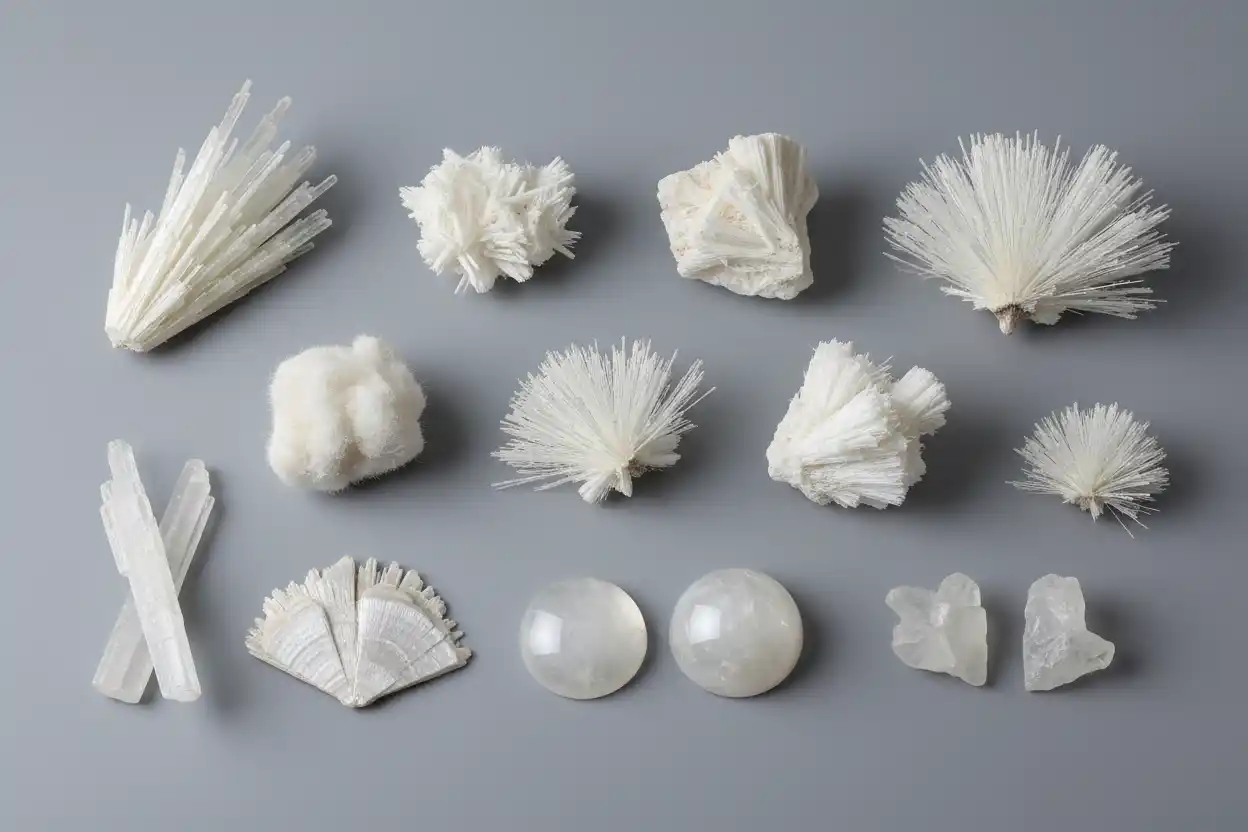
Real Scolecite is a hydrated calcium-aluminum silicate in the Zeolite group. It most commonly appears as colorless or white slender crystals, radiating sprays, fibrous masses, nodules and compact aggregates.
Fine specimens can resemble frozen fireworks, sea-urchin spines or bundles of delicate white needles. Massive fibrous material may also be cut into cabochons, beads, spheres, palm stones and carvings with pale radiating patterns.
The buying challenge is that Scolecite closely resembles several related Zeolites, especially Natrolite and Mesolite. It can also be confused with Stilbite, Selenite, white Aragonite, Calcite, Howlite, glass, resin and artificially assembled crystal clusters.
The Scolecite meaning and properties guide covers mineral identity and traditional symbolism. This guide focuses on sellers, Zeolite-group separation, specimen construction, treatment, durability and care.
Scolecite Is a Calcium Zeolite
Scolecite has the ideal composition CaAl2Si3O10·3H2O.
It crystallizes in the monoclinic system, although many crystals appear nearly square in cross-section and can look pseudotetragonal.
The Zeolite group guide provides the parent-mineral context.
Scolecite commonly forms:
- Slender prismatic crystals
- Long striated needles
- Radiating sprays
- Fibrous masses
- Nodules
- Compact massive material
- Penetration twins
- Cavity linings
It is transparent to translucent, usually colorless or white, and may show vitreous luster on crystal faces or silky luster in fibrous aggregates.
Mohs hardness is approximately 5 to 5.5. However, the mineral is brittle and has perfect cleavage, so delicate sprays can break after minor impact.
Where Scolecite Forms
Scolecite commonly forms through low-temperature alteration and hydrothermal activity.
It frequently occurs in cavities, fractures and vesicles within basalt and related volcanic rocks. Additional occurrences are known from metamorphic and intrusive settings.
Common associates include other Zeolites, Prehnite, Calcite and Apophyllite.
The mineral’s presence in a basalt cavity does not mean every white needle in the specimen is Scolecite. Several Zeolites can grow together and may form intergrown sprays that require analytical testing.
Choose the Product Form Before Shopping
| Scolecite product | Best source | Main buying concern |
|---|---|---|
| Natural crystal spray | Specialist mineral dealer | Broken needles, glue and exact mineral identity |
| Matrix specimen | Zeolite dealer | Artificial assembly, repairs and associated minerals |
| Individual prismatic crystal | Fine-mineral dealer | Scolecite versus Natrolite and provenance |
| Fibrous rough | Lapidary supplier | Intergrowths, fractures and resin |
| Cabochon | Independent cutter | Radiating texture, filler and backing |
| Sphere | Experienced lapidary retailer | Mixed Zeolite rock, resin and assembly |
| Palm stone | Reputable stone seller | Howlite, Selenite and white resin substitution |
| Bead strand | Established supplier | Dye, polymer and drill-hole damage |
| Carving | Skilled lapidary seller | Weak fibers, coating and composite construction |
| Collector locality specimen | Mineral specialist | Original label and laboratory-supported identity |
Crystal sprays should be purchased as specimens rather than handled like robust decorative stones.
Where to Buy Genuine Scolecite
Specialist Zeolite dealers
A dealer who handles Zeolite specimens should distinguish Scolecite from Natrolite, Mesolite and Stilbite.
Request the precise locality, crystal habit, associated minerals and basis for identification.
Ask whether X-ray diffraction, Raman spectroscopy or refractive-index measurements were used for unusual or high-value specimens.
A cautious label such as “Scolecite with possible Mesolite intergrowth” can be more trustworthy than unsupported certainty.
Fine-mineral dealers
Fine sprays and large individual crystals require detailed condition reporting.
Request close-up photographs of needle tips, the base, reverse and matrix contacts.
Ask whether individual crystals were reattached. Delicate sprays often sustain damage during extraction and transport.
A repaired natural specimen can remain collectible, but the extent of repair affects value.
Gem and mineral shows
Shows allow direct comparison with Natrolite, Mesolite, Stilbite, Apophyllite and Selenite.
Use a loupe to inspect striations, crystal cross-sections, cleavage, glue and surface coating.
Do not touch exposed needles unless the dealer permits it. A fingertip can break several crystals at once.
Avoid scratch or flame tests. Heating Scolecite is destructive and historically causes the mineral to curl as it loses water.
Established online sellers
The online gemstone buying guide explains seller identity, payment protection and return rights.
Request exact-item photographs at high magnification.
The seller should photograph the specimen before packing and explain how it will be supported during shipping.
Ask whether the item contains glue, consolidant, lacquer, filler or reconstructed matrix.
For polished objects, request front, back and edge views.
Lapidary suppliers
Massive fibrous Scolecite is less visually diagnostic than a crystal spray.
Request polished test pieces and laboratory or supplier identification.
Ask whether the material contains Natrolite, Mesolite, Stilbite, Calcite or Prehnite.
A mixed Zeolite rock may be completely natural and attractive, but it should not be presented as pure Scolecite without evidence.
What Genuine Scolecite Looks Like
Natural Scolecite is usually:
- Colorless
- Snow white
- Creamy white
- Grayish white
- Slightly yellowish
- Rarely pale pink or peach because of inclusions, staining or associated minerals
Crystal sprays consist of narrow needles radiating from one or more centers.
Individual crystals may have longitudinal striations and nearly square cross-sections.
Fibrous aggregates can display a silky sheen. When cut across radiating growth, polished stones may show white fans, starbursts or feather-like patterns.
Natural specimens often contain broken tips, contact marks and uneven crystal lengths. Perfectly identical needles arranged in a flawless symmetrical ball deserve inspection for artificial assembly.
Scolecite Versus Natrolite
Natrolite is a sodium-rich Zeolite that commonly forms slender white prismatic crystals and radiating sprays.
Its appearance can be extremely similar to Scolecite.
Natrolite commonly has a more distinctly orthorhombic crystal structure, while Scolecite is monoclinic and often twinned. Those distinctions may not be visible in a complex spray.
Refractive indices, Raman spectroscopy and X-ray diffraction provide more reliable identification than color or needle thickness.
A seller should not identify every white prismatic Zeolite as Scolecite simply because that name is more familiar.
Scolecite Versus Mesolite
Mesolite is a sodium-calcium Zeolite compositionally and structurally related to Natrolite and Scolecite.
It often forms extremely fine hair-like needles and can occur intergrown with either mineral.
Visual separation is especially difficult in dense sprays.
A specimen may legitimately contain Scolecite, Mesolite and Natrolite together. Several analytical points may be required to describe it accurately.
The absence of a dedicated tracker page for Mesolite does not justify merging every fine-needle Zeolite into Scolecite.
Scolecite Versus Stilbite
Stilbite commonly forms flattened blades, sheaf-like bundles, bow-tie aggregates and pearly peach or white crystals.
Scolecite generally forms narrower prismatic needles and radiating sprays.
Stilbite is softer, commonly around Mohs 3.5 to 4, while Scolecite is approximately 5 to 5.5.
The future guide to buying genuine Stilbite will own peach color, sheaf form, coatings and Zeolite-specific buying issues.
A peach-colored specimen should not receive the Scolecite name from color alone.
Scolecite Versus Apophyllite
Apophyllite commonly forms glassy tetragonal crystals with square outlines, pyramidal terminations and prominent basal cleavage.
Although Apophyllite often occurs with Zeolites, it is not itself a Zeolite mineral.
The completed guide to buying genuine Apophyllite covers crystal repairs, glass imitations and matrix assemblies.
A clear square crystal on a Zeolite matrix may be Apophyllite rather than Scolecite.
Scolecite Versus Prehnite
Prehnite is a calcium-aluminum silicate that commonly forms pale green botryoidal crusts and rounded aggregates.
The completed guide to buying real Prehnite owns botryoidal quality, Epidote associations and Jade confusion.
White Prehnite can occur, but it generally lacks Scolecite’s slender prismatic sprays.
The minerals may occur together in altered volcanic rocks.
Scolecite Versus Selenite
Selenite is crystalline Gypsum.
Fibrous Satin Spar Selenite can resemble massive Scolecite because both materials may appear white and silky.
Selenite is much softer, around Mohs 2, and commonly displays continuous parallel fibers rather than radiating Zeolite sprays.
Scolecite has greater hardness but remains brittle and cleavable.
Polished white objects may require Raman testing because carving removes the natural habit.
Scolecite Versus Calcite
Calcite can occur as white crystals, fibrous aggregates and matrix material beside Zeolites.
Calcite has rhombohedral cleavage, Mohs hardness 3 and strong birefringence.
Never use acid on a specimen. Acid would damage Calcite and potentially affect matrix, coatings or associated minerals.
Instrumental identification is safer.
Scolecite Versus Howlite
Howlite is an opaque white borate mineral commonly marked by gray or black veins.
Massive Scolecite is often more fibrous, translucent or radiating and generally lacks Howlite’s characteristic dark webbing.
White tumbled stones without visible texture can be difficult to separate from photographs.
A seller should provide mineral testing rather than relying on the phrase “high-vibration white stone.”
Scolecite Versus White Glass and Resin
White or translucent glass can imitate beads and polished carvings.
Round bubbles, flow lines, mold seams and conchoidal chips support glass.
Resin may contain white fibers, mineral powder or glitter. Casting seams and soft scratches provide additional clues.
The fake-crystal buyer’s guide provides broader glass and polymer checks.
Dyed Pink and Peach Scolecite
White Scolecite or another pale porous material can be dyed pink, peach, yellow or blue.
Artificial color may concentrate in fractures, cavities, fibrous boundaries and drill holes.
Some genuine specimens have natural peach staining or associated Stilbite, iron oxides or clay.
Therefore, color alone does not determine treatment.
A vivid uniformly colored spray with pale broken tips deserves closer inspection.
Glued Crystal Sprays
Separate crystals can be attached to matrix or arranged into radiating clusters.
Inspect each base for glossy adhesive, bubbles and unnatural sockets.
In a natural spray, crystals commonly share a growth center or enter the matrix coherently.
A repaired cluster differs from a completely fabricated specimen, but both need disclosure.
Ask whether the specimen was reconstructed after mining and what percentage remains in its original arrangement.
Resin Stabilization and Coatings
Fibrous rough and fragile matrix can be consolidated with clear resin.
A coating may reduce shedding or improve gloss on polished material.
Under magnification, polymer can pool between needles, form bubbles or produce an unnatural plastic luster.
The gemstone treatments guide explains consolidation, filling and reconstruction.
Treatment may improve durability, but it affects value and cleaning.
Reconstructed Scolecite Objects
Fragments, fibers and mineral powder can be mixed with resin and molded into spheres, towers or carvings.
The product may contain genuine Scolecite without being one continuous natural piece.
Mold seams, identical patterns and polymer-rich chips support reconstruction.
A seller should distinguish a stabilized natural rock from a heavily resin-bound composite.
How to Evaluate a Crystal Spray
Examine the crystal habit first. Look for slender prismatic needles, striations and coherent radiating growth.
Inspect the tip condition and estimate how much damage has occurred.
Check the base and matrix contacts for adhesive.
Ask whether other Zeolites were identified on the specimen.
Finally, request locality documentation and pre-shipping photographs.
How to Evaluate Massive Rough
Request dry and sawn-face photographs.
Look for radiating or fibrous internal structure rather than a featureless white body.
Determine whether the rough contains cavities, Calcite, Prehnite or other Zeolites.
Ask whether representative material has been polished successfully and whether resin was required.
Large size alone does not prove purity or cutting quality.
How to Judge Cabochons and Spheres
A strong cabochon should reveal fan-like, feathered or starburst structure beneath an even polish.
Inspect the back for backing, resin and mixed mineral zones.
A sphere should be shown through a full rotation. One face may contain attractive radiating fibers while the reverse is plain or heavily fractured.
Check for a straight assembly seam and concealed filler beneath the stand.
Buying Beads and Carvings
Natural bead strands should show variation in fiber orientation and translucency.
Inspect drill holes for resin, dye and cracking.
Perfectly identical white beads with no mineral texture may be glass, ceramic or polymer.
Carvings should avoid thin projections because fibrous and cleavable material can break easily.
Most Scolecite towers are carved rather than naturally crystallized.
Buying Scolecite Jewelry
Scolecite is not an ideal everyday-ring material.
Although hardness reaches approximately 5 to 5.5, perfect cleavage, brittleness and fibrous growth create impact risks.
The gemstone hardness chart, gemstone cleavage guide and toughness-versus-hardness guide explain why these properties must be considered separately.
Pendants, earrings and protected brooches are safer than rings and bracelets.
Locality and Provenance
Exceptional Scolecite is strongly associated with Maharashtra, India, including the wider Pune and Nashik mineral districts.
Notable specimens also come from Iceland, Scotland, Brazil, Mexico, the United States and other regions.
A white spray cannot prove a locality. Request original labels or supplier records when source affects price.
Indian specimens may contain several Zeolite species on one basalt matrix, making careful labeling especially important.
Price and Value
Common small Scolecite sprays and polished pieces are affordable.
Value rises with:
- Long intact crystals
- Dense but undamaged radiating sprays
- Transparency
- Luster
- Crystal size
- Symmetry
- Attractive matrix
- Rare associations
- Minimal glue
- Treatment disclosure
- Locality
- Provenance
A smaller natural cluster with intact needles can be more valuable than a large repaired or artificially assembled spray.
For polished material, pattern, structural stability and resin content matter more than pure white color.
The gemstone pricing guide explains how condition and provenance influence collector value.
Questions to Ask the Seller
Ask how the mineral was distinguished from Natrolite and Mesolite.
Request the locality and all associated minerals.
Confirm whether crystals were reattached or arranged on reconstructed matrix.
Ask about dye, resin, consolidant, coating and filler.
For polished items, request front, back and edge photographs. For sprays, request magnified views of the base and crystal tips.
Finally, obtain a return policy that permits professional mineral identification.
Professional Identification
Raman spectroscopy can distinguish Scolecite from many Zeolites and common white lookalikes.
X-ray diffraction is especially useful for closely related Natrolite-group minerals and mixed aggregates.
Refractive-index measurements can support identification on suitable transparent crystals.
Microscopy can reveal glue, resin, dye and artificial matrix.
Several test points may be necessary because one specimen can contain intergrown Scolecite, Mesolite, Natrolite and other phases.
Cleaning and Storage
Use a soft dry brush, air bulb or gentle dry cloth for routine cleaning.
Avoid soaking, steam and ultrasonic cleaning. Water can enter fractures, disturb fragile matrix or affect glue and consolidant.
Do not heat the mineral. Zeolites contain structural water, and heating can change or damage them.
Store crystal sprays in a covered display case where they cannot collect heavy dust or be touched accidentally.
Support specimens from the matrix rather than lifting them by crystal sprays.
Frequently Asked Questions
1. What is Scolecite?
Scolecite is a hydrated calcium-aluminum silicate mineral in the Zeolite group.
2. What color is natural Scolecite?
It is usually colorless or white, although pale cream, yellowish, pinkish or peach tones can occur through staining or associated minerals.
3. Is Scolecite a Zeolite?
Yes. It belongs to the Zeolite group and commonly forms in cavities within basaltic rocks.
4. How is Scolecite different from Natrolite?
Scolecite is calcium-rich and monoclinic, while Natrolite is sodium-rich and orthorhombic. Their appearance can be very similar.
5. Is Scolecite the same as Mesolite?
No. Mesolite is a related sodium-calcium Zeolite, though the minerals can occur intergrown.
6. How is Scolecite different from Stilbite?
Scolecite commonly forms slender needles, while Stilbite more often forms flattened blades and sheaf-like bundles.
7. Is Scolecite the same as Selenite?
No. Selenite is Gypsum and is much softer, while Scolecite is a Zeolite with different structure and cleavage.
8. Can Scolecite be dyed?
Yes. White Scolecite and similar pale materials can be dyed through fractures and fibrous boundaries.
9. Are Scolecite crystal sprays ever glued?
Yes. Natural clusters may be repaired, while artificial arrangements can be assembled from separate crystals.
10. Can Scolecite contain resin?
Yes. Fibrous rough, carvings and fragile matrix may be stabilized or reconstructed with polymer.
11. Is Scolecite suitable for everyday jewelry?
Generally, no. Its brittleness, cleavage and delicate crystal habit make low-impact jewelry or specimen display more appropriate.
12. What is the biggest warning sign in a listing?
Be cautious when a flawless symmetrical spray has identical needles sitting in glossy material and the seller provides no base photographs or explanation of repairs.
Buy the Zeolite Identity and the Specimen Condition Together
Scolecite’s appeal comes from delicate prismatic growth and radiating fibrous texture. Those same features make accurate identification, careful shipping and transparent repair disclosure essential.
The white gemstones guide, S crystal directory, S gemstone directory and visual gemstone guide provide wider comparisons. Choose a seller who can explain both the mineral identification and every alteration made after extraction.
Safety note: Scolecite is a hydrated silicate mineral and should not be ingested, burned or deliberately heated. Cutting, drilling or grinding can generate mineral dust and requires wet methods, effective local extraction and suitable respiratory and eye protection.