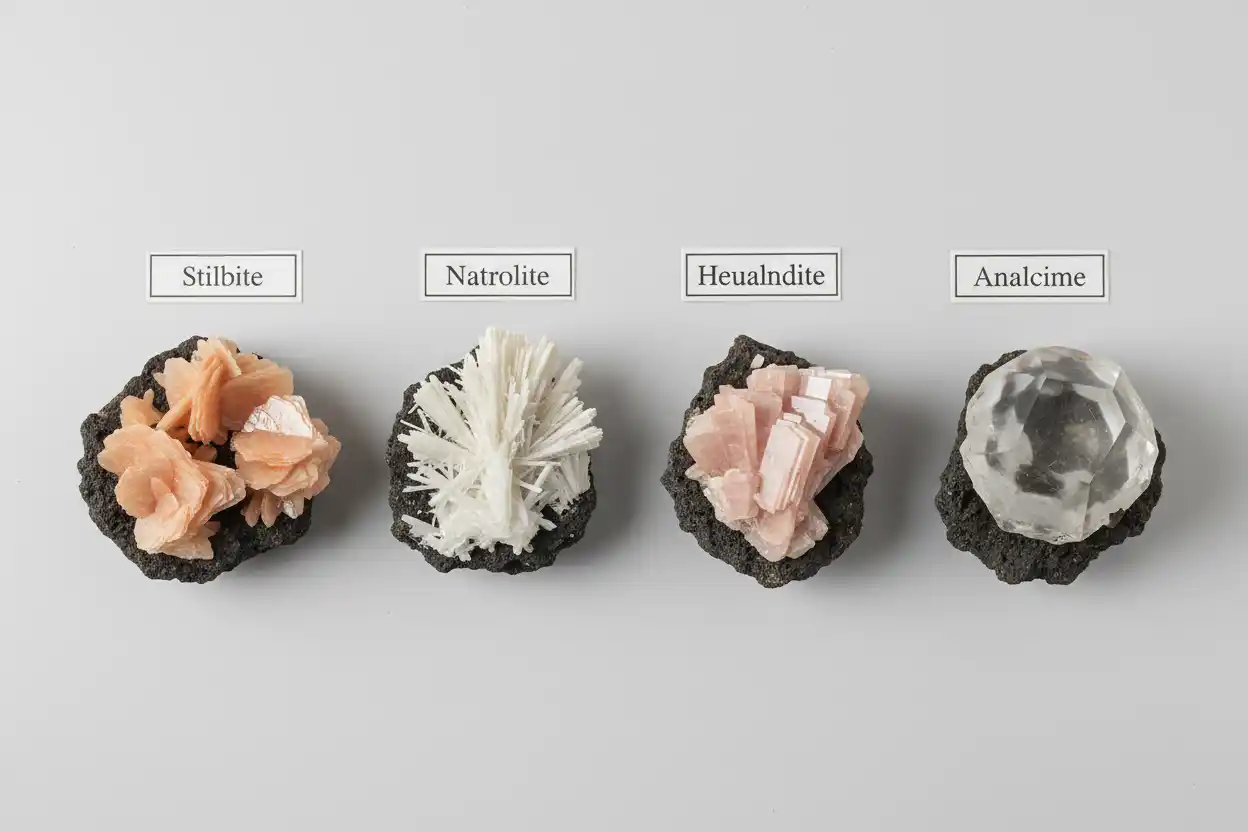
Zeolite Types, Properties, Uses and Meaning
Zeolites are a large family of hydrated framework minerals built from linked silicon-oxygen and aluminum-oxygen tetrahedra. Their structures contain channels and cavities that hold water and exchangeable ions, giving zeolites important roles in mineral collections, filtration, ion exchange, agriculture and industrial molecular sieves.
“Zeolite” is a family name rather than one mineral species. Stilbite, heulandite, clinoptilolite, natrolite, scolecite, chabazite and mordenite differ in chemistry, structure, crystal habit and safety considerations.
Zeolite at a Glance
| Property | Zeolite Group |
|---|---|
| Material type | Mineral group and structural family |
| General composition | Hydrated aluminosilicates containing sodium, calcium, potassium, magnesium or other exchangeable cations |
| Structural feature | Open three-dimensional frameworks with molecular-scale channels and cavities |
| Common colors | Colorless, white, cream, gray, peach, pink, yellow, green and reddish |
| Crystal systems | Vary by species; cubic, monoclinic, orthorhombic, trigonal and others occur |
| Common habits | Needles, blades, tablets, bow ties, radiating sprays, fibrous masses, trapezohedra and granular rock |
| Luster | Vitreous to pearly |
| Transparency | Transparent to opaque |
| Refractive index | Generally low, commonly about 1.46–1.52 |
| Specific gravity | Commonly about 2.0–2.4 |
| Mohs hardness | Commonly about 3.5–5.5 |
| Cleavage | Often good to perfect, depending on species |
| Tenacity | Brittle; fibrous and needle-like specimens can be extremely delicate |
| Distinctive properties | Reversible dehydration, ion exchange, adsorption and molecular sieving |
| Common use | Mineral specimens, water treatment, odor control, catalysts, soil products and industrial sorbents |
| Main care concern | Delicate crystals, heat-driven dehydration and the hazardous fibrous species erionite |
What Is a Zeolite?
A zeolite framework consists primarily of silicon and aluminum surrounded by oxygen atoms.
When aluminum replaces some silicon, the framework develops a negative electrical charge. Sodium, potassium, calcium and other positively charged ions occupy channels and cavities to balance that charge.
Water molecules also sit within those openings. In many species, the water can leave when heated and return when the mineral encounters moisture again without immediately destroying the framework.
This behavior inspired the name zeolite, traditionally translated as “boiling stone.” Early observers saw heated specimens release water and appear to froth or boil.
The family occupies a different structural category from ordinary ornamental stones in the types of gemstones guide. Most zeolites are soft collector minerals rather than durable faceted gems.
Mineral Species Versus Framework Types
A zeolite mineral species is defined through chemistry and crystal structure. Stilbite-Ca and stilbite-Na, for example, share a closely related framework but differ in their dominant exchangeable cations.
The International Zeolite Association also assigns three-letter codes to framework topologies. These codes describe how tetrahedra connect, not one mandatory chemical composition.
HEU represents the framework shared by heulandite and clinoptilolite. NAT applies to natrolite-related structures, while STI identifies the stilbite framework.
Synthetic materials can share a framework code with natural minerals while containing different proportions of silicon, aluminum or other elements.
Consequently, “zeolite type Y,” “zeolite A” and “ZSM-5” are industrial or synthetic structural materials rather than ordinary mineral-specimen names such as stilbite or heulandite.
Major Natural Zeolite Types
Analcime
Analcime is a sodium-rich hydrated aluminosilicate that commonly forms white, colorless or pale trapezohedral crystals.
Its equant crystal habit differs from the needles and blades seen in many other zeolites. Analcime occurs in volcanic cavities, alkaline igneous rocks and sedimentary environments.
Some mineralogists historically debated its position because its framework is relatively dense and its water behavior differs from more open zeolites. Modern classifications still place analcime within the zeolite mineral group.
Heulandite
Heulandite commonly forms pearly blades, tablets and coffin-shaped crystals in white, peach, pink, yellow or reddish colors.
It occurs in basalt cavities and low-temperature hydrothermal environments. Crystals often grow with stilbite, calcite and apophyllite.
Heulandite refers to a series containing chemically defined species such as heulandite-Ca and heulandite-Na. Visual appearance rarely determines the exact cation-dominant member.
Clinoptilolite
Clinoptilolite shares the HEU framework with heulandite but commonly has a higher silicon-to-aluminum ratio and greater thermal stability.
It often occurs as microscopic or fine-grained material in altered volcanic ash and tuff rather than as large decorative crystals.
Natural clinoptilolite is among the most important commercial zeolites. It is used in water treatment, odor control, animal husbandry, soil products and environmental remediation.
A product labeled simply natural zeolite powder is frequently clinoptilolite-rich rock, although testing is necessary to establish purity and contaminants.
Stilbite
Stilbite is known for sheaf-like, bow-tie and fan-shaped crystals with pearly cleavage surfaces.
Colors are commonly white, cream, peach or salmon pink. Green material may contain microscopic celadonite or another included mineral.
Stilbite is a series that includes stilbite-Ca and stilbite-Na. The calcium-dominant member is considerably more common.
Natrolite
Natrolite is a sodium-rich zeolite famous for slender white or colorless needles, radiating sprays and compact fibrous masses.
Fine crystals can resemble frozen fountains or bundles of glass fibers. However, their narrow tips are easily broken.
Natrolite has the NAT framework and forms a structural subgroup with mesolite, scolecite and related minerals.
Scolecite
Scolecite is a calcium-rich member of the natrolite subgroup.
It commonly forms white needle sprays, radiating groups and silky fibrous aggregates. Twinning can create characteristic striated or V-shaped crystal patterns.
Scolecite is frequently sold with apophyllite and stilbite from India. Its delicate habit requires far more careful handling than a polished quartz crystal.
Mesolite
Mesolite contains both sodium and calcium and occupies a compositional position between natrolite and scolecite.
Its crystals commonly appear as extremely fine white needles or hairlike sprays. The name derives from its intermediate chemistry.
Mesolite can be difficult to distinguish visually from natrolite or scolecite. Chemical and structural analysis may be required.
Chabazite
Chabazite commonly forms rhombohedral or pseudo-cubic crystals in white, cream, yellow, pink or reddish colors.
The chabazite series includes calcium-, sodium-, potassium- and magnesium-dominant members. It occurs in basalt cavities, volcanic tuffs and hydrothermal settings.
The CHA framework is also important in synthetic industrial catalysts and molecular sieves.
Mordenite
Mordenite commonly forms fine white fibers, needles, coatings or compact masses. Its open channels give it useful adsorption and catalytic properties.
Natural mordenite occurs in altered volcanic rocks and sedimentary tuffs. Synthetic and modified mordenite also have industrial roles.
Because some mordenite is fibrous, avoid generating dust from unidentified massive or fibrous specimens.
Thomsonite
Thomsonite forms radiating, fibrous, botryoidal and compact aggregates. Polished material from the Lake Superior region can show circular pink, cream, green and gray patterns.
Thomsonite cabochons are unusual among zeolites because dense nodular material can accept a polish. Delicate crystallized specimens remain unsuitable for ordinary jewelry.
Laumontite
Laumontite forms white, colorless, gray or pink prismatic crystals in volcanic and metamorphic rocks.
It can lose water in dry air and transform toward a powdery, opaque condition historically called leonhardite. This dehydration makes laumontite particularly difficult to preserve.
Apophyllite Is Not a Zeolite
Apophyllite frequently grows beside stilbite, heulandite and other zeolites in basalt cavities.
Retailers often describe an entire Indian mineral association as a zeolite cluster and may casually call apophyllite a zeolite.
Mineralogically, apophyllite belongs to a different phyllosilicate-related group rather than the zeolite family. Its square crystals, perfect basal cleavage and chemical structure differ.
The association is geologically genuine, but the family name should not be extended to every mineral on the specimen.
Likewise, blue cavansite, cotton-like okenite, pale green prehnite and calcite frequently accompany zeolites without becoming zeolite species themselves.
How Zeolites Form
Many collector zeolites form when low-temperature fluids enter bubbles, fractures and cavities within basalt.
Volcanic gases originally leave empty vesicles in cooling lava. Later groundwater and hydrothermal solutions introduce silica, aluminum, sodium and calcium.
As temperature and chemistry change, zeolites crystallize on cavity walls. One pocket may contain several generations, such as early heulandite followed by stilbite, natrolite and calcite.
Another major setting involves volcanic ash deposited in saline or alkaline lakes. Groundwater alters volcanic glass into fine-grained clinoptilolite, chabazite or phillipsite-rich rock.
Burial transforms zeolite assemblages as temperature increases. Certain species therefore indicate low-grade metamorphism or specific burial conditions.
Zeolites also occur in hydrothermal veins, ocean-floor basalts, alkaline igneous rocks and some meteorites.
Important Zeolite Localities
The Deccan Traps of Maharashtra, India, are the dominant modern source of large decorative zeolite specimens.
Quarries around Pune, Nashik, Jalgaon and Aurangabad expose basalt cavities containing stilbite, heulandite, scolecite, natrolite, apophyllite, calcite and cavansite.
Iceland and the Faroe Islands are classic sources of heulandite, stilbite, chabazite and related minerals. The word zeolite emerged from early study of such volcanic-cavity specimens.
Nova Scotia’s Bay of Fundy produces stilbite, heulandite, analcime and other zeolites. Stilbite is the provincial mineral.
New Jersey, Oregon and Washington contain notable zeolite-bearing volcanic rocks in the United States.
Italy, Scotland, Germany, Russia, Japan, New Zealand, Australia and Canada also host important collector localities.
Commercial clinoptilolite deposits occur in the United States, Turkey, Eastern Europe, China and several other volcanic-tuff regions.
Channels, Cavities and Molecular Sieving
Zeolite frameworks contain openings of specific sizes and shapes.
Small molecules can enter certain channels while larger molecules are excluded. This selective behavior explains the term molecular sieve.
The negatively charged framework also attracts exchangeable cations. Sodium, calcium, potassium, ammonium and some metal ions can move in or out without immediately collapsing the framework.
Different zeolites have different pore dimensions and chemical preferences. Therefore, one species may perform better for ammonium removal, while another suits gas separation or catalysis.
Natural specimen beauty and industrial performance are separate grading systems. A perfect stilbite bow tie may have little industrial value, while dull clinoptilolite tuff can be commercially useful by the ton.
Industrial and Environmental Uses
Natural clinoptilolite-rich rock is used to remove ammonium from water, control odors, condition soil and absorb certain dissolved ions.
Zeolites also appear in animal bedding, aquarium filtration, construction products and environmental cleanup systems.
Synthetic zeolites provide more uniform pore sizes and chemistry. They are widely used in detergents, petroleum refining, catalysis, gas drying and oxygen separation.
The words detox and purification require precision. A zeolite’s ability to adsorb or exchange ions in a controlled industrial process does not prove that an unregulated supplement safely removes toxins from the human body.
Collector specimens should never be ground or ingested. Unknown zeolite material may contain quartz, fibrous minerals, metals or other contaminants.
Internal Features and Mineral Associations
Zeolite crystals commonly contain fluid inclusions, growth zones, clay particles and earlier minerals trapped during cavity filling.
Pink or peach color may come from iron-rich inclusions or surface coatings. Green stilbite and heulandite can contain celadonite.
Needle sprays may grow over an earlier generation of heulandite, while apophyllite or calcite forms later across the zeolite surface.
Natural contact points are common where crystals grew against a cavity wall or another mineral. These are not automatically mining damage.
Repairs occur frequently in large Indian specimens because delicate crystals separate from basalt matrix during extraction and shipping.
Identifying Zeolite Minerals
“Zeolite” is not a sufficiently precise identification for most collector specimens. The individual species should be established where possible.
Crystal habit provides useful clues. Stilbite forms bow ties, heulandite forms pearly blades, analcime forms trapezohedra and natrolite-group minerals form needles.
However, habit overlaps. Natrolite, mesolite and scolecite can be visually difficult to separate, while heulandite and clinoptilolite share a framework.
Refractive index, optical character, density and cleavage narrow the possibilities. Raman spectroscopy, X-ray diffraction and chemical analysis provide stronger species-level identification.
The methods in how to identify crystals are especially important for mixed basalt-cavity specimens containing several pale minerals.
Treatments, Repairs and Synthetic Zeolites
Most natural zeolite specimens are not heat-treated or irradiated. Their crystal form and locality create the value.
Repairs are common. Individual crystals, matrix fragments or complete pockets may be reattached with adhesive.
A repaired specimen can remain collectible when the work is limited and disclosed. Large areas of glue or reconstructed matrix should reduce value.
Dye and coating are possible, especially in inexpensive tumbled or decorative products. Bright blue, green or pink color concentrated in cracks may be artificial.
Resin can stabilize compact thomsonite or porous zeolite rock before polishing.
Synthetic zeolites are produced on a vast industrial scale. Zeolite A, X, Y, ZSM-5 and many other materials are engineered for specific pore structures and chemical performance.
Synthetic industrial zeolite is not automatically an imitation mineral specimen. However, laboratory crystals should not be sold as naturally mined collector material.
The disclosure distinctions follow lab-grown versus natural gemstones and gemstone treatments explained.
Cutting, Polishing and Jewelry Use
Most crystallized zeolites are too soft, cleavable or fragile for faceting.
Needle sprays and bow ties should remain intact as specimens. Cutting them removes the natural habit that creates their value.
Dense thomsonite, analcime-rich rock and certain compact zeolite masses can become cabochons, beads or polished slabs.
Mixed hardness creates polishing challenges. Zeolite, calcite, quartz and basalt may wear at different rates across one piece.
Transparent analcime and some other species have occasionally been faceted as collector gems. Their low hardness and modest brilliance make them unsuitable for routine jewelry.
Pendants, earrings and display brooches are more realistic than rings. Delicate natural clusters should remain behind glass rather than exposed on the body.
Hardness, Cleavage and Durability
Most zeolites fall between about 3.5 and 5.5 on the Mohs scale, as contextualized by the gemstone hardness chart.
Many species also have good or perfect cleavage. Stilbite can split along its pearly planes, while needle minerals break with very little pressure.
The relationship between scratching and breakage is explained in gemstone toughness versus hardness and gemstone cleavage explained.
Even a large specimen can be fragile when its crystals attach to matrix at narrow points.
Handle clusters by their basalt base rather than by the crystals. Do not stack specimens or wrap packing material directly around needle tips.
Zeolite Prices in 2026
Common small Indian stilbite, heulandite and mixed zeolite specimens usually retail for approximately $5–$30.
Current small stilbite-heulandite specimens are listed around $5–$10, while attractive mixed clusters commonly fall around $30–$100.
Better miniature and cabinet specimens with sharp crystals, uncommon associations or strong aesthetics often range from $100–$300.
Large high-quality clusters, rare species and notable localities may sell for approximately $300–$1,000 or more.
Specimens featuring valuable associated cavansite, pentagonite or exceptional apophyllite can exceed the price of the zeolite crystals themselves.
Industrial clinoptilolite is a commodity sold by weight rather than specimen aesthetics. Its bulk pricing should not be compared with collector crystals.
Rare zeolite species, exceptional old-locality material and museum-scale specimens can exceed broad retail ranges substantially.
What Determines Collector Value?
Species rarity matters, but aesthetics often control the ordinary market. A common stilbite specimen with perfect bow ties may sell more readily than a rare but unattractive crust.
Crystal size, luster and condition are important. Broken needle tips and crushed sheaves reduce value.
Mineral association can create a strong premium. Blue cavansite over white stilbite or green apophyllite beside peach heulandite produces greater visual contrast.
Locality and old labels add collector interest, especially for depleted pockets or historically important mines.
Repairs should be limited and disclosed. A specimen reconstructed from several unrelated pieces has less integrity than one natural association.
Buying Guidance
Ask for the individual species rather than accepting only the label zeolite.
Request the locality and dimensions. Indian, Icelandic, Canadian and American specimens can have distinct habits and associations.
Inspect close photographs for glue, broken needles, dyed surfaces and repaired matrix.
Do not assume every square clear crystal on an Indian cluster is zeolite. It may be apophyllite, while calcite and prehnite can also occupy the same cavity.
For expensive rare species, seek X-ray diffraction or Raman confirmation. Visual identification becomes unreliable among fine needles and chemically related members.
Check whether the specimen contains fibrous erionite or comes from an erionite-bearing locality before cutting or handling dusty material.
Cleaning, Water, Heat and Sunlight
Use a hand air blower or very soft brush for routine cleaning. Avoid catching bristles between needle-like crystals.
Brief gentle rinsing may be acceptable for a robust untreated specimen, but prolonged soaking is unnecessary.
The complete piece may contain calcite, clay, soluble salts, glue or fragile matrix, so the general crystals-in-water guide should be applied conservatively.
Ultrasonic and steam cleaning are inappropriate. Vibration can break needles, while heat removes structural water and may change the crystal.
Some zeolites dehydrate in dry air or under warm display lamps. Laumontite is particularly vulnerable and can become opaque or powdery.
Natural colors are usually stable under ordinary indoor light, but dyes, repairs and associated minerals may not be. Follow the broad display guidance in crystals that fade in sunlight.
Dry contact-free options from how to cleanse crystals are preferable to water, salt, smoke residue or outdoor burial.
Zeolite Safety and Erionite
Most intact common collector zeolites, including stilbite and heulandite, can be displayed with ordinary mineral-handling precautions.
Erionite is a critical exception. It can form microscopic fibrous particles that behave similarly to asbestos when inhaled.
Airborne erionite exposure is associated with mesothelioma and lung cancer. Its danger arises primarily when fibrous material or erionite-bearing rock is disturbed, crushed, drilled or made dusty.
Unknown fibrous zeolite should remain enclosed until identified. Avoid collecting or processing material from known erionite-bearing deposits without professional controls.
The broader toxic crystals safety list provides context, but it should not be interpreted as meaning that every zeolite carries the same hazard.
Meaning and Symbolism
Modern crystal traditions often associate zeolites with openness, organization, adaptability and releasing what is no longer needed.
Their channel structures encourage symbolic comparisons with circulation, exchange and making space for new information.
Individual members have developed separate associations. Stilbite is often linked with reflection, natrolite with clarity, scolecite with calm and heulandite with perspective.
These meanings are cultural, spiritual or personal interpretations rather than scientifically established mineral effects.
Industrial adsorption or ion-exchange behavior must not be converted into medical detox claims. A mineral’s performance inside a controlled filtration system does not prove a therapeutic effect inside the human body.
Frequently Asked Questions
1. Is zeolite one mineral?
No. Zeolite is a large mineral family containing many species, including stilbite, heulandite, clinoptilolite, natrolite, scolecite and chabazite.
2. What makes a mineral a zeolite?
Zeolites have open aluminosilicate frameworks containing channels, water and exchangeable cations.
3. Is apophyllite a zeolite?
No. Apophyllite frequently grows with zeolites but belongs to a different mineral group.
4. What is the most common industrial natural zeolite?
Clinoptilolite-rich rock is among the most widely mined natural zeolite materials for filtration, odor control, agriculture and environmental uses.
5. Are stilbite and heulandite the same mineral?
No. They are separate zeolite series with different structures, chemistry and crystal habits, although they commonly occur together.
6. How can natrolite be distinguished from scolecite?
Both form white needles. Optical properties and chemical or structural analysis are often needed because visual habit can overlap.
7. Why do zeolites contain water?
Water molecules occupy channels and cavities within their open frameworks. Many species can lose and regain some water without immediate structural collapse.
8. Are synthetic zeolites fake?
Synthetic zeolites are legitimate engineered materials with controlled structures. They become misleading only when sold as naturally mined mineral specimens.
9. Can zeolites go in water?
Some tolerate brief rinsing, but prolonged soaking may affect repairs, matrix minerals and delicate crystals. Identification should come first.
10. Are zeolites safe to handle?
Most intact common specimens are handled with ordinary care. Fibrous erionite is hazardous when airborne and requires strict avoidance of dust.
11. How much are zeolite specimens worth?
Common small Indian specimens often cost $5–$30, attractive cabinet pieces $100–$300 and exceptional rare or aesthetic specimens several hundred dollars or more.
12. Do zeolites have scientifically proven detox or healing properties?
Industrial zeolites have genuine adsorption and ion-exchange uses, but those properties do not prove that collector minerals or unregulated powders detoxify or heal the human body.
Zeolites are best understood as a structural family rather than one pastel-colored crystal. Their open frameworks connect delicate mineral specimens with large-scale technologies, yet responsible use depends on identifying the species, respecting dehydration and cleavage, and recognizing that erionite requires very different safety precautions from ordinary stilbite or heulandite.
Zeolite appears in Crystals That Start With Z.
Safety disclaimer: Do not ingest collector zeolites or grind unidentified material. Erionite is a fibrous zeolite associated with lung cancer and mesothelioma when its fibers become airborne. Keep unknown fibrous specimens enclosed and seek expert identification before cleaning, cutting or collecting them.