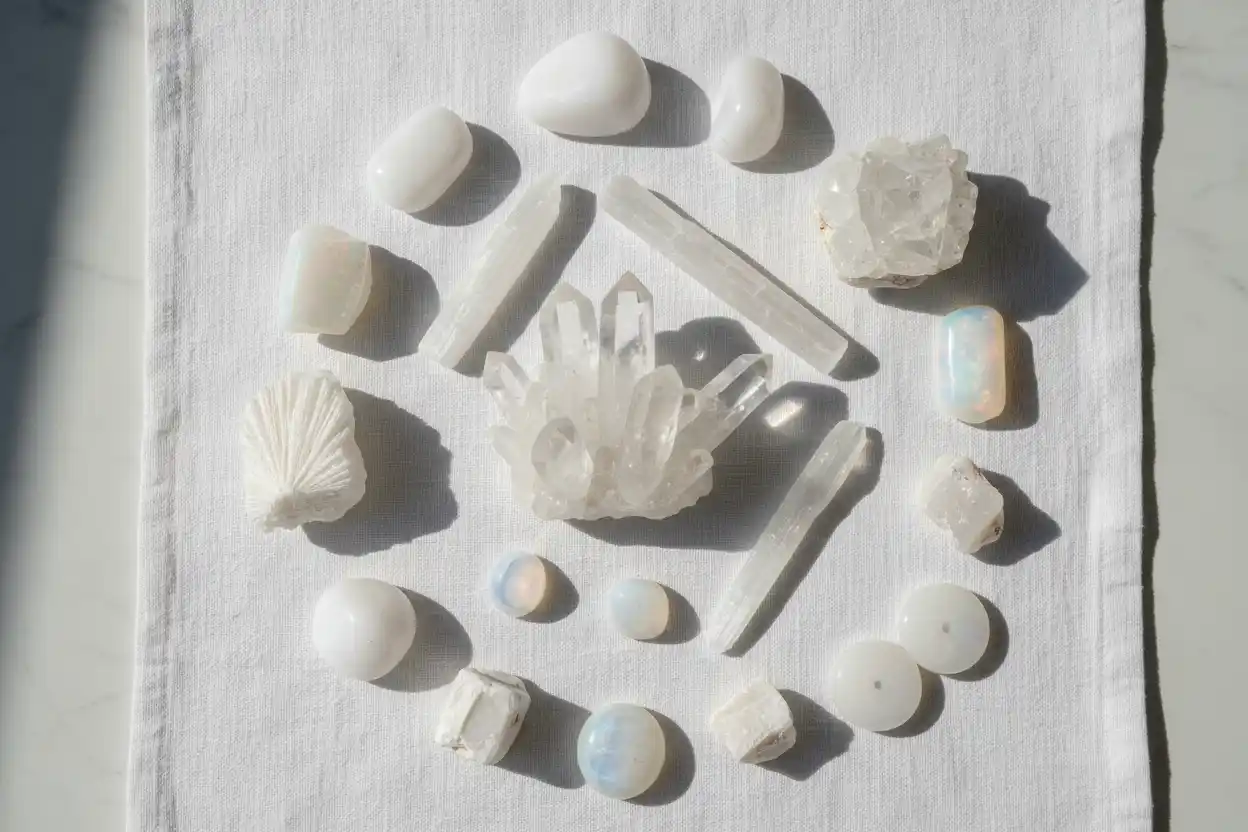
White Crystals: Meanings, Names and Complete List
White crystals range from opaque snow-white minerals to translucent stones, pearly organic gems and colorless crystals that appear bright against a pale background. They do not share one chemistry, crystal system, hardness or formation process.
Within spiritual and crystal traditions, white stones are commonly associated with clarity, renewal, simplicity, reflection, peace and new beginnings. Those associations are cultural and symbolic rather than scientifically established effects.
This guide organizes the major white crystals and crystal-shop materials by appearance, traditional meaning and practical care. The upcoming white gemstones guide owns jewelry and gemological comparisons, while the white engagement-ring stones guide will focus specifically on durability, brilliance and ring suitability.
White and Colorless Are Not the Same
A colorless crystal transmits most visible wavelengths without a strong body color. Clear Quartz, Diamond, White Sapphire and White Topaz can appear colorless when sufficiently transparent.
A genuinely white material scatters light back toward the viewer, creating a milky, chalky, snowy or pearly body. Snow Quartz, White Calcite, Howlite and Selenite are familiar examples.
Some stones occupy both categories. White Moonstone may have a colorless-to-white body with floating sheen, while White Opal can have a translucent white body and spectral play-of-color.
Therefore, the white-crystal category includes several appearances:
- Opaque white
- Milky white
- Translucent white
- Pearly white
- Silvery white
- Cream white
- White with gray veins
- White with rainbow flashes
- Colorless with white reflections
- Clear crystals commonly grouped with white stones
These visual categories do not imply shared mineral properties.
Traditional Meaning of White Crystals
White has long represented light, blank space, cleanliness, ceremony, transition and peace in many cultures. However, symbolism changes among communities and should not be treated as universal.
In modern crystal traditions, white stones are commonly chosen for:
- Mental clarity
- Fresh starts
- Meditation
- Quiet reflection
- Peaceful surroundings
- Symbolic cleansing
- Intention setting
- Emotional reset
- Neutral altar arrangements
- Pairing with stronger-colored stones
A white crystal does not produce a medical or psychological outcome merely through possession. Its practical value may instead come from personal ritual, visual focus, collecting interest or the meaning a person assigns to it.
Complete White Crystals List
| White crystal or material | What it is | Traditional association | Main care concern |
|---|---|---|---|
| Clear Quartz | Crystalline SiO2 | Clarity and amplification | Fracture filling and sharp points |
| Snow Quartz | Milky macrocrystalline Quartz | Calm focus and patience | Silica dust during cutting |
| White Agate | White banded Chalcedony | Stability and gentle balance | Dye and composite construction |
| White Calcite | Calcium carbonate | Release and fresh perspective | Softness, acids and water exposure |
| White Jade | Jadeite or Nephrite sold by color | Peace and steady judgment | Species and treatment disclosure |
| White Moonstone | White feldspar with adularescence | Cycles and reflection | Cleavage and impact |
| White Opal | White-bodied hydrated silica | Imagination and change | Heat, dehydration and crazing |
| White Sapphire | Colorless-to-white Corundum | Integrity and commitment | Treatment and synthetic origin |
| White Topaz | Colorless Topaz | Directness and intention | Perfect cleavage |
| Selenite | Transparent Gypsum variety | Symbolic cleansing and calm | Extreme softness and water sensitivity |
| Satin Spar | Fibrous Gypsum sold as Selenite | Peaceful spaces and ritual clearing | Fibers, scratches and moisture |
| Howlite | White borate mineral with gray veins | Patience and rest | Dye and low hardness |
| Scolecite | White calcium Zeolite | Quiet meditation | Cleavage and fragile sprays |
| Stilbite | White-to-peach Zeolite | Gentleness and openness | Soft, brittle crystal fans |
| Apophyllite | Glassy white or clear mineral | Insight and reflective practice | Perfect cleavage |
| Albite | Sodium feldspar | New perspectives | Cleavage and surface abrasion |
| Okenite | Fibrous calcium silicate | Softness and comfort | Extremely delicate fibers |
| Natrolite | White sodium Zeolite | Focus and order | Brittle needle clusters |
| Halite | Natural sodium chloride | Purification symbolism | Dissolves readily in water |
| Magnesite | Magnesium carbonate | Stillness and acceptance | Dye, softness and acids |
| Dolomite | Calcium-magnesium carbonate | Balance and steadiness | Acid sensitivity |
| Aragonite | Calcium carbonate polymorph | Grounding and patience | Fragility and acid sensitivity |
| Barite | Barium sulfate mineral | Stability and inner structure | High density and brittle cleavage |
| Gypsum | Hydrated calcium sulfate | Rest and simplicity | Softness, water and heat |
| Ulexite | Hydrated borate mineral | Perspective and observation | Water sensitivity and softness |
| Diamond | Crystalline carbon | Endurance and commitment | Reports, treatments and settings |
| Pearl | Organic gem formed by mollusks | Wisdom and emotional maturity | Acids, cosmetics and abrasion |
| Mother of Pearl | Nacre lining from mollusk shells | Protection and nurturing | Thin layers and chemical sensitivity |
This list uses the wider crystal-retail meaning of “crystal.” Pearl and Mother of Pearl are organic materials, White Opal is a mineraloid, and several entries are rocks or aggregates rather than individual transparent crystals.
Clear Quartz
Clear Quartz is the most familiar colorless crystal in modern spiritual collections.
Traditional practices associate it with clarity, focus and amplifying an intention. Scientifically, it is crystalline silicon dioxide and does not magnify health effects or the properties of another stone.
Natural points may be transparent, cloudy, included or internally fractured.
A clear object is not automatically natural Quartz. Glass and synthetic Quartz can closely imitate polished pieces.
The Clear Quartz versus Selenite guide separates two frequently confused pale crystals.
Snow Quartz
Snow Quartz is white or cloudy macrocrystalline Quartz.
Its milky appearance commonly comes from dense microscopic inclusions and internal scattering.
Traditionally, collectors associate Snow Quartz with patience, quiet focus and softer energy than transparent Clear Quartz.
It remains the same principal mineral species as Clear Quartz and has similar hardness.
The completed guide to buying real Snow Quartz covers white glass, Howlite, Calcite and resin imitations.
White Agate
White Agate is white, cream or colorless-to-white banded Chalcedony.
It may show subtle layers, translucency or gray bands.
Traditional meanings emphasize stability, composure and gentle emotional balance.
Commercial White Agate can be dyed, bleached, assembled or confused with white Chalcedony.
Its Quartz-family hardness makes it more practical for handling than Selenite or Calcite.
White Calcite
White Calcite is a white-to-colorless variety of calcium carbonate.
It can occur as translucent masses, rhombohedral crystals, fibrous aggregates and optical Calcite.
Traditional interpretations connect it with release, perspective and mental openness.
Physically, Calcite is soft, cleavable and acid-sensitive. Vinegar, citrus juice and household descalers can etch it.
It should not be cleaned or tested through acids.
White Jade
White Jade may refer to white Nephrite or pale Jadeite.
The two true Jade materials differ mineralogically, although both can appear cream white, gray-white or nearly colorless.
Traditional symbolism often connects White Jade with peace, judgment and steady decision-making.
Imitations include Quartz, Serpentine, Calcite, glass and polymer-treated material.
The word Jade should not be applied to every durable white carving.
White Moonstone
White Moonstone is feldspar with a white, silver or blue floating sheen known as adularescence.
Traditional interpretations connect Moonstone with cycles, reflection and transitions.
The body can be colorless, milky white or gray-white.
Quality depends on sheen strength, centering, body transparency, cutting and structural condition.
Moonstone has cleavage and requires more protection than Quartz-family stones.
The broader Moonstone meaning guide owns family-level symbolism and identity.
White Opal
White Opal has a white or light gray body and may display play-of-color.
Common white Opal may lack spectral flashes while retaining an opaque or translucent white body.
Traditional meanings often emphasize imagination, personal expression and adaptability.
Opal contains variable water and may craze, scratch or fracture through heat, impact and sudden temperature changes.
The white body should not be confused with the spectral color pattern.
White Sapphire
White Sapphire is colorless-to-nearly colorless Corundum.
Within symbolic traditions, it is associated with sincerity, commitment and disciplined thought.
Its Mohs hardness 9 makes it one of the more scratch-resistant white stones.
However, inclusions, cut, synthetic origin and treatment influence value.
White Sapphire does not match Diamond’s dispersion, so it commonly looks softer and less fiery in comparable cuts.
The dedicated engagement-ring page will own the full durability and substitution comparison.
White Topaz
White Topaz is colorless Topaz.
Traditional meanings often connect it with directness, intention and clear communication.
Topaz has Mohs hardness 8 but perfect cleavage. Therefore, a hard blow can split it despite its strong scratch resistance.
Colorless Topaz can resemble Diamond, White Sapphire, Quartz and glass in photographs.
Professional identification is preferable to destructive scratch testing.
Selenite and Satin Spar
Selenite is transparent-to-translucent crystalline Gypsum.
Most white wands, towers and plates sold as Selenite are actually fibrous Satin Spar Gypsum. Both are genuine natural Gypsum, but their habits differ.
Traditional crystal practices associate them with symbolic cleansing, quiet spaces and mental calm.
Physically, Gypsum has Mohs hardness 2 and can be scratched with very little contact.
The types of Selenite guide distinguishes crystal forms, while the Selenite versus Satin Spar guide explains the terminology.
The Selenite water-safety guide is essential because prolonged moisture damages Gypsum.
Howlite
Howlite is a white borate mineral commonly marked by gray or black veins.
Traditional associations include patience, reflection and creating a slower bedtime routine.
Howlite is porous and frequently dyed blue to imitate Turquoise. White pieces may also be coated, stabilized or reconstructed.
The completed guide to buying genuine Howlite covers dye and imitation issues.
The Howlite cleansing guide offers methods that avoid prolonged soaking.
Scolecite
Scolecite is a white-to-colorless calcium Zeolite.
It commonly forms slender prismatic crystals, radiating sprays and fibrous aggregates.
Traditional interpretations associate Scolecite with quiet meditation and receptive awareness.
Its fragile sprays need enclosed display and minimal handling.
The completed guide to buying real Scolecite explains confusion with Natrolite, Mesolite and glued clusters.
Stilbite
Stilbite is a Zeolite commonly forming white, cream or peach sheaves and bow-tie crystals.
Traditional associations emphasize gentleness, openness and reflective communication.
Stilbite is soft, brittle and perfectly cleavable.
Its crystal fans can break during dusting or shipping.
The completed guide to buying genuine Stilbite owns species identification, repairs and mixed Zeolite specimens.
Apophyllite
Apophyllite commonly forms colorless or white glassy crystals with square outlines and pyramidal terminations.
It often occurs with Stilbite and other minerals in basalt cavities.
Traditional practices associate Apophyllite with insight and contemplative focus.
Despite its glassy appearance, Apophyllite has perfect cleavage and can split after impact or heat.
The completed guide to buying genuine Apophyllite covers glass, coatings and repaired clusters.
Albite
Albite is the sodium-rich end member of the plagioclase feldspar series.
It is commonly white, colorless or gray and may form tabular crystals or massive material.
Traditional associations focus on new perspectives and adapting to change.
Albite has cleavage and should not be treated like durable Quartz.
It can occur with Quartz, Tourmaline, mica and many pegmatite minerals.
Okenite
Okenite is a white calcium silicate known for soft-looking fibrous balls and radiating sprays.
Traditional associations emphasize comfort and tenderness.
Its fibers are mineral crystals rather than cotton and should never be touched repeatedly.
Handling can flatten, break or contaminate the delicate growth.
Okenite belongs in a protected display case rather than a pocket, bracelet or water bowl.
Natrolite
Natrolite is a white sodium Zeolite that often forms slender prismatic needles and radiating sprays.
Traditional meanings commonly emphasize order, focus and mental organization.
Its appearance overlaps with Scolecite and Mesolite.
Instrumental testing may be needed because white needle habit alone does not establish the exact Zeolite species.
Natural sprays are brittle and should be supported from the matrix.
Halite
Halite is natural sodium chloride.
White or colorless Halite commonly forms cubes and granular masses.
Traditional symbolism associates it with purification and simplicity, reflecting salt’s broader cultural use.
Physically, Halite dissolves readily in water and can attract moisture from humid air.
It should never be rinsed, soaked or placed in a drink.
Magnesite
Magnesite is magnesium carbonate and commonly occurs as white, cream, gray or brown-veined material.
Traditional interpretations connect it with stillness and acceptance.
Because it is porous, Magnesite is frequently dyed blue, green or other colors.
White Magnesite can resemble Howlite, Calcite and Marble.
Acid testing is destructive and unnecessary.
Dolomite
Dolomite is a calcium-magnesium carbonate mineral and the principal component of dolostone.
White Dolomite can occur as crystals, curved saddles and massive material.
Traditional symbolism often centers on balance and steadiness.
Like other carbonates, it requires protection from acids.
A white carving may contain Dolomite, Calcite and other minerals rather than one pure crystal.
Aragonite
Aragonite is a calcium carbonate polymorph distinct from Calcite.
White Aragonite may form sprays, branching clusters, crystals and fibrous aggregates.
Traditional meanings emphasize patience and grounded attention.
Its clusters can be brittle, while acids damage the carbonate.
The mineral can alter toward Calcite over geological time, though ordinary specimens remain stable under dry indoor conditions.
Barite
Barite is barium sulfate and is unusually dense for a white or pale mineral.
It can form white, cream, honey, blue-gray or colorless blades and tabular crystals.
Traditional associations focus on stability and inner structure.
Barite is not a source of consumable barium and should not be ingested.
Its crystals are brittle despite the material’s substantial weight.
Gypsum
Gypsum is hydrated calcium sulfate and includes Selenite, Satin Spar, alabaster and desert rose forms.
Traditional symbolism often emphasizes rest, softness and simplicity.
Its extreme softness makes it unsuitable for abrasion-heavy jewelry.
Gypsum also loses or rearranges structural water under strong heat.
Different habits should be described accurately rather than sold as separate mineral species.
Ulexite
Ulexite is a hydrated sodium-calcium borate known for transmitting an image along parallel fibers, creating the “television stone” effect.
White fibrous material may look plain until placed over printed text.
Traditional interpretations associate it with seeing a situation from another perspective.
Ulexite is soft and sensitive to water.
A polished window may be stabilized or protected, so treatment disclosure matters.
Diamond
Diamond is crystalline carbon.
Most stones commonly called white Diamonds are actually colorless or near-colorless rather than true Fancy white Diamonds.
Traditional symbolism emphasizes endurance, commitment and lasting bonds.
Diamond is highly scratch resistant but can cleave after a severe blow.
Natural, laboratory-grown, treated and imitation stones require different disclosures.
The white engagement-ring page will own the complete comparison among Diamond, Sapphire, Moissanite and other durable alternatives.
Pearl and Mother of Pearl
Pearl is an organic gem formed within a mollusk. White pearls can show cream, rose, silver or green overtones.
Traditional symbolism often connects Pearl with wisdom, maturity and grace.
Mother of Pearl is the nacreous lining of certain shells rather than a free pearl.
Both materials contain calcium carbonate and organic components.
They are sensitive to acids, cosmetics, dehydration and abrasion and should be stored separately from harder crystals.
Choosing a White Crystal for Clarity
Clear Quartz is the most common symbolic choice for mental clarity because of its transparent appearance.
White Sapphire and White Topaz offer a more jewelry-oriented version of the same visual theme.
Apophyllite can provide a reflective collector crystal, although its cleavage makes frequent handling inappropriate.
Traditional symbolism can support a personal intention, but practical clarity comes from rest, information and deliberate decision-making rather than mineral exposure.
Choosing a White Crystal for Calm
Snow Quartz, White Agate and Howlite are commonly selected for calm visual arrangements.
Their muted white bodies can make a meditation space feel less visually demanding.
Selenite and Satin Spar are also popular, though their softness and moisture sensitivity require careful placement.
A stone can serve as a tactile reminder to pause without being presented as a treatment for anxiety, insomnia or another health condition.
Choosing a White Crystal for New Beginnings
White Moonstone, Albite and Clear Quartz are frequently associated with transitions and fresh starts.
Moonstone carries strong traditional links with cycles and changing phases.
Albite’s pale feldspar appearance can represent a new perspective, while Clear Quartz provides a neutral surface for written or spoken intentions.
These meanings remain personal and cultural rather than measurable mineral effects.
Choosing a White Crystal for Grounding
White is not limited to airy or cleansing symbolism.
White Jade, Barite and Dolomite can represent steadiness because of their compact textures or substantial physical presence.
A smooth White Jade or White Agate palm stone is more durable for handling than delicate Zeolite sprays.
Barite is dense but brittle, so it works better as a stationary specimen.
White Crystals for Jewelry
Durability varies dramatically.
Diamond, White Sapphire, White Topaz and White Agate are among the more practical options when their own cleavage and treatment risks are understood.
White Moonstone, White Opal and White Jade need greater protection.
Selenite, Okenite, Stilbite and Scolecite are generally poor choices for conventional daily jewelry.
The upcoming white-gemstone and engagement-ring pages will own detailed comparisons of brilliance, cut, value and setting suitability.
White Crystals for Display
Selenite plates, Scolecite sprays, Stilbite sheaves, Apophyllite clusters and Okenite balls create visually distinctive displays.
However, they require covered shelving, low handling and stable humidity.
Clear Quartz and Snow Quartz points tolerate routine display more easily but still need protection from falls.
Keep heavy Barite away from fragile Zeolites because a small impact can destroy an entire spray.
How to Combine White Crystals
White stones provide a neutral visual bridge among stronger colors.
For example, Clear Quartz can sit beside pink, blue or green stones without competing visually. Snow Quartz and White Agate create softer transitions.
Combining stones does not create a scientifically established energetic interaction.
Instead, choose combinations through color harmony, durability and the intentions each object represents personally.
Avoid storing hard Quartz directly against soft Calcite, Selenite or Opal.
Cleansing White Crystals Safely
No single cleansing method is safe for every white stone.
Water can damage or dissolve Halite, Selenite, Ulexite and some fragile mineral clusters.
Acids harm Calcite, Aragonite, Dolomite, Pearl and Mother of Pearl.
Sunlight and heat may affect Opal, Moonstone treatments, adhesives and organic materials.
Dry symbolic methods are more broadly compatible. These can include quiet intention setting, sound at a moderate volume, placing the object near rather than on a stable Selenite plate, or wiping durable stones with a clean cloth.
The Selenite cleansing guide provides material-specific care for Gypsum.
Storing a Mixed White-Crystal Collection
Store each material according to hardness and fragility.
Keep soft white minerals in individual padded boxes. Transparent Quartz points should not touch Pearl, Calcite, Opal or Gypsum.
Use covered cases for fibrous and needle-like specimens.
Label each piece with its identity, locality and treatment when known.
Avoid humid bathrooms for Halite and Gypsum.
Do not place heavy spheres on unstable shelves or above delicate crystal clusters.
Frequently Asked Questions
1. What do white crystals traditionally symbolize?
They are commonly associated with clarity, peace, renewal, simplicity and new beginnings, although meanings vary among cultures and individuals.
2. Are white crystals scientifically proven to heal?
No. Crystal-healing effects have not been established as medical treatments.
3. Is a white crystal the same as a colorless crystal?
No. White materials scatter visible light, while colorless transparent materials transmit it with little body color.
4. Is Clear Quartz considered a white crystal?
It is colorless, but crystal traditions often include it in white collections because of its bright neutral appearance.
5. Which white crystal is best for daily jewelry?
Diamond and White Sapphire are among the most scratch-resistant, while White Agate can also be practical. Setting, cleavage and treatment still matter.
6. Which white crystals should not go in water?
Halite, Selenite, Satin Spar, Ulexite and many fragile or treated specimens should not be soaked.
7. Is Selenite the same as Satin Spar?
Both are Gypsum, but transparent bladed Selenite and fibrous Satin Spar have different crystal habits.
8. Is White Jade always Nephrite?
No. White Jade may be Nephrite or Jadeite, while many white substitutes are incorrectly sold as Jade.
9. Is Snow Quartz the same as Clear Quartz?
They share the same mineral species, but Snow Quartz contains enough inclusions or microstructures to look cloudy and white.
10. Are Pearl and Mother of Pearl crystals?
No. They are organic gem materials, although crystal shops often include them in broader white-stone collections.
11. Can white crystals be dyed or coated?
Yes. Agate, Howlite, Magnesite, Jade substitutes and other pale materials may receive dye, bleach, polymer or surface coatings.
12. What is the safest way to cleanse an unknown white crystal?
Keep it dry and use a soft cloth or non-contact symbolic method until its mineral identity and treatment are confirmed.
Build a White Collection by Material, Not Color Alone
White crystals can look visually unified while differing radically in chemistry, durability and care. Clear Quartz tolerates conditions that would damage Selenite, while Pearl requires handling that would be unnecessarily cautious for Sapphire.
The W crystal directory and W gemstone directory organize names alphabetically. Choose each white piece for its real identity first and its traditional symbolism second.
Wellness and safety note: Crystal meanings are cultural and spiritual traditions, not medical claims. Do not ingest mineral powders or prepare crystal elixirs. White stones can contain soluble salts, carbonates, lead-bearing associates, silica or applied treatments, so confirm identity before using water, heat, sunlight or cleaning chemicals.