The History and Origin of Garnet: Ancient to Modern
Garnet has been used for thousands of years, moving from ancient beads and engraved seals to medieval cloisonné jewelry, Victorian Bohemian ornaments and today’s colorful market of red, orange, purple and green gems.
Its history is especially interesting because “garnet” does not describe one mineral. It is a group of related minerals whose identities became scientifically clearer long after people had already worn red garnets for centuries.
The story therefore has two parallel threads: the cultural history of garnet jewelry and the mineralogical history through which almandine, pyrope, spessartine, grossular, andradite and other garnets came to be understood as related but distinct materials.
Garnet History at a Glance
| Period | Garnet milestone |
|---|---|
| Bronze Age | Garnet used as gemstone and abrasive material |
| Ancient Egypt | Red garnets used in beads and elite jewelry |
| Ancient Greece and Rome | Garnet used in jewelry and engraved intaglios |
| Late Antiquity | Garnet increasingly important in elite personal ornaments |
| 5th–7th centuries | Garnet cloisonné prominent in Frankish and Anglo-Saxon jewelry |
| Middle Ages | Red garnets remain associated with clergy, nobility and decorative arts |
| Early modern period | Garnet continues in European and Asian jewelry traditions |
| 18th–19th centuries | Bohemian pyrope expands garnet jewelry production |
| Victorian era | Bohemian garnet becomes highly fashionable |
| 19th century | Russian demantoid enters fine jewelry |
| 20th century | Modern gemology clarifies garnet species and mixtures |
| Late 20th century | Tsavorite and additional colored garnets transform public perception |
| Modern market | Garnet recognized as a multicolored gemstone group |
Where the Name Garnet Comes From
The English word garnet developed through medieval terminology generally linked with the Latin granatus.
The name is traditionally connected with pomegranate seeds because common red garnets resemble the fruit’s translucent dark-red seeds.
This etymology reflects how strongly red dominated the historical public image of garnet.
Modern gemology has changed that picture dramatically.
The completed types of garnet guide shows that the group also includes vivid orange, green, purple-red and color-changing gems.
Garnet Before Modern Mineralogy
Ancient craftspeople did not classify gemstones using modern chemical formulas, refractive indices or spectroscopy.
A red transparent gem might be grouped according to appearance, locality or trade tradition rather than today’s mineral species.
Consequently, historical references to red gems require caution.
Not every ancient “carbuncle” or similar term can automatically be translated into modern garnet.
Archaeological objects that have been analytically identified provide stronger evidence.
This distinction prevents modern gemstone terminology from being projected too confidently onto older texts.
Garnet in the Bronze Age
Garnet use reaches back thousands of years.
Evidence and gemological histories place garnet among gemstones used during the Bronze Age.
Early garnets could be shaped into beads, small ornaments and polished decorative material.
The durability of many red garnets, combined with their attractive color, made them useful long before mechanized faceting.
Garnet also had abrasive applications because crushed material can be sufficiently hard for grinding and polishing.
Its industrial abrasive role continues in modern forms, although jewelry garnet and industrial garnet serve very different markets.
Garnet in Ancient Egypt
Red garnets appeared in ancient Egyptian jewelry.
Beads and necklaces incorporated the gemstone, and elite use contributed to its long association with status and protection.
Ancient Egyptian jewelry often combined several colored stones, glass and precious metals rather than treating one mineral as the complete design.
Modern crystal sources sometimes attach highly specific healing or supernatural claims to Egyptian garnet without strong historical evidence.
Those stories should be distinguished from the archaeological fact that garnet was genuinely used as an ornamental gemstone.
Garnet in the Ancient Mediterranean
Garnet circulated through Mediterranean trade networks and became important in Greek and Roman jewelry.
Roman craftspeople used garnet for engraved gems and intaglios.
An intaglio carries a design cut below the surface, allowing it to function decoratively and, in some cases, as a seal.
Signet rings could press engraved designs into wax used to secure correspondence or documents.
The gemstone’s deep red color and ability to take a polish made it especially effective for this purpose.
Roman Garnet Intaglios
Engraved garnets form an important part of Roman glyptic art.
The stone could carry portraits, figures, animals, symbols or other motifs.
A polished garnet’s translucency could also interact attractively with light when mounted in a ring.
However, historical garnet objects should be identified carefully because red glass and other gemstones were also engraved.
Modern museum identification may combine archaeology, stylistic analysis and scientific examination.
Garnet During Late Antiquity
During the centuries surrounding the decline of the western Roman Empire, garnet continued to circulate in elite jewelry.
Trade networks connected gemstone sources, cutting centers and workshops across large distances.
Red garnet became especially prominent in objects associated with Germanic kingdoms and neighboring cultural traditions.
Small pieces of garnet could be shaped into thin polished plates and set into gold.
This technical approach reached one of its most recognizable expressions through cloisonné work.
What Is Garnet Cloisonné?
Cloisonné involves creating small compartments, or cells, in metal and filling those compartments with colored material.
In early medieval garnet jewelry, craftspeople cut thin pieces of garnet to fit precisely within individual cells.
Patterned gold foil could be placed behind translucent garnet, reflecting light and enhancing its red appearance.
The technique required substantial precision because garnet is hard and brittle.
The result produced rich red surfaces divided by narrow gold borders.
Frankish Garnet Jewelry
Garnet cloisonné became especially important in Frankish luxury metalwork during the early medieval period.
Brooches, mounts and other objects combined garnet with gold, gilded silver and additional materials.
These objects demonstrate highly developed lapidary and metalworking skills.
Garnet use was not merely decorative.
The material participated in systems of status, identity and elite display.
However, exact symbolic interpretations should be made from historical evidence rather than projected from modern crystal-healing meanings.
Anglo-Saxon Garnet Jewelry
Anglo-Saxon jewelry also used garnet extensively.
Early seventh-century pieces from southeastern England show garnets combined with gold filigree and patterned foil backings.
Garnet jewelry found in high-status burials demonstrates the material’s importance within early medieval elite adornment.
Some of the most famous Anglo-Saxon archaeological finds contain garnet cloisonné alongside intricate goldwork.
These objects are valuable not only because of the gemstones but because they preserve evidence of craftsmanship, trade and social structure.
Long-Distance Garnet Trade
Scientific research on archaeological garnets has shown that early medieval stones could travel considerable distances before reaching European workshops.
That makes garnet part of a larger history of international trade.
The finished jewel may have been made in Europe while its raw gemstone originated far away.
This distinction resembles the modern gemstone supply chain, where mining, cutting and jewelry manufacturing often occur in different countries.
However, ancient trade routes must be reconstructed carefully from archaeology and material analysis rather than modern national borders.
Garnet in the Middle Ages
Red garnet remained prominent during the Middle Ages.
Clergy and nobility used the gemstone in rings, ornaments and other luxury objects.
Religious and symbolic interpretations varied according to time and place.
Later gemstone lore associated garnet with protection, faith, friendship and health.
Those beliefs form part of cultural history but should not be treated as evidence of medical effects.
Garnet’s status also changed as other red gemstones, especially ruby and spinel, became better distinguished through later gemological knowledge.
Before Ruby, Spinel and Garnet Were Clearly Separated
Historical gemstone names often grouped red stones by appearance.
Without modern instruments, distinguishing garnet, ruby and red spinel could be difficult.
The development of mineralogy and optical testing gradually separated these materials according to composition and crystal properties.
This change matters when reading historical inventories.
A famous red jewel described with an old trade term may not correspond neatly to today’s species name.
Modern identification of historical stones relies on examination of the actual objects whenever possible.
Bohemian Garnet
Bohemia, now largely within the Czech Republic, became famous for pyrope garnet.
The material often shows rich red color and occurred in quantities suitable for extensive jewelry production.
Bohemian garnet eventually became one of the strongest geographic associations in garnet history.
Small pyropes could be densely set together to create broad surfaces of dark-red sparkle.
These designs became particularly influential in nineteenth-century European jewelry.
Victorian Garnet Jewelry
Garnet reached a major period of fashion during the Victorian era.
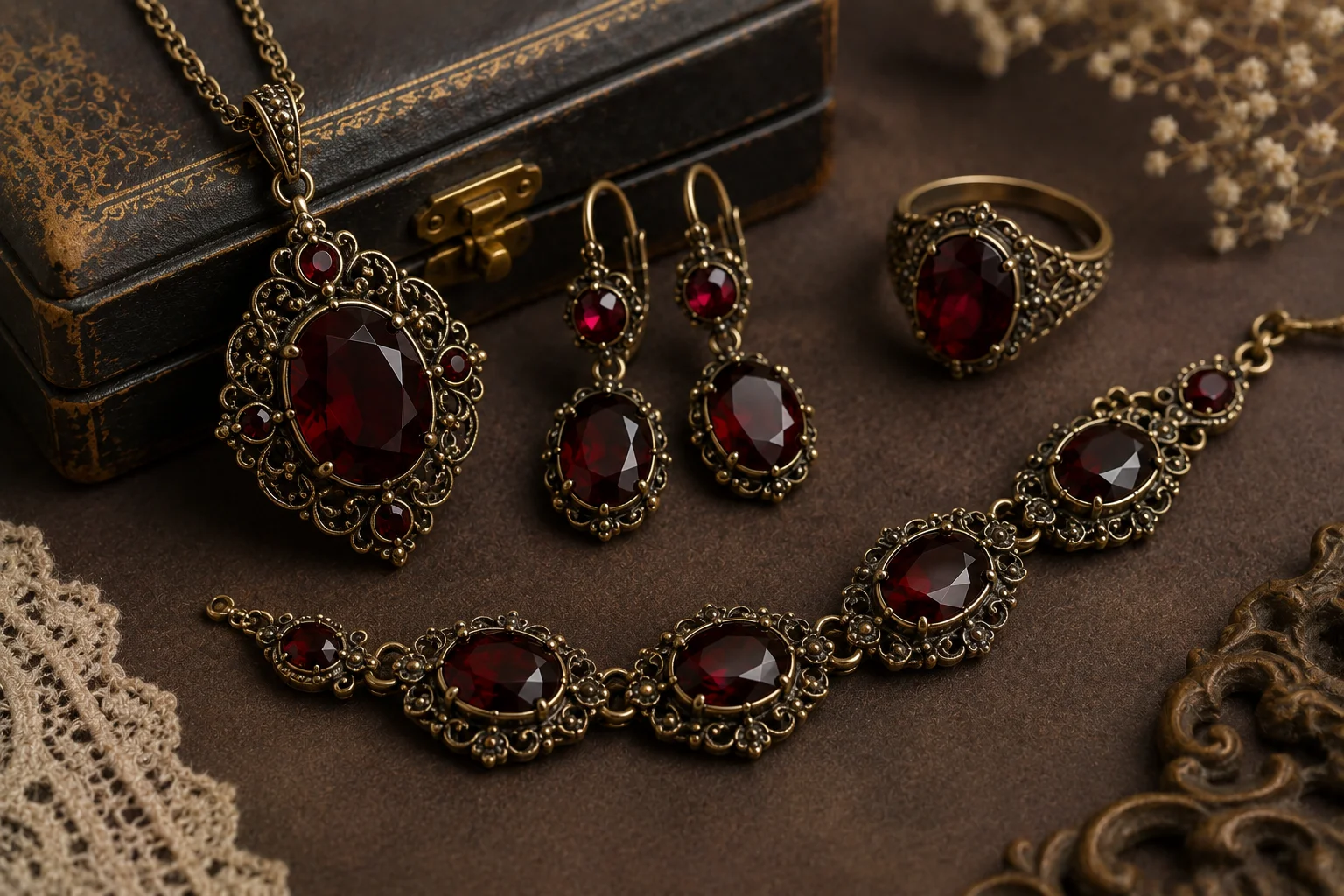
Bohemian pyrope was used in brooches, necklaces, bracelets, earrings, hair ornaments and elaborate matched sets.
Designs frequently placed many small red garnets close together rather than centering one enormous gemstone.
This style took advantage of the available material while producing a rich continuous color effect.
Antique Bohemian garnet remains collectible today.
Condition, authenticity, craftsmanship and provenance matter more than age alone.
Pyrope’s Historical Importance
Pyrope garnet became central to the image of traditional red garnet.
Its name has roots associated with fiery appearance.
Bohemian deposits helped make pyrope a commercially important European gemstone.
Pyrope also occurs in other geological environments and countries.
Modern buyers should therefore distinguish the mineral variety from one historical source.
Not every pyrope is Bohemian, and not every old red garnet jewel necessarily contains pure end-member pyrope.
Almandine Through History
Almandine garnet has also played a major role in garnet jewelry.
It is widespread and commonly shows deep red, brownish-red or purplish-red color.
Many natural garnets are mixtures rather than chemically pure end members, so historical red material can fall between pyrope and almandine compositions.
The scientific classification explains why visually similar red garnets may show different physical properties.
In practical jewelry history, however, both contributed to garnet’s long-standing reputation as a red gem.
The Rise of Modern Mineralogy
Garnet classification became increasingly precise as mineralogy developed.
Rather than treating garnet as one substance, scientists recognized a group of minerals sharing a common crystal structure but differing chemically.
Important gem species include:
- Almandine
- Pyrope
- Spessartine
- Grossular
- Andradite
Uvarovite is another important garnet species, although its crystals are usually too small for conventional faceting.
The group concept explains garnet’s extraordinary color and property range.
Garnet and Geological Science
Garnet also became important beyond gemology.
Because particular garnet compositions form under specific geological conditions, geologists use garnet in studying metamorphic rocks and geological processes.
Red garnet occurs widely in metamorphic environments.
Different species may form in skarns, serpentinite-related rocks and other settings.
Thus, garnet’s scientific history developed alongside its jewelry history.
A crystal admired in a ring can also record information about the pressure, temperature and chemistry of the rock in which it grew.
The Discovery of Demantoid
Green demantoid transformed the idea that garnet should look red.
Demantoid is a green-to-yellowish-green variety of andradite garnet discovered in Russia’s Ural region during the nineteenth century.
Its name refers to its diamond-like optical appearance.
Unlike many colored gemstones, demantoid can show extremely strong dispersion, producing flashes of spectral fire.
The drafted demantoid garnet meaning guide provides its dedicated mineralogical profile.
Demantoid and Russian Jewelry
Russian demantoid became an important luxury gemstone.
Its vivid green color and high dispersion attracted fine jewelers.
Fabergé and other workshops used demantoid in elaborate Russian jewelry.
Small green stones worked especially well as leaves and decorative accents.
Later discoveries in Namibia, Madagascar and additional locations expanded known sources.
Nevertheless, documented Russian origin can still influence collector value.
Garnet in Art Nouveau Jewelry
The late nineteenth and early twentieth centuries created new opportunities for colored gemstones.
Art Nouveau designers embraced organic forms, unusual color combinations and materials beyond traditional diamond-centered jewelry.
Garnet could appear alongside enamel, gold and other colored stones.
Demantoid was particularly suitable for leaf and plant motifs because of its green color.
Historical jewelry from this period should be valued according to design, maker, condition and provenance as well as gemstone quality.
Spessartine and Orange Garnet
Spessartine introduced another important color direction.
The manganese-rich garnet species can produce vivid orange, reddish-orange and yellow-orange gems.
Although orange garnet existed mineralogically long before modern marketing, important later discoveries increased its visibility in the jewelry market.
Today, fine orange spessartine can look dramatically different from conventional red garnet.
This reinforces a recurring theme in garnet history: new sources repeatedly expanded public understanding of the group.
Grossular and Hessonite
Grossular garnet has an exceptionally broad color range.
Hessonite garnet, an orange-to-brownish-orange variety, has a long jewelry tradition and particular cultural importance in South Asia.
Other grossular colors include yellow, colorless and green material.
Modern tsavorite eventually made vivid green grossular one of the most important contemporary garnets.
The shift from hessonite to tsavorite illustrates how one mineral species can occupy several very different commercial and cultural identities.
The Discovery of Tsavorite
Tsavorite’s modern story began in East Africa.
Geologist Campbell Bridges discovered vivid green grossular in Tanzania in 1967 and later worked with deposits in Kenya.
The gemstone was introduced to a wider international market during the 1970s under the name tsavorite, derived from the Tsavo region of Kenya.
Its saturated green and lack of routine clarity treatment created a new competitor within the fine green-gem market.
Tsavorite helped permanently break the public assumption that garnet meant inexpensive dark red.
Tsavorite and the Modern Colored-Gem Market
Tsavorite’s rise demonstrated how quickly a newly marketed gemstone could establish a premium identity.
Fine stones combine strong green color with good brilliance.
Large gems are rare because rough commonly occurs fractured and in relatively small pieces.
The commercial development of tsavorite also helped focus attention on East Africa as an important colored-gem producing region.
Today, Kenya and Tanzania remain closely associated with the variety.
Rhodolite and Modern Red Garnet
Rhodolite garnet offers raspberry, pinkish-red and purplish-red color.
It occupies a visually brighter position than many traditional dark-red garnets.
Rhodolite helped expand consumer expectations within the red side of the garnet spectrum.
Rather than choosing between dark red and green or orange, buyers could find vivid berry-colored stones within the same group.
Modern faceting also allows rhodolite to display excellent brilliance in earrings, rings and pendants.
Color-Change Garnet
Modern gemology identified garnets capable of significant color change under different light sources.
Some pyrope-spessartine compositions may shift between greenish or bluish appearances and reddish or purplish colors.
These stones were particularly surprising because blue had historically been considered essentially absent from the garnet palette.
Color-change garnet further demonstrated how chemically complex the group can be.
The phenomenon is optical and measurable, while any symbolism associated with transformation or adaptability is a later cultural interpretation.
Garnet as January’s Birthstone
Garnet is the principal modern birthstone for January.
The completed January birthstone guide covers this tradition in detail.
Birthstone associations helped maintain garnet’s visibility even while jewelry fashions changed.
Today, the January connection can include nearly any garnet color.
A wearer no longer needs to choose dark red when green, orange, purple-red or color-changing material better suits personal taste.
Garnet as an Anniversary Gem
Modern jewelry traditions also associate garnet with the second wedding anniversary.
Like birthstones, anniversary gemstone lists are cultural conventions rather than physical properties.
The symbolism commonly emphasizes commitment and enduring affection.
Garnet’s long history makes that association feel natural, but the tradition should not be interpreted as a guarantee of relationship success.
The gemstone represents the occasion; the relationship depends on the people involved.
Garnet in Modern Jewelry
Modern garnet jewelry spans an enormous price range.
Common red stones can appear in accessible silver pieces, while exceptional tsavorite and demantoid may be mounted in high jewelry.
The recently drafted garnet earrings guide shows how the group works across different jewelry styles.
The drafted garnet bracelet guide similarly demonstrates the variety’s effect on durability and pricing.
No single historical category now represents the complete garnet market.
Garnet as an Industrial Mineral
Garnet still has important uses outside jewelry.
Certain garnet materials are crushed and graded for abrasive applications.
Uses may include abrasive blasting, waterjet cutting and filtration-related applications.
Industrial value depends on physical properties and supply rather than gem color or transparency.
A beautiful faceted tsavorite and industrial garnet abrasive therefore belong to the same broad mineral group but serve entirely different economic purposes.
This dual identity has existed in different forms throughout garnet history.
How Garnet’s Reputation Changed
For much of popular jewelry history, garnet meant red.
Modern discoveries transformed that assumption.
Demantoid introduced exceptional green fire.
Spessartine expanded vivid orange.
Tsavorite created a premium saturated green grossular market.
Rhodolite increased interest in bright raspberry red.
Color-change material challenged old claims that blue was absent.
As a result, contemporary garnet is better understood as one of the most diverse major gemstone groups.
The drafted garnet color meaning guide explains that palette directly.
Garnet Symbolism Through History
Garnet has accumulated many symbolic meanings.
Historical and later traditions have associated it with protection, friendship, faith, commitment, vitality and safe travel.
Modern crystal culture adds grounding, motivation, prosperity and chakra correspondences.
These ideas come from different periods and should not be collapsed into one supposedly ancient universal belief.
The recently drafted garnet healing properties guide keeps modern healing claims separate from the historical record.
Symbolism forms part of cultural history, not scientific evidence of gemstone powers.
Garnet Today
Today’s garnet market is more diverse than ever.
A collector can pursue Ural demantoid, East African tsavorite, color-change stones, historic Bohemian pyrope or mineral specimens from numerous geological environments.
A jewelry buyer can choose nearly black-red almandine, bright rhodolite, orange spessartine or vivid green garnet.
Modern laboratory testing can identify species, detect some treatments and investigate origin questions for valuable material.
Yet the same qualities that attracted ancient wearers—color, polish and durability—remain central.
Conclusion
Garnet’s history spans thousands of years, from ancient Egyptian beads and Roman engraved gems to early medieval cloisonné, Bohemian Victorian jewelry and modern tsavorite and demantoid.
Its cultural identity changed as scientific understanding improved. What once appeared to be a principally red gemstone became recognized as a mineral group capable of extraordinary color diversity.
New discoveries did not replace garnet’s history; they expanded it. Red pyrope and almandine remain tied to some of its oldest traditions, while green, orange and color-changing varieties demonstrate how much the garnet story continues to develop.
Frequently Asked Questions
1. How old is garnet jewelry?
Garnet has been used as a gemstone since at least the Bronze Age and appears in several ancient jewelry traditions.
2. Where does the word garnet come from?
The name is generally linked with medieval Latin granatus and the resemblance of red garnet to pomegranate seeds.
3. Did ancient Egyptians use garnet?
Yes. Garnet appeared in ancient Egyptian beads and jewelry.
4. How did Romans use garnet?
Romans used garnet in jewelry and engraved intaglios, including signet rings used with wax seals.
5. What is garnet cloisonné?
It is a metalworking technique in which thin pieces of garnet are fitted into small metal cells, often over reflective patterned foil.
6. Why was garnet important in Anglo-Saxon jewelry?
Garnet was widely used in high-quality early medieval goldwork, especially cloisonné ornaments associated with elite dress and burial.
7. What is Bohemian garnet?
Bohemian garnet usually refers to pyrope historically mined and fashioned in the region now largely within the Czech Republic.
8. Why was garnet popular in Victorian jewelry?
Large supplies of Bohemian pyrope supported jewelry containing many closely set small red garnets, which became highly fashionable during the nineteenth century.
9. When was demantoid discovered?
Demantoid was identified from the Russian Ural region during the nineteenth century and later became important in Russian fine jewelry.
10. When was tsavorite discovered?
Campbell Bridges discovered the green grossular later known as tsavorite in Tanzania in 1967, with later production in Kenya and wider market introduction during the 1970s.
11. Was garnet always considered a group of minerals?
No. Modern mineralogy eventually established that garnet consists of several closely related mineral species rather than one chemically uniform gemstone.
12. Is garnet only historically important as a red gemstone?
No. Although red garnet dominates much of the historical record, modern discoveries have made green, orange, purple-red and color-change garnets important parts of the market.