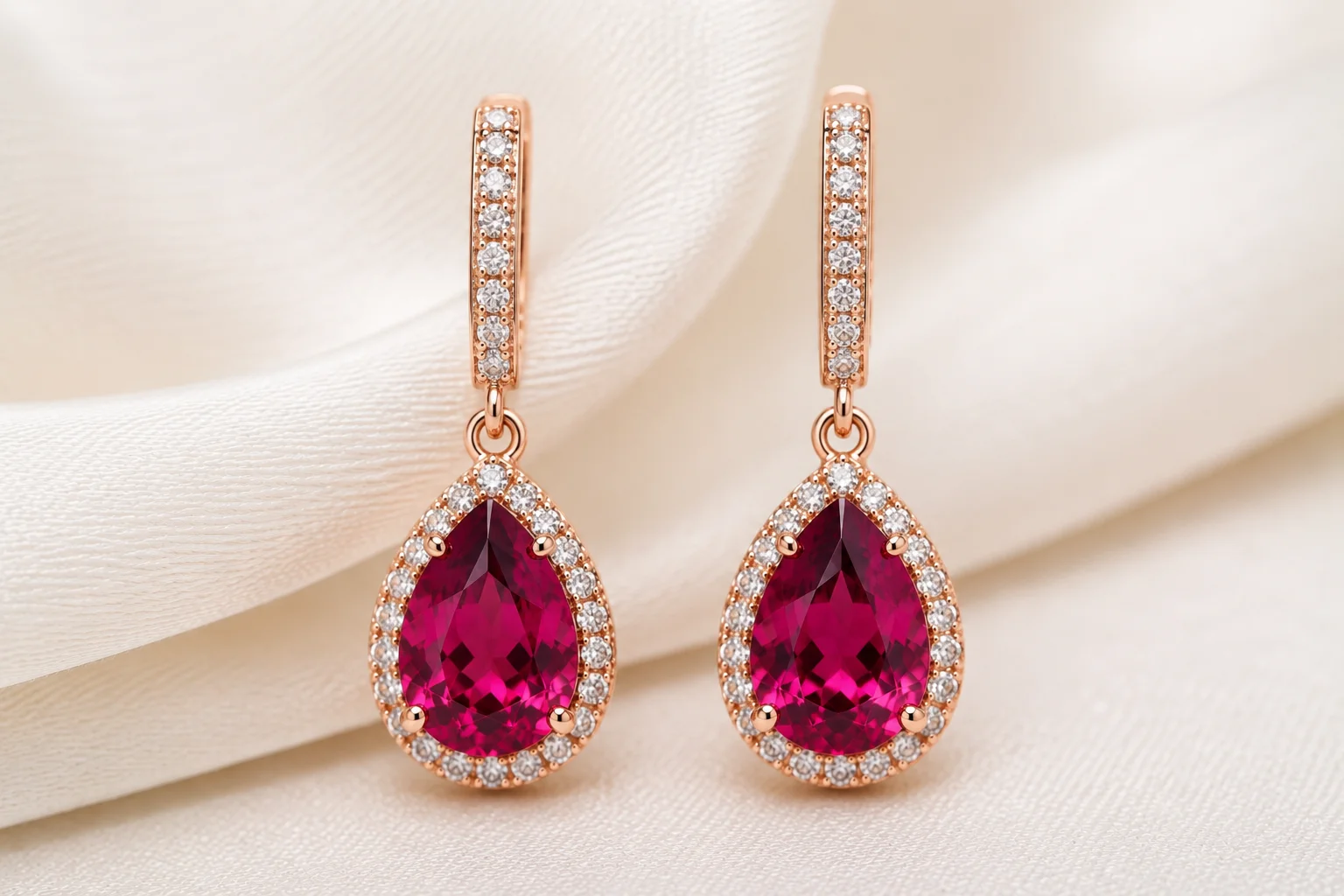
Rhodolite Garnet Earrings: Styles, Settings and Buying Guide
Rhodolite garnet earrings offer raspberry, rose-red and purplish-red color with more brightness than many traditional dark garnets. The stone’s transparent pyrope–almandine composition responds well to faceting, allowing small earrings to show strong color without requiring large or heavy gems.
Earrings are also one of the safest ways to wear rhodolite. They receive fewer impacts than rings and bracelets, remain away from most household chemicals and can use more delicate cuts or open settings.
The main buying challenges are pair matching, comfortable weight, secure backs and cuts that do not turn dark. This guide owns those earring-specific decisions. Loose-stone grading remains within the rhodolite garnet buying guide, while market ranges remain within the rhodolite garnet price guide.
Rhodolite Earring Styles at a Glance
| Style | Appearance | Best suited to | Main consideration |
|---|---|---|---|
| Solitaire studs | Clean point of color | Everyday wear and small gems | Pair matching and secure backs |
| Halo studs | Brighter and visually larger | Formal and gift jewelry | Small accent settings need inspection |
| Cluster earrings | Dense sparkle and floral patterns | Statement color at moderate cost | Clean between tightly grouped stones |
| Huggies | Compact hoop with close-set gems | Daily wear and layering | Hinge and latch quality |
| Drop earrings | Visible movement below the ear | Showcasing ovals, pears and cushions | Length and weight balance |
| Dangles | Greater movement and visual drama | Evening and occasion wear | Components can twist or catch |
| Chandelier earrings | Multi-level color and sparkle | Formal statement styling | Weight distribution and comfort |
| Ear climbers | Modern line following the ear | Small calibrated stones | Correct orientation and backing tension |
| Jacket earrings | Decorative element behind the lobe | Convertible styling | Front and back components must align |
| Hoops | Repeated stones around a curve | Strong color and movement | Inside-out settings need secure hinges |
Why Rhodolite Works Well in Earrings
The planned rhodolite garnet meaning guide explains the stone’s identity and symbolism.
Rhodolite is usually transparent and commonly eye-clean. This gives cutters enough clarity to produce small round, oval, pear and cushion stones that remain bright at earring scale.
Deep-red almandine may need a larger face-up area or shallower cut to avoid appearing black. Rhodolite’s purple and pink modifiers commonly remain more visible in small gems.
Earrings also receive light from many angles as the head moves. Drops and dangles make particularly effective use of this movement.
Compared with a rhodolite garnet bracelet, earrings experience less contact and can use more exposed settings safely.
Rhodolite Stud Earrings
Solitaire studs are the most versatile style.
A matched pair of round brilliants creates even sparkle, while cushions and ovals provide more visible color for a similar width.
Small studs work as subtle everyday jewelry. Larger stones become a stronger focal point and need backs that distribute weight effectively.
The stone should sit close to the lobe without tilting downward. A basket that is too deep can push the earring forward, while a very shallow setting may expose the pavilion.
Four prongs show more of the stone. Six prongs offer additional redundancy and a more traditional outline.
Halo Studs
A halo surrounds rhodolite with small diamonds, white sapphires or another contrasting gem.
The border increases face-up presence and makes the center appear larger.
White accents sharpen the purple-red color, while pink sapphire or rose-gold details create a softer tonal design.
Inspect the halo for even spacing. One missing or tilted accent disrupts the entire outline.
The center rhodolite should not sit so deep that the halo casts a shadow across it.
Halo studs can collect lotion and hair products beneath the stones, so open backs and accessible galleries improve cleaning.
Bezel-Set Studs
A bezel creates a smooth metal rim around the garnet.
It reduces snagging, protects the girdle and works well for people who wear earrings beneath scarves, helmets or over-ear headphones.
A full bezel can make a dark rhodolite appear deeper in tone. Open-backed construction helps light reach the pavilion.
Partial bezels retain more visible stone while protecting selected edges.
Bezel studs also suit modern minimal styling and are less likely than high prongs to catch on hair.
Rhodolite Huggie Earrings
Huggies are small hinged hoops that sit close to the earlobe.
Rhodolite may be prong-set, channel-set or bezel-set across the front.
Channel settings create a smooth surface but require accurately calibrated stones. Prongs admit more light but create additional snag points.
The hinge should move without wobbling, and the post should click securely into the latch.
Check the internal diameter rather than the outer diameter alone. A visually small hoop may still be too tight for a thicker lobe or higher piercing.
Rhodolite Hoop Earrings
Hoops can use stones across the front half or around both the outside front and inside back in an inside-out layout.
The second arrangement keeps gems visible from the front, but it creates more settings and additional weight.
Small rhodolite rounds produce a continuous red-purple line. Alternating garnets with diamonds or plain metal sections reduces visual density.
A secure hinged post or locking latch is important. Thin wire closures may deform under the weight of stone-set hoops.
Large hoops should remain light enough that they do not pull the piercing downward during extended wear.
Drop Earrings
Drop earrings suspend one principal gem below the lobe.
Pear, oval, cushion and elongated radiant cuts work well because their shape remains visible during movement.
A fixed drop offers controlled motion, while an articulated joint allows the rhodolite to swing and catch more light.
The pair should hang at equal length. Compare the position of every connecting ring and setting.
Open-backed drops usually show color better than closed cups. However, extremely dark stones may benefit from a bright reflective metal surface behind them when this construction is disclosed honestly.
The planned rhodolite garnet necklace guide offers matching pendant considerations.
Dangle and Chandelier Earrings
Dangle earrings use several articulated components, while chandeliers expand into wider multi-level designs.
Small rhodolites can create a graduated color cascade without requiring one large stone.
Every joint should move freely without excessive sideways play. Stiff links can cause the earrings to hang unevenly.
Weight needs careful attention. Rhodolite is denser than quartz and beryl, so a multi-stone design can become heavier than its photographs suggest.
A broad top element or supportive earring back distributes weight better than a narrow post.
Chandelier earrings are best removed before dancing, vigorous movement or wearing clothing with open lace and loose threads.
Cluster and Floral Earrings
Cluster earrings arrange several small rhodolites into flowers, rosettes or geometric groups.
They provide substantial visible color at a lower cost than two large matched stones.
The stones should have consistent tone. One dark center or pale outer stone may look intentional only when the pattern repeats symmetrically.
Shared prongs reduce metal but support more than one gemstone. Damage to a shared prong can therefore loosen multiple stones.
Cluster interiors trap residue easily. Choose a design that can be cleaned from the back.
Ear Climbers and Crawlers
Ear climbers follow the curve of the lobe.
Graduated rhodolite rounds, marquises or pears create a rising line of red-purple color.
The design depends on correct backing pressure. Too little tension allows rotation; too much causes discomfort.
A climber should fit the wearer’s ear rather than relying on a universal angle.
Smooth settings reduce hair snagging. Low bezels or carefully finished shared prongs are preferable to tall exposed baskets.
Earring Jackets
An earring jacket sits behind the lobe and surrounds or extends below a front stud.
A simple rhodolite solitaire can be combined with a diamond halo jacket, pearl drop or garnet cluster.
This allows one pair of studs to move between minimal and formal styling.
Check post length. The front stud must pass through the ear and jacket securely without leaving excessive loose space.
The color of the jacket accents should not overwhelm a small dark rhodolite center.
Matching Rhodolite Pairs
Pair matching is central to earring quality.
Compare hue, tone, saturation, cut, dimensions, transparency and brilliance.
One stone should not appear noticeably more purple, darker or more included than the other.
Rotating the pair under the same light exposes differences hidden in static photographs.
Millimeter dimensions are more useful than carat weight alone. Because garnet density varies by composition and cut depth, two equal-weight stones can face up differently.
A well-matched pair may be more valuable than two individually attractive but visibly different gems.
Choosing Color
Fine rhodolite commonly shows raspberry, purplish red or pinkish red.
A pair should remain visibly colored under ordinary room light rather than becoming black except at the edges.
Very pale stones create a softer rose effect and may suit understated studs. Deep burgundy gems offer drama but need excellent cutting.
Examine the earrings under cool and warm lighting. Rhodolite may appear more purple in daylight-equivalent light and warmer red under incandescent or warm LED illumination.
The broader red gemstones guide places rhodolite among ruby, spinel, tourmaline and other red materials without replacing garnet identification.
Clarity
Rhodolite is commonly eye-clean.
Large obvious inclusions are therefore less acceptable than they may be in hessonite or some spessartine garnets.
A tiny inclusion visible only under magnification has little effect on earrings when brightness remains strong.
Avoid large feathers or fractures reaching the surface, especially near prongs or drill holes.
Both stones should have similar clarity. One hazy gem paired with one transparent gem creates an obvious mismatch.
The broader garnet quality and grading guide retains group-wide grading principles.
Cut and Shape
Round brilliants provide consistent sparkle and are easy to match.
Ovals create a larger-looking colored area, while cushions combine soft corners with broad flashes.
Pears work naturally in drops. Their pointed ends need protective prongs or bezels.
Marquises create length but can show bow-tie extinction and exposed tips.
Checkerboard and rose cuts offer a decorative surface but return light differently from standard brilliant cuts.
Look for balanced outlines, centered culets and similar facet patterns between the two earrings.
Extinction and Windowing
Extinction appears as dark regions where little light returns to the viewer.
Some contrast is essential to brilliance, but a rhodolite should not look mostly black.
Windowing creates a pale see-through area, often beneath the table. It usually results from shallow cutting or unsuitable angles.
Earrings can conceal mild windowing against hair or skin, but it remains a cutting-quality issue.
View each stone over a neutral white background and then in its actual setting. This reveals whether color comes from the gem or from a reflective backing.
Choosing Earring Size
Visual size should be judged in millimeters.
A small 3–4 mm stud provides a subtle point of color. Medium studs around 5–6 mm become more noticeable, while larger stones create a stronger statement and require supportive backs.
Drops can use smaller stones effectively because movement increases visibility.
Photographs without scale can make earrings look much larger than they are. Ask for millimeter dimensions, total drop length and an image on an ear or standard display card.
The total carat weight normally refers to both earrings combined. Confirm whether a listing uses total or per-stone weight.
Weight and Comfort
Rhodolite is relatively dense.
Large clusters, thick gold settings and multi-level drops can become heavy even when individual stones are modest.
Comfort depends on total weight, distribution and how far the design extends from the lobe.
Broad friction backs, locking backs or supportive discs can help stabilize substantial studs.
Very heavy earrings can stretch piercings over time. Formal designs should be tested for several minutes before a long event.
Hollow construction can reduce metal weight, although thin walls must remain strong enough for repeated use.
Earring Backs
Friction backs are convenient and common, but they should grip the post securely.
Screw backs reduce accidental loss but take longer to put on and can irritate if overtightened.
Locking backs provide a positive mechanism and work well for valuable studs.
Leverbacks protect the wire end and suit drops and dangles.
Latch backs are common on huggies and hoops. The connection should click cleanly without sideways movement.
Shepherd hooks are lightweight but may benefit from silicone stoppers.
No backing type compensates for a bent, worn or undersized post.
Metal Choices
Yellow gold warms rhodolite and emphasizes red.
Rose gold creates a tonal raspberry appearance, particularly in romantic or vintage-inspired settings.
White gold, platinum and silver make the garnet appear more purple by contrast.
Metal preference should consider visual taste, budget, weight and sensitivity.
Nickel-containing white-gold alloys can cause reactions in some wearers. Ask for exact alloy information rather than assuming every gold earring is hypoallergenic.
Platinum and certain titanium components can be suitable alternatives, while sterling silver requires tarnish management.
Styling Rhodolite Earrings
Rhodolite studs add controlled color to workwear and simple clothing.
Huggies and small hoops suit layered ear styling, especially when combined with plain gold or tiny diamond studs.
Drops pair well with open necklines and swept-back hair because movement remains visible.
Chandeliers need less competition from necklaces. A simple neckline or restrained pendant prevents the jewelry from becoming visually crowded.
The rhodolite garnet ring guide can coordinate hand jewelry, but matching every piece exactly is not required. Repeating the metal or one color tone is often enough.
Birthstone and Gift Use
Rhodolite belongs to the garnet family, the traditional January birthstone.
Its brighter color can appeal to someone who does not prefer the brownish or nearly black red associated with inexpensive garnet.
Studs are practical gifts because sizing is simpler than for rings or bracelets.
A pair can also mark a second wedding anniversary under modern garnet traditions, although anniversary lists vary.
The complete calendar context appears in the January birthstone guide and January birthstone jewelry guide.
Treatments and Authenticity
Most rhodolite is not routinely heated or dyed.
Rare fracture filling can reduce the visibility of surface-reaching breaks.
Red glass, synthetic spinel, synthetic corundum and other simulants can imitate rhodolite color.
Garnet is singly refractive, and its refractive index and density separate it from many alternatives. Natural-versus-imitation questions can be resolved through routine gemological testing.
The recently drafted real-versus-fake garnet guide explains identification across the garnet group.
A laboratory report may be appropriate for large or unusually expensive earrings. The gemstone certification guide explains what such a report can and cannot establish.
Buying Rhodolite Garnet Earrings
Confirm that both stones are natural rhodolite garnet rather than generic red garnet.
Request exact dimensions, total carat weight, metal fineness and treatment disclosure.
Inspect matching under at least two light sources.
Check prongs, posts, hinges and backs. The settings should be symmetrical and the earrings should hang at equal angles.
Avoid paying for an unsupported AAA or investment grade. No universal commercial grading scale governs those labels.
For online transactions, follow how to buy gemstones online and use the return period to evaluate comfort and matching.
Cleaning and Storage
Warm water, mild soap and a soft brush are suitable for most untreated rhodolite earrings.
Clean the backs and posts carefully because skin products collect there.
Avoid steam. Ultrasonic cleaning is inappropriate when the stones are fractured, filled or the settings are delicate.
The completed rhodolite garnet jewelry cleaning guide provides the full procedure.
Store each earring in a separate compartment or secure both to an earring card. This prevents the stones and posts from scratching one another.
Keep rhodolite away from harder diamonds, rubies and sapphires during storage.
Frequently Asked Questions
1. Is rhodolite suitable for everyday earrings?
Yes. Earrings receive relatively little impact, and rhodolite has adequate hardness for regular wear.
2. What color should fine rhodolite earrings be?
They commonly show lively raspberry, purplish-red or pinkish-red color without excessive brown or black extinction.
3. Are rhodolite earrings brighter than ordinary garnet earrings?
They often appear brighter and more purple than dark almandine, although cut and tone remain important.
4. Which cut is best for rhodolite studs?
Round brilliant, oval and cushion cuts provide strong color and are comparatively easy to match.
5. Which setting is most secure?
A well-made bezel offers excellent edge protection, while six-prong baskets provide additional redundancy for larger stones.
6. How can I tell whether two earrings are matched?
Compare hue, tone, dimensions, cut, transparency and brilliance under the same lighting.
7. Does carat weight show how large the earrings will look?
Not reliably. Millimeter dimensions provide a better measure of visible size.
8. Are rhodolite earrings usually treated?
Most are untreated, although rare fracture filling or other alterations can occur.
9. Which metal makes rhodolite look redder?
Yellow and rose gold generally emphasize warmth. White metals create greater contrast and can emphasize purple tones.
10. Are heavy rhodolite drops uncomfortable?
They can be. Ask for total earring weight and choose supportive backs or broader ear wires for substantial designs.
11. Can rhodolite earrings be cleaned ultrasonically?
Only when the stones are unfilled, free of significant fractures and the settings are suitable. Warm soapy water is safer.
12. Is rhodolite a January birthstone?
Yes. Rhodolite is a garnet variety and belongs to January’s traditional birthstone family.
Rhodolite earrings succeed when the pair looks unified, moves comfortably and returns purple-red light rather than darkness. Matching, millimeter scale, secure backs and sound settings deserve as much attention as carat weight. Because earrings protect garnet from much of the impact faced by rings and bracelets, they are among the most practical ways to showcase rhodolite’s brighter side.
Rhodolite is indexed in Crystals That Start With R and Gemstones That Start With R.