Red Gemstones: Names, Meanings, Durability and Jewelry Uses
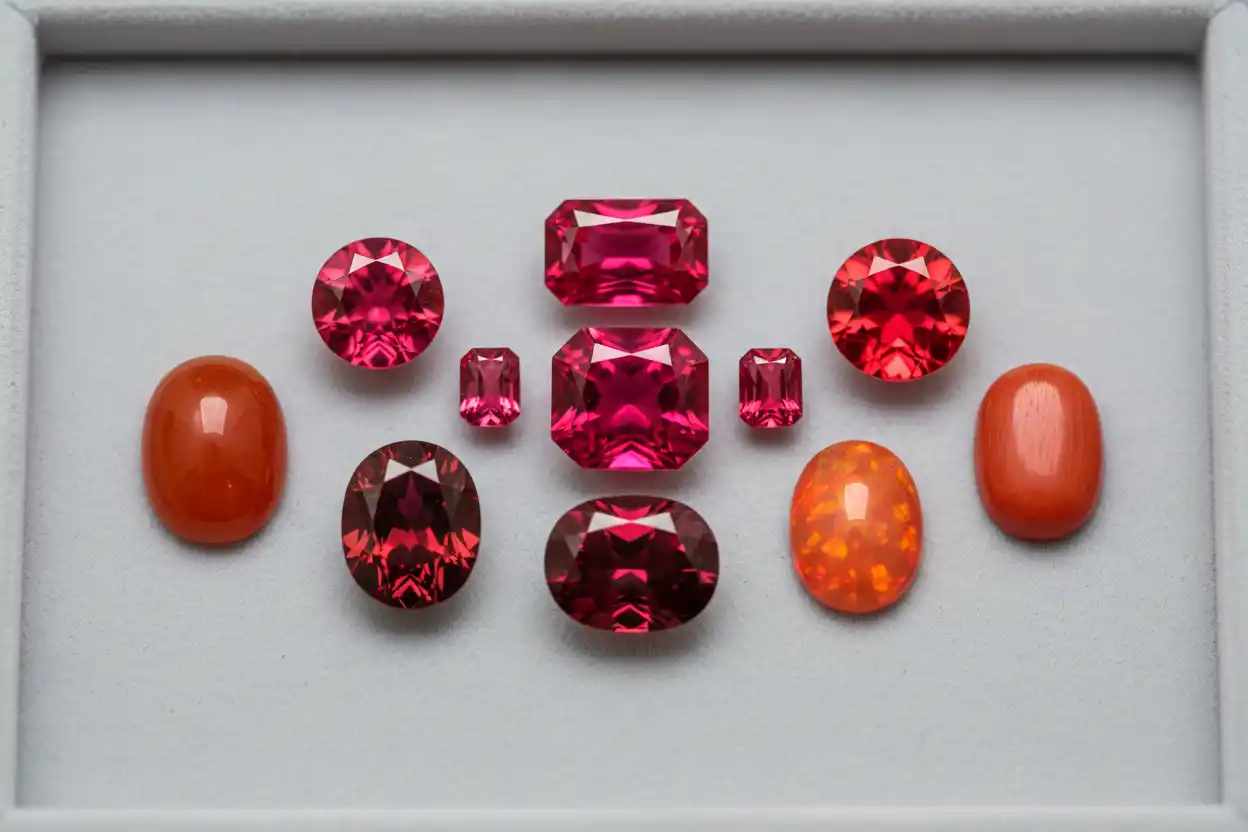
Red gemstones range from transparent ruby and spinel to opaque jasper, organic coral and banded rhodochrosite. They do not form one mineral family, and the word red covers shades from bright scarlet and crimson to burgundy, orange-red, purple-red and earthy brick.
Their color can arise from chromium, manganese, iron, copper-related chemistry, mineral inclusions, organic structures or treatment. Consequently, two visually similar red stones may have different hardness, cleavage, value and jewelry suitability.
This article owns the gemological and jewelry intent of the red color group. It compares species, durability, transparency, treatments and typical uses. Readers looking primarily for spiritual symbolism, chakra associations and meditation ideas should use Red Crystals: Meanings and Complete List.
Red Gemstones at a Glance
| Gemstone | Material type | Typical red appearance | Mohs hardness | Common use |
|---|---|---|---|---|
| Ruby | Corundum | Vivid red to purplish or orangish red | 9 | Fine rings, earrings and heirloom jewelry |
| Red spinel | Spinel | Bright scarlet, pink-red or orangish red | 8 | Durable faceted jewelry |
| Red garnet | Garnet group | Dark red, purplish red, raspberry or orange-red | 6.5–7.5 | Rings, beads and traditional jewelry |
| Rubellite | Tourmaline | Pink-red to deep crimson | 7–7.5 | Faceted rings and pendants |
| Red beryl | Beryl | Vivid red to purplish red | 7.5–8 | Rare collector gems and protected jewelry |
| Carnelian | Chalcedony | Translucent orange-red to brown-red | 6.5–7 | Cabochons, seals and beads |
| Red jasper | Microcrystalline quartz | Opaque earthy brick or rust red | 6.5–7 | Carvings, beads and casual jewelry |
| Rhodonite | Manganese silicate | Pink-red with black veining | 5.5–6.5 | Cabochons and ornamental objects |
| Rhodochrosite | Manganese carbonate | Pink to red with white bands | 3.5–4 | Collector cabochons and pendants |
| Fire opal | Hydrated silica | Yellow-orange to red-orange | 5–6.5 | Protected rings, earrings and pendants |
| Precious coral | Organic calcium-carbonate structure | Orange-red, red or pink | 3–4 | Beads, carvings and antique jewelry |
| Red zircon | Zirconium silicate | Orange-red, brown-red or purplish red | 6–7.5 | Brilliant faceted gems |
| Sunstone | Feldspar | Peach, orange-red or copper-red with sparkle | 6–7.5 | Cabochons and faceted jewelry |
| Red aventurine | Included quartz | Sparkling peach-red to brick red | 7 | Beads, carvings and casual jewelry |
| Red tiger’s eye | Chatoyant quartz aggregate | Red-brown with a moving light band | About 7 | Cabochons, beads and men’s jewelry |
| Sardonyx | Banded chalcedony | Red-brown, orange, white and black layers | 6.5–7 | Cameos, seals and beads |
| Red calcite | Calcium carbonate | Translucent coral to brick red | 3 | Display specimens and low-impact pendants |
| Cinnabar | Mercury sulfide | Scarlet to brown-red | 2–2.5 | Collector specimens; restricted jewelry use |
| Realgar | Arsenic sulfide | Orange-red to scarlet | 1.5–2 | Enclosed mineral specimens only |
Hardness is only one durability factor. Cleavage, toughness, porosity, treatments and setting style also determine whether a gemstone is suitable for everyday jewelry.
What Makes a Gemstone Red?
A gemstone appears red when its structure absorbs much of the visible spectrum while transmitting or reflecting wavelengths perceived as red.
Chromium causes red in ruby and many red spinels. The same trace element can produce noticeably different color because corundum and spinel have different crystal structures.
Manganese contributes red and pink in rhodochrosite, red beryl, tourmaline and some garnets.
Iron-related absorption and iron-oxide inclusions create earthy red, orange-red and brown-red shades in jasper, aventurine, tiger’s eye and chalcedony.
Inclusions can produce color without replacing atoms in the host crystal. Red aventurine, sunstone and strawberry quartz depend heavily on reflective or colored particles.
Dye, heat, irradiation, diffusion and coating can also create or intensify red. Therefore, color should never be treated as proof of natural untreated origin.
Transparent, Translucent and Opaque Red Gems
Transparent red gems are usually faceted to return light. Ruby, spinel, garnet, rubellite, red beryl and zircon belong to this group.
Translucent materials such as carnelian and fire opal may be faceted, cut as cabochons or carved according to clarity and internal structure.
Opaque stones such as red jasper, rhodonite and coral depend on surface polish, pattern and bodycolor rather than brilliance.
The best cut follows the material. A transparent ruby benefits from carefully calculated facets, while a patterned sardonyx or rhodochrosite needs a broad polished surface.
Ruby
Ruby is the best-known red gemstone.
It is red corundum, with chromium responsible for its primary color. Fine stones combine vivid saturation with enough brightness to avoid appearing black.
Ruby’s hardness and general toughness make it suitable for rings, including frequently worn jewelry.
However, natural, laboratory-grown, heated, diffusion-treated and glass-filled rubies occupy very different markets.
The recently drafted real-versus-fake ruby guide explains identification, while the completed ruby buying guide and ruby price guide retain purchase and value intent.
Traditional symbolism associates ruby with vitality, devotion, leadership and protection.
Red Spinel
Spinel can rival ruby in vivid red color.
It is a separate cubic mineral and is singly refractive, while ruby is doubly refractive corundum.
Red spinel has a long history of mistaken identity. Several famous historical rubies were eventually identified as spinel.
The stone is durable enough for rings and requires no routine treatment to achieve fine color, although synthetic and treated material occur.
The spinel price guide owns market values.
Traditional meanings center on renewal, enthusiasm and restoring confidence.
Red Garnet
Garnet is a mineral group rather than one species.
Almandine tends toward dark brownish or purplish red. Pyrope can show deep red, while rhodolite commonly appears brighter raspberry or purple-red.
Some mixed garnets produce vivid orange-red and color-change effects.
Garnet is generally suitable for jewelry, although hardness and durability vary by composition.
The recently drafted real-versus-fake garnet guide explains the group’s identification, while the garnet price guide retains valuation.
Garnet’s traditional meanings include commitment, protection and endurance.
Rubellite
Rubellite is strongly saturated pink-to-red tourmaline.
The finest material remains red or pink-red across different lighting conditions rather than becoming brown.
Tourmaline’s pleochroism influences cutting because color changes with crystal direction.
Rubellite can contain visible fractures and inclusions. Filling may occur in selected material.
The completed rubellite price guide explains color, clarity, size and treatment premiums.
Its symbolic traditions emphasize emotional honesty, affection and expressive confidence.
Red Beryl
Red beryl is one of the rarest facetable red gemstones.
It belongs to the beryl family with emerald, aquamarine and morganite, but manganese produces its red color.
Most crystals are small, included and unsuitable for large clean gems.
Because of the rarity, glass, synthetic red beryl and other red stones may be misrepresented.
Red beryl works best in protected collector jewelry rather than exposed daily-wear designs.
Traditional symbolism focuses on resilience, rarity and concentrated purpose.
Carnelian
Carnelian is orange-red to brownish-red chalcedony.
Its translucency and durability made it a historical material for seals, intaglios, beads and amulets.
Color may be natural, heated or enhanced from pale agate. Treatment can be stable but should be represented accurately.
Carnelian is suitable for everyday pendants, earrings, beads and moderately protected rings.
The stone’s traditional associations include confidence, creativity and motivation.
Red Jasper
Red jasper is opaque microcrystalline quartz colored by iron-bearing material.
Its earthy color and dense structure make it popular for beads, carvings, cabochons and ornamental objects.
Red jasper is affordable and durable, although fractures, dye and reconstructed material can affect quality.
It is generally better suited to casual jewelry than soft red carbonate stones.
Traditional meanings emphasize grounding, persistence and practical courage.
Rhodonite
Rhodonite is a manganese silicate commonly cut from opaque pink-to-red material with black manganese-oxide veins.
Fine transparent red rhodonite exists but is uncommon.
Most jewelry uses cabochons and beads selected for pattern and color.
The mineral can cleave and scratch more readily than quartz, so rings require protection.
Traditional symbolism connects rhodonite with compassion, reconciliation and emotional boundaries.
Rhodochrosite
Rhodochrosite is manganese carbonate.
It commonly shows pink, red and white bands, while rare transparent crystals can be faceted.
Its softness and perfect cleavage limit daily jewelry use. Pendants, earrings and collector cabochons are safer than exposed rings.
Acids, ultrasonic vibration and hard impacts can cause damage.
Traditional associations emphasize self-kindness, emotional warmth and memory.
Fire Opal
Fire opal is opal valued for yellow, orange or red bodycolor.
Some stones show spectral play-of-color, while others do not.
Transparent Mexican material is commonly faceted, though internal fractures and lower hardness require careful setting.
Opal is sensitive to impact and abrupt environmental change. Treatment, hydrophane behavior and construction should be considered.
Traditional meanings connect fire opal with creativity, spontaneity and pleasure.
Precious Red Coral
Coral is an organic gem material rather than a mineral.
Fine red and orange coral is carved into beads, branches, cameos and cabochons.
It is soft, porous and vulnerable to perfume, acids, heat and sunlight-related fading when dyed.
Dyeing, waxing, polymer stabilization and reconstruction are common market concerns.
Legal trade depends on species, origin and local or international regulation. Documentation should accompany valuable or recently sourced material.
The completed coral buying guide owns purchase criteria.
Traditional coral symbolism includes protection, ancestry and life-force imagery.
Red Zircon
Red zircon is a natural zirconium silicate, not cubic zirconia.
It may appear orange-red, brown-red or purplish red and can display strong brilliance and dispersion.
Zircon’s hardness varies, and its brittle nature means facet edges can abrade or chip.
Heat treatment affects many zircon colors, although red and brown shades also occur naturally.
Traditional meanings include renewal, clarity and enthusiasm.
Sunstone
Sunstone belongs to the feldspar family.
Copper, hematite or other reflective inclusions can create red, orange and sparkling appearances depending on variety and locality.
Some transparent Oregon sunstone displays attractive red or green-red zoning and can be faceted.
Feldspar cleavage requires protection from impact.
The completed sunstone price guide explains why color, copper content, transparency and locality affect value.
Traditional associations emphasize optimism, visibility and independence.
Red Aventurine
Red aventurine is included quartz with peach-red, orange-red or brick-red color and subtle aventurescence.
The reflective effect comes from platy mineral inclusions.
It is durable enough for beads, pendants, carvings and many rings.
Dyed quartz and manufactured glass can imitate the sparkle, so excessive uniformity deserves scrutiny.
Traditional meanings include ambition, constructive momentum and optimism.
Red Tiger’s Eye
Red tiger’s eye is chatoyant quartz aggregate with a moving band of light.
Much red market material is produced by heating golden or brown tiger’s eye.
The treatment is generally stable, but natural-red claims should be evaluated carefully.
Its hardness supports ordinary jewelry use, though fractures and thin cabochons remain vulnerable to impact.
Symbolic traditions emphasize focus, confidence and directed action.
Sardonyx
Sardonyx combines red-brown or orange-brown sard layers with onyx-style bands.
Its hardness and fine grain support cameos, intaglios, beads and seals.
Dyeing can strengthen layer contrast or create material suitable for carving.
Pattern continuity through the side helps distinguish natural banding from assembled or painted products.
Traditional meanings include discipline, loyalty and reliable action.
Collector-Only Red Minerals
Realgar is orange-red arsenic sulfide. It is soft, light-sensitive and unsuitable for routine jewelry.
Cinnabar is red mercury sulfide. It is also soft and requires dust-control precautions.
Neither mineral should be placed in drinking water, ground into powder or worn where abrasion can create particles.
Their inclusion in a red gemstone list reflects collector interest, not a recommendation for skin-contact jewelry.
Red Diamond
Natural red diamond is among the rarest gemstone categories.
Its color is associated with structural distortion rather than ordinary chromium or manganese coloration.
Most consumers will encounter laboratory-grown red diamond, treated diamond, red cubic zirconia or another simulant rather than a natural red diamond.
Any meaningful natural-red claim requires a major independent diamond report.
Because no dedicated tracker page owns this extremely narrow category, it should remain a brief reference rather than dominate the broader red-gemstone guide.
Which Red Gemstones Are Best for Rings?
Ruby and red spinel offer the strongest combination of hardness, toughness and brilliance.
Many garnets and rubellite can also perform well when the setting protects edges and inclusions.
Carnelian, red jasper, red aventurine and red tiger’s eye are suitable for cabochon rings with reasonable care.
Red beryl needs protection because rarity, inclusions and small size increase risk.
Rhodochrosite, red calcite, coral, fire opal, realgar and cinnabar are poor choices for unprotected daily rings.
Use the completed gemstone hardness chart as a starting point rather than the entire durability decision.
Red Gemstones for Earrings and Pendants
Earrings and pendants face fewer impacts than rings and bracelets.
This makes them practical settings for rhodochrosite, coral, fire opal, red calcite and heavily included collector gems.
Weight still matters. Large garnets and cubic-zirconia imitations can become uncomfortable in earrings because of density.
Pendant settings should protect sharp points and prevent soft stones from rubbing against metal chains.
Treatments, glue and backing must also tolerate ordinary skin products.
How Treatments Affect Red Gemstones
Heating is common in ruby, carnelian, tiger’s eye and several other stones.
Dye can affect chalcedony, jasper, coral, quartz and reconstructed products.
Glass filling dramatically improves the apparent clarity of low-quality ruby but changes care and value.
Coatings can create red on quartz, topaz, glass and other substrates.
Irradiation and annealing influence color in selected diamonds, quartz and other gems.
The completed gemstone treatments guide explains why the base material and treatment must both be named.
Red Gemstone Imitations
Red glass can imitate ruby, garnet, spinel, tourmaline and fire opal.
Synthetic spinel and synthetic corundum appear frequently in vintage and modern jewelry.
Dyed quartz and chalcedony can imitate carnelian, red jasper and red aventurine.
Resin and ceramic can reproduce coral, rhodochrosite and banded stones.
A gemstone is not authenticated by red color, sparkle or weight alone. Refractive index, density, birefringence, inclusions and spectroscopy provide the dependable separation.
Choosing by Color
Scarlet and vivid pure red create the most dramatic appearance.
Purplish reds can look richer under cool light, while orangish reds feel warmer and often pair well with yellow gold.
Dark burgundy stones can appear nearly black when cut too deeply. Brightness should be judged under ordinary indoor light rather than only a spotlight.
Opaque earthy reds offer a subtler choice and often show more visible pattern.
The ideal red is not one universal hue. It is the color that remains attractive in the intended setting and lighting.
Choosing by Budget
Red jasper, carnelian and common red garnet offer affordable natural options.
Fine rhodolite, rubellite, spinel and fire opal occupy broad middle-to-premium ranges depending on quality.
Ruby and red beryl can become expensive quickly when size, color and transparency improve.
Coral pricing depends on species, color, size, treatment, documentation and legal availability.
A rare name does not compensate for poor cutting, undisclosed treatment or questionable identification.
Buying Safely
Request the exact mineral name rather than accepting red gemstone as a complete description.
Ask whether the stone is natural, laboratory-grown, treated, filled, dyed, coated, assembled or reconstructed.
For ruby, spinel and rare red beryl, an independent report can be proportionate to value.
Compare millimeter dimensions rather than carat weight alone because gemstone densities differ.
Check whether the setting permits examination of the back and girdle.
Current price pages such as those for ruby, garnet, spinel and rubellite should own market figures rather than a broad color guide.
Frequently Asked Questions
1. What is the most durable red gemstone?
Ruby is the hardest major red gemstone at Mohs 9 and is generally suitable for frequent wear.
2. Which red gemstone looks most like ruby?
Fine red spinel can resemble ruby closely. Red garnet, rubellite and red glass can also overlap visually.
3. Is garnet always dark red?
No. Garnet includes brighter red, purple-red, orange, green and other colors across several species and mixed compositions.
4. What is the rarest red gemstone?
Natural red diamond and fine red beryl are among the rarest, although rarity depends on the precise quality and size being compared.
5. Which red gemstones are affordable?
Red jasper, carnelian, common garnet, red aventurine and red tiger’s eye are widely available at accessible prices.
6. Which red gemstones are best for daily rings?
Ruby and spinel are leading choices. Many garnets and rubellites also work well with suitable settings.
7. Is red coral a mineral gemstone?
No. Precious coral is an organic gem material formed by marine organisms.
8. Can fire opal be red without play-of-color?
Yes. Fire opal is defined principally by yellow, orange or red bodycolor and may lack spectral play-of-color.
9. Is red beryl the same as ruby?
No. Red beryl is a manganese-colored beryl, while ruby is chromium-colored corundum.
10. Are all red gemstones naturally colored?
No. Heat, dye, irradiation, diffusion, coating and filling can create or alter red color.
11. Can red gemstones be identified from photographs?
Not reliably. Lighting and editing alter color, while many different species overlap visually.
12. Which red gemstones should not be worn casually?
Realgar, cinnabar and fragile collector minerals should not be used for ordinary skin-contact jewelry. Soft coral, calcite and rhodochrosite also require protective wear.
Red gemstones offer far more variety than ruby alone. Spinel provides vivid brilliance, garnet spans multiple red families, carnelian and jasper bring translucent and opaque options, while coral and fire opal introduce organic and hydrated-silica structures. The best choice balances color with mineral identity, treatment, durability, budget and responsible sourcing.
Gemstone symbolism is cultural and personal rather than medical. Realgar and cinnabar contain hazardous elements and should be treated as labeled collector specimens, not ingredients, elixir stones or casual abrasion-prone jewelry.