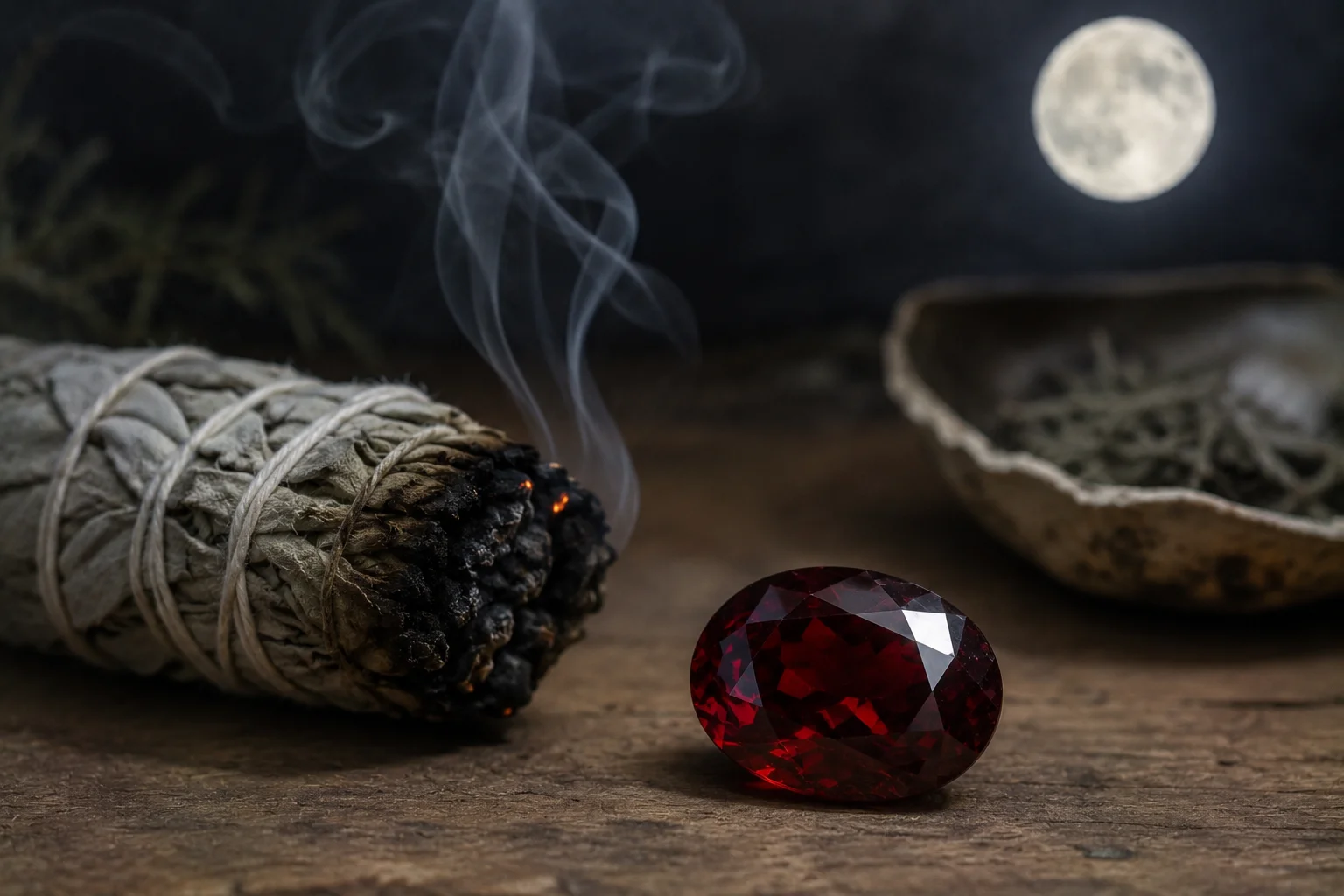
How to Cleanse and Charge Garnet
The safest ways to cleanse and charge Garnet are sound, intention, visualization, indirect moonlight, a brief lukewarm-water rinse, a written dedication, and careful placement near a symbolic object. Most sound, untreated Garnets are durable enough for brief water contact, but dry methods remain safer for fractured, filled, glued, antique, beaded, or mixed-gem pieces.
Garnet is generally stable in ordinary light and does not need to be protected from every moment of daylight. Nevertheless, concentrated heat, steam, direct salt burial, abrupt temperature changes, and rough contact with harder stones add no value to a symbolic ritual.
What Cleansing and Charging Mean
Cleansing is a personal or spiritual practice used to mark a new beginning, release previous associations, or prepare an object for meditation and intentional use.
Charging generally means connecting the stone with a particular purpose, routine, memory, or personal value.
Neither practice is required to preserve Garnet as a mineral. No established scientific evidence shows that symbolic cleansing alters its chemistry, hardness, health effects, or measurable physical energy.
The family’s mineralogy, colors, history, and traditional symbolism belong to the broader Garnet guide. More focused symbolic interpretation appears in Garnet Spiritual Meaning and Garnet Color Meaning.
Garnet Is a Mineral Group
Garnet is not one chemically uniform mineral. It is a group of related silicates that includes almandine, pyrope, spessartine, grossular, andradite, uvarovite, and intermediate compositions.
The complete family structure belongs to Types of Garnet.
| Property | Ritual implication |
|---|---|
| Mineral group | Garnet |
| Common gem species | Almandine, pyrope, spessartine, grossular, and andradite |
| Typical colors | Red, orange, yellow, green, purple, pink, brown, and rarely colorless |
| Mohs hardness | Approximately 6.5 to 7.5, depending on variety |
| Toughness | Fair to good |
| Cleavage | None |
| Safest ritual methods | Sound, intention, visualization, moonlight, and brief water contact |
| Sunlight | Generally stable under ordinary exposure |
| Main risks | Fractures, rare filler, impact, heat, salt, and setting damage |
The gemstone hardness chart explains why most Garnets resist scratches better than Feldspar, Apatite, Fluorite, Calcite, and many ornamental stones.
However, scratch resistance does not prevent every chip or fracture. The distinction appears in Gemstone Toughness vs Hardness and Gemstone Cleavage Explained.
Species and Condition Matter
Almandine, pyrope, spessartine, and Tsavorite tend to fall toward the harder side of the Garnet range. Demantoid is somewhat softer and may contain prominent inclusions.
A compact polished Garnet can tolerate more controlled handling than a thin crystal, a heavily included Demantoid, an Uvarovite druse, or a bead with a damaged drill hole.
Rare fracture filling also changes the care limit. Filler may react to heat, vibration, solvents, or repeated immersion.
The broader enhancement framework belongs to Gemstone Treatments Explained.
When the species, treatment, or construction is uncertain, choose sound, intention, or visualization rather than water, salt, or direct sunlight.
Inspect the Garnet Before Beginning
Examine the stone beneath bright, indirect light.
Look for open fractures, chipped facets, loose crystals, cloudy filler, damaged drill holes, movement in a setting, stretched elastic, weak knots, or lifting glue.
Natural inclusions and color zoning are not dirt. Do not scrape or press against them.
A polished tumble or securely set ring may be physically sound, while a crystal cluster or druse can contain delicate attachments that should not be handled.
If the stone clicks inside its setting or a fracture reaches the surface, leave it on a padded support and use a non-contact ritual.
Physical Cleaning Is a Separate Task
Symbolic cleansing does not remove skin oil, cosmetics, soap film, or setting residue.
The complete physical-care method belongs to How to Clean Garnet Jewelry Safely.
Warm water, mild liquid soap, and a soft brush are appropriate for sound Garnet. Fracture-filled stones require manual warm-soapy-water cleaning only.
The tracker’s Is Garnet Durable Enough for Everyday Wear? page owns broader wearability, while Is Garnet Safe in Water and Sunlight? owns the environmental-exposure comparison.
Dry the stone and its setting completely before beginning a symbolic ritual.
Method 1: Cleanse Garnet with Sound
Place the Garnet on a folded cloth or padded tray.
Ring a singing bowl, bell, chime, or tuning fork nearby. You may also hum, chant, clap gently, or play calm music.
Do not place a faceted Garnet directly inside a metal bowl while striking it. Hard contact can chip facet edges or scratch the mounting.
Sound works across red, green, orange, purple, and color-changing Garnets because it does not depend on chemical composition or treatment.
Several gentle tones are sufficient.
Method 2: Use Intention
Leave the Garnet on a padded surface or hold a smooth piece loosely over a cloth.
Choose one concise purpose. The object might remind you to complete a long-term commitment, rebuild a routine, act consistently, maintain a relationship boundary, or follow through on a decision.
State the intention silently or aloud.
The tracker’s How to Use Garnet page owns wider practical applications, while Garnet Affirmations provides purpose-specific wording.
The ritual does not require prolonged handling or exposure.
Method 3: Use Visualization
Place the Garnet where it cannot roll or fall.
Imagine previous associations fading while the object becomes connected with your chosen purpose.
Some practitioners visualize red, green, orange, white, or neutral light according to the Garnet’s color. The image is symbolic rather than a measurable emission from the mineral.
Continue for several slow breaths or a few minutes.
Visualization is particularly suitable for valuable, included, filled, or antique Garnet jewelry because it requires no physical contact.
Method 4: Use Indirect Moonlight
Place Garnet indoors near a window on a padded tray or inside an open lined jewelry box.
An hour, an evening, or overnight indoor placement may be used according to personal preference.
The moon phase affects personal symbolism rather than Garnet’s physical properties.
Outdoor placement is unnecessary. Dew, rain, animals, theft, and temperature changes create avoidable risks even when the Garnet itself is stable.
The broader ritual comparison belongs to How to Cleanse Crystals.
Method 5: Use a Brief Water Ritual
A sound, untreated, unfilled Garnet can be rinsed briefly in clean lukewarm water.
Hold it over a bowl rather than an open drain. Blot it with a soft cloth and allow moisture around drill holes or settings to evaporate.
Do not soak Garnet for hours or overnight.
Avoid water rituals for fracture-filled stones, glued cabochons, elastic bracelets, antique settings, porous companion materials, or strands with weak knots.
Water is an optional symbolic method rather than a requirement.
Method 6: Use Brief Indirect Daylight
Most Garnets are stable under ordinary light, so a short indoor daylight ritual is generally appropriate for sound material.
Place the Garnet near—but not on—a hot window for several minutes or part of a morning.
Do not leave it inside a closed vehicle, beneath an intense display lamp, or where a metal setting can overheat.
Brief indirect daylight is different from prolonged outdoor exposure.
The wider sunlight comparison belongs to Which Crystals Can and Can’t Go in the Sun.
Method 7: Use a Written Dedication
Write one clear statement and place it beside the Garnet.
A practical statement might focus on finishing a project, maintaining a daily habit, protecting time for a relationship, or acting with consistency.
Keep pens, clips, and metal objects away from polished surfaces.
The note can remain beside the stone for several minutes or an evening.
Written intention provides a repeatable ritual without exposing the Garnet to water, smoke, salt, or strong light.
Method 8: Use a Companion Object with a Barrier
Some practitioners place Garnet near Clear Quartz, Selenite, another Garnet, a photograph, or a meaningful keepsake.
Use separate cloths or padded compartments.
Harder stones and metal components can scratch or chip a Garnet, while Garnet itself can damage softer minerals.
Direct contact is not necessary for symbolic charging.
The tracker’s Garnet Chakra and Garnet Benefits and How to Use It pages own the belief-based associations that may shape such an arrangement.
Avoid Direct Salt Burial
Salt grains can lodge inside fractures, drill holes, prong settings, and crystal clusters.
Coarse salt may also trap hard contamination that scratches polished surfaces.
Saltwater adds prolonged moisture and can affect metal, thread, elastic, glue, filler, and companion stones.
When salt carries personal symbolism, keep it in a separate bowl while the Garnet remains on a lined dish nearby.
Avoid Steam and Extreme Heat
Steam cleaning is not recommended for Garnet.
Concentrated heat and pressure may affect fractures, rare filler, glue, enamel, antique solder, and vulnerable accompanying materials.
Do not place Garnet beside flames, hot ash, radiators, heated ritual bowls, or repair equipment.
Normal indoor warmth and brief daylight are different from concentrated heat.
Avoid Soil Burial
Soil contains Quartz grains, mineral debris, moisture, fertilizers, microorganisms, and organic acids.
These materials can scratch the stone, lodge in settings, or weaken stringing.
Outdoor burial also risks loss and impact.
A safer nature-based ritual places Garnet near a potted plant while keeping it on a separate dry cloth or dish.
Do Not Use Acid or Destructive Tests
Garnets are generally stable to ordinary chemicals, but hydrofluoric acid can attack them.
Household rituals never require industrial acids, etching compounds, metal-cleaning dips, or destructive tests.
Do not scratch, heat, grind, or strike a Garnet to assess identity.
The family-wide authenticity workflow belongs to Real vs Fake Garnet, while purchasing factors belong to the Garnet buying guide.
Garnet Jewelry and Birthstone Context
Garnet commonly appears in rings, earrings, necklaces, bracelets, beads, and antique jewelry.
A ritual should follow the most vulnerable component of the complete object rather than the Garnet alone.
Stringing, glue, foil backs, enamel, old solder, and companion stones may exclude water or prolonged environmental exposure.
Garnet is January’s birthstone, covered in the January birthstone guide.
The stone’s long cultural history does not create one mandatory cleansing tradition. Personal practice and material safety can coexist.
Frequently Asked Questions
1. What is the safest way to cleanse Garnet?
Sound, intention, visualization, indirect moonlight, and a written dedication have the widest compatibility.
2. Can Garnet be cleansed in water?
A sound, untreated Garnet can be rinsed briefly. Avoid soaking filled, fractured, glued, strung, or antique pieces.
3. Can Garnet be left in moonlight overnight?
Yes, when kept indoors on a padded surface.
4. Can Garnet be charged in sunlight?
Brief indirect daylight is generally suitable because Garnets are stable to light. Avoid concentrated heat and long outdoor exposure.
5. Can Garnet be buried in salt?
Direct salt burial is unnecessary and may introduce scratches, residue, and setting damage.
6. Can Garnet be cleansed with smoke?
A brief cool-smoke ritual is possible, but sound or intention avoids soot, fragrance, and rewashing.
7. Can Garnet be steam cleansed?
No. Steam is not recommended and adds heat and pressure without a ritual benefit.
8. Can Clear Quartz charge Garnet?
Some practitioners use it symbolically. Keep the stones separated by a soft cloth to avoid abrasion.
9. Are all Garnet varieties cleansed the same way?
The safest dry methods apply across the family, but fractures, filler, species hardness, and jewelry construction may alter water suitability.
10. How long should Garnet charge?
A few minutes or an evening is sufficient. There is no scientifically required duration.
11. How often should Garnet be cleansed?
Use a schedule that fits your practice while avoiding unnecessary exposure and handling.
12. Does cleansing change Garnet scientifically?
No established evidence shows that cleansing changes its chemistry, health effects, or measurable physical energy.
Conclusion
Garnet is durable enough to allow several ritual options, but its family diversity and occasional fractures still reward a conservative approach. Sound, intention, visualization, and protected moonlight work across nearly every Garnet variety. Brief water or daylight may suit a verified sound stone, yet the most meaningful ritual remains one that clarifies its purpose without damaging the gem or setting.
Crystal cleansing and charging are spiritual or personal practices, not scientifically established methods for changing health, energy, or the physical properties of Garnet.