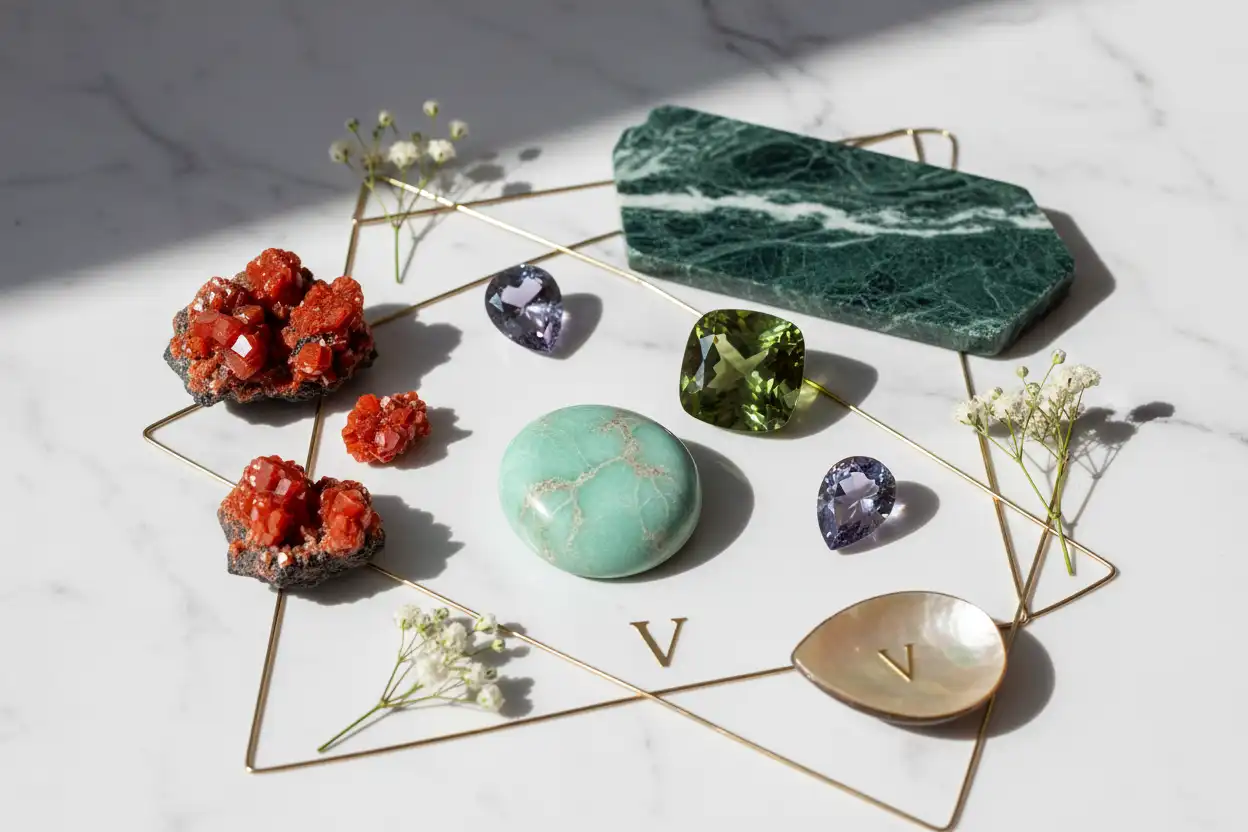
Gemstones That Start With V: A–Z Guide
Gemstones and gem materials that start with V include vanadinite, variscite, väyrynenite, verdelite, vesuvianite and vivianite.
The V directory contains vivid collector minerals, rare facetable gemstones, green ornamental materials and several stones that require special protection from chemicals, light or dust.
Traditional meanings are symbolic associations rather than scientifically proven medical effects.
Continue from Gemstones That Start With U. For the broader mineral directory, explore Crystals That Start With V.
V Gemstones at a Glance
| Gemstone or material | Typical appearance | Material type | Common use |
|---|---|---|---|
| Vanadinite | Red, orange or brown hexagonal crystals | Lead chlorovanadate mineral | Collector specimens |
| Variscite | Apple green, blue-green or pale green | Aluminum phosphate mineral | Cabochons and inlay |
| Väyrynenite | Pink, orange, red or pale crystals | Rare phosphate gemstone | Faceted collector jewelry |
| Verdelite | Pale to deep green | Green tourmaline | Fine faceted jewelry |
| Vesuvianite | Green, yellow, brown, purple or blue | Silicate gemstone | Cabochons and faceted gems |
| Vivianite | Pale, blue-green or dark green | Hydrated iron phosphate | Light-protected collector specimens |
Vanadinite
Vanadinite is a lead chlorovanadate mineral known for vivid hexagonal crystals.
Its colors include:
- Bright red.
- Scarlet.
- Orange-red.
- Brown.
- Yellow.
- Deep reddish brown.
Vanadinite is traditionally associated with:
- Motivation.
- Discipline.
- Focus.
- Completing demanding work.
- Using time and energy purposefully.
The mineral commonly forms in the oxidized zones of lead-bearing deposits and often appears on contrasting matrix.
Vanadinite is not suitable for conventional jewelry. It contains lead and should not be cut, drilled, ground or worn where dust could be released.
Store specimens:
- In a stable display box.
- Away from children and pets.
- Away from food and drink.
- Where crystals cannot rub or break.
- With a clear mineral label.
Additional precautions for lead-bearing minerals appear in the toxic crystals safety list.
Variscite
Variscite is a hydrated aluminum phosphate mineral valued for green and blue-green colors.
It may display:
- Apple green.
- Mint green.
- Yellow-green.
- Blue-green.
- Brown or black matrix.
- Spiderweb-like veining.
- Cream host-rock areas.
Variscite is traditionally associated with:
- Calm.
- Patience.
- Practical communication.
- Honest reflection.
- Steady decision-making.
It is commonly cut into:
- Cabochons.
- Beads.
- Inlay.
- Pendants.
- Carved objects.
Variscite can resemble turquoise, but the two minerals differ in composition, typical hardness and trace-element chemistry.
Because variscite is relatively soft and chemically sensitive, it should be kept away from acids, perfume, prolonged soaking and ultrasonic cleaning.
Väyrynenite
Väyrynenite is a rare manganese-bearing phosphate gemstone.
It may occur in:
- Rose pink.
- Red.
- Orange.
- Reddish brown.
- Pale yellow.
- Nearly colorless crystals.
Transparent material can be faceted, although clean crystals are scarce and finished gems are usually small.
Väyrynenite is traditionally associated with:
- Individuality.
- Persistence.
- Independent thinking.
- Patience.
- Recognizing uncommon opportunities.
Its rarity makes it mainly a collector gemstone rather than a mainstream jewelry material.
Professional identification is important because pale pink or orange stones may resemble tourmaline, topaz, spinel and other rare phosphates.
Väyrynenite belongs among the specialist materials discussed in the guide to the rarest gemstones in the world.
Verdelite
Verdelite is the traditional variety name for green tourmaline.
Its shades may include:
- Pale yellow-green.
- Mint green.
- Grass green.
- Forest green.
- Bluish green.
- Deep green that appears nearly black.
Verdelite is traditionally associated with:
- Growth.
- Confidence.
- Generosity.
- Emotional balance.
- Clear self-expression.
Color zoning and pleochroism are common. One crystal may look lighter, darker or more blue-green from different viewing directions.
Verdelite belongs to the wider tourmaline family.
Transparent stones have good scratch resistance and are suitable for rings, earrings and pendants. Included stones should be protected from sudden heat and sharp impact.
Vesuvianite
Vesuvianite is a complex silicate mineral also known by the historical name idocrase.
Its colors include:
- Green.
- Yellow-green.
- Brown.
- Yellow.
- Purple.
- Blue.
- Nearly black.
Transparent material may be faceted, while opaque specimens are commonly cut into cabochons, beads and carvings.
Vesuvianite is traditionally associated with:
- Cooperation.
- Purposeful action.
- Confidence.
- Releasing indecision.
- Aligning plans with personal values.
Green vesuvianite can resemble jade, diopside, garnet or tourmaline.
Visual appearance alone may be insufficient for valuable stones. The non-destructive observations in How to Identify Crystals can narrow the possibilities before professional testing.
Vivianite
Vivianite is a hydrated iron phosphate mineral known for dramatic color changes after exposure to air and light.
Fresh material may be nearly colorless or pale. It can progressively develop:
- Pale blue.
- Blue-green.
- Green.
- Dark blue-green.
- Nearly black.
Vivianite is traditionally associated with:
- Reflection.
- Gradual change.
- Emotional honesty.
- Patience.
- Understanding the effects of time and exposure.
The mineral is soft, cleavable and highly light-sensitive.
Vivianite is unsuitable for ordinary jewelry. Collector specimens should be stored in low-light conditions and handled minimally.
The broader guide to crystals that fade or change in sunlight explains why some minerals require controlled display.
V Gemstones by Color
Green V Gemstones
Variscite, verdelite, vesuvianite and vivianite provide shades ranging from mint and apple green to deep forest green.
Red and Orange V Gemstones
Vanadinite and väyrynenite are the primary red, orange and reddish-brown entries.
Blue V Gemstones
Vivianite may develop blue or blue-green color. Variscite and rare vesuvianite can also occur in blue-green shades.
Dark V Gemstones
Oxidized vivianite can become nearly black. Deep green verdelite and vesuvianite may also appear dark under ordinary light.
Which V Gemstones Are Best for Jewelry?
Best for Frequent Wear
Verdelite is the most practical V gemstone for regular jewelry. It offers tourmaline-level hardness and occurs in transparent facetable material.
Suitable for Protected Jewelry
Vesuvianite can be used in rings, earrings and pendants when free from significant fractures.
Variscite works well in protected cabochons, pendants and earrings but scratches more easily than quartz or tourmaline.
Collector Jewelry
Transparent väyrynenite may be used in carefully protected collector jewelry.
Primarily Display Minerals
Vanadinite and vivianite should remain in controlled specimen collections.
The differences between scratch resistance and resistance to breakage are explained in Gemstone Toughness vs. Hardness.
Identification and Buying Notes
Consider these factors before purchasing:
- Vanadinite should have clear safety disclosure because it contains lead.
- Variscite should not be sold as turquoise without accurate identification.
- Väyrynenite requires laboratory confirmation when rarity affects price.
- Verdelite may be unusually dark if the cut is poorly oriented.
- Vesuvianite can imitate several green gems.
- Vivianite should be sold and displayed with light-sensitivity warnings.
Origin claims for rare faceted stones should be supported by documentation rather than color alone.
Care Guide for V Gemstones
- Store vanadinite securely and prevent dust formation.
- Keep variscite away from acids, perfume and prolonged soaking.
- Protect väyrynenite from impact and pressure during setting.
- Avoid sudden heat when cleaning included verdelite.
- Check vesuvianite for fractures before professional cleaning.
- Display vivianite in low light.
- Keep soft V minerals separate from tourmaline and other harder jewelry.
- Avoid steam and ultrasonic cleaning when cleavage, porosity or inclusions create risk.
Frequently Asked Questions
What is the most valuable gemstone that starts with V?
Fine transparent väyrynenite can be valuable because facetable crystals are exceptionally rare. High-quality verdelite may also command significant prices.
Which green gemstones start with V?
Variscite, verdelite, vesuvianite and vivianite are notable green V materials.
Is vanadinite safe to wear?
No. Its lead content, softness and fragile crystal habit make it inappropriate for ordinary jewelry.
Is variscite the same as turquoise?
No. They can look similar but have different compositions and physical properties.
Is verdelite a tourmaline?
Yes. Verdelite is the traditional name for green tourmaline.
Is idocrase the same as vesuvianite?
Yes. Idocrase is an older name for vesuvianite.
Why does vivianite darken?
Exposure to light and air changes the oxidation state of its iron, producing deeper blue-green and dark colors.
Which V gemstone is best for everyday rings?
Verdelite is generally the strongest and most practical choice.
Continue the Gemstone Alphabet
Continue with Gemstones That Start With W, or browse all alphabetical directories through the Crystals 101 collection.