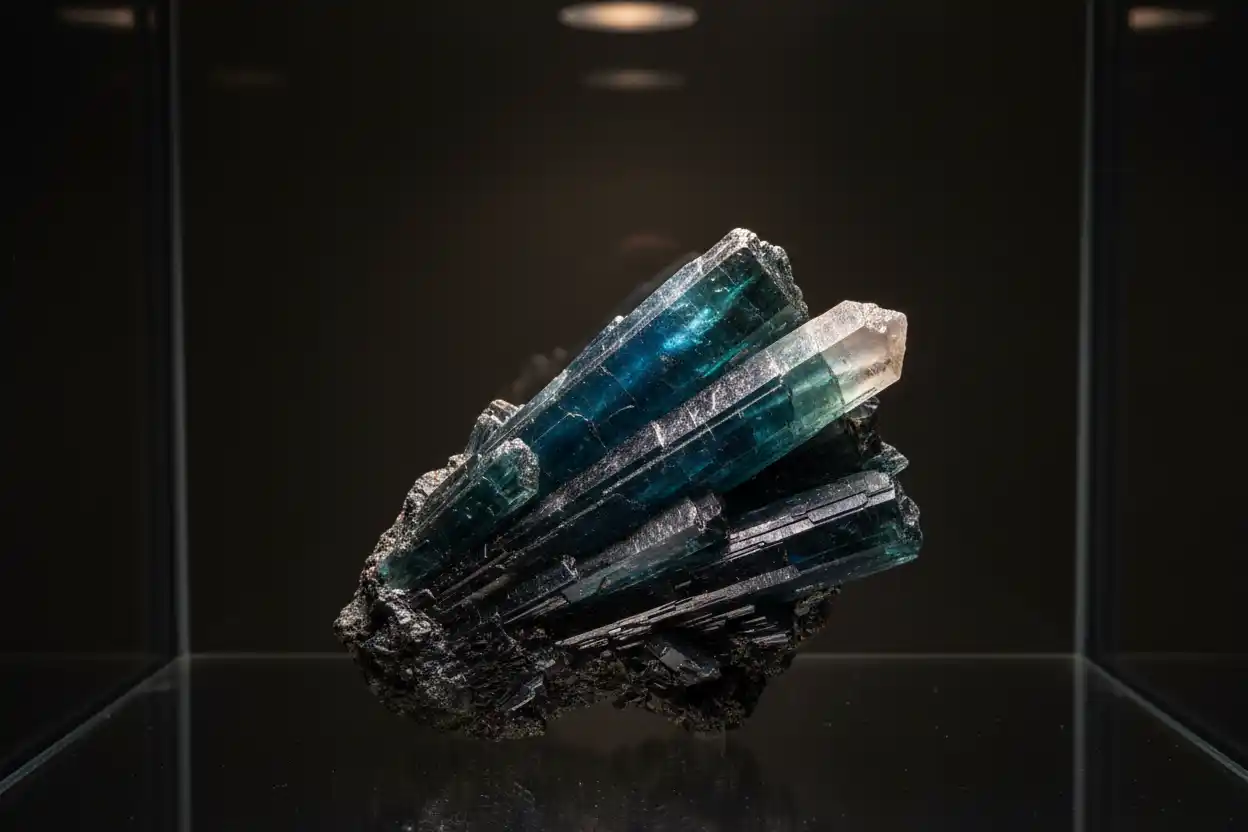
Vivianite Meaning, Properties, Value and Light Sensitivity
Vivianite is a hydrated iron phosphate whose appearance changes as its iron oxidizes. Fresh material can be nearly colorless, yet exposure to oxygen and light gradually produces pale green, blue-green, deep blue and eventually very dark crystals.
Its color, strong pleochroism and delicate bladed habit make vivianite highly collectible, but its softness and light sensitivity keep it closer to a mineral specimen than a practical gem within the wider types of gemstones guide.
Vivianite at a Glance
| Property | Vivianite |
|---|---|
| Mineral class | Hydrated phosphate |
| Chemical formula | Fe₃(PO₄)₂·8H₂O |
| Principal metal | Ferrous iron |
| Common colors | Colorless when fresh, pale green, blue-green, deep blue, dark green and nearly black |
| Crystal system | Monoclinic |
| Common habit | Bladed, prismatic, tabular, radiating, fibrous, earthy and concretionary |
| Luster | Vitreous on crystal faces; pearly on cleavage surfaces |
| Transparency | Transparent to opaque |
| Refractive indices | Approximately 1.58–1.70, varying by direction and oxidation |
| Birefringence | Strong, commonly about 0.047–0.073 |
| Optical character | Biaxial positive |
| Specific gravity | Approximately 2.6–2.7 |
| Mohs hardness | About 1.5–2 |
| Cleavage | Perfect in one direction |
| Tenacity | Sectile to brittle, depending on habit and alteration |
| Common use | Mineral specimens, protected display pieces and exceptionally rare collector cuts |
| Main care concern | Light-driven oxidation, extreme softness, perfect cleavage and dehydration risk |
What Is Vivianite?
Vivianite is an iron-rich member of the vivianite mineral group. Its structure contains ferrous iron, phosphate groups and eight molecules of water.
The mineral often forms under oxygen-poor conditions where dissolved iron meets a source of phosphate. As soon as fresh vivianite encounters air and stronger light, some ferrous iron begins changing to ferric iron.
That oxidation alters both color and structure. Consequently, a specimen’s blue-green beauty records chemical change rather than one permanently fixed original color.
The broader crystal identification guide explains why color alone cannot distinguish vivianite from other blue-green phosphate minerals.
Why Does Vivianite Change Color?
Fresh, unoxidized vivianite can be colorless or extremely pale. Partial oxidation creates green, blue-green and blue shades as interactions between ferrous and ferric iron alter the mineral’s absorption of visible light.
Continued exposure can deepen the crystal toward navy, dark green, brownish blue or nearly black. The process may also reduce transparency and weaken the crystal.
This transformation is not equivalent to ordinary fading. Vivianite often darkens before it eventually loses visual brilliance, while light-sensitive gems more commonly become paler.
The light-related distinction is important when applying the guidance in crystals that fade in sunlight. Vivianite requires low-light storage even though its immediate reaction is often darkening rather than simple fading.
Vivianite and Metavivianite
As vivianite oxidizes, it can transform toward mixed-valence iron-phosphate phases such as metavivianite. Additional alteration may eventually produce more heavily oxidized or structurally disordered material.
Metavivianite commonly appears dark green, blue-black or brownish and may retain the outward form of the original crystal. Therefore, a dark specimen may represent partly altered vivianite rather than pristine material.
The boundary is difficult to determine from photographs. Raman spectroscopy, X-ray diffraction and chemical analysis provide a more dependable answer.
Collectors should not assume that every deep blue or nearly black crystal represents the most desirable condition. Strong color remains attractive, but excessive alteration can reduce transparency, luster and stability.
Vivianite Colors and Crystal Habits
Pale Green and Blue-Green Crystals
Pale green specimens often show limited oxidation and may retain considerable transparency. Blue-green crystals balance color and clarity and are especially popular with collectors.
These tones place vivianite visually among both blue crystals and green crystals, although its mineral identity depends on iron-phosphate chemistry.
Deep Blue Vivianite
Rich blue crystals can display dramatic pleochroism, changing from greenish yellow to cobalt or indigo blue as the viewing direction changes.
Deep color can be desirable when light still passes through the blade. However, extremely dark material may appear black except at thin edges.
Bladed and Prismatic Crystals
Well-formed vivianite commonly appears as flattened blades or elongated prisms. The perfect cleavage runs through these crystals and makes thin specimens exceptionally fragile.
Sharp terminations, transparency and undamaged edges increase collector value. Even careful handling can split a crystal along its cleavage plane.
Radiating and Fibrous Aggregates
Crystals may grow outward from a common center, producing fans, sprays or spherical aggregates. Such material can occur in sedimentary nodules, fossils and mineralized cavities.
Radiating pieces are attractive but difficult to clean because dust settles between the blades.
Earthy and Concretionary Vivianite
Fine-grained vivianite can form blue or green earthy masses and rounded nodules. This material may occur in clay, peat, lake sediment and phosphatic concretions.
Although less visually dramatic than transparent crystals, earthy vivianite can be geologically important as evidence of reducing sediment conditions.
How Vivianite Forms
Vivianite develops where iron, phosphate, water and low-oxygen conditions coincide. Ferrous iron remains soluble under reducing conditions, while phosphate may come from sediment, organic decay, guano, bones, shells, fertilizers or phosphate-bearing minerals.
When the chemical balance becomes suitable, vivianite precipitates within pores, fractures, concretions or cavities. It can form through both inorganic and biologically influenced processes.
In lakes and wetlands, vivianite can lock phosphorus into sediment. Its stability changes when oxygen reaches the deposit, which is why the mineral also interests environmental scientists studying nutrient cycling.
Within metal deposits, vivianite may occur in oxidized or weathered zones alongside iron oxides and secondary phosphates. Pegmatite pockets can also produce attractive crystals when iron-bearing solutions react with phosphate minerals.
The phosphate association connects vivianite with materials such as apatite, although the two have different structures, hardness and geological roles. The broader types of apatite guide retains apatite’s separate classification intent.
Other related collector phosphates include variscite and wavellite, neither of which undergoes vivianite’s characteristic iron-driven color transformation.
Vivianite in Bones, Shells and Organic Sediments
Phosphate released from bone, teeth or shell material can react with iron-bearing groundwater and produce vivianite. The mineral may coat or replace parts of buried remains, particularly in waterlogged, oxygen-poor settings.
This occurrence has led to exaggerated online claims that vivianite routinely grows on recent human remains. In reality, formation requires a specific long-term combination of phosphate, iron, moisture and reducing chemistry.
Vivianite is also found inside fossil shells and phosphatic nodules. Those specimens can preserve unusual geological associations, but they should be documented carefully before receiving an archaeological or fossil-related premium.
Important Vivianite Localities
Bolivia has produced transparent blue-green crystals from mines in the Oruro region, including material associated with Huanuni. These specimens may occur on dark matrix and can display strong pleochroism.
Brazil has supplied large green and blue-green crystal sprays, including striking material from Amazonas and Minas Gerais. Some Brazilian pieces reach cabinet size and command high collector prices.
The Kerch Peninsula region is known for dark green to blue vivianite in sedimentary iron formations. Romania has produced transparent crystals associated with quartz and sulfide minerals.
Cameroon is recognized for vivianite and metavivianite in sedimentary environments, while Canada’s Yukon contains phosphate nodules and unusual vivianite-group associations.
Additional occurrences exist in Germany, England, Ukraine, the United States, Australia, Japan and several other countries. Locality should be supported by a reliable label because appearance alone rarely proves origin.
Associated Minerals and Internal Features
Vivianite may occur with quartz, siderite, ludlamite, pyrite, limonite, goethite, calcite and numerous phosphate minerals.
Metallic pyrite can provide an attractive contrast with transparent blue-green blades. Nevertheless, sulfide matrix may oxidize and create acidic residues if stored in humid conditions.
Brown limonite and goethite often represent iron-rich host material or alteration products. These associations can help explain the geological environment but are not diagnostic by themselves.
Internal fractures, cleavage lines, fluid inclusions and color zoning are common. Pleochroism can make one section appear blue from one direction and yellow-green from another.
Some crystals contain cloudy oxidized areas that spread inward from fractures or exposed surfaces. Those zones may continue changing after the specimen enters a collection.
Vivianite Pleochroism
Vivianite can show exceptionally strong pleochroism. Depending on orientation, the same transparent crystal may appear cobalt blue, deep green, yellow-green or nearly colorless.
This effect results from unequal light absorption along different crystallographic directions. It is not the same as color change under different lamps.
A collector can observe pleochroism by gently changing the viewing angle while keeping illumination low. Prolonged use of intense inspection lights should be avoided because exposure contributes to oxidation.
Pleochroism also complicates photography. A seller can make the same crystal look dramatically different by changing its orientation, backlighting and white balance.
How to Identify Vivianite
The combination of perfect cleavage, very low hardness, strong pleochroism, blue-green oxidation and iron-phosphate chemistry provides useful evidence.
Vivianite is soft enough to be scratched by many common materials. However, destructive scratch tests should never be used on a collector specimen.
Its place near the bottom of the gemstone hardness chart explains why even dust and packaging material can damage polished surfaces.
Hardness also should not be confused with resistance to splitting. The difference described in gemstone toughness versus hardness is particularly important because vivianite combines extreme softness with perfect cleavage.
Gemological and mineralogical laboratories may use Raman spectroscopy, X-ray diffraction, optical microscopy and chemical analysis. These techniques can also determine whether a dark specimen has partly transformed into metavivianite.
Common Vivianite Lookalikes
Ludlamite
Ludlamite is another hydrated iron phosphate that can appear green. It is usually harder and forms different crystal habits, while laboratory spectroscopy separates it reliably.
Lazulite and Scorzalite
These phosphate minerals can be blue to blue-green but are much harder and generally lack vivianite’s perfect bladed cleavage and rapid light-driven oxidation.
Scorodite
Scorodite can appear pale blue, green or violet. It is an iron arsenate rather than an iron phosphate and requires greater handling caution because of its arsenic content.
Blue-Green Apatite
Transparent apatite can overlap vivianite in color. Apatite is substantially harder and normally remains stable under ordinary light.
Glass and Resin
Manufactured blue-green material may imitate color but commonly contains bubbles, molded surfaces or artificial internal patterns. It lacks vivianite’s natural cleavage and pleochroism.
Treatments, Synthetics and Imitations
Vivianite does not have a routine commercial treatment system. Its color change occurs naturally through oxidation rather than through an accepted enhancement process.
Some fragile specimens may be repaired with adhesive or supported with resin. A coating can also reduce dusting or temporarily improve luster, but it may trap moisture and complicate conservation.
Sellers may expose pale material to light intentionally to deepen its color. Although the process uses a natural reaction, it permanently alters the specimen and should be disclosed when done deliberately.
Laboratory-grown vivianite exists for scientific research, environmental studies and material experiments. It is not a significant commercial gem product.
The distinction between synthetic mineral, imitation and repaired specimen follows the terminology in lab-grown versus natural gemstones and gemstone treatments explained.
Cutting and Polishing Behavior
Vivianite is one of the least practical minerals for conventional lapidary work. Its hardness of only 1.5–2 allows rapid shaping, but the same softness makes a lasting polish difficult.
Perfect cleavage can split a crystal during sawing, preforming, polishing or setting. Water, heat and pressure add further risks.
A small number of transparent crystals have been faceted for collections. These stones are usually tiny, softly polished and stored rather than worn.
Cutting a fine terminated crystal normally destroys more specimen value than faceting creates. Consequently, well-formed natural blades should remain intact.
Earthy or massive material is also unsuitable for tumbling because it can crumble, smear, contaminate the barrel and lose its color or surface texture.
Durability and Jewelry Suitability
Vivianite is not suitable for rings, bracelets or ordinary exposed jewelry. Fingernails, fabric fibers and airborne grit can scratch it.
Pendants are possible only when the mineral is fully enclosed behind glass or resin and protected from bright light. Even then, oxidation may continue.
A protected collector box or low-light display case is usually the most appropriate setting. The specimen should not be handled by its crystal blades.
Damage risk depends on more than hardness. Thin blades, altered zones, perfect cleavage and attachment points can fail without warning.
Vivianite Prices in 2026
Vivianite is priced primarily by specimen size, crystal transparency, color, locality, condition and aesthetic arrangement.
Small earthy pieces, fragments and low-grade thumbnails commonly retail for approximately $10–$50. Better miniature specimens with recognizable crystals often range from $50–$250.
Attractive cabinet specimens with transparent blue-green blades may sell for roughly $250–$1,000. Fine locality pieces with large crystals, strong luster and minimal damage can exceed $1,000.
Exceptional Brazilian sprays and other museum-scale specimens can enter the $5,000–$12,500 or higher range. Such prices apply to outstanding display pieces rather than ordinary vivianite.
Tiny faceted examples are too rare and inconsistent for a dependable per-carat guide. Their value depends more on cutting difficulty and collector novelty than on conventional gemstone grading.
What Determines Vivianite Value?
Transparency and luster matter greatly. A bright translucent crystal generally commands more than an opaque dark blade of similar size.
Color should remain visible without extreme backlighting. Medium blue-green and deep transparent blue are especially desirable.
Crystal form is another major factor. Sharp terminations, broad undamaged faces and an attractive spray arrangement increase value.
Condition must be assessed realistically. Tiny edge chips are common, but major cleavage breaks, glue repairs and dark oxidized zones reduce value.
Locality and provenance can add interest, especially for classic Bolivian, Brazilian, Kerch and historic European material.
Buying Guidance
Request photographs taken under moderate neutral light rather than only intense backlighting. Strong illumination can make a dark specimen appear much more transparent than it looks in normal display conditions.
Ask whether the photographs are recent. A vivianite specimen may darken between the time it is listed and the time it is delivered.
Check for repaired blades, adhesive at the base, loose crystals and contact damage. Sellers should disclose restorations and include exact dimensions.
Confirm how the specimen has been stored. Long exposure in a bright shop window may have accelerated oxidation.
Shipping requires a rigid specimen box with clearance around every crystal. Padding should support the matrix without touching delicate blade tips.
Cleaning, Water, Heat and Sunlight
Vivianite should not be soaked. Structurally bound water, soft cleavage surfaces, associated minerals and possible repairs make prolonged immersion inappropriate.
The broad guidance in which crystals can and cannot go in water should therefore be applied conservatively.
Remove dust with a hand air blower or an extremely soft brush while supporting the matrix. Do not scrub crystal faces.
Avoid ultrasonic cleaners, steam, solvents, acids, alcohol and household jewelry products. Even a damp cloth can scratch a crystal if grit is trapped beneath it.
Bright light and direct sunlight accelerate darkening and structural alteration. Store vivianite in a closed box or low-light cabinet and illuminate it only briefly for viewing.
Heat can dehydrate the mineral and worsen fractures. Keep specimens away from radiators, hot display lamps and direct airflow from heating systems.
For spiritual or personal cleansing practices, use contact-free options from how to cleanse crystals rather than sunlight, salt, water or smoke residue.
Meaning and Symbolism
Modern crystal traditions often associate vivianite with introspection, patience, acceptance and the willingness to recognize gradual change.
Its transformation from pale material to deep blue-green crystal encourages symbolism involving hidden qualities becoming visible over time. Some people also connect its pleochroism with viewing the same situation from several perspectives.
These interpretations are modern cultural, spiritual or personal associations rather than scientifically demonstrated mineral effects.
Vivianite’s strongest evidence-based significance lies in mineral chemistry, environmental phosphorus cycling and the preservation of low-oxygen geological conditions.
Frequently Asked Questions
1. Is vivianite naturally blue?
Fresh vivianite can be colorless or very pale. Partial oxidation of its iron produces the familiar green, blue-green and deep blue colors.
2. Why does vivianite turn black?
Continued oxidation and exposure to light can deepen the crystal until it becomes nearly black and less transparent.
3. Can dark vivianite be restored to its original color?
No practical conservation method can reverse the oxidation without altering or destroying the mineral. Prevention through low-light storage is essential.
4. Is metavivianite the same as vivianite?
Metavivianite is a partly oxidized related phase. A dark crystal may contain both vivianite and altered iron-phosphate material.
5. Does vivianite form on bones?
It can form on or within buried bones when phosphate, dissolved iron, water and oxygen-poor conditions remain present long enough. It does not routinely grow on all remains.
6. Is vivianite radioactive?
No. Vivianite is not naturally radioactive under ordinary mineralogical classification.
7. Can vivianite be worn in jewelry?
Exposed jewelry is impractical because the mineral is extremely soft, light-sensitive and easily cleaved. Fully enclosed collector pendants are possible but still delicate.
8. Can vivianite go in water?
It should not be soaked. Water may affect soft surfaces, associated minerals, repairs and long-term specimen stability.
9. Does vivianite fluoresce under ultraviolet light?
Vivianite is generally considered nonfluorescent. Any observed glow may come from an associated mineral or coating.
10. How should vivianite be displayed?
Use a low-light enclosed cabinet or specimen box. Limit photography and viewing sessions under bright lamps.
11. How much is vivianite worth?
Small common pieces may cost $10–$50, while fine transparent specimens commonly range from several hundred dollars to more than $1,000. Exceptional cabinet pieces can reach five-figure prices.
12. Does vivianite have scientifically proven healing properties?
No. Its symbolism may hold personal value, but scientific research does not establish medical, emotional or metaphysical healing effects.
Vivianite is beautiful partly because it is unstable: the blue-green color that attracts collectors also records the gradual oxidation that can eventually obscure the crystal. Preserving a fine specimen therefore means accepting limited light, minimal handling and a display strategy built around conservation rather than constant exposure.
Vivianite is included in Crystals That Start With V.