Verdelite Meaning, Properties, Value and Identification
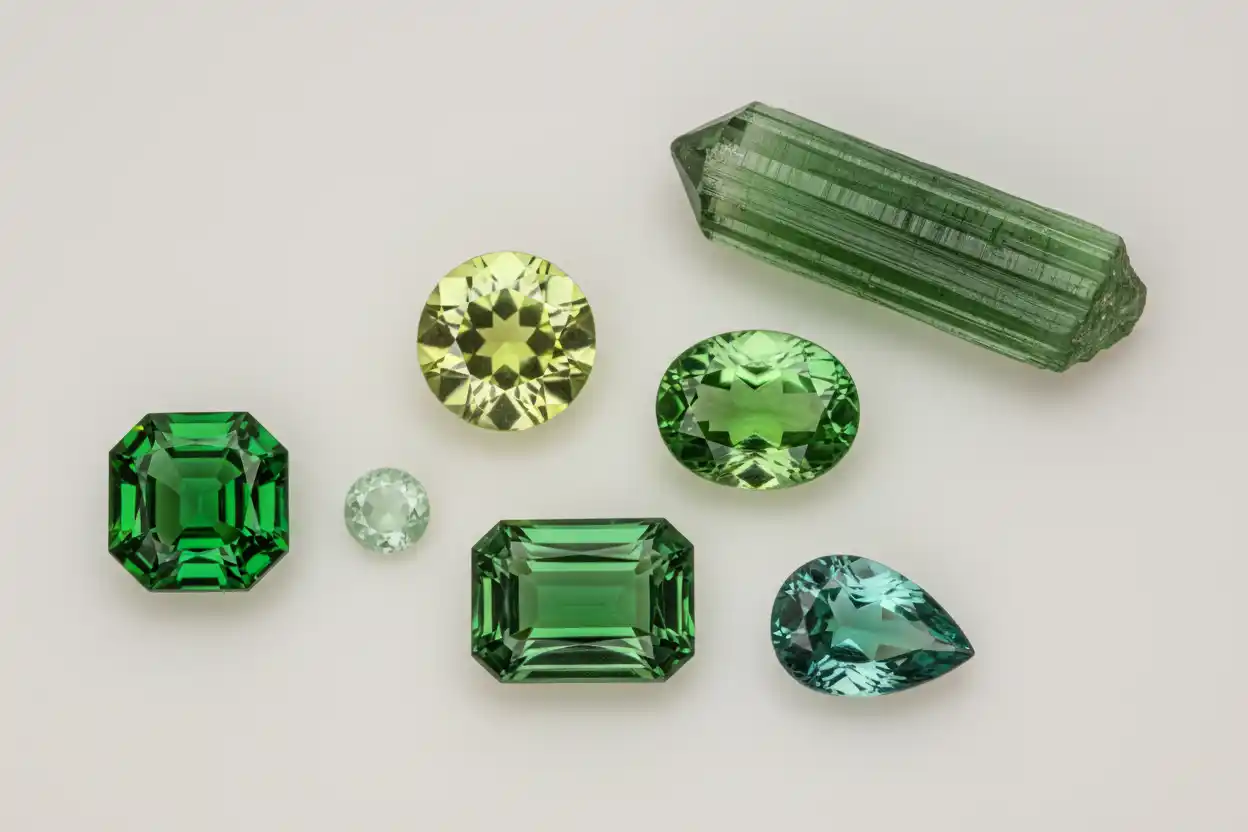
Verdelite is the traditional trade name for green tourmaline, particularly iron-colored green elbaite. Its colors range from pale yellow-green and fresh leaf green to deep forest and bluish green, often with strong pleochroism that makes the stone look lighter from one direction and nearly black from another.
The name does not apply equally to every green member of the tourmaline group. Chrome tourmaline, copper-bearing Paraíba material and green uvite-dominant stones have separate chemical or commercial identities within the wider tourmaline family.
Verdelite at a Glance
| Property | Verdelite |
|---|---|
| Material type | Green tourmaline trade variety, commonly elbaite |
| General composition | Complex borosilicate; chemistry varies within the tourmaline supergroup |
| Principal color cause | Commonly iron, sometimes with titanium-related interactions |
| Typical colors | Yellow-green, grass green, olive, forest green, blue-green and very dark green |
| Crystal system | Trigonal |
| Common habit | Vertically striated prismatic crystals, often with rounded triangular cross-sections |
| Luster | Vitreous |
| Transparency | Transparent to opaque |
| Refractive index | Commonly approximately 1.624–1.644 |
| Birefringence | Commonly approximately 0.018–0.040 |
| Specific gravity | Commonly about 3.00–3.20 |
| Optical character | Uniaxial negative |
| Mohs hardness | 7–7.5 |
| Cleavage | Poor to indistinct |
| Tenacity | Brittle; toughness generally fair |
| Common cuts | Ovals, cushions, emerald cuts, long rectangles, rounds and cabochons |
| Main care concern | Dark pleochroic orientation and liquid-rich fractures can affect appearance and durability |
What Is Verdelite?
Verdelite is a color-based gem-trade name rather than a formally recognized mineral species. It usually refers to green tourmaline whose color comes largely from iron.
Most transparent verdelite used in jewelry belongs to elbaite, a lithium-bearing tourmaline species that also produces pink, red, blue and multicolored gems.
However, the tourmaline group forms broad chemical ranges. A green stone described casually as verdelite may contain elbaite, dravite, uvite or a mixed composition.
The broad classification of these materials belongs to the types of tourmaline guide. This page owns the more specific identity, value, symbolism, wear and care intent for ordinary green verdelite.
What Does the Name Verdelite Mean?
The name derives from words associated with green color. Historical spellings include verdelite, verdelith and verdilite.
Modern English-language trade most commonly uses verdelite or simply green tourmaline. Because the traditional name is unfamiliar to many buyers, reputable sellers often provide both terms.
Verdelite should not be used to make a commercial stone sound like a separate rare species. The mineral report may identify the gem only as natural tourmaline or elbaite.
Verdelite Color Range
Yellow-Green Verdelite
Yellow-green stones can resemble peridot, chrysoberyl or green grossular. Iron-related coloration often creates warm secondary tones.
Fine yellow-green verdelite appears lively rather than muddy. Excessive brown or gray reduces saturation and value.
Grass-Green Verdelite
Medium grass green is one of the most recognizable colors. Stones with moderate tone and good clarity can show strong brilliance without the black extinction that affects darker material.
Forest-Green Verdelite
Forest-green tourmaline may look rich and elegant under strong lighting but nearly black indoors. Orientation and pavilion depth become especially important.
A cutter can improve face-up brightness by directing the lighter pleochroic axis toward the viewer. Poorly oriented rough may retain carat weight but lose visible green.
Bluish-Green Verdelite
Blue-green stones occupy a boundary with indicolite. There is no universally enforced point at which green becomes greenish blue.
Dealers may describe the same gem as teal tourmaline, blue-green tourmaline or verdelite. The actual hue, saturation and laboratory identity matter more than the label.
Olive and Brownish Green
Olive material contains visible yellow or brown components. Attractive stones can be affordable alternatives to highly saturated green gems, although dark or strongly brownish examples receive lower prices.
Cat’s-Eye Green Tourmaline
Parallel hollow growth tubes can create chatoyancy when the stone is cut as a cabochon. The resulting eye is usually broader and softer than the line in fine chrysoberyl.
Cat’s-eye verdelite is a phenomenal variety based on internal structure, not a separate tourmaline species.
Verdelite Versus Chrome Tourmaline
Gem-A uses verdelite for iron-colored green tourmaline. Chrome tourmaline, by contrast, receives its intense green from chromium, vanadium or both.
Many chrome tourmalines belong to mixtures in the dravite–uvite compositional range rather than lithium-rich elbaite.
Fine chrome tourmaline can show an emerald-like saturated green that stays vivid despite its typically small size. Ordinary verdelite often has stronger blue, yellow or gray modifiers and more obvious pleochroism.
A Chelsea filter may produce red or pink reactions in some chromium- and vanadium-bearing tourmalines, but the test is not conclusive. Spectroscopy and chemical analysis provide stronger evidence.
Verdelite Versus Paraíba Tourmaline
Paraíba tourmaline contains copper as an essential coloring element. Its most desired colors include neon blue, greenish blue and vivid turquoise-green.
Some green copper-bearing stones may resemble bright verdelite. However, copper must be established through laboratory chemical analysis before Paraíba terminology is justified.
A phrase such as Paraíba-like green describes appearance but does not establish copper content, origin or market category.
Verdelite normally trades at far lower prices than fine copper-bearing material. Buyers should therefore be cautious when an undocumented green stone receives a Paraíba premium.
Verdelite Versus Other Tourmaline Varieties
Rubellite describes rich red or pinkish-red tourmaline, whereas verdelite covers green colors.
Watermelon tourmaline shows pink or red inner zones surrounded by green. The outer green portion may resemble verdelite, but the complete stone is classified by its multicolored zoning.
Green crystals may also occur beside pink, colorless, blue or yellow zones. Such stones are parti-colored tourmalines rather than pure verdelite.
The broader meanings associated with different hues remain with the tourmaline color meaning guide.
How Verdelite Forms
Most gem verdelite forms in granitic pegmatites during the final stages of magma crystallization.
Boron, lithium, fluorine, water and other elements become concentrated in residual fluids after common rock-forming minerals have crystallized. Those enriched fluids enter cavities and fractures, where tourmaline grows beside quartz, feldspar and mica.
Changing fluid chemistry can produce color zones within a single crystal. Iron-rich stages may create green or blue-green areas, while manganese-rich conditions produce pink or red zones.
Some green tourmaline forms in metamorphic or skarn environments rather than pegmatites. These stones may belong to dravite-uvite compositions and should not automatically receive the verdelite name in strict usage.
Weathering can release durable tourmaline crystals into river gravels. Alluvial rough often becomes rounded, but its internal pleochroism and chemical identity remain unchanged.
Important Sources
Brazil, particularly Minas Gerais, has supplied large quantities of green elbaite. Brazilian material ranges from pale mint to deep forest green and may occur beside pink or blue zones.
Afghanistan and Pakistan produce elongated verdelite crystals from mountainous pegmatites. Fine rough can show excellent clarity, but fractures and dark optical directions are common cutting concerns.
Namibia has produced strong blue-green and forest-green tourmaline. The Erongo and related regions are especially known among collectors.
Madagascar supplies green, teal and multicolored elbaite, including crystals with complex zoning.
Nigeria and Mozambique yield commercial green tourmaline alongside rubellite, indicolite and copper-bearing material. Geographic origin alone does not establish the coloring element.
Maine and California are historically important American sources. Although modern production is limited, fine locality specimens retain collector value.
Inclusions and Internal Features
Tourmaline commonly grows in fluid-rich environments, so liquid inclusions are expected. They may occur as threadlike channels, irregular cavities or partially healed fractures.
Long hollow tubes often run parallel to the crystal’s length. Surface-reaching tubes can collect polishing compound, while dense parallel groups may create a cat’s-eye effect.
Verdelite can also contain mineral crystals such as feldspar, quartz, mica, apatite and zircon. Fine needles or platelets may record specific stages of pegmatite growth.
Color zoning may appear as lighter and darker green bands, blue-green rims or irregular sectors. Zoning can be visible only from certain directions because pleochroism modifies the apparent pattern.
Green tourmaline is generally expected to have better eye-visible clarity than rubellite. Prominent white inclusions, surface-reaching fractures and cloudy tubes therefore reduce value significantly.
Identifying Verdelite
A gemologist confirms tourmaline using refractive index, birefringence, pleochroism, density, absorption spectra and microscopic features.
Strong pleochroism is particularly important. One direction may look yellow-green or medium green, while the direction along the crystal’s length appears deep blue-green or nearly black.
High birefringence can create visible doubling of rear facet edges under magnification. The effect is usually less dramatic than in zircon but remains useful.
Rough crystals often show vertical striations and rounded triangular cross-sections. These features support tourmaline identification but do not establish elbaite chemistry or the verdelite trade category.
The general crystal identification guide explains why color alone cannot separate tourmaline from other green gems.
Verdelite Lookalikes
Emerald
Emerald can overlap verdelite in medium to deep green. Emerald usually has a lower refractive index, different inclusions and weaker pleochroism.
Verdelite generally shows greater durability than heavily fractured emerald, although both materials require inspection for surface-reaching inclusions.
Peridot
Peridot typically has a more yellowish or olive green and strong double refraction. Lily-pad inclusions may support peridot identification.
Tsavorite Garnet
Tsavorite is singly refractive and lacks tourmaline’s strong pleochroism. Fine tsavorite can show a vivid chromium-vanadium green similar to chrome tourmaline.
Chrome Diopside
Chrome diopside is usually softer and has prominent cleavage. Its intense green can become very dark in larger stones.
Prasiolite and Glass
Prasiolite has quartz properties, lower density and much lower refractive index. Green glass may contain rounded bubbles and lacks natural tourmaline growth features.
Treatments and Enhancement
Heat treatment can lighten overly dark green tourmaline or modify color zoning. Depending on chemistry, heating may reduce brown or gray components and make the stone appear brighter.
Treatment results are not equally predictable in every tourmaline. Liquid-rich stones may fracture during heating, making careful rough selection necessary.
Fracture filling with oil, wax or resin occurs less frequently than in emerald but remains possible. Hardened fillers can reduce the visibility of surface-reaching fractures.
Colorless or nearly colorless coatings may improve luster, while colored coatings can create stronger green. Coating is not a standard verdelite treatment, but it must be considered when surface color appears damaged or concentrated at facet junctions.
Irradiation is associated more strongly with pink and red tourmalines than ordinary iron-colored green material. Nonetheless, a complete laboratory report is useful for unusually valuable stones.
Commercial synthetic tourmaline is extremely rare. Glass, synthetic spinel and other simulants are more common than a laboratory-grown chemical counterpart.
Cutting and Polishing
Verdelite crystals commonly grow as long prisms, encouraging cutters to use elongated rectangles, emerald cuts, ovals and cushions.
Orientation is critical because tourmaline absorbs light strongly along certain directions. A dark green crystal can become almost black if the table is placed incorrectly.
Cutters often orient dark rough so the lighter direction faces upward. Pale rough may be oriented differently to deepen the apparent color.
A stone cut too shallowly develops a window through its center. Conversely, excessive pavilion depth may preserve weight while producing extinction.
Open tubes and healed fractures can pit during polishing. Tourmaline otherwise accepts a bright vitreous finish.
Custom cuts can make effective use of unusual crystal dimensions, though nonstandard shapes may require bespoke jewelry settings.
Durability and Jewelry Suitability
Verdelite has a Mohs hardness of 7–7.5, giving it practical resistance to ordinary scratching. Its position appears in the broader gemstone hardness chart.
Despite that hardness, tourmaline remains brittle and has only fair toughness. A sharp impact can chip a girdle, point or elongated corner.
Eye-clean stones work well in rings, earrings, pendants and necklaces. Highly included or cat’s-eye cabochons are better suited to protected designs.
The dedicated tourmaline ring guide covers setting choices. Lower-impact alternatives appear in tourmaline necklaces and tourmaline earrings.
Beaded and cabochon designs are discussed in the tourmaline bracelet guide, although bracelets face more impact than pendants.
Verdelite Prices in 2026
Commercial pale, olive or strongly included green tourmaline may retail for approximately $20–$75 per carat.
Attractive eye-clean stones with medium green color commonly fall around $75–$250 per carat, depending on size, saturation and cutting.
Fine vivid forest-green, bluish-green or evenly saturated stones may range from approximately $250–$600 per carat. Exceptional large, clean verdelite with balanced tone can exceed $600–$1,000 per carat.
Very dark stones, shallow windowed cuts and gems with prominent white inclusions receive substantial discounts.
Chrome tourmaline and copper-bearing Paraíba material belong to different pricing segments and should not be used to inflate ordinary verdelite values. The complete family-wide ranges remain with the tourmaline price guide.
Current individual dealer examples demonstrate the market’s variability: ordinary commercial green stones may sell below $100 per carat, while clean large gems with attractive color can command several hundred dollars per carat.
What Determines Verdelite Value?
Color dominates the evaluation. Medium to medium-dark green generally performs best because it retains saturation without becoming black.
Hue also matters. Fresh green and slightly bluish-green stones often receive more attention than strongly yellowish, brownish or grayish examples.
Clarity standards are relatively strict for green tourmaline. Eye-visible white inclusions and surface-reaching fractures lower value more than comparable inclusions in rubellite.
Cut quality determines whether pleochroism becomes an asset or a problem. A well-oriented gem shows lively color across its face, while a poorly oriented stone contains broad black zones.
Size can add value when color and clarity remain strong. Large verdelite exists, but clean, bright examples become less common as weight increases.
Buying Guidance
First determine what the seller means by green tourmaline. Verdelite, chrome tourmaline and Paraíba are not interchangeable labels.
View the stone under daylight-equivalent and warm indoor light. Rotate it to reveal pleochroism, dark ends and uneven color zoning.
Inspect the girdle and pavilion under magnification. Open tubes, filled fractures and chips can reduce both durability and value.
Compare millimeter dimensions with carat weight. A deep pavilion may increase weight without improving face-up size.
Request a laboratory report for an expensive stone advertised as chrome, Paraíba, unheated or from a prestigious locality. Ordinary verdelite may not require extensive origin testing, but mineral identity and treatment disclosure remain useful.
The tourmaline buying guide retains the complete seller, laboratory and quality-assessment workflow.
Cleaning, Water, Heat and Sunlight
Clean verdelite with lukewarm water, mild soap and a soft brush. Rinse without sudden temperature changes and dry with a lint-free cloth.
The complete procedure appears in how to clean tourmaline jewelry.
Avoid ultrasonic and steam cleaners when inclusions, fractures or treatment status are uncertain. Liquid-filled cavities can expand or fracture under heat and vibration.
Brief water contact is usually acceptable for a sound untreated gem. Prolonged soaking remains unnecessary, particularly for filled stones or glued jewelry.
Most iron-colored green tourmaline is stable in ordinary light. Nevertheless, avoid high heat because it can alter color, disturb fillers and extend fractures.
Store verdelite separately from sapphire, diamond and other harder gems. Protect long corners and points from impacts.
Meaning and Symbolism
Verdelite is commonly associated in modern crystal traditions with growth, patience, creativity, vitality and connection with the natural world.
Some people use green tourmaline as a personal symbol of renewal or as a reminder to approach ambition with balance. These meanings reflect cultural and spiritual interpretation rather than scientifically established mineral effects.
Because verdelite belongs to the wider tourmaline family, its symbolism often overlaps with themes of protection, confidence and emotional expression. Individual traditions may interpret the color differently.
Verdelite also appears among green crystals and can serve as an alternative October birthstone for people who prefer green tourmaline to pink stones or opal.
Frequently Asked Questions
1. Is verdelite the same as green tourmaline?
Verdelite is the traditional trade name for green tourmaline, particularly iron-colored green elbaite. Many sellers now use the simpler term green tourmaline.
2. Is verdelite a separate mineral species?
No. It is a color variety or trade category, not a formally recognized tourmaline species.
3. Is all green tourmaline verdelite?
Not in strict usage. Chromium- or vanadium-colored stones may be sold as chrome tourmaline, while copper-bearing material can belong to the Paraíba category.
4. What causes verdelite’s green color?
Iron is the principal color contributor in ordinary verdelite, sometimes interacting with titanium and other trace elements.
5. How is verdelite different from chrome tourmaline?
Verdelite is generally iron-colored green tourmaline. Chrome tourmaline receives its intense color from chromium, vanadium or both and often has dravite-uvite chemistry.
6. Can verdelite be blue-green?
Yes. Blue-green stones may be called verdelite, teal tourmaline or indicolite depending on which hue dominates and how the seller applies the trade terms.
7. Why does green tourmaline sometimes look black?
Strong pleochroism and light absorption along the crystal’s length can create an extremely dark optical direction. Poor cutting orientation makes the problem more obvious.
8. Is verdelite normally treated?
Many stones are untreated, but heat may lighten dark material. Rare fracture filling, coating or other enhancement should be disclosed.
9. Is verdelite suitable for an everyday ring?
A clean stone in a protective setting can handle regular wear, although impacts can chip its brittle facet edges.
10. Can verdelite go in water?
Brief gentle washing is normally acceptable for sound untreated stones. Avoid soaking filled gems, glued settings or heavily included material.
11. How much does verdelite cost?
Commercial stones may begin near $20–$75 per carat, while fine clean vivid gems commonly range from $250–$600 per carat. Exceptional examples can exceed $1,000 per carat.
12. Does verdelite have scientifically proven healing properties?
No. Green-tourmaline symbolism can have personal or cultural meaning, but scientific evidence does not establish healing effects.
Verdelite offers a broad green palette without the treatment dependence of many colored gems, yet its trade name must be used carefully. The strongest purchases combine verified natural tourmaline, balanced pleochroic orientation, good clarity and a green that remains attractive beyond bright showroom lighting.
Verdelite appears in Crystals That Start With V and Gemstones That Start With V.