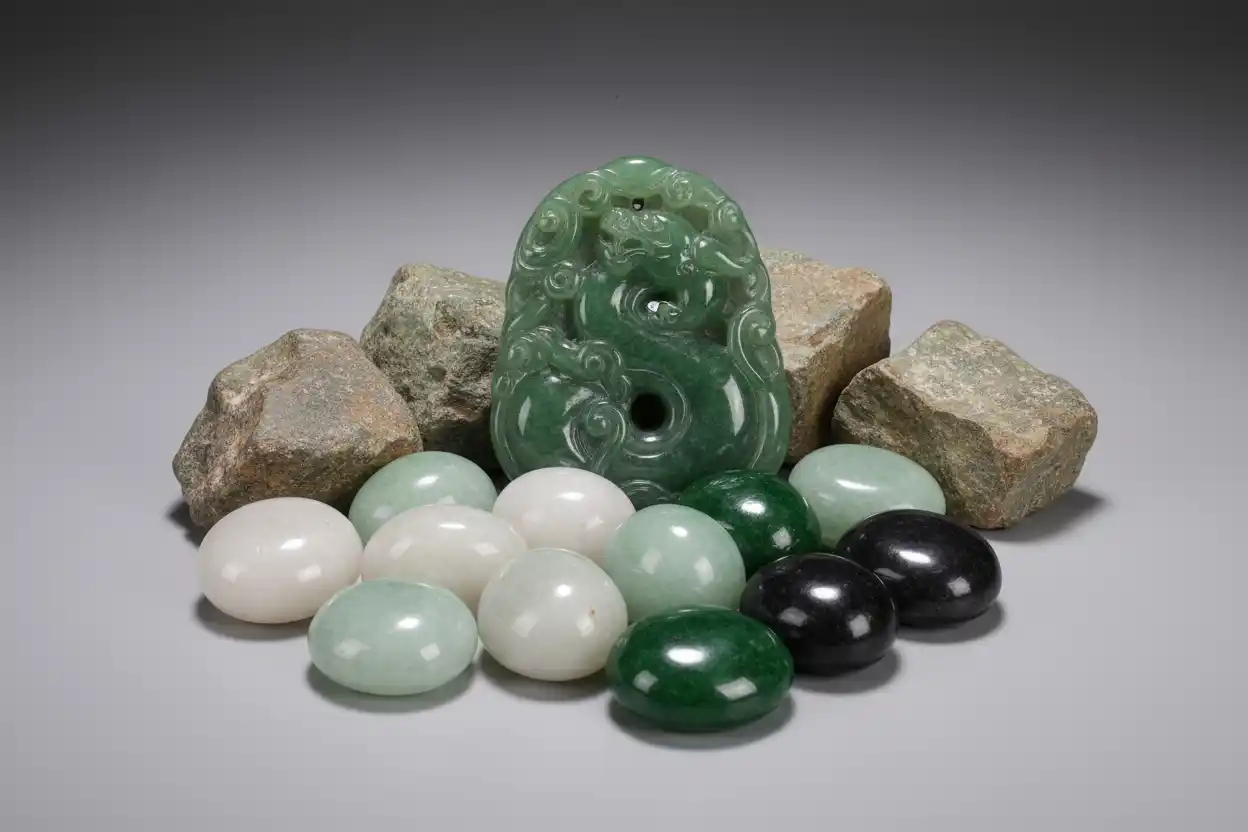
Nephrite Meaning, Properties, Identification & Value
Nephrite is one of the two distinct natural materials properly called jade. It consists mainly of densely interlocked microscopic amphibole fibers from the tremolite-actinolite series, producing a smooth polish and exceptional resistance to breaking.
Its colors range from creamy white and pale celadon to yellow-green, spinach green, brown, gray, and nearly black. Although nephrite is slightly softer than quartz, its felted internal texture makes it one of the toughest ornamental stones used for carving, tools, bangles, and jewelry.
Nephrite at a Glance
| Property | Nephrite |
|---|---|
| Material type | Essentially monomineralic metamorphic or metasomatic rock and one of the two true jades |
| Main composition | Dense microcrystalline to cryptocrystalline tremolite-actinolite amphibole aggregate |
| General formula | Ca₂(Mg,Fe)₅Si₈O₂₂(OH)₂, with variable magnesium and iron |
| Common colors | White, cream, celadon, yellow, pale green, apple green, spinach green, gray-green, brown, gray, and black |
| Crystal system | No single system applies to the rock aggregate; constituent amphiboles are monoclinic |
| Texture | Felted, fibrous, interlocking, compact, fine-grained, and commonly mottled |
| Luster | Waxy, greasy, vitreous, or silky after polishing |
| Transparency | Translucent at thin edges to opaque |
| Mohs hardness | Approximately 6–6.5 |
| Cleavage | Not normally visible in the compact aggregate |
| Tenacity | Exceptionally tough |
| Fracture | Splintery, fibrous, or uneven |
| Common uses | Carvings, bangles, beads, cabochons, pendants, rings, tools, seals, inlay, and ceremonial objects |
| Main care concern | Misidentification, dye or impregnation, surface scratches, hidden fractures, impact, and amphibole-bearing lapidary dust |
One of the Two Materials Called Jade
The word jade correctly refers to two geologically unrelated materials: nephrite and jadeite-rich jade.
Nephrite consists mainly of tremolite-actinolite amphiboles. Jadeite belongs to the pyroxene group and has different chemistry, density, refractive index, texture, and color possibilities.
Both materials can develop dense interlocking structures suitable for carving. That shared performance and cultural use explain why they retained one historical gem name despite their mineralogical differences.
The parent jade guide owns the broader cultural identity and symbolism of jade. The present article focuses specifically on nephrite’s composition, formation, appearance, durability, and market.
A complete side-by-side separation appears in jadeite versus nephrite, which should own detailed comparative search intent rather than being repeated here.
Nephrite Is Better Described as a Rock
Older gem references often call nephrite a compact variety of tremolite or actinolite. Modern mineralogical descriptions are more precise: nephrite is an essentially monomineralic rock made from densely felted amphibole crystals.
That distinction matters because a polished nephrite object does not behave like one large tremolite crystal. Millions of microscopic fibers interlock across the material.
The fibers usually fall within the tremolite-actinolite compositional series. Magnesium-rich pale material lies closer to tremolite, while increasing iron shifts the composition toward actinolite and commonly deepens the green color.
Other minerals may occur in small amounts. Diopside, chromite, magnetite, graphite, chlorite, serpentine minerals, talc, carbonate, and iron oxides can influence color, pattern, density, and polish.
Consequently, nephrite has a general amphibole composition but not one perfectly fixed formula for every piece.
Why Nephrite Is So Tough
Tremolite and actinolite crystals can form slender fibers. In nephrite, those microscopic fibers twist, interlock, overlap, and bind into a dense felted texture.
A crack cannot travel easily in a straight line through this network. Instead, it must turn, divide, pull fibers apart, or consume additional energy.
This structure gives nephrite extraordinary toughness despite a Mohs hardness of only about 6–6.5. Hardness measures resistance to scratching, not resistance to impact.
The distinction explains why ancient and historic communities used nephrite for axe heads, blades, tools, ornaments, and carvings. The material could endure repeated shock better than many harder but more brittle stones.
The gemstone hardness chart places nephrite below quartz in scratch resistance, while gemstone toughness versus hardness explains its exceptional structural performance.
How Nephrite Forms
Geologists recognize two broad formation environments, although individual deposits can be complex.
Serpentinite-related nephrite develops where altered ultramafic rock interacts with calcium- and silica-bearing fluids near contacts with more silica-rich rocks. These deposits commonly produce green nephrite.
Dolomite-related nephrite forms when silicic fluids replace magnesium-rich carbonate rock. Such deposits can produce pale green, cream, and highly valued white nephrite.
Both processes are metasomatic. Fluids introduce and remove chemical components while new amphibole grows within the original rock.
Deformation often accompanies formation. Shearing and repeated recrystallization help create the densely interlocked texture that distinguishes high-quality nephrite from ordinary coarse tremolite rock.
Iron, chromium, graphite, magnetite, and other components influence color. Grain size, fiber orientation, porosity, and inclusions affect translucency and polish.
Color Causes and Recognized Descriptions
Pure magnesium-rich tremolite is colorless or white. Pale cream, ivory, and white nephrite therefore contain relatively little iron.
Iron entering the amphibole structure produces green, yellow-green, gray-green, brownish-green, and dark spinach tones. Increasing iron does not produce one perfectly predictable color because inclusions and oxidation also contribute.
Chromium-bearing minerals may strengthen green coloration in some deposits. Magnetite and graphite can create gray, dark green, or black nephrite.
Brown and yellow weathering skins can form around river pebbles or boulders. In the Hetian market, naturally weathered outer surfaces may contribute artistic or collector interest.
“Mutton fat” describes exceptionally fine, warm white-to-cream nephrite with an oily luster and dense texture. The term is a quality and appearance description rather than a separate mineral species.
“Spinach jade” refers to dark green nephrite with black or darker inclusions resembling spinach leaves. “Black jade” may be nephrite, jadeite, omphacite-rich material, serpentine, or another dark stone, so the color name alone does not prove identity.
The broader commercial palette is covered in the jade color guide, while types of jade distinguishes mineral identity from color and trade terminology.
Major Nephrite Sources
The Hetian region of Xinjiang, China, is historically famous for pale green, white, yellowish, and river-worn nephrite associated with the Kunlun Mountains. Fine white material has held exceptional cultural and artistic importance.
British Columbia, Canada, is one of the world’s leading modern sources of green nephrite. Large boulders and blocks supply carving, jewelry, architectural objects, and export markets.
Siberian and other Russian deposits produce vivid green, dark green, white, gray-green, and patterned nephrite. Fine translucent green material can command strong demand.
New Zealand contains culturally significant pounamu. The term has specific Māori cultural meaning and may include nephrite as well as certain other treasured greenstones. Responsible sellers should respect its legal, geographic, and cultural context rather than treating pounamu as a generic marketing synonym.
Taiwan supplied nephrite for prehistoric and historic exchange networks across parts of Southeast Asia. Taiwanese material often appears green to dark green.
Wyoming, Alaska, California, Washington, Pakistan, Afghanistan, Kazakhstan, Poland, South Korea, and several other regions also produce nephrite or nephrite-like amphibole rocks.
Locality should be supported by documentation. Color alone cannot prove Canadian, Siberian, Hetian, Taiwanese, or New Zealand origin.
Identifying Nephrite
Nephrite commonly shows a waxy or greasy polish rather than the glassier appearance of many jadeites. Thin edges may transmit light even when the main body looks opaque.
Its texture is extremely fine. Individual amphibole fibers usually require magnification or analytical methods rather than unaided vision.
Specific gravity generally falls around 2.9–3.1, lower than most jadeite-rich jade. Refractive index is also lower, usually near the low 1.60 range.
A polished surface resists steel better than calcite or serpentine but can be scratched by quartz. Destructive tests are inappropriate for finished objects.
Nephrite commonly produces a splintery or fibrous fracture on rough broken surfaces. However, buyers should not damage a piece to look for this feature.
A dull bell-like sound from a bangle is not a reliable identification test. Thickness, shape, cracks, treatment, and suspension method all affect sound.
Professional laboratories use refractive index, specific gravity, microscopy, infrared spectroscopy, Raman spectroscopy, X-ray diffraction, and chemical analysis.
The dedicated real-versus-fake jade guide owns detailed home observations and laboratory distinctions.
Nephrite and Jadeite
Jadeite-rich jade is generally denser and slightly harder. It also occurs in a broader range of vivid colors, including intense emerald green, lavender, orange, red, black, and near-colorless material.
Nephrite usually has a softer waxy appearance and a visibly fibrous or felted microscopic structure. Its greens often range from celadon and olive to spinach and deep forest tones.
Jadeite can achieve exceptionally high translucency and vivid chromium-green color. Nephrite’s most prized appearance often emphasizes fine texture, oily luster, evenness, and subtle white or green tones.
Neither material is inherently “fake jade.” Both are true jade, and each has independent cultural, artistic, and market traditions.
The name “imperial jade” is most properly associated with top-quality vivid green jadeite, not ordinary dark green nephrite. Sellers sometimes misuse the term to elevate lower-priced material.
Nephrite and Common Imitations
Serpentine is one of the most common nephrite substitutes. It can show a waxy green appearance but is generally softer and may have different density, texture, and polish.
Green aventurine is quartz containing reflective mineral inclusions. It is harder and often shows glittering aventurescence. The dedicated aventurine-versus-jade comparison explains the distinction.
Dyed quartzite, marble, soapstone, calcite, glass, plastic, bowenite, hydrogrossular garnet, prehnite, and other green stones may also be sold as jade.
White marble, quartzite, and magnesite can imitate pale nephrite. Black serpentine and other dense dark rocks may be promoted as black nephrite.
Visual testing cannot resolve every case because fine-grained natural materials overlap. A professional report is worthwhile for expensive white, highly translucent, or named-origin nephrite.
Treatments and Disclosure
Waxing is common after polishing. A thin wax layer fills microscopic surface irregularities and strengthens luster without deeply changing the stone.
Dye can intensify green, black, lavender, red, or other colors. It may concentrate along fractures, pores, grain boundaries, and drill holes.
Polymer impregnation can fill fractures or porous areas, improve translucency, and strengthen weak material. Coatings may also change gloss or color.
Bleaching and impregnation are strongly associated with jadeite treatment markets, but nephrite can also be altered. Sellers should describe the actual treatment rather than applying jadeite terminology automatically.
The familiar Type A, B, and C jade categories are used principally for jadeite in commercial disclosure. They should not be transferred carelessly to every nephrite product without explanation.
Heat treatment is not a routine method for improving fine nephrite. Strong heat can instead alter color, create cracks, or damage wax and polymer.
Detailed treatment identification belongs on the treated-jade guide.
Jewelry and Carving Suitability
Nephrite’s toughness makes it excellent for bangles, beads, pendants, rings, earrings, carvings, seals, and objects handled regularly.
A solid nephrite bangle can survive impacts that would break many brittle gemstones. Nevertheless, a hard fall on stone or tile can still cause a crack.
Thin carved sections, openwork, sharp corners, and drill holes remain vulnerable. Toughness does not eliminate all structural risk.
Nephrite rings tolerate wear well, although their surfaces can scratch against quartz, topaz, sapphire, and diamond. Low-profile designs reduce impact.
Bangles must fit correctly. Forcing a bangle over the hand can strain both the jewelry and the wearer. Detailed sizing and construction belong on the jade bracelet guide.
Mounted rings require secure metalwork and enough jade thickness around the setting. The jade ring guide covers design and wear decisions without duplicating nephrite mineralogy.
Nephrite is particularly suitable for carving because its fibers hold fine details while resisting breakage. However, internal dark spots, healed fractures, and changing grain direction still influence the carver’s design.
Current Nephrite Asking Prices
Nephrite occupies an unusually broad market, from inexpensive commercial beads to museum-level carvings and fine Hetian material.
| Nephrite product | Broad retail asking range |
|---|---|
| Small tumbled stone or common cabochon | About $5–$40 |
| Fine cabochon or matched pair | About $30–$300 |
| Common bead strand | About $15–$100 |
| Better-quality Canadian, Siberian, or white-nephrite strand | About $75–$500 or more |
| Simple carved pendant | About $20–$200 |
| Fine hand-carved pendant | About $200–$2,000 or more |
| Commercial nephrite bangle | About $50–$500 |
| Fine translucent or documented bangle | About $500–$5,000 or more |
| Small carving or display object | About $50–$1,000 |
| Fine white, historic, artist-signed, or important carving | From thousands to substantially more |
These figures represent broad July 2026 retail asking prices rather than appraisals or resale guarantees.
A dedicated jade price guide should own current market segmentation and detailed value comparisons between nephrite, jadeite, origin claims, treatment, and finished objects.
What Gives Nephrite Value?
Texture is central. Fine, tightly felted material accepts a smoother polish and feels more cohesive than coarse, granular, or weak nephrite.
Translucency generally raises value, especially when light penetrates evenly rather than revealing cloudy fractures.
Color preferences vary by market. Fine warm white, even celadon, vivid green, and rich spinach tones can all command demand when texture and polish are strong.
Uniformity matters for plain bangles and beads. Conversely, natural black spots, russet skin, veining, and color transitions can add value when an experienced carver uses them deliberately.
Size affects carving potential. A large fracture-free block provides more artistic options than smaller rough, although large size cannot compensate for poor texture.
Treatment status must be disclosed. Untreated or traditionally waxed material generally carries more collector confidence than heavily dyed or polymer-filled stone.
Provenance can add importance, particularly for documented Hetian, British Columbia, Siberian, Taiwanese, New Zealand, Wyoming, or historic collection material.
Craftsmanship may dominate finished value. A masterfully designed carving can be worth far more than the raw nephrite used to make it.
Buying Nephrite
First confirm that the seller identifies the material as nephrite rather than merely “jade.” The invoice should distinguish nephrite from jadeite.
Ask about color treatment, polymer, fracture filling, coating, wax, assembly, and repair. “Natural jade” does not necessarily answer those questions.
Inspect the stone in diffuse daylight and direct light. Diffuse lighting shows overall color, while transmitted light can reveal texture, cracks, dye, and variable translucency.
Check drilled holes, carved recesses, and thin edges for concentrated color. Dye and polymer often become easier to see in these areas.
Named-origin nephrite deserves documentation. A color description alone cannot prove Hetian, Canadian, Siberian, Taiwanese, or New Zealand source.
Avoid paying for terms such as imperial nephrite or Grade A nephrite unless the seller defines the terminology and supports the quality claim.
Detailed transaction checks, reports, origin claims, and seller policies belong on the jade buying guide.
Nephrite appears in the crystals beginning with N directory and the gemstones beginning with N directory.
Cleaning and Storage
Wipe nephrite after wear with a soft cloth. Skin oils can enrich its surface appearance temporarily but may also trap dust.
For routine cleaning, use lukewarm water, mild soap, and a soft brush. Rinse briefly and dry thoroughly.
Avoid prolonged soaking when the item contains dye, polymer, glue, backing, string, or a repaired fracture.
Do not use bleach, acids, harsh detergents, abrasive paste, or household descalers. These products can damage treatment, metal settings, and surface polish.
Ultrasonic cleaning may be safe for some untreated solid nephrite, but it is unnecessary and unsuitable when treatment, fractures, repairs, or mixed materials are present.
Steam can damage wax, polymer, adhesive, and hidden weaknesses. Gentle hand cleaning is safer.
Store nephrite away from harder stones that can scratch it. Wrap carved pieces separately so projecting details do not strike each other.
Setting-specific instructions appear in how to clean jade jewelry.
Nephrite Meaning and Symbolism
Nephrite has carried cultural meaning across many regions and time periods, including China, Central Asia, New Zealand, Taiwan, Europe, and the Americas.
Its toughness and smooth polish have supported associations with endurance, integrity, protection, skill, status, remembrance, and continuity.
Chinese traditions developed especially extensive jade symbolism involving virtue, refinement, ritual, scholarship, and social responsibility. Those traditions are historically and culturally specific rather than generic metaphysical properties transferable without context.
Māori relationships with pounamu involve genealogy, place, authority, responsibility, and living cultural practice. Commercial descriptions should respect those meanings rather than reducing them to a universal crystal-healing slogan.
Modern crystal practice often links green nephrite with balance, prosperity, calm decision-making, and steady growth. White nephrite receives distinct color symbolism described on the white jade guide.
These meanings remain cultural, historical, spiritual, or personal interpretations. Scientific evidence does not show that nephrite cures illness, guarantees wealth, or produces specific emotional outcomes.
Frequently Asked Questions
Is nephrite a mineral or a rock?
Nephrite is best classified as an essentially monomineralic rock composed mainly of densely interlocked tremolite-actinolite amphibole fibers.
Is nephrite genuine jade?
Yes. Nephrite and jadeite-rich jade are the two distinct natural materials properly called jade.
How does nephrite differ from jadeite?
Nephrite is an amphibole aggregate with exceptional felted toughness and lower density. Jadeite-rich jade is a pyroxene rock that can show brighter colors and higher translucency.
What causes green nephrite?
Iron within the tremolite-actinolite series creates much of the green color. Chromium-bearing minerals and other inclusions may also influence hue.
What is mutton-fat nephrite?
It is a high-quality appearance category for fine, warm white-to-cream nephrite with dense texture and an oily luster, not a separate mineral species.
How does nephrite form?
It forms through metasomatic reactions in serpentinite-related environments or through replacement of dolomitic rocks by silica-bearing fluids.
Where does high-quality nephrite come from?
Important sources include Xinjiang, British Columbia, Siberia, New Zealand, Taiwan, Wyoming, Alaska, Pakistan, and several other regions.
Why is nephrite tougher than many harder stones?
Its microscopic amphibole fibers interlock in a dense felted network that diverts cracks and absorbs impact energy.
Is nephrite commonly treated?
Waxing is common, while dye, polymer impregnation, filling, coating, and repair can also occur.
What stones are commonly sold as nephrite?
Serpentine, quartzite, aventurine, marble, soapstone, calcite, glass, plastic, and several other green or white materials may be mislabeled as jade.
Can nephrite be worn every day?
Yes. It is one of the toughest ornamental stones, although its surface can scratch and thin carved areas can still break.
What is the safest way to clean nephrite?
Use lukewarm water, mild soap, and a soft cloth or brush. Avoid harsh chemicals, steam, and prolonged soaking when treatment or repair is possible.
Nephrite’s toughness explains why artisans have shaped it into both practical tools and intricate sculpture for millennia. Its cutting behavior and suitability for detailed work can be compared with other resilient ornamental materials in the guide to gemstones for carving.
Nephrite is a dense non-asbestiform rock, but its constituent tremolite-actinolite minerals belong to the amphibole group. Cutting, drilling, sanding, or crushing can release hazardous fine mineral dust. Use professional wet-working methods, effective extraction, eye protection, and suitable respiratory protection; do not ingest the material or use it in drinking-water preparations.