Serpentine: Meaning, Properties & Symbolism
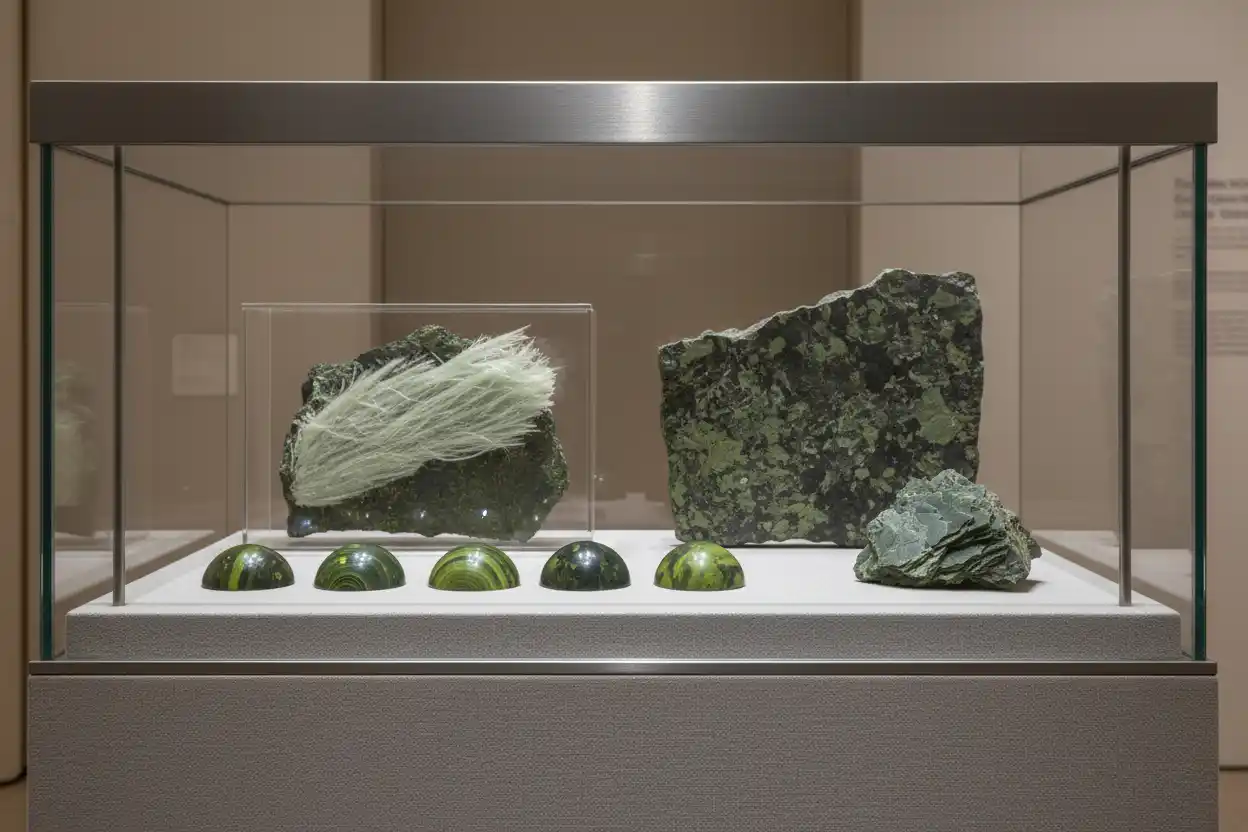
Serpentine is the collective name for a subgroup of hydrated magnesium silicate minerals, chiefly lizardite, antigorite, and chrysotile. These minerals commonly form when water alters magnesium-rich ultramafic rocks, producing green, yellow, brown, black, or pale compact material that may be carved, polished, or mistaken for jade.
Serpentine must be discussed as a mineral group rather than one uniform gemstone. Its hardness, texture, toughness, composition, and safety considerations vary substantially between dense antigorite-rich carving material and fibrous chrysotile-bearing rock.
Serpentine at a Glance
| Property | Serpentine |
|---|---|
| Composition | Approximately Mg₃Si₂O₅(OH)₄, with iron, nickel, aluminum, chromium, and other substitutions |
| Group or type | Serpentine subgroup of hydrated sheet silicates |
| Color | Green, yellow-green, olive, cream, white, brown, grey, black, mottled or veined |
| Crystal system or texture | Varies by species; commonly massive, platy, fibrous, lamellar, or cryptocrystalline |
| Habit | Massive, compact, foliated, platy, fibrous, vein-filling, pseudomorphic |
| Luster | Waxy, greasy, silky, pearly, or dull |
| Transparency | Translucent to opaque |
| Mohs hardness | Approximately 2.5–5.5, depending on species and aggregate |
| Cleavage | Perfect basal cleavage in individual minerals; often indistinct in compact aggregates |
| Tenacity | Brittle, flexible, splintery, or tough in compact interlocking material |
| Common uses | Carvings, cabochons, beads, architectural stone, decorative objects, mineral specimens |
| Primary care concern | Scratching, acid sensitivity, heat, variable composition, treatments, and fibrous chrysotile dust |
What Is Serpentine?
Serpentine is not one mineral species. It is a subgroup containing several minerals with similar magnesium silicate chemistry but different arrangements of their layered structures.
The three most common species are:
- Lizardite: usually fine-grained, platy, or massive and volumetrically the most abundant serpentine mineral
- Antigorite: commonly develops corrugated layers and can form tough, compact carving material
- Chrysotile: has rolled or cylindrical layers and may form flexible fibers, including the commercial asbestos variety
Other serpentine-group species exist, but these three dominate most geological and gemological discussions.
The term is also used loosely for rocks made largely of serpentine minerals. More precisely, such a rock is called serpentinite.
Serpentine appears within the wider guide to types of gemstones when compact material is polished or carved. It also belongs in crystals that start with S and gemstones that start with S.
Serpentine Minerals Versus Serpentinite
Serpentine refers to the mineral subgroup. Serpentinite is a metamorphic rock composed predominantly of one or more serpentine minerals, usually with magnetite, brucite, talc, carbonates, chromite, or surviving fragments of the original ultramafic minerals.
A polished cabochon sold as serpentine may therefore be:
- Predominantly antigorite
- Predominantly lizardite
- A mixture of several serpentine minerals
- Serpentinite containing multiple accessory minerals
- A trade-named ornamental rock with uncertain composition
The distinction matters because properties measured for one pure mineral may not describe a mixed rock accurately.
A seller who simply states “natural serpentine” has identified a broad material family, not necessarily the exact species.
Composition and Layer Structures
The approximate formula Mg₃Si₂O₅(OH)₄ represents magnesium-rich serpentine. Iron, nickel, aluminum, chromium, manganese, and other elements can replace part of the magnesium or silicon.
Each common species contains linked silica tetrahedral sheets and magnesium-rich octahedral sheets. The mismatch between those layers produces different structures.
Lizardite maintains relatively flat layers. Chrysotile accommodates the mismatch by curling the layers into cylinders, creating fibers. Antigorite develops a wave-like or corrugated arrangement.
These structural differences influence habit, stability, mechanical behavior, and the way each mineral forms.
Individual specimens may contain more than one species. Gem-quality material from some deposits includes lizardite, antigorite, and chrysotile intergrown with calcite, dolomite, quartz, chlorite, brucite, magnetite, or other minerals.
How Serpentine Forms
Serpentine minerals form primarily through serpentinization, a process in which water reacts with olivine- and pyroxene-rich ultramafic rocks.
The original rock may come from the Earth’s mantle and contain peridotite, dunite, or related material. When fractures allow water to enter, chemical reactions convert olivine and pyroxene into serpentine minerals, magnetite, brucite, and other products.
These reactions change the rock’s volume, density, strength, chemistry, and magnetic properties. They can also generate hydrogen and influence deep microbial ecosystems.
Lizardite and chrysotile generally form under lower-temperature conditions. Antigorite becomes stable at higher metamorphic temperatures and pressures.
Chrysotile commonly fills later fractures that cut earlier serpentinite. Antigorite may replace lower-temperature phases as metamorphic grade increases.
Serpentinization occurs in oceanic crust, subduction zones, mountain belts, ophiolites, and altered ultramafic complexes. It plays an important role in tectonics, fluid movement, and element cycling.
Serpentine Colors and Their Causes
Green is the best-known color, ranging from pale apple and yellow-green to deep olive and nearly black.
Iron commonly darkens the material or shifts green toward olive and brown. Nickel may contribute brighter green in some compositions, while chromium can intensify green locally.
Magnetite and chromite create black grains, spots, and veins. Calcite, magnesite, brucite, or pale serpentine can form white or cream markings.
Weathering may produce brown, orange, or rusty coatings. Surface wax and oil can deepen color, while resin impregnation may increase translucency.
Serpentine fits naturally into green crystals and green gemstones, yet a green color label cannot identify the species or rule out treatment.
Main Gem and Ornamental Varieties
Compact antigorite-rich material is frequently used for carving because its interlocking structure can be tougher than platy or fibrous forms.
Bowenite is a traditional ornamental name generally applied to tough, translucent, fine-grained antigorite. It may be pale green, yellow-green, or bluish green.
Williamsite usually refers to translucent oil-green serpentine, often antigorite-rich, containing dark magnetite or chromite inclusions.
Noble serpentine is a broad trade term for translucent, fine-textured ornamental material. It does not identify one universally agreed composition.
“Serpentine jade” describes serpentine used as a jade substitute. It is a trade name, not evidence that the stone is jadeite or nephrite.
“Infinite Stone” is another retail name sometimes applied to green serpentine or mixed serpentine-bearing material. The name does not establish a mineral species, deposit, or treatment status; the underlying material should be verified before purchase.
The dedicated lizardite guide owns species-specific discussion of that common serpentine mineral.
Important Localities
Serpentine minerals occur worldwide wherever ultramafic rocks have undergone hydration and metamorphism.
Italy’s Val Malenco is known for carved and polished serpentine associated with Alpine metamorphic rocks. Investigated gem material from the region contains mixtures of lizardite, antigorite, and chrysotile with carbonate and silicate minerals.
China, Afghanistan, Pakistan, Russia, South Korea, India, Zimbabwe, South Africa, Canada, New Zealand, the United Kingdom, and the United States all produce ornamental or specimen material.
California, Vermont, Pennsylvania, Maryland, and other US regions contain serpentinite belts. Some localities also contain naturally occurring asbestos, making disturbance and lapidary work a safety concern.
A country name does not identify the exact species. Reliable locality information should include the mine, quarry, district, or geological unit when provenance affects value.
Serpentine and Jade
Serpentine has been used as a jade substitute for centuries because compact green material can accept a smooth waxy polish.
True jade refers principally to jadeite or nephrite. Serpentine belongs to a different mineral group and has different physical properties.
Jadeite is a pyroxene mineral with substantially greater hardness. Fine jadeite can also achieve vivid green color and high translucency that serpentine rarely matches.
Nephrite is an exceptionally tough aggregate of amphibole fibers. Although its hardness is only moderately higher, its resistance to fracture greatly exceeds that of most serpentine.
The jadeite vs nephrite comparison explains the two accepted jade minerals. Serpentine should not be inserted as a third jade species.
Trade names such as new jade, Korean jade, Soochow jade, olive jade, or serpentine jade may refer to serpentine. Buyers should ask for the mineral identity rather than rely on the word jade.
How to Identify Serpentine
Identification starts with color, waxy or greasy luster, relatively low hardness, density, texture, and geological association.
Many compact serpentines have a specific gravity around 2.5–2.7 and refractive indices near the mid-1.50s. Mixed material varies according to accessory minerals.
A steel blade may scratch softer serpentine, while quartz scratches it readily. Destructive tests should not be used on finished carvings or polished stones.
Under magnification, compact material may show mottled green areas, white carbonate veins, black magnetite grains, fibrous structures, platy texture, or polishing undercut.
A magnet can respond when magnetite is abundant, but nonmagnetic serpentine is also common.
Raman spectroscopy and X-ray diffraction can distinguish lizardite, antigorite, chrysotile, and associated minerals. Microscopy or electron analysis may be needed when fibrous material raises a safety concern.
The how to identify crystals guide explains why appearance alone cannot separate serpentine from jade, soapstone, calcite, dyed marble, or other green rocks.
Common Lookalikes
Jadeite and nephrite are the most commercially important lookalikes. Serpentine is generally softer and less tough, although visual separation can remain difficult in carved objects.
Soapstone may share a greasy luster but is usually softer because it contains abundant talc.
Green calcite can resemble pale translucent serpentine. Calcite has perfect rhombohedral cleavage and reacts strongly with acid.
Prehnite, chrysoprase, green chalcedony, aventurine, and variscite can overlap in color. Their hardness, structure, luster, and optical properties differ.
Dyed marble and carbonate rock may be sold under serpentine-related trade names. Bubbles, resin-rich areas, concentrated dye, or acid sensitivity may help expose the substitution.
The broader real vs fake jade guide is relevant because serpentine is frequently encountered during jade authentication.
Treatments and Stabilization
Waxing and oiling are common ways to deepen serpentine’s color and improve surface luster. A light wax may be traditional finishing rather than deceptive treatment, but disclosure remains preferable.
Resin or polymer impregnation can strengthen porous, fractured, or soft material. It may also produce an unnaturally glossy surface and collect inside cavities.
Dye is used to imitate more saturated jade-like green. Color may concentrate in cracks, drill holes, porous zones, or around pale veins.
Bleaching, coating, fracture filling, backing, and assembly are also possible. Repairs can be concealed in large carvings or decorative objects.
The treatment methods discussed in treated jade are not automatically transferable to every serpentine piece, but they illustrate why green carvings need careful disclosure.
For general terminology, consult gemstone treatments explained.
Synthetic Serpentine and Imitations
Synthetic serpentine-group minerals can be produced for research and industrial study, but laboratory-grown serpentine is not a significant jewelry market.
Imitations are more common. Dyed calcite, marble, quartzite, glass, resin, pressed powder, and reconstructed stone may copy its green appearance.
A resin imitation may feel light, show bubbles, develop a plastic odor under inappropriate hot-point testing, or display mold seams. Hot-point testing should not be performed because it is destructive and can release fumes.
Pressed composites may contain genuine serpentine fragments bound with polymer. Such material should be described as reconstructed or composite rather than solid natural stone.
The differences among synthetic, imitation, and assembled products are explained in lab-grown vs natural gemstones.
Cutting and Carving Behavior
Dense antigorite-rich material can carve well and accept a smooth waxy polish. Its interlocking texture gives it more practical toughness than platy or fibrous material.
Mixed serpentinite can behave unpredictably. Soft serpentine may undercut beside harder quartz, magnetite, chromite, or carbonate veins.
Hidden fractures can open during sawing. Porous material may require stabilization before carving or polishing.
Heat from dry grinding can discolor treatments, dehydrate associated minerals, or contribute to fracture. Wet methods also suppress dust, although water alone is not adequate protection when asbestiform fibers may be present.
Unknown rough should never be casually drilled or ground. Mineral identification and an assessment of fibrous content need to come first.
Cabochons are usually cut with rounded edges and moderate domes. Sharp points and thin sections are more likely to chip.
Durability and Jewelry Suitability
Serpentine durability varies widely. Soft, platy material may have hardness near 2.5, while compact antigorite-rich aggregates can reach approximately 5–5.5.
Most commercial cabochons scratch more easily than quartz. Household dust, metal findings, and neighboring beads can dull the polish.
Pendants, earrings, brooches, beads, and carvings are generally more practical than rings. Protective bezels improve ring durability, though daily wear still produces abrasion.
Acids can attack carbonate-bearing material and some associated minerals. Strong heat may affect wax, resin, glue, or the mineral aggregate.
A jeweler should know whether the piece is solid, treated, reconstructed, backed, or potentially fibrous before repair.
Serpentine Value and July 2026 Asking Prices
Ordinary serpentine is generally affordable. Value depends on translucency, color, pattern, toughness, cut, carving quality, locality, treatment, and whether the material has been misrepresented as jade.
As of July 2026, small polished stones and commercial cabochons commonly carry asking prices around $5–$30 each. Dealer examples of larger cabochons often fall near $1–$5 per carat, although sellers frequently price by the piece.
Attractive translucent cabochons, matched pairs, and larger designer cuts may ask approximately $25–$100. Bead strands, carvings, spheres, and decorative objects often range from $20 to $250.
Large sculptures, historically important carvings, unusual locality material, or exceptional workmanship may exceed $250, but the value usually comes from artistry and provenance rather than raw serpentine rarity.
A serpentine carving should not receive jadeite or fine nephrite pricing merely because a trade name includes “jade.” The how gemstone prices work guide explains why material identity must be established before comparing prices.
Buying Serpentine
Ask for the mineral name, trade name, origin, treatments, and whether the product is solid, stabilized, dyed, reconstructed, or assembled.
When the seller uses “jade,” request clarification: jadeite, nephrite, or serpentine? A vague answer should prevent a jade-level purchase.
Inspect drill holes and carved recesses for concentrated dye, resin, powder, or glue. Backlighting can reveal uneven translucency and hidden fractures.
For rough specimens, ask whether fibrous chrysotile or other asbestiform material has been identified. Avoid sellers who encourage grinding unknown fibrous pieces without safety controls.
The general transaction checks in how to buy gemstones online help evaluate return policies, photographs, measurements, and unsupported grade claims.
Cleaning and Storage
Wipe polished serpentine with a soft damp cloth and a small amount of mild soap. Dry it promptly.
Avoid acids, vinegar, lemon juice, bleach, strong solvents, abrasive pastes, and harsh jewelry cleaners. Mixed carbonate veins or surface treatments may react.
Steam and ultrasonic cleaning are not recommended. Vibration can affect fractures and composites, while heat can damage wax, glue, or resin. The guide to gemstones in ultrasonic cleaners provides the wider reasoning.
Do not soak serpentine repeatedly. The crystals you can put in water guide distinguishes brief cleaning from prolonged immersion.
Guidance in how to clean jade jewelry can help with gentle hand-cleaning principles, but serpentine remains softer and may require even greater caution.
Store pieces separately from quartz, topaz, corundum, and other harder stones. Wrap carvings so projecting details cannot strike the box.
Serpentine Meaning and Symbolism
Serpentine has a long ornamental history, but symbolic interpretations vary because the name covers several minerals and trade varieties from many regions.
Its green color, sinuous veining, and name commonly inspire associations with renewal, adaptation, nature, transformation, and cyclical change.
Some traditions connect serpentine with protection, grounded awareness, meditation, or releasing patterns that no longer serve a person’s goals. Others use it as a reminder of flexibility because serpentinization transforms one rock into another through interaction with water.
“Serpent” imagery can carry positive, negative, sacred, medicinal, or regenerative meanings depending on the culture. No universal interpretation should be imposed across different religious or community traditions.
These meanings remain cultural and personal beliefs. Scientific evidence does not show that serpentine detoxifies the body, removes parasites, changes DNA, or treats disease.
Frequently Asked Questions
1. Is serpentine one mineral?
No. It is a subgroup containing several minerals, especially lizardite, antigorite, and chrysotile.
2. What is the difference between serpentine and serpentinite?
Serpentine names the minerals, while serpentinite is a rock composed mainly of serpentine-group minerals.
3. Is serpentine a type of jade?
No. True jade consists of jadeite or nephrite; “serpentine jade” is a trade name for a substitute.
4. Which serpentine mineral is commonly used for carving?
Dense antigorite-rich material is especially suitable because it can be compact, tough, and finely textured.
5. What is Infinite Stone?
It is a retail trade name often applied to green serpentine or serpentine-bearing material, not a recognized mineral species.
6. Does all serpentine contain asbestos?
No. Chrysotile can occur in an asbestiform habit, but many compact polished serpentines are dominated by nonfibrous material.
7. How can serpentine be separated from nephrite?
Serpentine is generally softer, less tough, and structurally different; reliable separation may require refractive, density, microscopic, or spectroscopic testing.
8. Can serpentine be dyed?
Yes. Dye may deepen green color and collect in cracks, pores, veins, or drill holes.
9. Is serpentine suitable for an everyday ring?
Usually not. Most varieties scratch and abrade too easily for unrestricted daily wear.
10. Can serpentine go in water?
Brief gentle cleaning is usually acceptable for stable polished material, but prolonged soaking can affect fractures, fillers, dyes, and associated minerals.
11. Is synthetic serpentine common in jewelry?
No. Dyed stones, resin, reconstructed composites, and mislabeled materials are more common than laboratory-grown serpentine.
12. What should be checked before cutting serpentine rough?
Confirm the mineral composition and determine whether fibrous chrysotile or another hazardous asbestiform phase is present.
Serpentine is best appreciated when its exact identity remains clear: a varied mineral group with significant geological importance, useful ornamental varieties, and properties that should never be confused with those of jade.
Some serpentine-bearing rocks contain fibrous chrysotile, a regulated asbestos mineral. Intact, nonfibrous polished pieces present a different exposure scenario from cutting or crushing rough, but unknown serpentine should not be sawed, drilled, sanded, or dry-polished without professional mineral identification, wet controls, local exhaust ventilation, suitable respiratory protection, and safe waste handling. Never inhale or ingest the dust.