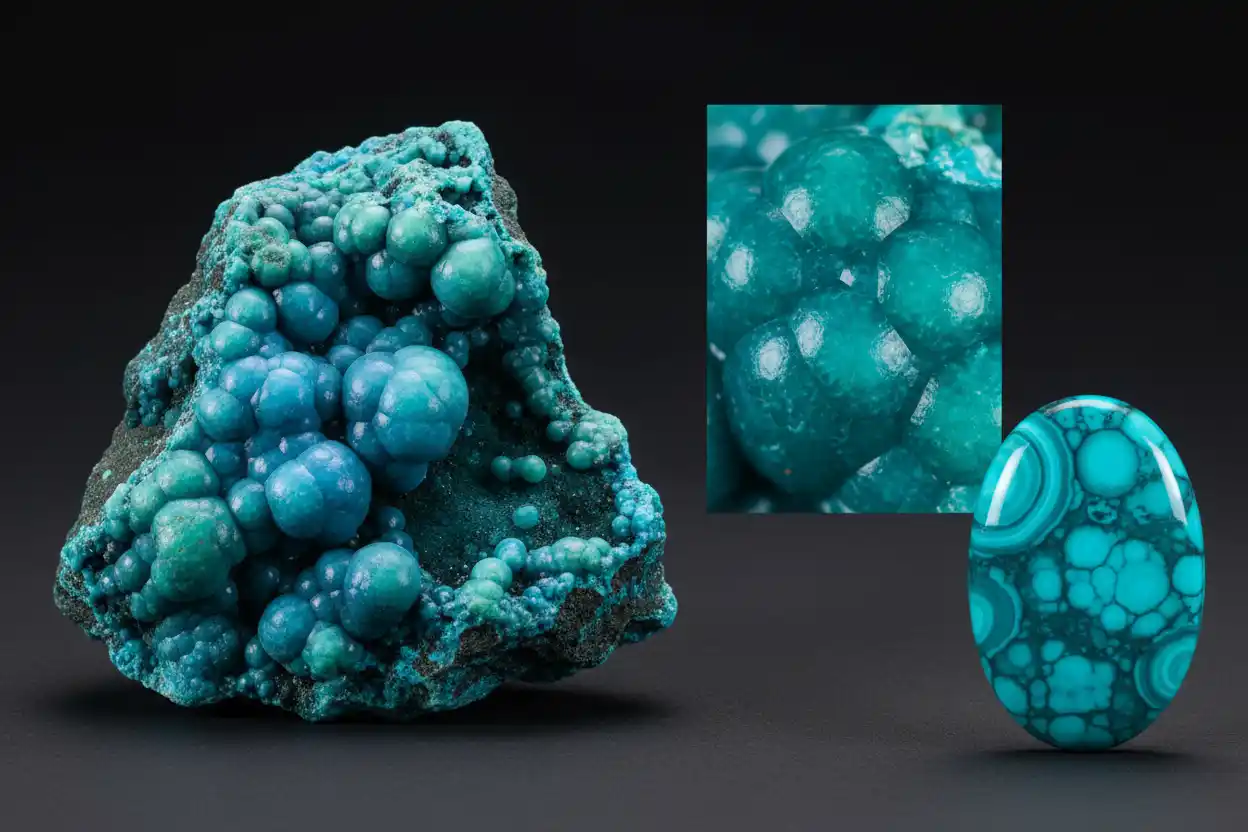
Rosasite Meaning, Properties, Identification & Value
Rosasite is an uncommon blue, sky-blue, blue-green, or green copper-zinc carbonate hydroxide mineral with the general formula (Cu,Zn)₂(CO₃)(OH)₂. It usually forms microscopic needles arranged into velvety crusts, radial sprays, rounded botryoids, globules, and fibrous cavity linings rather than large individual crystals.
The mineral develops in the oxidized zones of copper-zinc deposits, commonly with Malachite, Aurichalcite, Smithsonite, Hemimorphite, Calcite, Cerussite, and iron oxides. Its delicate fibers, softness, carbonate chemistry, and mixed associations make it primarily a specimen mineral rather than a practical jewelry stone.
Rosasite at a Glance
| Property | Rosasite |
|---|---|
| Material type | Copper-zinc carbonate hydroxide mineral |
| General composition | (Cu,Zn)₂(CO₃)(OH)₂, with variable copper-to-zinc proportions |
| Mineral group | Rosasite group |
| Common colors | Sky blue, turquoise blue, blue-green, pale blue, emerald green, and dark green |
| Crystal system | Monoclinic |
| Typical habit | Microscopic acicular crystals, radial sprays, botryoidal crusts, mammillary surfaces, globular masses, and fibrous cavity linings |
| Luster | Silky, vitreous, dull, or velvety |
| Transparency | Semitransparent to opaque |
| Mohs hardness | Approximately 4–4.5 |
| Cleavage | Distinct to perfect in two directions |
| Tenacity | Brittle |
| Fracture | Fibrous or splintery |
| Specific gravity | Approximately 4.0–4.2 |
| Streak | Pale blue to green |
| Common uses | Mineral specimens, micromounts, ore-deposit collections, educational displays, and rare stabilized lapidary pieces |
| Main care concern | Fragile fibers, acid sensitivity, dust, misidentification, water entering matrix, and copper-zinc mineral contamination |
Rosasite Is a Distinct Mineral Species
Rosasite is not merely blue Malachite, Chrysocolla, or Smithsonite.
It has its own monoclinic crystal structure and belongs to a group of related carbonate hydroxide minerals.
Copper and zinc share related positions within the structure. Their proportions can vary, which is why the formula is written with both elements inside parentheses.
The material may contain approximately similar copper and zinc proportions or become more copper rich.
Iron, magnesium, nickel, cobalt, and other elements can occur in smaller amounts.
Rosasite also forms relationships with minerals such as Glaukosphaerite, Kolwezite, McGuinnessite, Nullaginite, and Zincrosasite.
These species can look similar as tiny green or blue botryoids, making analytical identification important.
The parent link in the tracker is how to identify crystals because Rosasite is primarily a specimen-identification subject rather than a mainstream gem family.
Discovery and Name
Rosasite was described from the Rosas Mine in the Sulcis mining district of southern Sardinia, Italy.
The mineral was named for that locality rather than for its color.
The name does not derive from rose, pink, or red.
In fact, typical Rosasite is blue, blue-green, or green.
The type locality operated within a metal-mining region containing lead, zinc, copper, silver, and associated secondary minerals.
Historic locality information matters because tiny blue-green crusts can be difficult to distinguish once removed from their geological context.
How Rosasite Forms
Rosasite forms in the oxidation zone above or around copper-zinc sulfide deposits.
Primary minerals such as Chalcopyrite and Sphalerite react with oxygenated groundwater near Earth’s surface.
Copper and zinc dissolve, migrate through fractures and cavities, and precipitate again when pH, carbonate availability, water chemistry, and metal concentration become suitable.
Carbonate ions may come from limestone, Calcite veins, groundwater, or atmospheric carbon dioxide dissolved in water.
Rosasite can coat earlier copper minerals or grow inside limonite-rich cavities.
Some occurrences may form after mining when exposed ore surfaces encounter new air and water conditions.
That possibility is important for collection labels. A post-mining growth remains a real mineral but records a different environment from an ancient natural cavity.
Crystal Habit
Individual Rosasite crystals are typically microscopic and acicular.
They can reach only fractions of a millimeter in many specimens.
Thousands of needles radiate from common centers, creating spherical aggregates and rounded botryoids.
A continuous layer can look like velvet, felt, moss, frost, or fine turquoise powder.
Under magnification, the surface may resolve into divergent sprays.
Compact mammillary masses also occur, although even these commonly retain a fibrous internal texture.
Large transparent facetable crystals are not characteristic of Rosasite.
A specimen advertised as a large clean Rosasite gem should therefore receive close scrutiny.
Color and Pleochroism
Rosasite ranges from pale sky blue to turquoise, blue-green, emerald green, and dark green.
Copper contributes strongly to the blue-green color.
Increasing zinc content and changes in structure, grain size, associated minerals, and oxidation conditions influence the final hue.
Microscopic crystals can appear pale blue in transmitted light and deeper green or blue-green in reflected light.
Rosasite is strongly pleochroic at the crystal scale, showing different pale and dark green tones according to direction.
However, this effect is difficult to observe in ordinary botryoidal crusts because the tiny needles point in many directions.
Color alone cannot separate Rosasite from Aurichalcite, Chrysocolla, Malachite, or Hemimorphite.
Rosasite and Malachite
Malachite is copper carbonate hydroxide, Cu₂CO₃(OH)₂.
It lacks essential zinc in its ideal formula.
Malachite commonly forms green bands, botryoids, stalactites, fibers, and crystal coatings.
Rosasite overlaps in green color and carbonate chemistry but often appears bluer because of its copper-zinc composition and fine fibrous habit.
The two minerals can grow together or replace earlier phases in the same cavity.
A pale blue-green layer over dark green Malachite is a common specimen association.
Color does not provide a conclusive separation, particularly when both occur as microscopic fibers.
Raman spectroscopy, X-ray diffraction, and chemical analysis are more reliable.
Rosasite and Azurite
Azurite is a deep-blue copper carbonate with the formula Cu₃(CO₃)₂(OH)₂.
It forms prismatic, tabular, nodular, and massive material.
Azurite commonly shows a darker royal, navy, or electric blue than Rosasite.
However, Azurite can alter to Malachite and then receive a pale Rosasite coating.
Pseudomorphic specimens may preserve the blocky form of Azurite beneath layers of Malachite and Rosasite.
The complete mineral sequence can carry more collector value than any one phase considered alone.
Rosasite and Chrysocolla
Chrysocolla is a blue-green hydrated copper-bearing material with variable structure and composition.
It commonly forms smooth botryoids, crusts, veins, and massive porous material.
Rosasite tends to show finer acicular or velvety crystalline texture.
Chrysocolla can be much softer, particularly when it lacks silica support.
Silicified Chrysocolla can instead become harder than Rosasite and accept a strong lapidary polish.
Because the two may occur together, hardness and appearance can vary across one specimen.
A seller should not call every turquoise-colored copper crust Chrysocolla or Rosasite without analysis.
Rosasite and Shattuckite
Shattuckite is a hydrated copper silicate.
It commonly appears deep blue, turquoise, or blue-green and may form fibrous, botryoidal, acicular, or massive material.
Rosasite is a copper-zinc carbonate hydroxide rather than a silicate.
The two occur in different but potentially overlapping oxidized copper environments.
Shattuckite commonly shows stronger royal-blue areas, while Rosasite often forms paler sky-blue or green velvety crusts.
This visual difference is not conclusive.
Rosasite and Smithsonite
Smithsonite is zinc carbonate, ZnCO₃.
It can be blue, green, pink, yellow, brown, white, or colorless.
Botryoidal Smithsonite can closely resemble Rosasite.
Smithsonite is commonly smoother and more porcelain-like, whereas Rosasite often has a finely fibrous velvety surface.
Copper-bearing Smithsonite can become turquoise blue or green.
The two may occur together, particularly in oxidized zinc deposits.
Chemical analysis distinguishes zinc-dominant Smithsonite from copper-zinc Rosasite.
Rosasite and Aurichalcite
Aurichalcite is a hydrated copper-zinc carbonate mineral commonly found with Rosasite.
It usually forms pale blue, blue-green, or green needles and delicate radiating sprays.
Aurichalcite is softer, commonly around Mohs 1–2, while Rosasite is approximately 4–4.5.
Nevertheless, hardness testing is destructive and can destroy delicate fibers.
Aurichalcite crystals may appear longer, finer, and more feathery, while Rosasite commonly forms compact velvety botryoids.
These tendencies overlap.
X-ray diffraction or Raman spectroscopy provides a safer distinction.
The absence of a dedicated Aurichalcite tracker page means this article should explain the comparison without creating a competing internal destination.
Rosasite and Dioptase
Dioptase is an emerald-green copper silicate that usually forms bright trigonal crystals.
Its transparent-to-translucent crystal faces and high luster differ from typical Rosasite crusts.
However, small Dioptase crystals can sit on blue-green Rosasite, creating a valuable mixed specimen.
A seller should not identify every bright green grain as Dioptase merely because the name increases market interest.
Magnification and spectroscopy can establish whether a contrasting emerald crystal belongs to Dioptase, Malachite, or another copper phase.
Other Common Associations
Rosasite frequently occurs with Calcite, Dolomite, Cerussite, Hemimorphite, Hydrozincite, iron oxides, and remnants of primary ore minerals.
Calcite provides a white, cream, or transparent matrix in many attractive specimens.
Dolomite can form pale rhombohedra or host-rock surfaces.
Cerussite may occur as clear, white, gray, or reticulated lead-carbonate crystals.
Hemimorphite commonly forms colorless, white, blue, or green crystal sprays and botryoidal material.
These associated phases can raise scientific and aesthetic value while making care more complicated.
Important Rosasite Localities
The Rosas Mine in Sardinia is the type locality.
Tsumeb in Namibia produced world-class Rosasite with Cerussite, Calcite, Malachite, Smithsonite, and numerous additional copper-lead-zinc minerals.
The Ojuela Mine at Mapimí, Durango, Mexico, is one of the most important modern specimen sources.
Its Rosasite commonly occurs with Hemimorphite, Calcite, Adamite, Aurichalcite, and iron-rich matrix.
The Kelly Mine in New Mexico produced attractive blue-green Rosasite in oxidized zinc ore.
Arizona localities include the Silver Bill Mine, Bisbee district, and additional copper deposits.
England’s Caldbeck Fells and Cornwall contain classic European examples.
Locality labels matter because similar blue-green coatings can belong to several minerals at the same mine.
How to Identify Rosasite
Identification begins with microscopic texture, color, associations, and locality.
A fine velvety blue-green crust inside an oxidized copper-zinc cavity is consistent with Rosasite but not conclusive.
Magnification may reveal radial bundles of tiny acicular crystals.
The mineral’s hardness is approximately 4–4.5, but scratching should not be attempted on a specimen.
Dilute acid causes carbonate decomposition, yet acid testing permanently destroys the surface and can mobilize copper and zinc compounds.
Raman spectroscopy can identify individual Rosasite areas when the crystals are large enough.
Powder X-ray diffraction is highly effective but requires a sample and is therefore destructive.
Scanning electron microscopy with chemical analysis can separate Copper- and Zinc-rich phases across microscopic zones.
The safest approach preserves the specimen while combining locality, habit, spectroscopy, and chemistry.
Why Visual Identification Is Difficult
Copper secondary minerals commonly share blue and green colors.
Many form botryoids, crusts, fibers, needles, and cavity linings.
Weathering can alter the surface from one phase to another.
A Rosasite coating may also be only a few micrometers thick over Malachite, Smithsonite, or iron oxide.
One analytical measurement from the matrix does not prove that the blue crust itself is Rosasite.
Similarly, an X-ray fluorescence reading showing copper and zinc does not establish the exact carbonate-hydroxide structure.
This difficulty explains why older specimens may receive revised identifications after modern testing.
Treatments, Repairs, and Artificial Products
Fine natural specimens normally receive no enhancement.
Glue may stabilize a loose matrix or reattach a detached fragment.
Resin can consolidate crumbly limonite or protect a fragile crust, although it may alter luster and complicate future analysis.
Blue or green pigment can be applied to porous matrix to imitate a copper-mineral coating.
Artificial copper salts may also crystallize on rock surfaces.
Warning signs include color only on exposed surfaces, pigment transfer, repeated identical growths, glue around the “crystals,” and an implausible absence of associated minerals.
Treatment and repair should be disclosed because even a genuine Rosasite specimen loses scientific information when coatings conceal its surface.
The broader treatment framework appears in gemstone treatments explained.
The general warning signs of manufactured specimens appear in how to spot fake crystals.
Can Rosasite Be Used as a Gemstone?
Rosasite is rarely used as a conventional gemstone.
Its crystals are generally microscopic, brittle, and attached as thin crusts to matrix.
Compact Rosasite-rich masses can theoretically be stabilized and polished, but they are uncommon and often mixed with other minerals.
A polished blue-green cabochon sold as Rosasite may contain Chrysocolla, Malachite, Smithsonite, quartz, or resin.
Cutting also destroys the fibrous surface that makes a specimen identifiable and visually distinctive.
For these reasons, natural Rosasite generally has greater value as an intact mineral specimen.
Its Mohs hardness is placed in context by the gemstone hardness chart.
The relationship between softness, brittle fibers, and breakage appears in gemstone toughness versus hardness.
Current Rosasite Asking Prices
Rosasite is priced primarily by specimen size, locality, crystal texture, associations, and aesthetics.
| Rosasite product | Broad July 2026 retail asking range |
|---|---|
| Tiny micromount or low-grade crust | About $15–$50 |
| Small visible botryoidal specimen | About $40–$125 |
| Attractive Ojuela or Arizona miniature | About $100–$300 |
| Medium specimen with Hemimorphite or Calcite | About $150–$500 |
| Fine Tsumeb or classic-locality specimen | About $400–$2,000 |
| Exceptional large, historic, or highly aesthetic specimen | Several thousand dollars or more |
| Stabilized lapidary object sold as Rosasite | Individually priced and dependent on confirmed composition |
These figures represent broad asking-price context rather than appraisals or guaranteed sale values.
Current specialist inventories include medium Ojuela and mixed Rosasite specimens near approximately $100–$225, while fine Tsumeb material can command substantially more.
What Gives Rosasite Value?
Color is the first visible factor.
Bright sky-blue, turquoise, and contrasting blue-green surfaces usually attract more demand than dull gray-green crusts.
Texture matters. Fine velvety botryoids, complete radial spheres, and dense cavity linings provide stronger aesthetics.
Associated minerals can increase value when they create contrast or document the mineral sequence.
White Calcite, clear Cerussite, pale Hemimorphite, dark Malachite, and brown limonite commonly produce attractive combinations.
Locality matters strongly. Tsumeb, Rosas, Ojuela, Kelly, and historic English mines carry distinct collector contexts.
Condition is essential. Rubbed fibers, detached crusts, glue, dust, and broken matrix lower value.
Accurate identification, original labels, collection history, treatment disclosure, and stable storage complete the valuation.
Buying Rosasite
Buy the specimen rather than the color name.
Request magnified photographs showing the individual fibers or botryoidal texture.
Ask whether the Rosasite identification was confirmed through Raman spectroscopy, X-ray diffraction, or chemical analysis.
Verify the mine, district, country, specimen dimensions, repairs, and associated minerals.
A label saying Ojuela blue mineral is not enough because the mine contains several blue-green species.
Inspect the piece for pigment, glue, loose fibers, powder, and unstable limonite.
Avoid jewelry products that claim pure Rosasite without compositional evidence.
Rosasite appears in the crystals beginning with R directory and the gemstones beginning with R directory, although its practical role remains mineral collecting rather than ordinary jewelry.
Cleaning and Storage
Do not wash a delicate Rosasite specimen routinely.
Water can enter porous matrix, loosen clay or limonite, affect glue, and carry fine copper-zinc particles away from the surface.
The general water-safety discussion in which crystals can and cannot go in water should not be interpreted as permission to immerse Rosasite.
Remove loose dust only with a hand-operated air bulb from a safe distance.
Do not use compressed air, vacuum suction, stiff brushes, ultrasonic cleaning, steam, acids, or household chemicals.
Handle the specimen by its stable matrix rather than touching the blue-green crust.
Store it in a closed display box where other stones cannot abrade the fibers.
A padded base reduces vibration and prevents the matrix from shifting.
The principles in raw versus polished crystals are particularly relevant because Rosasite’s natural surface holds more identification value than a polished reconstruction.
Rosasite Meaning and Symbolism
Rosasite entered mineralogical literature during the twentieth century and has limited documented use as a historical wearable gem.
Modern crystal traditions associate its blue-green color with thoughtful communication, patience, emotional balance, and cooperation.
Its microscopic needles forming larger rounded surfaces can symbolize many small contributions creating one visible result.
The mineral’s copper-zinc chemistry may also inspire themes of complementary roles within a shared structure.
Because Rosasite often grows as a later mineral over earlier ore phases, it can represent change occurring through new environmental conditions rather than through immediate replacement.
These meanings remain personal, artistic, cultural, or spiritual interpretations. Scientific evidence does not show that Rosasite treats illness, supplies beneficial copper or zinc through handling, improves communication, or guarantees emotional balance.
Frequently Asked Questions
Is Rosasite a real mineral species?
Yes. Rosasite is a recognized monoclinic copper-zinc carbonate hydroxide mineral.
What is Rosasite’s chemical formula?
Its general formula is (Cu,Zn)₂(CO₃)(OH)₂, with variable copper and zinc proportions.
What colors can Rosasite show?
Sky blue, turquoise blue, blue-green, pale blue, emerald green, and dark green are typical.
Where was Rosasite discovered?
It was described from the Rosas Mine in southern Sardinia, Italy.
How does Rosasite form?
It develops as a secondary mineral in oxidized copper-zinc deposits when dissolved metals react with carbonate-bearing groundwater.
Is Rosasite the same as Malachite?
No. Malachite is copper carbonate hydroxide without essential zinc, while Rosasite contains both copper and zinc.
How does Rosasite differ from Aurichalcite?
Aurichalcite is generally softer and often forms longer delicate needle sprays, but analytical testing may be needed because their colors and habits overlap.
How does Rosasite differ from Chrysocolla?
Rosasite is a crystalline copper-zinc carbonate hydroxide, while Chrysocolla is a hydrated copper-bearing silicate material with variable structure.
Can Rosasite be cut into jewelry?
Compact mixed material may be stabilized and polished, but natural Rosasite is usually too fibrous, fragile, and specimen oriented for practical jewelry.
Is Rosasite commonly treated?
Fine specimens are normally untreated, although glue, resin consolidation, pigment, and artificial surface growths can occur.
Can Rosasite go in water?
Immersion is not recommended. Water can damage matrix, repairs, fibers, and associated minerals while spreading fine copper-zinc material.
What makes Rosasite valuable?
Color, velvety texture, complete botryoids, associated minerals, locality, size, condition, confirmed identity, provenance, and lack of treatment determine value.
Rosasite is best appreciated as a microscopic fibrous mineral whose collective growth creates a striking blue-green surface. Preserving that natural texture, matrix, and locality information is usually more important than attempting to convert the mineral into a polished gem.
Rosasite contains copper and zinc compounds. Do not ingest, lick, heat, burn, acid-test, powder, cut, or place it in drinking water. Avoid generating or spreading dust. Specimen preparation requires professional containment, local extraction, eye protection, protective clothing, and appropriately selected respiratory controls.