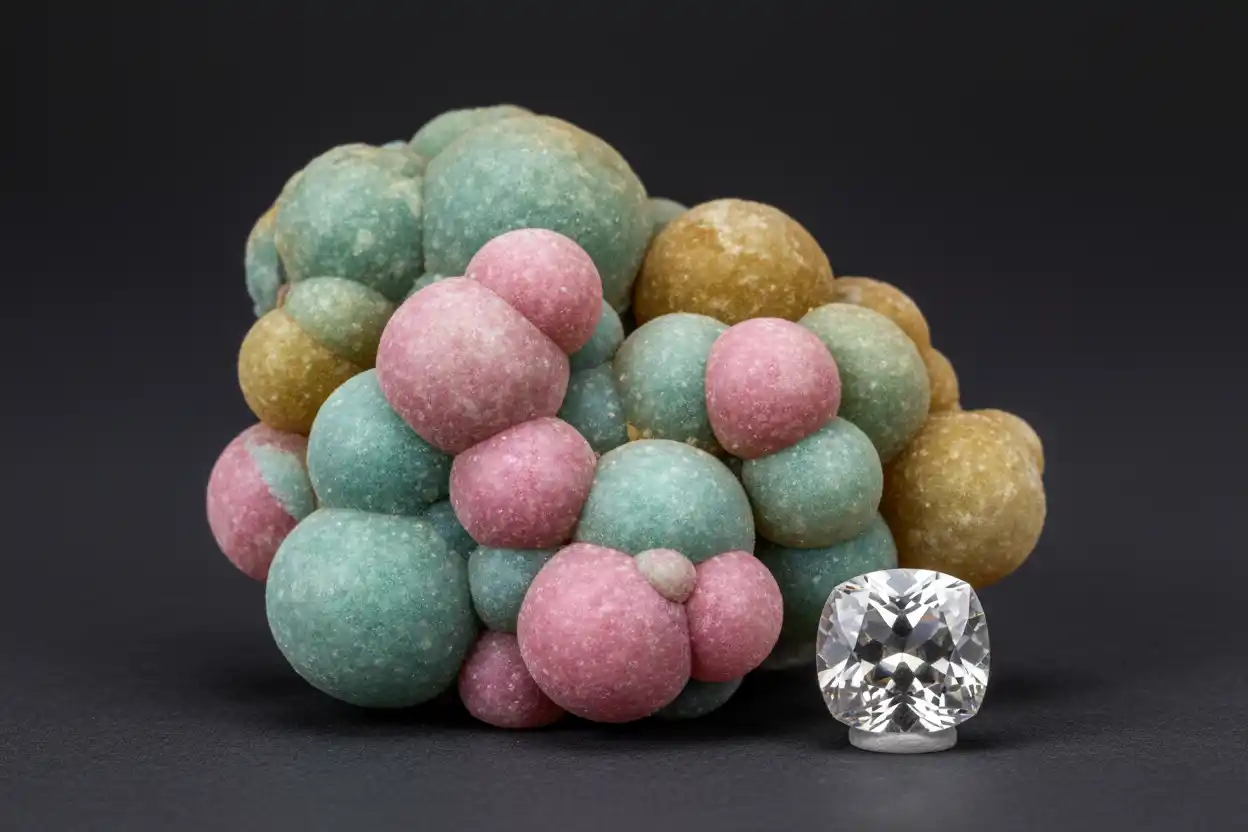
Smithsonite: Meaning, Properties & Symbolism
Smithsonite is a zinc carbonate mineral known for rounded botryoidal crusts, pearly luster, substantial density, and a remarkably broad range of pastel colors. A member of the calcite structural group, it usually develops in the oxidized portions of zinc deposits rather than as the large transparent crystals required for conventional gemstone cutting.
Collectors prize blue, green, pink, lavender, yellow, and color-zoned specimens, especially when the surface forms smooth overlapping “grapes” or sparkling microcrystals. Facetable material is much scarcer, while the mineral’s perfect cleavage and modest hardness limit its suitability for everyday jewelry.
Smithsonite at a Glance
| Property | Smithsonite |
|---|---|
| Composition | Zinc carbonate, ZnCO₃ |
| Group or type | Calcite-group carbonate mineral |
| Color | Colorless, white, grey, yellow, brown, green, blue-green, blue, pink, lavender, purple |
| Crystal system or texture | Trigonal |
| Habit | Botryoidal, reniform, stalactitic, granular, compact, earthy; rare rhombohedral crystals |
| Luster | Vitreous, pearly, silky, waxy, earthy, or dull |
| Transparency | Transparent in rare crystals; commonly translucent to opaque |
| Mohs hardness | Approximately 4–4.5 |
| Cleavage | Perfect rhombohedral cleavage |
| Tenacity | Brittle |
| Common uses | Mineral specimens, cabochons, carvings, rare faceted collector gems, historic zinc ore |
| Primary care concern | Cleavage, scratching, porosity, acids, soaking, and fragile botryoidal surfaces |
What Is Smithsonite?
Smithsonite consists primarily of zinc, carbon, and oxygen. Its ideal chemical formula is ZnCO₃, although calcium, iron, magnesium, manganese, cobalt, cadmium, copper, lead, and other elements may occur in natural material.
Structurally, it belongs to the same broad carbonate group as calcite. The two minerals share trigonal symmetry and rhombohedral cleavage, yet smithsonite is much denser because zinc replaces calcium as the dominant metal.
Smithsonite was once confused with hemimorphite under the historic ore name calamine. Mineralogists eventually established that the old term covered two distinct zinc minerals: carbonate-rich smithsonite and silicate-rich hemimorphite.
The modern name honors James Smithson, whose scientific work helped clarify the distinction. Smithson later became the founding benefactor and namesake of the Smithsonian Institution.
Smithsonite belongs among the mineral and ornamental materials covered in types of gemstones. It is also listed within the crystals that start with S and gemstones that start with S directories.
How Smithsonite Forms
Smithsonite most commonly forms as a secondary mineral in the oxidation zone of zinc-bearing ore deposits. These zones develop near the surface, where groundwater and oxygen chemically alter primary sulfide minerals.
Sphalerite is the most important primary zinc mineral in this process. As sphalerite weathers, zinc enters solution and moves through fractures, porous rock, and old mine workings.
When zinc-rich fluids encounter carbonate-bearing water or limestone, smithsonite can precipitate. It may coat cavities, replace limestone, fill fractures, or form thick irregular masses.
The mineral also develops through direct replacement of earlier zinc phases. Some deposits contain smithsonite with willemite, hydrozincite, hemimorphite, cerussite, malachite, azurite, rosasite, adamite, calcite, dolomite, quartz, and iron oxides.
Because several alteration episodes may overlap, one specimen can preserve color zoning, layered crusts, pseudomorphic shapes, late crystal coatings, and open cavities.
Smithsonite can itself be altered by later weathering. Powdery zinc carbonates, iron oxides, or copper-bearing minerals may replace or coat its surface.
Crystal Habits and Surface Textures
Large individual smithsonite crystals are unusual. Most specimens form as rounded aggregates rather than obvious rhombohedra.
Botryoidal smithsonite consists of closely packed rounded forms that resemble bunches of grapes. Reniform material develops larger kidney-shaped surfaces, while stalactitic growth produces cylindrical or hanging structures.
Some pieces are granular, porous, chalky, earthy, or compact. Others carry a drusy surface of tiny crystals that sparkles beneath direct light.
A polished cross-section may reveal concentric color bands beneath the botryoidal exterior. These layers can record changing fluid chemistry during growth.
Individual rhombohedral or scalenohedral crystals occur at a limited number of localities. Their rarity, clarity, and recognizable faces make them especially desirable to mineral collectors.
Surface quality matters greatly. A specimen with broad undamaged botryoids and strong luster usually commands more interest than one whose rounded forms have been bruised, flattened, or coated with dirt.
Smithsonite Colors and Their Causes
Smithsonite has one of the broadest color ranges among secondary zinc minerals. Colorless and white material occur, but blue-green, mint green, pink, lavender, yellow, and brown specimens attract the greatest attention.
Copper has traditionally been associated with blue and green smithsonite. However, detailed analysis has shown that some material marketed as “cuprian smithsonite” gains its appearance from microscopic inclusions or adjacent copper minerals rather than large amounts of copper replacing zinc in the structure.
Likewise, cobalt may produce pink coloration in some specimens, but not every pink smithsonite contains enough cobalt to justify the term cobaltian. Mineral inclusions, structural defects, and mixed trace elements can create similar appearances.
Cadmium is often associated with yellow tones, while iron can contribute yellow-brown, brown, grey, or dark coloration. Manganese and other elements may influence pink, lavender, or violet material.
Color zoning can appear as concentric bands, irregular patches, pale rims, or contrasting layers. A specimen may shift from white to green, pink to cream, or yellow to brown across only a few millimeters.
Blue examples belong naturally within broader comparisons of blue gemstones, while apple-green material can appear beside green gemstones. Pink and lavender specimens may also overlap visually with pink gemstones.
Nevertheless, color alone cannot identify smithsonite or prove the presence of a specific trace element.
Important Smithsonite Localities
The Tsumeb Mine in Namibia produced some of the world’s best-known smithsonite. Its specimens include transparent crystals, pale green and yellow material, pink crystals, and associations with copper and lead minerals.
The Berg Aukas district in Namibia is also historically significant. Transparent yellow-green material from Namibian deposits has supplied some of the limited rough suitable for faceting.
The Kelly Mine in New Mexico is famous for blue and blue-green botryoidal smithsonite. Fine examples can display saturated color across rounded crusts with a smooth pearly surface.
Mexico has yielded pink, lavender, blue, green, yellow, and color-zoned material. The Choix district in Sinaloa is particularly noted for large botryoidal plates and thick multicolored crusts.
Lavrion in Greece produced classic pale blue and green smithsonite, some of which survives mainly in museums and older collections. Precise mine documentation greatly affects the value of historic examples.
The Monteponi and Masua mining areas of Sardinia, Italy, supplied translucent yellow and banded smithsonite. Much of this classic material came from workings that are no longer active.
Broken Hill, now Kabwe, in Zambia produced rare transparent crystals and crystallized specimens. Other important sources include the Republic of the Congo, Morocco, Spain, Australia, China, Algeria, Tunisia, Germany, Belgium, and the United Kingdom.
Associated Minerals and Inclusions
Smithsonite frequently occurs with other minerals formed during the weathering of zinc, lead, and copper ores.
Willemite may occur in zinc deposits with smithsonite, although it is a zinc silicate rather than a carbonate. Its hardness, fluorescence, crystal structure, and typical habits differ.
Adamite can form yellow, green, or colorless crystals on smithsonite-rich matrix. The contrast between sparkling adamite crystals and rounded smithsonite can raise collector value.
Rosasite commonly forms blue-green fibrous or botryoidal coatings in oxidized copper-zinc deposits. Mixed specimens may be incorrectly sold under only one of the two names.
Cerussite is a dense lead carbonate that can grow with smithsonite in mixed lead-zinc deposits. It has different crystal habits, optical behavior, density, and safety concerns.
Malachite and azurite may contribute green and blue areas to a mixed specimen. Their presence can make visual color-based identification particularly unreliable.
Transparent smithsonite can contain fluid inclusions, small crystals, cleavage traces, growth zoning, and fractures. Massive material may enclose iron oxides, carbonate minerals, silica, or remnants of altered ore.
How to Identify Smithsonite
Smithsonite’s combination of high density, carbonate chemistry, low-to-moderate hardness, perfect cleavage, and botryoidal habit provides useful identification clues.
A pure piece feels noticeably heavy for its size. Its specific gravity commonly falls around 4.3–4.45, substantially above calcite, quartz, chrysocolla, magnesite, or many similarly colored materials.
Smithsonite has a white streak and a hardness around 4–4.5. It can be scratched by harder steel tools and will not scratch quartz.
Acid causes carbonate material to react, particularly when powdered or warmed. However, acid testing damages polished stones, specimens, and associated minerals and should not be used on collectible material.
Transparent smithsonite shows very strong double refraction because its two principal refractive indices differ widely. Facet edges viewed through the stone may appear strongly doubled.
Gemological readings can include a refractive-index range of approximately 1.621–1.848, uniaxial negative character, birefringence around 0.227, and dispersion strong enough to produce visible fire in a well-cut transparent gem.
Fluorescence varies. Some specimens react under longwave or shortwave ultraviolet light, while others remain weak or inert.
Raman spectroscopy, X-ray diffraction, chemical analysis, and specific-gravity measurement provide the strongest confirmation. The how to identify crystals guide explains why a combination of observations works better than one destructive home test.
Smithsonite Lookalikes
Hemimorphite is one of the most important lookalikes because it also occurs in oxidized zinc deposits and can form blue, white, or green botryoidal material. Hemimorphite is a hydrated zinc silicate with lower density, orthorhombic symmetry, and different crystal habits.
Calcite can resemble pale massive smithsonite. It is considerably softer and lighter, although both minerals react to acid and possess rhombohedral cleavage.
Aragonite may form rounded or fibrous carbonate aggregates. It has orthorhombic symmetry and lower density.
Chrysocolla can show similar blue-green colors and botryoidal surfaces. Its composition is more variable, and most material is much lighter.
Dyed magnesite and howlite are frequently marketed in bright blue-green colors. Dye may collect in pores, veins, cracks, and drill holes.
Cerussite is heavy enough to cause confusion but generally has even greater density. It also contains lead, making correct identification important for handling and lapidary work.
Treatments and Surface Enhancement
Most collector-grade smithsonite retains natural color. However, oiling and surface coating are documented treatments.
Oil can deepen color, improve translucency, and make porous areas appear less chalky. It may accumulate in cracks or slowly migrate to the surface.
Wax and polymer coatings can produce a smoother gloss over dull or porous botryoidal material. A coating may also reduce dusting from earthy surfaces.
Resin impregnation can stabilize fractured cabochon rough or porous masses. Stabilized material may be more durable, but it should be disclosed because heat and solvents can damage the polymer.
Dyeing is less established than in agate or howlite, yet pale porous smithsonite or associated matrix could absorb color. An unnaturally uniform saturated blue, purple, or pink deserves closer examination.
Repairs and reattached pieces occur in the specimen market. Glue may be hidden beneath matrix, inside cracks, or under a custom base.
The gemstone treatments explained guide covers the differences among oiling, coating, filling, impregnation, dyeing, and repair.
Synthetic Smithsonite and Imitations
Smithsonite can be synthesized for scientific and industrial research, but laboratory-grown gem material is not a meaningful commercial jewelry category.
Glass is a more practical imitation. It may reproduce pastel color and transparency but usually lacks smithsonite’s density, cleavage, strong birefringence, and mineral texture.
Resin and reconstructed composites may imitate botryoidal surfaces or hold crushed mineral fragments. Air bubbles, mold seams, low density, and plastic luster can expose them.
Dyed calcite, magnesite, howlite, hemimorphite, chrysocolla, and mixed copper-zinc rock are more common marketplace substitutions than true synthetic smithsonite.
A specimen can also be genuine natural material but incorrectly identified. The distinction between laboratory-grown gems, simulants, composites, and misidentified natural stones is explained in lab-grown vs natural gemstones.
Cutting and Polishing Behavior
Massive smithsonite can be cut into cabochons, tablets, carvings, beads, and polished cross-sections. Lapidaries often orient the rough to emphasize concentric banding or a translucent blue, green, pink, or yellow layer.
Porous areas can undercut during polishing. Botryoidal surfaces may also conceal cavities that open unexpectedly beneath the wheel.
Perfect cleavage presents a more serious challenge. Pressure, vibration, or poor orientation can split the rough along rhombohedral planes.
Transparent faceting rough is exceptionally scarce. A cutter must work around cleavage, internal fractures, strong doubling, limited crystal size, and color zoning.
When successful, faceted smithsonite can show striking fire because of its high dispersion and strong refractive behavior. Most finished stones remain collector gems rather than practical jewelry.
Polishing heat should remain low, especially when the material may be oiled, coated, filled, or resin-stabilized.
Durability and Jewelry Suitability
Smithsonite has poor durability for everyday jewelry. A hardness of 4–4.5 means household dust, quartz grains, metal edges, and harder gems can scratch it.
Perfect cleavage leaves it vulnerable to sharp impacts. A stone may split even when its polished surface shows little prior wear.
Pendants, earrings, brooches, and protected collector pieces are safer than rings and bracelets. A substantial bezel can guard the edges but cannot prevent surface abrasion.
Faceted stones need especially cautious settings because thin girdles and sharp facet junctions chip readily. Large cabochons may also fracture if pressure from the mounting is uneven.
Smithsonite should not be worn during sports, cleaning, gardening, cooking, bathing, or physical work. Perfume and cosmetics should be applied before the jewelry is put on.
Smithsonite Value and July 2026 Asking Prices
Smithsonite does not have one universal per-carat price structure. Mineral specimens, cabochons, carvings, and faceted collector gems trade through different markets.
As of July 2026, small commercial botryoidal specimens commonly carry asking prices around $15–$75. Attractive thumbnail and miniature pieces with good color and intact surfaces often appear around $75–$300.
Larger display specimens, unusual colors, strong translucency, crystallized examples, and documented locality pieces commonly ask approximately $300–$1,500.
Fine Tsumeb crystals, classic Lavrion material, rare Zambian crystal groups, major Kelly Mine examples, and exceptional Mexican botryoidal plates may range from $1,500 to $7,500 or more. Current specialist listings demonstrate that museum-level pieces can extend well beyond ordinary retail ranges.
Commercial cabochons often appear around $10–$100 per stone, while large, strongly colored, well-polished, or locality-documented examples may cost several hundred dollars.
Faceted smithsonite remains too scarce for a dependable market average. Small included stones may sell for a few hundred dollars, while clean, strongly colored, well-cut gems—especially above several carats—can command substantially more.
Buying Smithsonite
Begin by deciding whether the target is a natural mineral specimen, polished cabochon, faceted collector stone, or mixed-mineral decorative object.
For a specimen, request dimensions, weight, exact locality, crystal or botryoid size, condition, repair history, and treatment disclosure. Photographs should show the front, back, edges, and any contact areas.
Inspect rounded surfaces for bruising and flattened bubbles. Fresh chips often appear lighter and duller than naturally terminated areas.
For a cabochon, ask whether the material has been oiled, waxed, resin-stabilized, dyed, backed, or assembled. Surface pits and open fractures should be visible in magnified photographs.
For a transparent faceted stone, request refractive data or an independent laboratory report. Color and strong doubling may support the identification, but they do not exclude every alternative.
Provenance is particularly important for Tsumeb, Kelly Mine, Lavrion, Sardinian, and historic Mexican material. Old labels, collection records, and mine-level information can contribute significantly to value.
The general how to buy gemstones online framework helps evaluate photographs, returns, seller descriptions, measurements, and independent testing.
Cleaning and Storage
Dust a delicate natural specimen with a hand blower or an extremely soft brush. Do not scrub botryoidal, porous, or microcrystalline surfaces.
A stable polished stone can be wiped with a soft damp cloth. When necessary, use lukewarm water and a small amount of mild soap, then dry the piece immediately.
Avoid prolonged soaking. Porous material can absorb liquids, while oil, resin, glue, matrix minerals, and iron-rich inclusions may respond unpredictably.
Do not use acids, vinegar, lemon juice, bleach, ammonia, abrasive powder, or commercial jewelry dips. Carbonate minerals can be etched by acids.
Steam and ultrasonic cleaning are unsuitable. The guide to gemstones in ultrasonic cleaners explains why vibration threatens cleaved, porous, and fracture-filled materials.
The broader crystals you can put in water guide distinguishes brief controlled cleaning from soaking or preparing crystal water.
Store smithsonite separately in a padded box. Specimens should fit securely without pressure on rounded crusts or individual crystals.
Smithsonite Meaning and Symbolism
Smithsonite was recognized as a distinct mineral comparatively recently, so most symbolism associated with it comes from modern crystal traditions rather than one continuous ancient system.
Its rounded growth forms often inspire themes of gradual development, adaptability, patience, and building stability layer by layer.
Blue smithsonite may symbolize measured communication and thoughtful expression. Green material is frequently associated with renewal and balance, while pink examples can represent kindness, affection, and emotional openness.
Yellow and honey-colored stones may be used as symbols of confidence, curiosity, and constructive action. Color-zoned pieces can serve as reminders that several experiences or qualities can coexist within one person.
These interpretations belong to personal, cultural, and spiritual belief systems. Scientific evidence does not show that smithsonite treats disease, regulates hormones, corrects mineral deficiencies, or produces guaranteed emotional effects.
A collector may value it instead for its zinc chemistry, unusual density, mine history, surface growth, and extraordinary range of natural color.
Frequently Asked Questions
1. Is smithsonite a zinc mineral?
Yes. Smithsonite is zinc carbonate with the ideal formula ZnCO₃.
2. Is smithsonite the same as hemimorphite?
No. Smithsonite is a carbonate, while hemimorphite is a hydrated zinc silicate with a different crystal structure and density.
3. Why is smithsonite commonly botryoidal?
It often precipitates in cavities and porous oxidation zones as many closely packed crystals growing outward from numerous nucleation points.
4. What makes smithsonite blue or green?
Copper-related chemistry, microscopic copper-mineral inclusions, structural effects, or combinations of these factors can contribute.
5. Is every pink smithsonite cobaltian?
No. Some pink material contains cobalt, but similar colors may occur without enough cobalt to justify the variety name.
6. Why does smithsonite feel unusually heavy?
Zinc gives the mineral a specific gravity around 4.3–4.45, much higher than many similarly colored gems.
7. Can smithsonite be transparent?
Yes, but transparent facetable crystals are rare. Most material is translucent or opaque.
8. Does smithsonite react with acid?
Yes. As a carbonate, it can react with acid, particularly when powdered or warmed.
9. Is smithsonite suitable for an everyday ring?
No. Low hardness, brittleness, and perfect cleavage make everyday ring wear risky.
10. Is smithsonite commonly treated?
Oiling and surface coating are documented, while resin stabilization, waxing, filling, repair, and occasional dye may also occur.
11. Which locality produces famous blue smithsonite?
The Kelly Mine in New Mexico is particularly celebrated for blue and blue-green botryoidal material.
12. What most affects smithsonite value?
Color, crystal or botryoidal form, surface condition, luster, translucency, locality, repairs, rarity, and provenance determine value.
Smithsonite rewards close evaluation because its finest quality is not defined by color alone. A well-documented piece combines natural surface form, believable locality, strong condition, and transparent disclosure of every treatment or repair.
Smithsonite contains zinc and may occur with copper-, lead-, arsenic-, or cadmium-bearing ore minerals. Do not ingest it, lick it, prepare drinking water with it, or inhale dust produced by cutting, drilling, or damaged earthy material. Lapidary work requires wet methods, local exhaust ventilation, eye protection, suitable respiratory protection, and controlled waste handling.