Malachite Meaning: Properties, Healing Traditions, Uses & Care
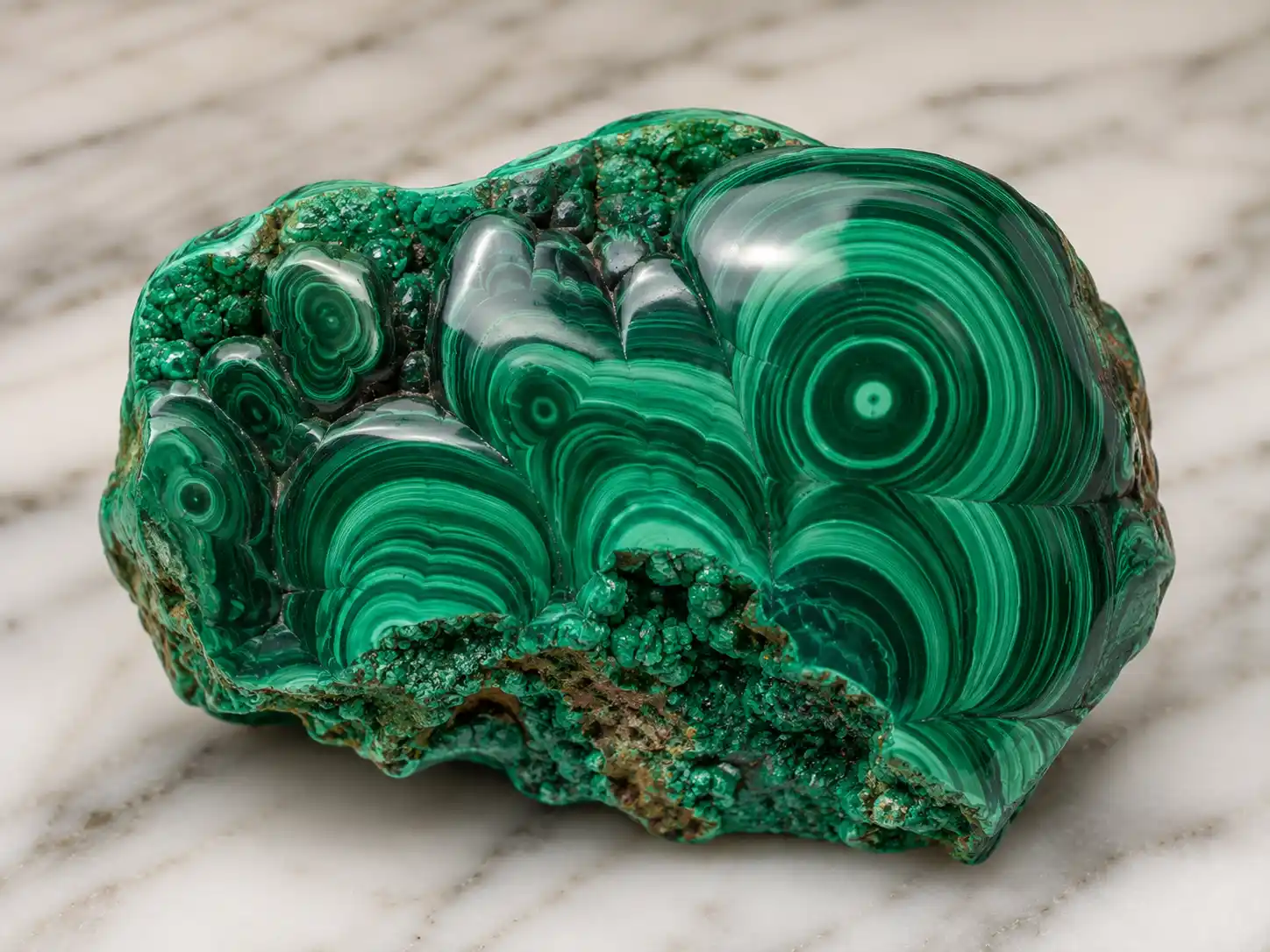
Malachite is an opaque green copper carbonate hydroxide famous for its sweeping bands, concentric eyes, fibrous textures and rich color. The physical story behind those patterns begins in weathered copper deposits, while malachite meaning comes from a separate layer of history and modern symbolism. In contemporary crystal traditions, the stone is commonly associated with transformation, boundaries, courage, emotional honesty and heart-centered reflection. Those interpretations can be personally meaningful, but they are not scientifically established healing effects.
Understanding malachite meaning is most useful when the stone’s symbolism is kept distinct from its mineral identity. Malachite is soft, relatively dense, acid-sensitive and often treated or reconstructed, so practical questions about authenticity, jewelry durability and safe care matter just as much as spiritual associations. Its vivid green appearance also connects it naturally with the wider world of green gemstones, though malachite differs from transparent gems such as emerald, peridot and tourmaline because its visual value comes mainly from pattern rather than brilliance.
Malachite at a Glance
| Property | Malachite |
|---|---|
| Mineral class | Carbonate |
| Chemical formula | Cu₂(CO₃)(OH)₂ |
| Crystal system | Monoclinic |
| Typical color | Pale, bright, medium, dark and nearly blackish green |
| Transparency | Usually opaque; translucent in thin areas |
| Luster | Silky, vitreous, adamantine, earthy or dull |
| Mohs hardness | About 3.5–4 |
| Cleavage | Perfect in one direction, fair in another |
| Specific gravity | Roughly 3.6–4.05 |
| Streak | Pale green |
| Common habits | Banded masses, botryoids, stalactites, crusts, fibers and crystals |
| Main uses | Cabochons, beads, carvings, inlay, decorative stone and historical pigment |
| Main care concern | Scratches, impact, acids, aggressive chemicals, heat and treatment stability |
| Common symbolic themes | Transformation, boundaries, courage, growth and heart-centered reflection |
What Is Malachite?
Malachite is a secondary copper mineral with the formula Cu₂(CO₃)(OH)₂. Copper within the structure produces its characteristic green color. Unlike many gemstones valued for transparency, malachite is normally opaque and prized for alternating bands that can form waves, ribbons, eyes, concentric circles and feather-like patterns.
The mineral commonly develops in the oxidized zones of copper deposits. That formation history provides the physical background for malachite meaning without proving any spiritual claim. Near the surface, oxygenated water alters primary copper minerals and transports copper through fractures and cavities. Where chemical conditions allow carbonate minerals to precipitate, malachite can grow as fibrous layers, rounded botryoidal masses, crusts and stalactitic forms.
This geology helps explain why malachite meaning is so often linked with change. The symbolism is modern interpretation, but the visible bands genuinely record repeated episodes of mineral growth. The physical process does not prove spiritual transformation; it simply gives the stone a natural visual metaphor that many people find compelling. Malachite meaning remains symbolic, not geological.
Malachite often occurs with azurite, chrysocolla, cuprite, calcite, iron oxides and native copper. This geological context matters because malachite meaning should not be confused with the properties of associated minerals. The broader copper guide helps separate native copper from copper-bearing minerals, while the direct malachite vs azurite comparison explains why the familiar green and blue minerals can form together without being the same substance.
Why Malachite Has Green Bands
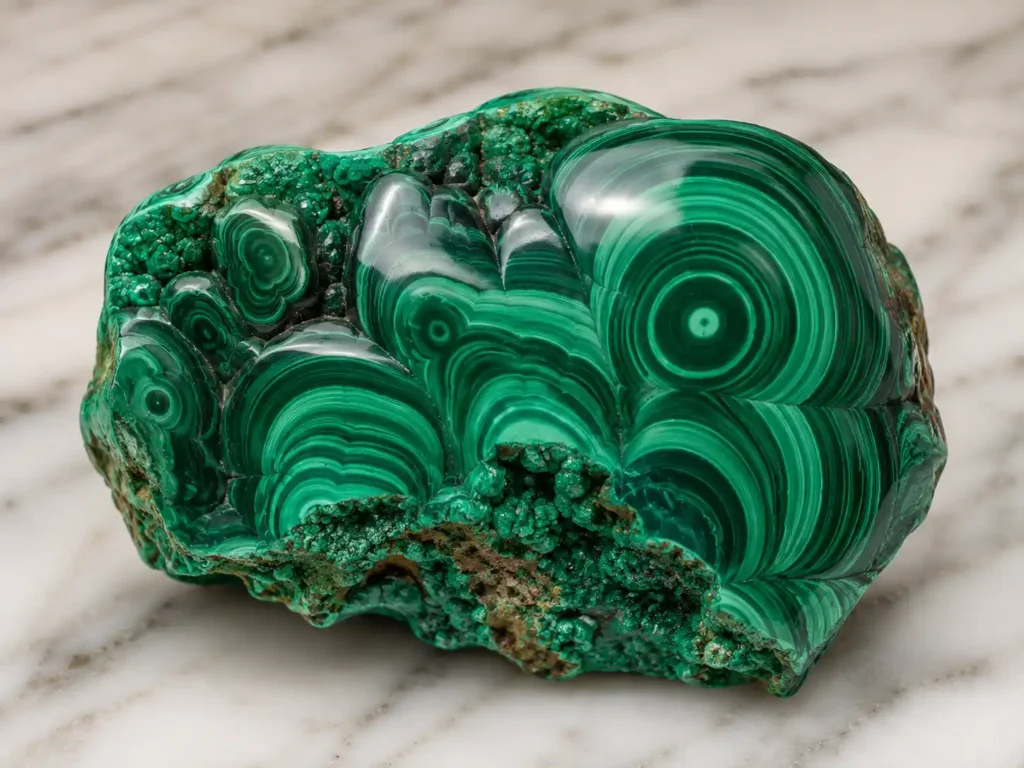
Malachite commonly grows as fine radiating fibers. When growth continues outward from a surface or central point, the mineral develops layered structures. A cross-section through rounded growth may reveal bull’s-eyes and concentric rings, while a cut along a different direction can produce parallel stripes, waves or feathery bands.
For collectors and jewelry buyers, this matters because pattern orientation can change the appearance of the same rough material dramatically. It also explains why malachite meaning is so often expressed through the visual language of layers and cycles. A cutter may rotate the rough to center an eye, create matched waves or expose long striped sections. In carved objects and cabochons, the pattern is not merely surface decoration; it reflects the direction in which the mineral grew.
The relationship between growth and pattern also influences malachite meaning. Many modern interpretations use the bands as symbols of gradual change, recurring cycles and layers of experience. That symbolic reading can be useful as a reflective metaphor, but it should not be mistaken for evidence that the mineral controls emotions or future events.
Malachite Meaning and Symbolism
The most common malachite meaning in modern crystal practice is transformation. The stone is often chosen during periods when someone wants to change a habit, leave an unhelpful pattern, approach a difficult conversation or make a deliberate transition.
A grounded way to work with malachite meaning is to connect the stone with an observable action. Instead of asking the stone to “transform” a situation, a person might use it as a reminder to identify what is changing, what remains within their control and what practical step comes next. That keeps symbolism in the realm of personal reflection rather than magical causation.
Protection is another traditional theme attached to malachite meaning. Historical amulets and modern crystal traditions sometimes describe malachite as a protective stone. No measurable protective field has been established around the mineral, so it should never replace locks, protective equipment, medical precautions, emergency planning or sound judgment. As a symbol, however, it can represent the decision to set a boundary, verify information or leave an unsafe situation.
Courage and emotional honesty also appear frequently in malachite meaning. Its symbolism often emphasizes facing uncomfortable patterns rather than avoiding them. In practice, this may mean preparing a clear statement before a difficult conversation, checking whether a repeated problem has the same trigger, or acknowledging that a boundary needs to be stated rather than silently expected.
Malachite Meaning for Transformation
Transformation is the strongest recurring theme in malachite meaning. The stone’s changing green layers make an intuitive visual symbol for growth that occurs through stages rather than one dramatic moment.
A practical transformation exercise can begin with three questions: What exactly needs to change? Which part can I influence? What is the smallest useful action I can take next? The stone can sit beside a journal or planning page as a visual cue, but the change itself comes from decisions, repetition, support and follow-through.
This approach also prevents malachite meaning from becoming a promise of instant reinvention. Major life changes often include uncertainty, setbacks and revised plans. The banded stone can symbolize that complexity without implying that carrying it guarantees a particular outcome.
For broader comparisons with other stones used symbolically during change, Gems Lore’s green crystals guide places malachite within a wider color and tradition context.
Malachite Meaning for Emotional Reflection
Malachite meaning is often associated with emotional honesty and recognizing repeating patterns. Some traditions describe the stone as bringing hidden feelings to the surface. There is no evidence that the mineral extracts memories or emotions from the body, but a deliberate ritual can create space for reflection.
A useful prompt is to describe a repeating situation without explaining it away: What happens? What tends to happen immediately before it? How do I usually respond? What consequence follows? Which boundary, decision or request could interrupt the sequence?
This version of malachite meaning keeps responsibility with the person rather than assigning power to the stone. It also avoids treating serious emotional distress as an “energy block.” Persistent depression, trauma symptoms, panic, self-harm thoughts or other significant mental-health concerns require appropriate professional support rather than crystal-based treatment.
The broader crystals for emotional healing page discusses similar symbolic practices while keeping medical claims separate from personal ritual.
Malachite Meaning in Relationships and Boundaries
In relationship contexts, malachite meaning is commonly tied to honesty, boundaries and pattern recognition. The stone cannot determine whether someone is faithful, compatible, trustworthy or destined to return. It cannot make another person apologize, reconcile or change.
Its symbolism can still be applied in a practical way. A person might use malachite as a reminder to distinguish compassion from unlimited access, forgiveness from the absence of accountability, and hope from evidence. If the same conflict repeats, the useful question is not what the stone predicts, but what observable pattern needs a different response.
This aspect of malachite meaning is especially relevant to boundaries. A boundary is an action or limit a person controls, not a spell placed on another person. For example, “I will end the conversation if I am being insulted” is a boundary; “the other person must become respectful because I am wearing malachite” is not.
Malachite and the Heart Chakra
Malachite is commonly associated with the heart chakra in contemporary spiritual traditions. The green color contributes to this connection, and many practitioners use the stone to represent compassion, trust, grief, relationship balance and emotional growth.
Within this framework, malachite meaning is often more challenging than soothing. Instead of representing harmony at any cost, the stone may symbolize the willingness to notice an unhealthy pattern, communicate clearly or protect emotional limits. This makes it distinct from softer heart-centered symbolism often attached to rose quartz.
The heart chakra crystals guide compares malachite with other stones used in this tradition. Chakras are spiritual concepts rather than anatomical structures, and malachite has not been shown to treat heart disease, blood pressure problems, circulation conditions or other medical concerns.
Malachite Meaning for Prosperity and Personal Power
Some modern traditions connect malachite meaning with prosperity, business growth, confidence and personal power. Its association with copper mining and its green color may contribute to those interpretations.
A gemstone does not generate income, choose investments or protect against financial loss. A practical prosperity ritual can instead use the stone as a cue to review a budget, follow up on an application, strengthen a skill, verify a business claim or take another concrete step that affects real outcomes.
Personal power in malachite meaning is also better understood as responsibility for one’s own choices. Confidence does not mean controlling other people, ignoring consequences or assuming success is guaranteed. The stone can symbolize agency, but evidence and action remain essential.
Meditation and Reflective Uses
Malachite’s banding makes it a visually engaging meditation object. In this setting, malachite meaning works best as a focus for attention rather than a claim about invisible forces. Place an intact polished piece on a stable surface and choose one line or curve to follow with your eyes. Notice how it moves through lighter and darker zones, then widen attention to the entire pattern.
A short practice can end by naming one action that supports change and one limit that should be respected. This keeps malachite meaning connected with deliberate behavior rather than vague prediction.
If meditation increases panic, distress, dissociation or traumatic flashbacks, stop the exercise. Meditation is not suitable for every person or every situation, and a stone should never be used to push through severe distress.
For ritual care, how to cleanse and charge malachite focuses on low-risk symbolic methods that do not expose the mineral to damaging chemicals or prolonged water.
Physical Properties and Durability
Malachite ranks about 3.5–4 on the Mohs scale, which means it scratches much more easily than quartz, topaz, sapphire or diamond. The gemstone hardness chart provides the wider comparison.
Hardness is only one part of durability. Physical durability is separate from malachite meaning, and both should be understood on their own terms. Malachite also has cleavage and a fibrous or layered structure that can create weaknesses. The distinction between scratch resistance and resistance to breaking is covered in gemstone toughness vs hardness, while gemstone cleavage explained shows why structural planes matter even when a polished surface looks sound.
Because malachite is soft and chemically sensitive, it is better suited to pendants, earrings, protected cabochons, beads, carvings and inlay than to exposed daily-wear rings. A bezel setting can protect edges more effectively than open prongs. Hard accent stones should not rub directly against malachite.
Malachite Jewelry and Decorative Uses
Malachite’s strongest visual feature is pattern. Jewelry can express malachite meaning aesthetically, but wearability still depends on the stone’s softness and construction. Cabochons allow large areas of banding to remain visible, while carvings can use eyes, stripes and curves as part of the design. The stone also appears in beads, boxes, veneers, mosaic work and ornamental panels.
Among jewelry types, malachite earrings reduce the repeated impact experienced by hand-level jewelry. A malachite necklace can display larger cabochons or carvings in a relatively protected position.
The stone is also popular with lapidaries because its bold pattern can create dramatic cabochons and carvings. However, the best gemstones for carving guide highlights an important limitation: malachite dust contains copper-bearing particles, so cutting, drilling and sanding require appropriate wet methods, ventilation and protective controls.
How to Judge Malachite Quality
For most polished malachite, quality depends more on pattern, color, surface condition and workmanship than on transparency. Malachite meaning does not raise the objective quality grade of a weak or damaged stone. Strong natural-looking contrast between green shades can be attractive, especially when the cutter has oriented eyes, curves or stripes intentionally.
A good piece should have a smooth polish without obvious deep scratches, cloudy abrasion, peeling coating or unstable fractures. Open pits and weak fibrous areas may be acceptable in mineral specimens but can reduce suitability for jewelry.
The malachite buying guide goes deeper into pattern, construction, treatments and seller evidence. Current market values vary widely, so the malachite price guide is more useful than assuming every vivid green piece is rare or expensive.
Malachite meaning should not be used as a value factor. A seller’s claim that one stone carries stronger transformation, protection or prosperity energy does not establish mineral quality, rarity or market price.
Treatments, Reconstruction and Synthetic-Looking Material
Natural malachite may be waxed, resin-impregnated, stabilized, filled, coated or dyed. These processes do not determine malachite meaning, but they can materially affect identification, price and care. These treatments can improve polish, seal porosity or support fractures, but they may also change cleaning requirements and value.
Reconstructed malachite can contain crushed natural particles bound with resin. Other products are made from polymer, glass, ceramic or dyed stone and are simply imitations. Some inexpensive striped products are marketed loosely as “synthetic malachite,” even though they may not be laboratory-grown malachite mineral at all.
The treated malachite guide explains these distinctions in detail. Treatment is not automatically a defect, but it should be disclosed accurately so buyers understand what they own. That keeps malachite meaning separate from material claims.
Real vs Fake Malachite
Natural malachite usually shows subtle variation within its bands. Authenticity should be established from physical evidence, not from claims about malachite meaning or energy. Lines may change width, branch, merge or curve in ways that reflect mineral growth. Many resin imitations show repetitive dark lines, identical swirls, flat-looking color or patterns that fail to continue naturally around the sides.
Those visual clues are useful but not conclusive. Good imitations can be irregular, and genuine malachite can sometimes look surprisingly orderly. The real vs fake malachite guide covers pattern, density, treatments and laboratory methods in greater depth.
Avoid destructive home tests such as scratching, acid, flame or hot needles. They can permanently damage natural stone, coatings, resin, glue and jewelry settings. The broader how to identify crystals guide explains why several independent clues are safer than one damaging test.
Malachite Safety
Malachite contains copper, but an intact polished stone is generally suitable for ordinary external handling. Safety decisions should follow mineral properties rather than any interpretation of malachite meaning. The main physical hazard arises when the mineral is cut, drilled, sanded or ground, because those processes can generate copper-bearing dust.
Do not inhale malachite dust, ingest the mineral, grind it into homemade cosmetics or place it in drinking water to prepare a crystal elixir. Broken, dusty or crumbling pieces should be handled cautiously and kept away from children and pets who may mouth objects.
Malachite meaning does not change these physical facts. A spiritual practice should never require unsafe handling, prolonged soaking, ingestion or exposure to mineral dust.
How to Clean and Store Malachite
For routine care, use a soft dry or barely damp cloth. Proper care preserves the material itself; it does not change or validate malachite meaning. If more cleaning is necessary, a small amount of mild soap with brief contact can be appropriate, followed by prompt drying. Do not soak malachite.
Avoid vinegar, lemon juice, ammonia, bleach, alcohol, acetone, abrasive powders, toothpaste and harsh jewelry dips. Acids can react with carbonate minerals, while solvents and aggressive chemicals may also damage wax, resin, dye, glue or coatings.
Steam and ultrasonic cleaning are poor choices because heat, vibration and liquids can damage the mineral or its treatments. The dedicated malachite jewelry cleaning guide provides a conservative step-by-step approach.
Store malachite separately from harder gemstones and sharp metal edges. This practical protection is important regardless of how someone personally interprets malachite meaning. Care advice and malachite meaning answer different questions. A soft pouch or padded compartment helps preserve the polish. Keep the stone away from high heat and household chemicals.
How Malachite Meaning Fits With the Mineral Itself
Malachite meaning becomes more useful when its symbolic and physical identities support rather than contradict each other. A grounded malachite meaning framework keeps metaphor, mineralogy and safety clearly separated. The green bands can represent gradual change; the stone’s softness can remind the owner that growth still requires protection and good boundaries; its dense copper-rich nature can serve as a tactile focus during reflection.
None of those interpretations require claiming that malachite changes body chemistry, absorbs illness, predicts danger or controls another person. At Gems Lore, malachite meaning is treated as a cultural and personal layer around a real mineral with testable properties, practical care requirements and a long history of ornamental use.
That distinction also protects the value of the symbolism. In other words, malachite meaning does not need a medical claim to be meaningful. A reflective ritual does not become less meaningful because it is not a medical treatment. It simply belongs in a different category from mineral science, diagnosis and evidence-based care.
Frequently Asked Questions
What is the main malachite meaning?
The main malachite meaning in modern crystal traditions is transformation. It is also associated with boundaries, courage, emotional honesty, protection symbolism and heart-centered growth. These are cultural and personal interpretations rather than scientifically established effects.
What does malachite symbolize in relationships?
In relationship-focused practice, malachite meaning often emphasizes repeating patterns, honest communication and boundaries. The stone cannot determine compatibility, force reconciliation or reveal another person’s intentions.
Is malachite a heart chakra stone?
Yes, malachite is commonly associated with the heart chakra in contemporary spiritual traditions. That association is symbolic. Chakras are not anatomical structures, and malachite does not treat cardiovascular conditions.
Does malachite have healing properties?
Malachite healing properties are traditional or modern spiritual claims, not medically proven effects. The stone has not been shown to treat anxiety, depression, trauma, inflammation, heart disease, pain or other health conditions.
Can malachite help with anxiety?
There is no established mineral-specific anti-anxiety effect. Some people may find a familiar reflective ritual calming, but persistent anxiety or panic should be addressed with appropriate professional support.
Does malachite protect against negative energy?
Energetic protection is a spiritual belief. A practical interpretation of malachite meaning is to use the stone as a reminder to apply real-world boundaries, verify information and take sensible safety precautions.
Does malachite attract money?
There is no evidence that malachite creates wealth or prevents financial loss. Prosperity symbolism can be used as a cue for practical actions such as budgeting, skill development or pursuing suitable opportunities.
Is malachite safe to touch?
An intact polished piece is generally suitable for normal external handling. Avoid dust from cutting or grinding, and do not ingest malachite or use it in drinking-water preparations.
Can malachite go in water?
Brief, controlled contact during careful cleaning is different from soaking. Avoid prolonged water exposure, especially with treated, glued, reconstructed or jewelry-mounted pieces. Never place malachite in water intended for drinking.
Is real malachite always banded?
Most ornamental malachite shows some form of banding, fibrous pattern or layered growth, but specimens can vary. Pattern alone cannot prove authenticity, especially because convincing resin and composite imitations exist.
What is the best jewelry type for malachite?
Earrings, pendants, necklaces, beads and protected cabochons are generally more practical than exposed everyday rings. Malachite’s Mohs hardness of about 3.5–4 makes scratches and abrasion a significant concern.
How should malachite be stored?
Store it separately in a soft pouch or padded compartment away from harder gems, metal edges, heat and chemicals. Gentle storage preserves both polish and treated surfaces.
Malachite combines one of the mineral world’s most distinctive patterns with a long history of ornament, pigment and modern symbolic use. The most responsible approach to malachite meaning keeps that symbolic layer meaningful without turning it into a medical, financial or predictive promise. Its green layers explain much of its appeal, but responsible ownership means respecting both sides of the stone: malachite meaning can support reflection and personal ritual, while its mineral properties determine how it should be identified, worn, cleaned and handled.
Malachite meaning, chakra, protection, prosperity and emotional-healing associations belong to cultural, spiritual or personal traditions and are not scientifically established medical effects. Do not ingest malachite, use it in drinking elixirs, inhale cutting dust or use crystal practices in place of professional medical or mental-health care.