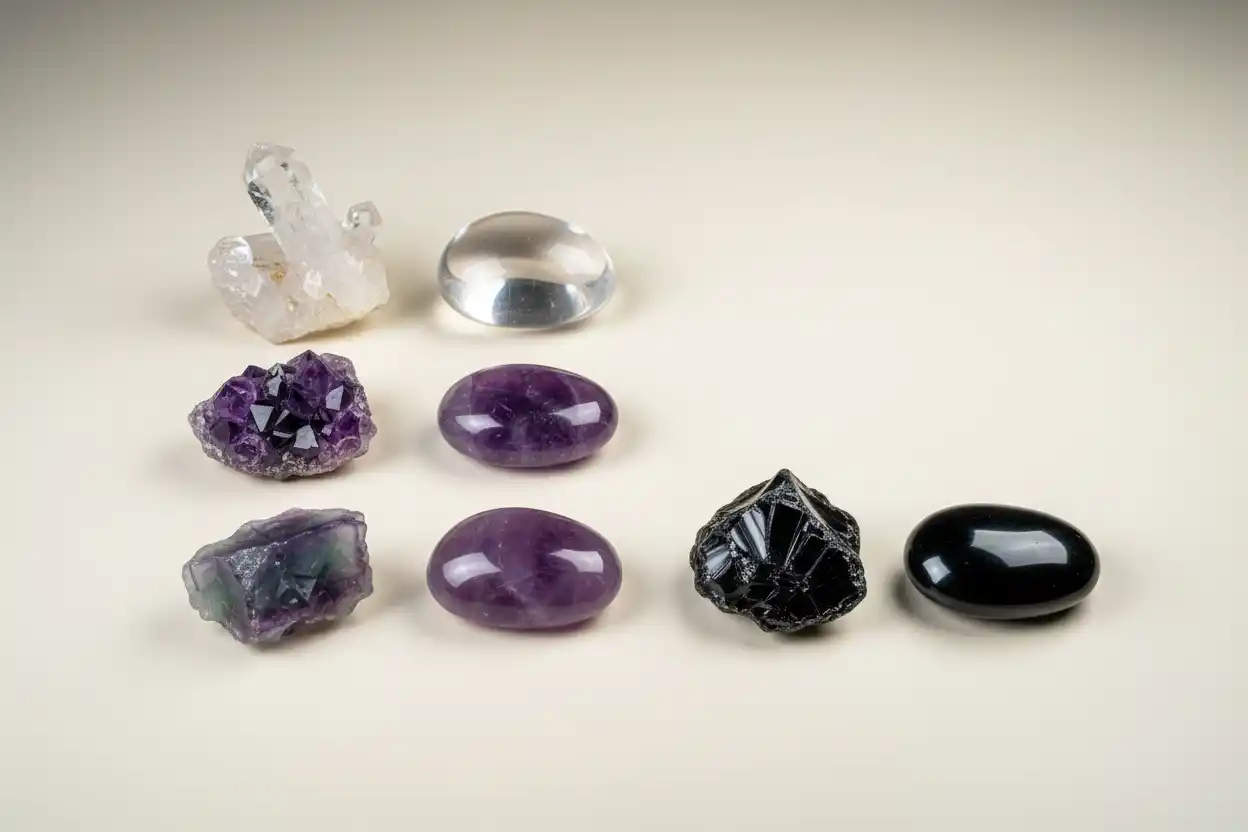
Raw vs Polished Crystals: Differences, Benefits and Uses
Raw crystals preserve more of a mineral’s natural growth surfaces, fractures, matrix and crystal habit. Polished crystals have been shaped with abrasives to create smoother surfaces, stronger color contrast and forms suited to carrying, jewelry, carving or display.
Neither format is universally better. A mineral collector may prefer an undamaged natural crystal because the faces, terminations and associated matrix preserve geological information. Someone choosing a comfortable pocket stone may prefer a polished form. Jewelry normally requires cutting or polishing so that the material fits a setting and does not expose dangerously sharp edges.
The format also does not determine whether a stone is genuine. Natural rough can be dyed, coated, glued, acid-etched or assembled. A polished stone can be entirely natural except for its shape. Identity, treatment and workmanship should be evaluated separately.
Raw and Polished Crystals at a Glance
| Feature | Raw crystal | Polished crystal |
|---|---|---|
| Surface | Natural growth faces, fractures or broken rough | Smoothed with abrasives |
| Shape | Controlled by crystal growth and breakage | Controlled by lapidary work |
| Geological information | Often preserves habit, matrix and associations | Some external evidence is removed |
| Comfort | May be sharp, fragile or uneven | Usually easier to hold or carry |
| Color | Can appear muted by rough surfaces | Often looks deeper or clearer |
| Inclusions | May be difficult to see | Windows and smooth surfaces may reveal them |
| Durability | Delicate terminations may chip | Rounded edges can reduce chipping |
| Jewelry use | Limited unless drilled, wrapped or set | Suitable for beads, cabochons and faceted gems |
| Price basis | Specimen quality, natural form and rarity | Material quality plus cutting labor |
| Cleaning | Natural crevices trap dirt | Smooth surfaces are usually easier to clean |
| Authentication | Habit and matrix can provide clues | Optical features may be easier to inspect |
| Spiritual use | Often associated with natural form | Often associated with comfort and deliberate shaping |
What Does Raw Crystal Mean?
Raw generally means that the material has not been fully fashioned into a polished gemstone, bead, cabochon or carving.
The word is not a guarantee that the crystal remains exactly as it left the ground. Rough may have been trimmed, cleaned, stabilized, repaired, acid-treated or separated from matrix.
A broken chunk of mineral can also be called raw even when it does not preserve natural crystal faces. Conversely, a complete undamaged specimen with crystal terminations is more accurately described as a natural crystal specimen.
Gem rough refers to material selected as a potential source for cutting. Not all raw crystal is gem quality, and not all gem rough is attractive enough to remain a display specimen.
The planned types-of-gemstones guide will explain how rough minerals, rocks, natural glasses and organic gem materials enter the lapidary trade.
What Does Polished Crystal Mean?
A polished crystal has had part of its surface ground and smoothed with progressively finer abrasives.
The process may create a tumbled stone, palm stone, sphere, tower, freeform, cabochon, bead, carving or faceted gem.
Polishing does not normally alter the mineral species. Quartz remains quartz after it becomes a sphere, and obsidian remains volcanic glass after it becomes a cabochon.
However, treatment may accompany polishing. Fractures can be filled, porous material stabilized, pale stones dyed and surfaces coated. The gemstone treatments guide explains these modifications separately.
Natural Crystal Shape Versus Manufactured Shape
A crystal’s natural habit develops from its internal structure and growth conditions. Quartz may form six-sided prisms with terminations, pyrite may form cubes and fluorite may form cubes or octahedrons.
A polished tower with six flat sides is a lapidary shape, not proof that the stone grew as one natural crystal.
The crystal shapes and meanings guide owns the difference between natural habits and manufactured spiritual forms.
Terms such as point, generator, wand and tower may describe retail shapes without identifying the material’s original growth form.
Why Polishing Changes Color
A rough surface scatters light in many directions. Tiny pits, fractures and irregular textures can make transparent material appear cloudy or pale.
Polishing creates a smoother boundary, allowing light to enter and exit more predictably. Consequently, the same stone may appear darker, more saturated or more transparent after polishing.
This change does not mean dye was necessarily added. Wetting rough has a similar temporary effect because water fills surface irregularities.
However, extreme color differences deserve investigation. A polished stone may have received dye, resin, oil or a coating in addition to ordinary lapidary work.
Raw Crystals for Mineral Collecting
Collectors often value natural crystal faces, terminations, growth zoning, twinning and mineral associations.
A quartz crystal attached to feldspar and mica can reveal a pegmatite environment more clearly than a polished quartz sphere. Pyrite on shale or prehnite with epidote also retains locality-specific context.
Damage affects specimen value. A natural termination is generally more desirable than a repaired tip, while a rare crystal may remain valuable despite contacts caused during geological growth or mining.
Polishing a scientifically or historically important specimen can destroy evidence and reduce collector value. The decision should be made before grinding begins.
Polished Stones for Carrying
Smooth stones are more practical for pockets, bags and repeated handling.
Rounded edges reduce snagging and make the object comfortable during meditation or tactile grounding exercises. The upcoming tumbled-stones guide owns tumbling media, quality and beginner use.
A polished surface can still scratch or chip. Carrying quartz beside fluorite, calcite or selenite may damage the softer material.
Pouches and separate compartments are more effective than assuming a rounded stone is indestructible.
Raw Versus Polished for Jewelry
Most conventional jewelry uses polished material because smooth surfaces interact better with settings, clothing and skin.
Cabochons suit opaque, translucent and phenomenal stones. Faceting creates controlled reflections in transparent gems. Beads require drilling and smoothing around the holes.
The best gemstones for carving and cabochons guide owns material selection for shaped ornamental work.
Raw jewelry remains possible. Wire-wrapped crystal points, natural nuggets and druzy clusters can create distinctive pieces, but sharp surfaces and fragile terminations need protection.
A drilled rough crystal is no longer completely untouched. The hole, glue or mounting should be inspected as carefully as the mineral.
Which Is More Durable?
The answer depends on the mineral and shape.
A polished rounded stone may survive impact better because it lacks thin points and sharp corners. Tumbled quartz is generally more practical than an elongated quartz cluster in a pocket.
Polishing cannot remove a mineral’s cleavage. A polished fluorite, topaz or kunzite can still split along structural planes.
The gemstone hardness chart explains scratch resistance, while gemstone toughness versus hardness explains why breakage cannot be predicted from Mohs hardness alone.
Internal fractures may become more visible after polishing and can weaken either format.
Raw Versus Polished for Identification
Raw crystals can preserve useful clues: habit, matrix, associated minerals, weathering and natural surface textures.
Polished stones allow other features to be seen more clearly. Smooth windows reveal inclusions, color zoning, bubbles, flow lines and aggregate structure.
Neither format guarantees easy identification. A rough green chunk can be serpentine, prehnite, fluorite, glass or another material. A polished purple stone can be amethyst, fluorite, glass, dyed quartz or synthetic material.
Use the beginner’s crystal identification guide rather than relying on texture or color alone.
Destructive scratch, flame and acid tests should not be performed on a valued specimen.
Fake and Altered Raw Crystals
The word raw can create false confidence.
Common alterations include gluing crystals onto matrix, repairing broken terminations, dyeing geodes, coating quartz with metals, acid-etching glass and assembling clusters from separate pieces.
Some laboratory-grown crystals also preserve sharp geometric shapes. A crystal-looking object is not automatically natural.
The laboratory-grown versus natural gemstones guide explains why manufactured crystals, treated natural material and imitation glass are different categories.
Inspect glue lines, repeated identical shapes, color concentration in fractures and coatings that stop at protected areas.
Treatments in Polished Stones
Polishing may reveal treatment or conceal it.
Dye can concentrate in cracks and drill holes. Resin can make porous material appear smoother. A coating may produce color that disappears where the surface is scratched.
Polished turquoise, jade, opal, quartz, agate and many other stones can be treated legitimately when the process is disclosed.
A polished appearance should never be advertised as natural proof. Ask for the exact mineral, treatment and whether the product is solid, stabilized, reconstructed or composite.
Raw Quartz Versus Polished Quartz
Quartz shows the contrast clearly.
Raw crystals may preserve prisms, terminations, growth striations, twins, inclusions and attached matrix. Polished quartz reveals internal veils, rainbows, mineral inclusions and clarity more easily.
Transparent rough suitable for faceting may be more valuable after skilled cutting, while an intact unusual crystal could lose collector value if polished.
Amethyst geodes are usually kept partly raw because the natural crystal-lined cavity is the central attraction. Individual amethyst rough may instead be tumbled, carved or faceted.
Raw Fluorite Versus Polished Fluorite
Fluorite forms attractive cubes and octahedrons that mineral collectors often preserve.
Polished fluorite can reveal bands of purple, green, blue and yellow more evenly, but it remains soft and cleavage-sensitive.
Rounded fluorite is easier to hold but not necessarily stronger internally. A fall can still split it.
Aggressive polishing may remove etched surfaces, phantoms or natural forms that made the original specimen distinctive.
Raw Pyrite Versus Polished Pyrite
Pyrite commonly forms cubes and pyritohedrons with metallic striated surfaces.
Polished pyrite may appear in beads, cabochons and small metallic facets. The surface becomes smoother, but brittleness and oxidation risk remain.
Natural crystal geometry usually provides greater collector interest than a generic polished pebble. Jewelry buyers may prefer the latter for comfort and setting compatibility.
Neither form belongs in drinking water or prolonged moisture.
Raw Obsidian Versus Polished Obsidian
Obsidian is natural volcanic glass rather than a mineral crystal.
Fresh broken obsidian can have extremely sharp edges. Polishing transforms it into safer cabochons, mirrors, beads and palm stones.
The process may reveal sheen, snowflake patterns or rainbow layers that remain difficult to see on rough surfaces.
A polished obsidian item still fractures like glass. Rounded edges reduce immediate cutting risk but do not make it impact-resistant.
Raw Selenite Versus Polished Selenite
Selenite is crystalline gypsum with very low hardness and strong cleavage.
Commercial satin-spar gypsum is frequently cut into polished wands, towers and bowls. Those shapes are manufactured even when the material itself is natural.
Raw bladed or transparent crystals preserve more geological form but can split and scratch easily.
Polishing does not make gypsum water-safe. Both formats require dry, gentle handling.
Which Form Is Easier to Clean?
Polished surfaces are usually easier because dirt has fewer cavities in which to collect.
Raw clusters may trap dust between points and matrix minerals. A soft dry brush is often safer than soaking, especially when the mineral identity or matrix is uncertain.
The which-crystals-can-go-in-water guide explains why water safety depends on solubility, porosity, fractures, treatments and associated minerals.
The sunlight-sensitive crystals guide should be checked before drying or displaying colored minerals in direct sun.
Raw Versus Polished for Spiritual Practice
Some practitioners believe raw stones have a stronger, less directed energy, while polished stones feel softer or more focused.
These interpretations vary and cannot be measured scientifically. Cutting does not remove the mineral’s composition, crystal structure or geological origin.
Practical differences are easier to establish. A smooth palm stone is comfortable during meditation. A natural cluster creates a visually complex display. A tower provides a deliberate symbolic shape.
The best form is the one that supports the practice safely without requiring unsupported claims that one is universally more powerful.
Cleansing Raw and Polished Crystals
Physical cleaning and spiritual cleansing should remain separate.
Raw material may include soluble minerals, metallic sulfides, matrix or repaired sections that cannot tolerate water. Polished stones may contain dye, resin, glue or coatings.
The how-to-cleanse-crystals guide covers symbolic methods. Sound, quiet reflection and placement on a clean cloth avoid many material risks.
Never use salt, acid or prolonged soaking simply because a stone is labeled raw and natural.
Price Differences
Raw material is not always cheaper.
Common broken rough may cost less because no lapidary labor was added. A complete natural crystal with rare habit, locality or matrix can cost far more than a polished stone of the same mineral.
Polished stones include yield loss, cutting time, equipment, skill and quality control. Fine faceting can add substantial value when the rough has sufficient transparency and color.
Poor polishing can reduce value through uneven surfaces, flat spots, undercutting or loss of optical effect.
Compare like with like rather than assuming raw means wholesale and polished means overpriced.
Ethical and Environmental Considerations
Neither format is automatically more ethical.
Raw crystals still require mining, sorting, transport and retail. Polishing adds energy, water, abrasives and labor, but it may also allow fractured rough to be used efficiently rather than discarded.
Ask sellers about locality, labor conditions, treatment and whether the material is newly mined, old stock or recycled from existing jewelry.
A vague “ethically sourced” label should be supported by specific information.
The online gemstone buying guide provides wider seller-verification safeguards.
Choosing Between Raw and Polished
Choose raw when natural crystal habit, matrix, locality and geological structure are central to the purchase.
Choose polished when comfort, jewelry use, visible inclusions, easy cleaning or controlled optical performance matters more.
For a beginner, owning both formats can be useful. Comparing one rough piece with one polished piece of the same mineral reveals how surface texture changes color and transparency.
The decision does not need to reflect a spiritual hierarchy. It should match the material, use and care routine.
Frequently Asked Questions
1. Are raw crystals more powerful than polished crystals?
There is no scientific evidence that raw crystals have stronger energy. The two forms differ physically in shape, comfort and preserved surface features.
2. Are polished crystals still natural?
They can be. Polishing changes the surface and shape but does not automatically make the material synthetic or imitation.
3. Does polishing remove a crystal’s properties?
It does not remove mineral composition or crystal structure. It may remove natural faces, matrix, surface features and part of the original rough.
4. Are raw crystals always untreated?
No. Rough can be dyed, coated, stabilized, repaired, glued or acid-etched.
5. Why do polished stones look darker?
A smooth surface scatters less light and allows color and transparency to appear more clearly.
6. Which form is better for carrying?
A polished palm or tumbled stone is usually more comfortable and less likely to snag or expose sharp edges.
7. Which form is better for mineral collecting?
Natural undamaged crystals generally preserve more geological information and often attract greater specimen interest.
8. Are tumbled stones the same as polished stones?
Tumbled stones are one type of polished stone. Polishing also includes cabochons, beads, spheres, carvings and faceted gems.
9. Can raw crystals be used in jewelry?
Yes, but fragile points, sharp edges and drilling or glue quality must be considered.
10. Is a polished stone more durable?
Rounded edges can reduce chipping, but polishing does not remove cleavage, internal fractures or material softness.
11. Which form is easier to identify?
Raw material may preserve habit and matrix, while polished material may reveal inclusions and optical features. Neither format guarantees identification.
12. Should beginners buy raw or polished crystals?
Choose according to use. A polished stone suits handling, while raw material is better for studying natural form. One of each provides a useful comparison.
Raw and polished crystals answer different needs. Rough preserves more evidence of growth and geological context; polishing makes color, inclusions and practical use easier to appreciate. Neither form proves authenticity or spiritual strength. The better choice is the one whose identity, workmanship and physical limitations fit what the owner plans to do with it.