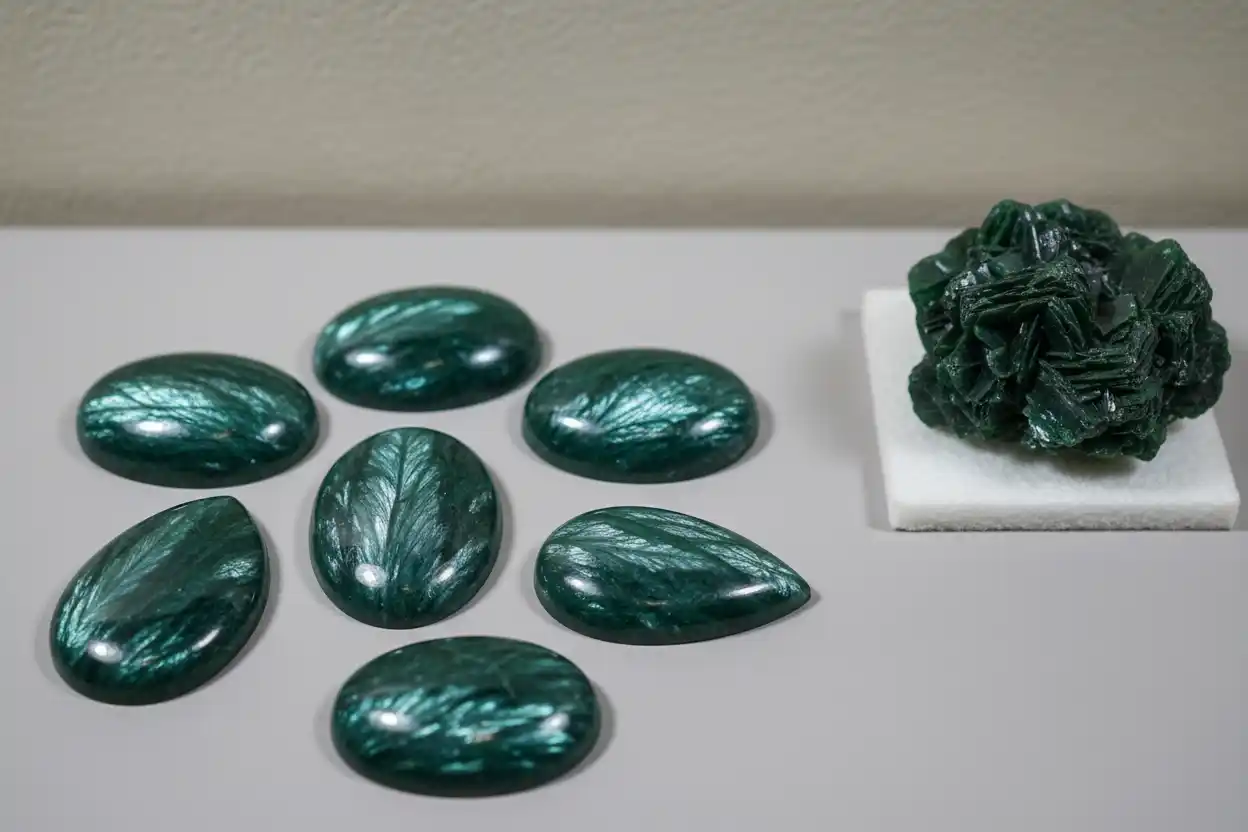
Seraphinite: Meaning, Properties & Symbolism
Seraphinite is the decorative trade name for a plumose, radiating variety of clinochlore, a magnesium-rich member of the chlorite mineral group. Its defining feature is a deep green body crossed by silvery, pearly fibers that resemble feathers, frost, or sweeping wings when the stone moves beneath a light.
Unlike transparent faceted gems, seraphinite is usually cut as cabochons, tablets, beads, and carvings so its directional fibers remain visible. Its low hardness and perfect cleavage make it visually distinctive but unsuitable for careless everyday wear.
Seraphinite at a Glance
| Property | Seraphinite |
|---|---|
| Composition | Magnesium-iron-aluminum silicate hydroxide; clinochlore, approximately Mg₅Al(AlSi₃O₁₀)(OH)₈ |
| Group or type | Chlorite-group phyllosilicate; plumose variety of clinochlore |
| Color | Dark green, forest green, grey-green, yellow-green, sometimes nearly black, with silver or pale green fibers |
| Crystal system or texture | Monoclinic; foliated, fibrous, or radiating aggregate |
| Habit | Platy, tabular, foliated, massive, radiating, feather-like |
| Luster | Pearly, vitreous, greasy, or silky |
| Transparency | Translucent to opaque |
| Mohs hardness | Approximately 2–2.5 |
| Cleavage | Perfect basal cleavage |
| Tenacity | Flexible in thin lamellae but not elastic; aggregates remain fragile |
| Common uses | Cabochons, pendants, beads, carvings, display slabs, collector material |
| Primary care concern | Very low hardness, cleavage, abrasion, heat, chemicals, and possible impregnation |
What Is Seraphinite?
Seraphinite is not a separate mineral species. Mineralogically, it is clinochlore whose crystals or lamellae form radiating, plumose, or feathery patterns suitable for ornamental cutting.
Clinochlore belongs to the chlorite group, a family of sheet silicates that commonly forms during metamorphism and hydrothermal alteration. The sheets separate readily along perfect basal cleavage, which explains both the stone’s pearly reflections and its physical delicacy.
The commercial name refers mainly to appearance. Ordinary clinochlore without the characteristic silver-green feathering may be scientifically identical at the species level but would not normally receive a premium seraphinite label.
Seraphinite appears among uncommon ornamental materials in the broader guide to types of gemstones. It also belongs in the alphabetical crystals that start with S and gemstones that start with S directories.
Why Does Seraphinite Look Like Feathers?
The silver “feathers” are not painted markings or metallic inclusions applied to the surface. They arise from radiating, densely packed clinochlore plates and fibers that reflect light differently from the surrounding green material.
Each tiny lamella has a preferred orientation. As the stone moves, some surfaces catch the light while neighboring areas become darker, producing a shifting silky or chatoyant effect.
Cutting orientation controls the result. A cabochon sliced across a well-organized plumose aggregate may show broad sweeping wings, while another section of the same rough may reveal short needles, mossy patches, or weak indistinct streaks.
The strongest patterns combine several features:
- High contrast between dark green body color and pale reflective fibers
- Broad, continuous feather structures rather than scattered scratches
- A mobile pearly flash that changes under directional light
- Enough depth to prevent the surface from looking flat or chalky
- Limited fractures, pits, or dull areas interrupting the design
A stationary photograph can exaggerate or conceal this phenomenon. For that reason, video under one moving light provides a better view than an overexposed front-facing image.
Composition and Mineral Family
Clinochlore is a magnesium-rich chlorite with aluminum in both octahedral and tetrahedral structural positions. Iron, chromium, nickel, manganese, and other elements may substitute into the lattice.
Iron commonly contributes to the green body color. Trace chromium can deepen or modify green tones in some material, although not every vivid specimen is chromium-rich.
The mineral’s sheet structure resembles aspects of other phyllosilicates, but seraphinite should not simply be called mica. Micas and chlorites belong to different structural groups and have different chemistry, even though both can split into thin plates.
Similarly, the feathering does not consist of mica inclusions embedded inside an unrelated host. The reflective structures are usually part of the clinochlore aggregate itself.
How Seraphinite Forms
Clinochlore develops during low- to medium-grade metamorphism and hydrothermal alteration. Magnesium- and iron-rich rocks react with water-bearing fluids, causing earlier minerals to transform into chlorite-group phases.
The process commonly affects ultramafic rocks, basic igneous rocks, iron-rich formations, marbles, skarns, schists, and hydrothermal vein systems. Temperature, pressure, fluid chemistry, and the composition of the original rock determine which chlorite species forms.
Seraphinite-quality material requires more than the presence of clinochlore. The crystals must grow in organized radiating or plumose aggregates, remain compact enough to cut, and develop enough color contrast to create the characteristic pattern.
The best-known commercial source lies in the Korshunovskoye iron deposit near Zheleznogorsk-Ilimsky in Russia’s Irkutsk region. There, clinochlore occurs in an iron-rich geological environment and can form dense masses with sweeping reflective structures.
This setting differs from the formation of transparent crystals in open cavities. Seraphinite rough usually appears as compact, patterned material rather than clean individual crystals intended for faceting.
Color and Pattern Variations
Dark forest green is the market ideal because it provides strong contrast with the silvery fibers. Medium green, grey-green, yellow-green, and nearly black material also occurs.
Some pieces show pale mint fibers on a softer green body. Others contain brown, black, white, or grey areas caused by iron oxides, associated minerals, weathering, fractures, or uneven composition.
The pattern can appear as:
- Long angel-wing or fern-like plumes
- Short radiating sprays
- Dense frost-like networks
- Parallel silky streaks
- Irregular mossy or clouded patches
- Broad patches with weak reflection
Not every highly patterned piece has strong chatoyancy. A stone may show attractive pale markings but little movement under light, while another may look understated until tilted.
Seraphinite is naturally relevant to collections of green crystals and green gemstones. Nevertheless, its value comes more from pattern and optical movement than from green saturation alone.
Seraphinite and Related Green Minerals
Seraphinite may be confused with several green ornamental stones, especially in polished form.
Fuchsite is chromium-bearing muscovite. It tends to show glittering mica flakes, a lighter green color, and a more sparkly appearance rather than seraphinite’s directional silver plumes.
Kammererite is chromium-rich clinochlore, usually recognized by pink, purple, or reddish-violet color. Although it belongs to the same mineral species, its visual identity differs substantially.
Green aventurine typically shows small reflective mica or hematite platelets distributed through quartz. The green aventurine body is harder, more granular, and less foliated than seraphinite.
Nephrite can resemble compact green seraphinite when feathering is weak. However, nephrite is far tougher and harder, with an interlocking amphibole-fiber structure rather than easily cleaved chlorite sheets.
Retailers may loosely associate seraphinite with jade because both can be green and carved. Seraphinite is neither jadeite nor nephrite, and the jade label should not be used as a mineralogical identity.
How to Identify Seraphinite
Visual identification begins with its combination of deep green color, silver-green plumose structure, pearly reflections, low hardness, and platy texture.
The reflective markings should appear internal or structurally integrated rather than printed on the surface. Under magnification, they often resolve into fine blades, fibers, or lamellar aggregates.
Seraphinite scratches easily. Even quartz dust can abrade its polish, while a steel point can damage it readily. Destructive scratch testing should never be performed on a finished stone.
Measured properties commonly include a refractive index near 1.57–1.59 and specific gravity around 2.6–2.7, although aggregate texture can make readings difficult. More transparent areas may show green pleochroism.
The most reliable confirmation uses Raman spectroscopy or X-ray diffraction to identify clinochlore. Chemical analysis can detect magnesium, aluminum, iron, chromium, and associated elements.
The broader how to identify crystals guide explains why trade name, color, hardness, magnification, and analytical testing should be considered together.
Treatments and Surface Enhancement
Seraphinite may receive wax, oil, resin, or polymer impregnation. These treatments can deepen color, improve surface luster, conceal porosity, or strengthen fragile material.
Waxing is difficult to distinguish from an ordinary polish without magnification or chemical testing. Excess material may collect in pits, scratches, drill holes, and fractures.
Polymer impregnation can improve durability, but it also changes the stone’s response to heat, solvents, repair work, and repolishing. Sellers should disclose stabilization rather than describe all treated material simply as natural and untreated.
Backing may be used to support thin cabochons or intensify dark color. Assembled pieces can include a seraphinite layer glued to another material.
Artificial dye is less common than impregnation, yet pale porous material can absorb color. Dye may concentrate along fractures or produce an unnaturally uniform green.
The principles in gemstone treatments explained apply directly: treatment does not necessarily make a stone undesirable, but undisclosed treatment prevents an informed comparison.
Synthetic Seraphinite and Imitations
Laboratory-grown clinochlore may be produced for research, but synthetic seraphinite is not an established commercial gemstone category. Most deceptive products are imitations, composites, or incorrectly named natural stones.
Dyed marble, resin, printed glass, polymer clay, and low-grade green rocks can reproduce the general color. However, they rarely imitate the mobile feathering convincingly.
Fuchsite-rich rock may be sold as seraphinite because both contain reflective green sheet silicates. The sparkle pattern usually differs under magnification and movement.
Artificially patterned resin may show repeated feather motifs, bubbles, mold marks, low density, or a plastic surface. Printed patterns can appear sharp at one depth and disappear at the edge.
The distinction between imitation and laboratory-grown material is explained more broadly in lab-grown vs natural gemstones.
Cutting and Polishing Behavior
Seraphinite is usually cut into low or medium domed cabochons. A cutter studies the orientation of the reflective fibers before marking the rough because an incorrect slice can weaken the plumose effect.
The material grinds rapidly because of its low hardness. Excess pressure can tear lamellae, create pits, or open cleavage planes.
Polishing requires a light touch and fine abrasives. A high dome is not always desirable because thin edges and steep shoulders chip easily.
Backing can support a fragile slice, although it should be disclosed. Drilling beads also creates risk around the hole, where cleavage and vibration may lead to breakage.
Carvings work best in compact, stable material. Fine protruding details are vulnerable, while broad rounded forms preserve the pattern and resist accidental snapping.
Durability and Jewelry Suitability
Seraphinite is one of the softer ornamental materials used in jewelry. Its hardness of roughly 2–2.5 means ordinary household dust, harder gemstones, metal edges, and rough fabric can scratch it.
Perfect cleavage adds another weakness. A blow may lift a thin layer, chip an edge, or split a cabochon.
Pendants, brooches, earrings, and collector pieces offer safer settings. Rings should be reserved for occasional wear and protected by a substantial bezel.
Bracelets expose the stone to desks, walls, and neighboring beads, so they usually show abrasion faster. Long strands can also strike hard surfaces when worn.
Jewelers need treatment information before setting or repair. Heat from a torch can damage the mineral, soften wax, discolor polymer, or open existing fractures.
Seraphinite Value and July 2026 Asking Prices
Seraphinite is generally valued by pattern, cut, size, stability, and appearance rather than a standardized per-carat schedule.
As of July 2026, small commercial cabochons and polished pieces commonly carry asking prices around $10–$50 each. Larger cabochons with strong silver plumes, cleaner polish, and a well-centered pattern often appear around $40–$150.
Matched pairs, designer cuts, and bead strands may ask approximately $35–$125, depending on consistency and quality. Large slabs, carvings, collector rough, and display pieces commonly range from $75 to $500 or more.
The highest prices usually reflect broad continuous feathering, dark green contrast, good movement under light, scarce large sizes, stable rough, and careful cutting. Weight alone adds little value when the pattern is weak or the material is fractured.
Because retail naming and treatment disclosure vary widely, detailed seller selection belongs on the dedicated where to buy seraphinite page.
Buying Seraphinite
Request a video under one moving point of light. The silver structures should brighten and fade naturally as the stone tilts.
Photographs should show the front, back, edge, and any drill holes. These views can reveal backing, glue, open cleavage, resin-filled pits, and differences between the patterned surface and the underlying material.
Ask the seller to disclose wax, oil, resin, polymer stabilization, dye, backing, repair, and country of origin. “Natural seraphinite” does not automatically mean untreated.
For jewelry, inspect thin points and sharp corners. Rounded outlines usually survive better than narrow marquise tips or delicate freeforms.
Return terms matter because pattern can look very different under ordinary room lighting. The general how to buy gemstones online framework helps evaluate photographs, measurements, seller language, and return policies.
Cleaning and Storage
Wipe seraphinite with a soft, slightly damp cloth. If necessary, use a small amount of mild soap and dry the stone immediately.
Do not scrub it with a stiff brush. Abrasive cloths, polishing powders, toothpaste, and jewelry-cleaning pastes can remove the surface finish.
Avoid soaking, steam, hot water, bleach, acids, alcohol, acetone, and strong commercial dips. Liquids and solvents may enter cleavage, affect wax, or attack polymer treatments.
Ultrasonic cleaning is inappropriate because vibration can separate layers or enlarge hidden fractures. The guide to gemstones in ultrasonic cleaners explains why visual soundness does not guarantee structural stability.
Seraphinite should not be treated like durable quartz in water-based rituals or fountains. Guidance on crystals you can put in water provides the wider care distinction.
Store each piece in a padded compartment away from harder gems. Keep pendants from rubbing against chains, clasps, or metal findings.
Seraphinite Meaning and Symbolism
The name seraphinite evokes seraphim, the winged beings described in Abrahamic religious traditions. The commercial association arose from the stone’s feather-like pattern rather than evidence that ancient communities used this mineral under the same name.
Modern crystal traditions commonly interpret seraphinite as a symbol of inner reflection, compassionate action, personal growth, and connection with a larger purpose. Its silver-green plumes may also represent renewal, movement, or emerging from a period of change.
Green material is often associated symbolically with balance, vitality, nature, and emotional steadiness. Meanwhile, the shifting reflective fibers can serve as a visual reminder that perception changes with perspective.
These meanings belong to cultural, spiritual, and personal belief systems. Scientific evidence does not show that seraphinite heals organs, detoxifies the body, repairs cells, or produces guaranteed psychological effects.
A person may still choose it as a meditation object, keepsake, artistic material, or reminder of a personal commitment. Others value it entirely for its mineralogy, Russian locality, plumose growth, and unusual optical texture.
Frequently Asked Questions
1. Is seraphinite a separate mineral species?
No. It is the decorative trade name for plumose or radiating clinochlore.
2. What creates the silver feathers in seraphinite?
Oriented clinochlore lamellae and fibers reflect light from different directions, producing pale feather-like flashes.
3. Does seraphinite contain actual silver?
No. Its silvery appearance comes from reflected light rather than metallic silver.
4. Is seraphinite a type of mica?
No. Clinochlore is a chlorite-group mineral, although its sheet structure can resemble mica visually.
5. Is seraphinite the same as kammererite?
No. Both are clinochlore varieties, but kammererite is typically chromium-rich and pink to purple.
6. Is seraphinite a form of jade?
No. It is neither jadeite nor nephrite and is much softer than both jade minerals.
7. Where does most commercial seraphinite come from?
The best-known source is the Korshunovskoye iron deposit in Russia’s Irkutsk region.
8. Can seraphinite be worn every day?
Daily wear is not recommended because the stone scratches, cleaves, and abrades easily.
9. Is seraphinite commonly treated?
Waxing, oiling, resin filling, and polymer impregnation can occur, particularly in porous or fragile material.
10. How can a strong seraphinite pattern be judged online?
Look for moving-light video, dark green contrast, broad continuous plumes, clean polish, and views of the back and edges.
11. Can seraphinite go in an ultrasonic cleaner?
No. Ultrasonic vibration can open cleavage planes and damage treated or fractured material.
12. Why do two seraphinite cabochons from the same slab look different?
Each slice intersects the radiating clinochlore structures at a different angle, changing the pattern and reflective movement.
Seraphinite is most compelling when its natural feathering remains broad, mobile, and structurally intact. Pattern quality, treatment disclosure, and a protective setting matter far more than weight or an exaggerated grade label.