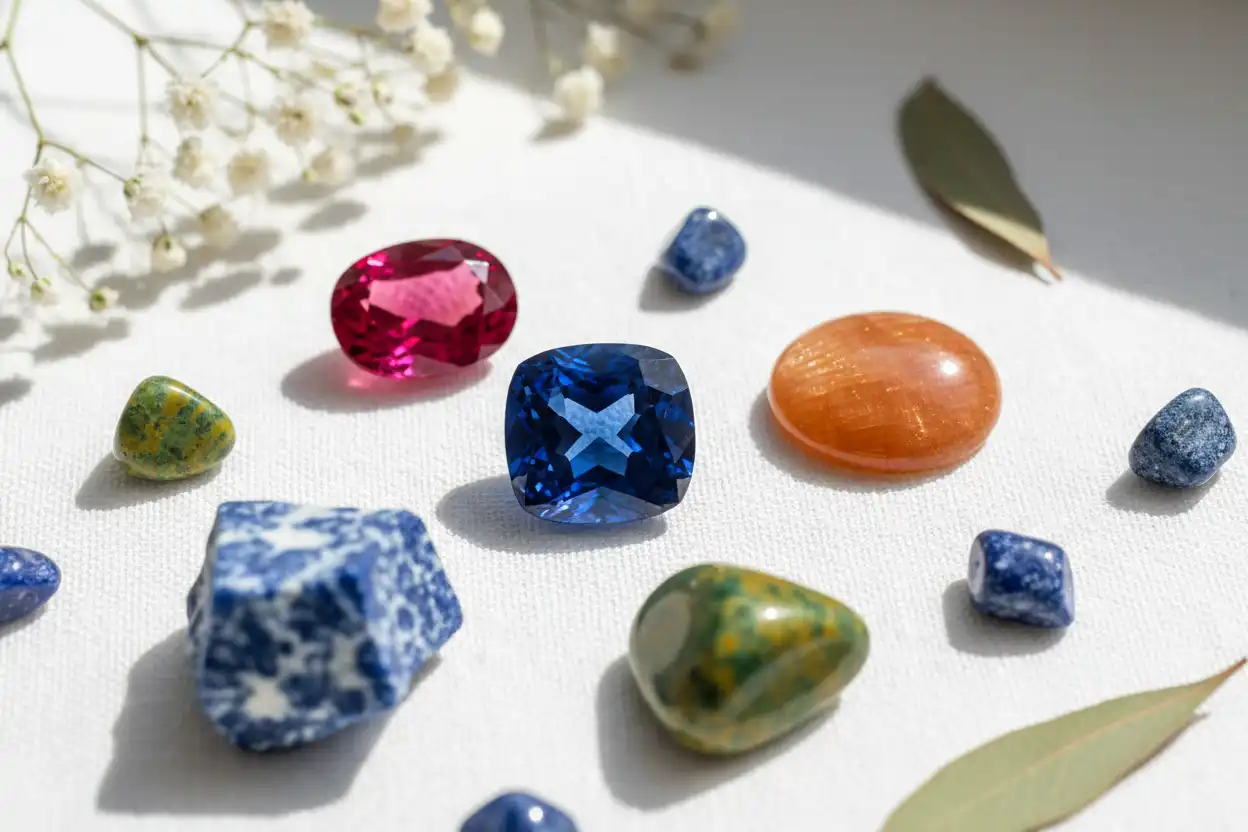
Gemstones That Start With S: A–Z Guide
Gemstones and gem materials that start with S include sapphire, sardonyx, scapolite, scheelite, scolecite, selenite, septarian, seraphinite, serendibite, serpentine, shattuckite, shungite, silver sheen obsidian, smithsonite, smoky quartz, snow quartz, snowflake obsidian, sodalite, spectrolite, spessartite garnet, sphalerite, sphene, spinel, spirit quartz, star ruby, star sapphire, staurolite, stilbite, strawberry quartz, sugilite, sunstone and Super Seven.
The S directory contains durable fine-jewelry gems, rare collector stones, soft zeolites, volcanic glass, quartz varieties, rocks and trade-named materials.
Traditional meanings are symbolic associations rather than scientifically proven medical effects.
Continue from Gemstones That Start With R. For the broader specimen directory, explore Crystals That Start With S.
S Gemstones at a Glance
| Gemstone or material | Typical appearance | Material type | Common use |
|---|---|---|---|
| Sapphire | Blue or nearly any color except ruby red | Corundum gemstone | Everyday fine jewelry |
| Sardonyx | Brown-red, black and white bands | Chalcedony variety | Cameos, beads and rings |
| Scapolite | Yellow, violet, pink or colorless | Mineral group | Faceted collector jewelry |
| Scheelite | White, yellow, orange or brown | Calcium tungstate mineral | Collector gems |
| Scolecite | White or clear needle-like crystals | Zeolite mineral | Display specimens |
| Selenite | Clear, white or pearly | Gypsum variety | Carvings and decorative pieces |
| Septarian | Brown, yellow and gray cracked patterns | Multi-mineral concretion | Cabochons and carvings |
| Seraphinite | Green with silver feather-like patterns | Clinochlore trade variety | Cabochons and pendants |
| Serendibite | Blue-green, dark blue or black | Rare borosilicate gemstone | Collector jewelry |
| Serpentine | Green, yellow-green or brown | Mineral group or rock | Carvings and cabochons |
| Shattuckite | Vivid blue to blue-green | Copper silicate mineral | Collector cabochons |
| Shungite | Black carbon-rich material | Carbon-rich rock | Beads and carvings |
| Silver Sheen Obsidian | Black glass with silver reflection | Volcanic glass | Cabochons and carvings |
| Smithsonite | Blue, green, pink or yellow | Zinc carbonate mineral | Collector cabochons |
| Smoky Quartz | Pale brown to nearly black | Quartz variety | Faceted jewelry |
| Snow Quartz | Milky white translucent quartz | Quartz variety | Beads and carvings |
| Snowflake Obsidian | Black glass with white-gray spots | Volcanic glass | Cabochons and beads |
| Sodalite | Deep blue with white or gray areas | Feldspathoid mineral | Beads and carvings |
| Spectrolite | Dark feldspar with vivid spectral flash | Labradorite trade variety | Cabochons and jewelry |
| Spessartite Garnet | Orange to reddish orange | Garnet species | Fine jewelry |
| Sphalerite | Yellow, brown, red or black | Zinc sulfide mineral | Collector faceted gems |
| Sphene | Yellow-green, brown or orange | Titanite gemstone | Collector jewelry |
| Spinel | Red, pink, blue, violet or black | Oxide gemstone | Everyday fine jewelry |
| Spirit Quartz | Main quartz crystal covered in smaller crystals | Quartz formation | Collector jewelry and specimens |
| Star Ruby | Red corundum displaying a star | Corundum variety | Cabochon jewelry |
| Star Sapphire | Sapphire displaying a star | Corundum variety | Cabochon jewelry |
| Staurolite | Brown cross-shaped crystals | Silicate mineral | Pendants and specimens |
| Stilbite | White, peach, pink or yellow | Zeolite mineral | Collector specimens |
| Strawberry Quartz | Pink-red included quartz | Quartz trade variety | Cabochons and beads |
| Sugilite | Purple, violet or magenta | Cyclosilicate mineral | Cabochons and fine ornamental jewelry |
| Sunstone | Peach, orange, red, green or sparkling | Feldspar gemstone | Faceted and cabochon jewelry |
| Super Seven | Purple, clear or smoky included quartz | Commercial included quartz | Cabochons and collector pieces |
Sapphire
Sapphire is corundum in every color except the red material classified as ruby.
Its colors include:
- Blue.
- Pink.
- Yellow.
- Green.
- Purple.
- Orange.
- White.
- Black.
- Color-changing combinations.
Sapphire is traditionally associated with wisdom, loyalty, discipline and commitment.
Its hardness makes it one of the strongest colored gemstones for everyday rings.
Natural stones may be heated, diffusion-treated, fracture-filled or laboratory-grown. Valuable purchases should include disclosure of origin and treatment.
Explore major commercial colors and varieties in Types of Sapphire.
Sardonyx
Sardonyx is banded chalcedony composed of sard-colored layers and onyx-like white or dark bands.
It commonly appears:
- Red-brown and white.
- Orange-brown and cream.
- Black and white.
- Brown with parallel layers.
Sardonyx is traditionally associated with discipline, confidence and loyalty.
Its chalcedony toughness makes it suitable for:
- Cameos.
- Intaglios.
- Rings.
- Beads.
- Carved pendants.
Dyeing and assembled layered material may be used to improve contrast.
Scapolite
Scapolite refers to a mineral group and solid-solution series capable of producing transparent gemstones.
Colors include:
- Yellow.
- Violet.
- Pink.
- Colorless.
- Gray.
- Blue.
Scapolite is traditionally associated with independence, clear purpose and problem-solving.
Some stones display cat’s-eye effects or fluorescence.
Its moderate hardness and cleavage make pendants and earrings safer than exposed everyday rings. Transparent faceted scapolite remains primarily a collector gem.
Scheelite
Scheelite is a calcium tungstate mineral and an important source of tungsten.
It may appear:
- White.
- Yellow.
- Orange.
- Brown.
- Greenish.
- Transparent to opaque.
Many specimens fluoresce strongly under ultraviolet light.
Scheelite is traditionally associated with focus, persistence and careful learning.
It is dense, relatively soft and brittle. Faceted material is mainly collected rather than worn regularly.
Protect crystals from impact, scratches and prolonged unnecessary ultraviolet exposure.
Scolecite
Scolecite is a zeolite mineral commonly found as white or colorless needle-like crystals.
It may form:
- Radiating sprays.
- Fibrous masses.
- Slender prisms.
- Rounded aggregates.
Scolecite is traditionally associated with calm, reflection and simplifying an overloaded routine.
Its soft, cleavable crystals are too delicate for ordinary jewelry. Natural sprays should remain in protected display boxes and should not be washed or brushed.
Selenite
Selenite is the transparent or crystalline variety of gypsum.
The name is also frequently applied in retail settings to fibrous satin spar.
Selenite is traditionally associated with clarity, simplicity and mental organization.
Gypsum has a Mohs hardness of 2 and can be scratched by a fingernail.
Selenite is used for carvings, pendants and decorative pieces, but it should be kept dry and away from abrasion.
The guide to Selenite vs. Satin Spar explains how the two gypsum forms differ.
Septarian
Septarian is a decorative concretion containing natural cracks filled with minerals such as calcite, aragonite or barite.
It commonly displays:
- Brown matrix.
- Yellow or golden fillings.
- Gray limestone.
- White or dark veins.
Septarian is traditionally associated with stability, cooperation and bringing separate parts together.
It is a multi-mineral rock rather than one gemstone species.
Polished material is used for cabochons, carvings, beads and decorative slabs. Acidic cleaners can damage its carbonate components.
Seraphinite
Seraphinite is a trade name for green clinochlore with silver, feather-like chatoyant patterns.
It is traditionally associated with:
- Growth.
- Self-reflection.
- Compassion.
- Personal improvement.
- Recognizing recurring patterns.
Seraphinite is commonly cut as cabochons to display its reflective fibers.
Its layered structure makes it soft and vulnerable to scratches, pressure and abrasion. Pendants and earrings are safer than rings.
Serendibite
Serendibite is a rare borosilicate mineral found in dark blue-green, blue, gray, black and nearly colorless material.
Transparent facetable stones are extremely uncommon.
Serendibite is traditionally associated with individuality, persistence and independent judgment.
High-value stones require laboratory identification because dark serendibite can resemble sapphire, spinel and other collector gems.
Protected pendants or collector settings are preferable to everyday rings.
Serpentine
Serpentine refers to a mineral group and to rocks composed largely of serpentine minerals.
Colors include:
- Pale green.
- Yellow-green.
- Olive.
- Brown.
- Cream.
- Nearly black.
Serpentine is traditionally associated with renewal, adaptability and connection with nature.
It is widely carved and may imitate jade. However, serpentine is generally softer and has different structural properties.
Avoid cutting, sanding or grinding unidentified rough material because some serpentinite rocks may contain hazardous fibrous minerals.
Shattuckite
Shattuckite is a copper silicate hydroxide mineral known for vivid blue and blue-green color.
It may occur as:
- Fibrous crystals.
- Botryoidal coatings.
- Veins.
- Quartz inclusions.
- Mixtures with malachite or chrysocolla.
Shattuckite is traditionally associated with communication, honesty and expressing complex ideas clearly.
Compact material may be polished into cabochons, but many specimens are too fragile for exposed jewelry.
Avoid acids, prolonged soaking and consumable water preparations because the mineral contains copper.
Shungite
Shungite is a black carbon-rich rock associated most famously with Karelia, Russia.
It ranges from dull, earthy material to rarer lustrous varieties.
Shungite is traditionally associated with grounding, stability and boundaries.
It is used for beads, carvings and polished decorative pieces.
Claims that ordinary shungite can reliably purify drinking water or treat health conditions should not replace certified filtration or medical care.
Common substitutes and misleading products are covered in Real vs. Fake Shungite.
Silver Sheen Obsidian
Silver sheen obsidian is black volcanic glass with a silver-gray reflective effect.
The sheen comes from microscopic structures or inclusions formed as the glass cooled.
It is traditionally associated with awareness, protection and clear boundaries.
Silver sheen obsidian is commonly used for:
- Cabochons.
- Beads.
- Carvings.
- Spheres.
- Pendants.
It takes a smooth polish but can develop extremely sharp chipped edges after impact.
Smithsonite
Smithsonite is a zinc carbonate mineral known for rounded botryoidal surfaces and pastel colors.
It may appear:
- Blue.
- Green.
- Pink.
- Yellow.
- White.
- Gray.
- Brown.
Smithsonite is traditionally associated with gentleness, patience and gradual development.
Compact material may be cut into cabochons, but the mineral is soft, brittle and acid-sensitive.
Most fine specimens are better suited to protected collection displays than frequently worn jewelry.
Smoky Quartz
Smoky quartz ranges from pale gray-brown to deep brown and nearly black.
Its color develops through natural or artificial irradiation interacting with trace components in quartz.
Smoky quartz is traditionally associated with grounding, focus and practical judgment.
Its hardness makes it suitable for:
- Rings.
- Earrings.
- Pendants.
- Bracelets.
- Faceted statement gems.
Very dark commercial material may have been irradiated to intensify its color. Treatment is generally stable but should be disclosed when known.
Snow Quartz
Snow quartz is a trade name for milky white quartz with a cloudy or softly translucent appearance.
Its whiteness is produced by microscopic inclusions and internal light scattering.
Snow quartz is traditionally associated with patience, clarity and simplicity.
It is commonly used for beads, carvings and cabochons.
Quartz-level hardness supports casual jewelry, although heavily fractured pieces and sharp points still require impact protection.
Snowflake Obsidian
Snowflake obsidian is black volcanic glass containing white or gray rounded structures commonly composed of cristobalite.
The patterns may resemble:
- Snowflakes.
- Flowers.
- Stars.
- Scattered circles.
- Irregular pale patches.
Snowflake obsidian is traditionally associated with balance, acceptance and recognizing patterns.
It is widely used for beads, cabochons and carvings.
As with other volcanic glass, broken edges may be extremely sharp.
Sodalite
Sodalite is a blue feldspathoid mineral commonly found with white calcite, gray areas or darker blue patches.
It is traditionally associated with logic, communication and clear thinking.
Sodalite is commonly fashioned into:
- Beads.
- Cabochons.
- Carvings.
- Pendants.
- Decorative objects.
It can resemble lapis lazuli or azurite but usually lacks prominent metallic pyrite.
Sodalite is softer than quartz and should be protected from scratches, acids and prolonged soaking.
Spectrolite
Spectrolite is a trade name associated with high-quality Finnish labradorite displaying strong spectral colors against a dark base.
Its flashes may include:
- Blue.
- Green.
- Yellow.
- Orange.
- Red.
- Violet.
Spectrolite is traditionally associated with transformation, confidence and creativity.
Cabochon cuts emphasize the moving flash. Feldspar cleavage means rings require protection from impact.
The name should be used accurately for qualifying material rather than as a general label for every dark labradorite.
Spessartite Garnet
Spessartite is a manganese-aluminum garnet known for orange, reddish-orange and brownish-orange colors.
Bright stones are sometimes called mandarin garnets.
Spessartite is traditionally associated with creativity, motivation and confidence.
Its good hardness and lack of prominent cleavage make it suitable for rings, earrings and pendants.
Color, clarity, size and origin influence the values discussed in the spessartite garnet price guide.
Sphalerite
Sphalerite is a zinc sulfide mineral occurring in yellow, orange, red, brown, green and black.
Transparent stones can show exceptional dispersion and bright spectral fire.
Sphalerite is traditionally associated with discernment, vitality and recognizing personal resources.
Despite its brilliance, it is soft, brittle and strongly cleavable.
Faceted sphalerite is primarily a collector gem suited to display or protected occasional wear.
Sphene
Sphene, also called titanite, is known for strong dispersion that can create vivid rainbow fire.
Its colors include:
- Yellow-green.
- Green.
- Brown.
- Orange.
- Gray.
- Black.
Sphene is traditionally associated with creativity, insight and seeing connections between ideas.
It is softer and more brittle than major everyday gemstones.
Sphene vs. Demantoid Garnet compares two highly dispersive green gems with very different structures and durability.
Spinel
Spinel is a durable gemstone found in:
- Red.
- Pink.
- Blue.
- Violet.
- Gray.
- Black.
- Orange.
- Color-changing varieties.
It is traditionally associated with renewal, resilience and recovering motivation.
Historically, some famous red spinels were mistaken for rubies.
Spinel’s hardness and lack of prominent cleavage make it suitable for everyday rings and bracelets.
Explore its major commercial shades in Types of Spinel.
Spirit Quartz
Spirit quartz is a trade name for quartz whose central crystal is covered by many smaller crystals.
It is also known as cactus quartz.
Common colors include:
- Clear.
- White.
- Purple.
- Yellow.
- Smoky.
- Gray.
Spirit quartz is traditionally associated with cooperation, unity and shared growth.
The fine surface crystals can chip or collect dirt. Most pieces are better suited to protected pendants or display than rings and bracelets.
Star Ruby
Star ruby is red corundum cut as a cabochon to display asterism, usually as a six-rayed star.
The effect is produced by oriented needle-like inclusions reflecting light.
Star ruby is traditionally associated with courage, purpose and commitment.
The most desirable stars are:
- Sharp.
- Centered.
- Complete.
- Visible under a direct light.
- Mobile across the surface.
Synthetic and treated star stones exist. Natural origin and treatment should be documented for valuable gems.
Star Sapphire
Star sapphire is sapphire that displays a star-shaped reflection when cut with a domed surface.
Colors include:
- Blue.
- Black.
- Gray.
- Pink.
- Purple.
- Yellow.
- White.
Star sapphire is traditionally associated with discipline, guidance and loyalty.
Asterism results from aligned inclusions rather than an engraved or painted design.
Stone quality depends on body color, star sharpness, centering, movement and treatment.
Staurolite
Staurolite is a brown, reddish-brown or nearly black mineral known for cross-shaped twinned crystals.
The natural crosses may form:
- Right-angle intersections.
- X-shaped twins.
- Intersecting prisms.
- Crystals embedded in mica-rich matrix.
Staurolite is traditionally associated with strength, endurance and perseverance.
Natural crosses are used in pendants and collector jewelry, but matrix-backed pieces can be fragile.
Avoid aggressive cleaning that could loosen the crystal from its host rock.
Stilbite
Stilbite is a zeolite mineral commonly found in white, cream, peach, pink and pale yellow crystals.
It often forms:
- Sheaf-like clusters.
- Bladed crystals.
- Rounded groups.
- Radiating formations.
Stilbite is traditionally associated with openness, patience and gentle change.
Its softness and cleavage make it unsuitable for ordinary jewelry. Fine clusters should remain dry and protected from brushing, rubbing and pressure.
Strawberry Quartz
Strawberry quartz is a trade name for transparent or translucent quartz containing pink, red or reddish-brown inclusions.
Its internal features may appear as:
- Speckles.
- Clouds.
- Fine flakes.
- Layered patterns.
- Red-pink threads.
Strawberry quartz is traditionally associated with joy, affection and emotional warmth.
Natural included quartz exists, but glass, dyed quartz and manufactured composites may use the same name.
Bubbles, molded surfaces and overly uniform color can indicate imitation.
Sugilite
Sugilite is known for purple, violet, magenta and reddish-purple material, often with dark matrix.
It is traditionally associated with individuality, self-respect and healthy boundaries.
Sugilite is commonly cut into:
- Cabochons.
- Beads.
- Inlay.
- Carvings.
- Statement pendants.
Fine vivid purple material is uncommon and may be valuable.
Dyed, reconstructed and misidentified purple materials exist, so significant purchases benefit from professional identification.
Sunstone
Sunstone is a feldspar gemstone known for warm colors and, in some pieces, aventurescent sparkle.
Its colors include:
- Peach.
- Orange.
- Red.
- Yellow.
- Green.
- Colorless.
- Bicolored combinations.
Sunstone is traditionally associated with confidence, optimism and independence.
Transparent material may be faceted, while included stones are often cut as cabochons.
Color, clarity, optical effect and origin influence the figures discussed in the sunstone price guide.
Super Seven
Super Seven is a commercial name used for included quartz, often purple, smoky or clear.
Sellers may claim it contains combinations of:
- Amethyst.
- Clear quartz.
- Smoky quartz.
- Rutile.
- Goethite.
- Lepidocrocite.
- Cacoxenite.
Not every specimen contains all seven claimed components, and visual inspection cannot reliably confirm each inclusion.
Super Seven is traditionally associated with integration, cooperation and personal growth.
It is used in cabochons, pendants and collector pieces.
Which S Gemstones Are Best for Jewelry?
Strong choices include:
- Sapphire.
- Spinel.
- Star ruby.
- Star sapphire.
- Spessartite garnet.
- Smoky quartz.
- Sunstone.
- Sardonyx.
Suitable with protection:
- Spectrolite.
- Sugilite.
- Sodalite.
- Snowflake obsidian.
- Silver sheen obsidian.
- Seraphinite.
- Strawberry quartz.
Primarily collector materials:
- Scheelite.
- Scolecite.
- Stilbite.
- Selenite.
- Shattuckite.
- Smithsonite.
- Sphalerite.
- Serendibite.
Care Guide for S Gemstones
- Confirm sapphire and star-stone treatments before mechanical cleaning.
- Keep gypsum and zeolites dry and separate from harder gems.
- Avoid acids on smithsonite and carbonate-rich septarian.
- Do not soak copper-bearing shattuckite.
- Protect feldspar gems from cleavage-related impacts.
- Keep iron sulfides and porous rocks in controlled conditions.
- Store druzy or clustered surfaces where crystals cannot rub together.
- Avoid cutting unidentified serpentine material.
- Treat volcanic glass as chip-prone despite its polished surface.
Before using steam or ultrasound, check which gemstones can enter ultrasonic cleaners.
Frequently Asked Questions
What is the most valuable gemstone that starts with S?
Fine sapphire can reach exceptional values. Rare serendibite, vivid spinel and high-quality spessartite garnet can also be expensive.
Which blue gemstones start with S?
Sapphire, sodalite, shattuckite, blue smithsonite and blue spinel are notable examples.
Which purple gemstones start with S?
Sugilite, spirit quartz, violet spinel, purple sapphire and some Super Seven specimens are notable choices.
Is selenite suitable for jewelry?
Only in very protected designs. Its extreme softness makes it unsuitable for rings or bracelets.
Is shungite a crystal?
No. It is a carbon-rich rock.
Is spectrolite the same as labradorite?
Spectrolite is a trade name associated with high-quality Finnish labradorite showing strong spectral flashes.
Is star sapphire naturally star-shaped?
The star is a natural optical effect produced by aligned inclusions and revealed through cabochon cutting.
Does Super Seven always contain seven minerals?
No. The trade name does not guarantee that every claimed component is present.
Continue the Gemstone Alphabet
Continue with Gemstones That Start With T, or browse all alphabetical directories through the Crystals 101 collection.