Shattuckite: Meaning, Properties & Symbolism
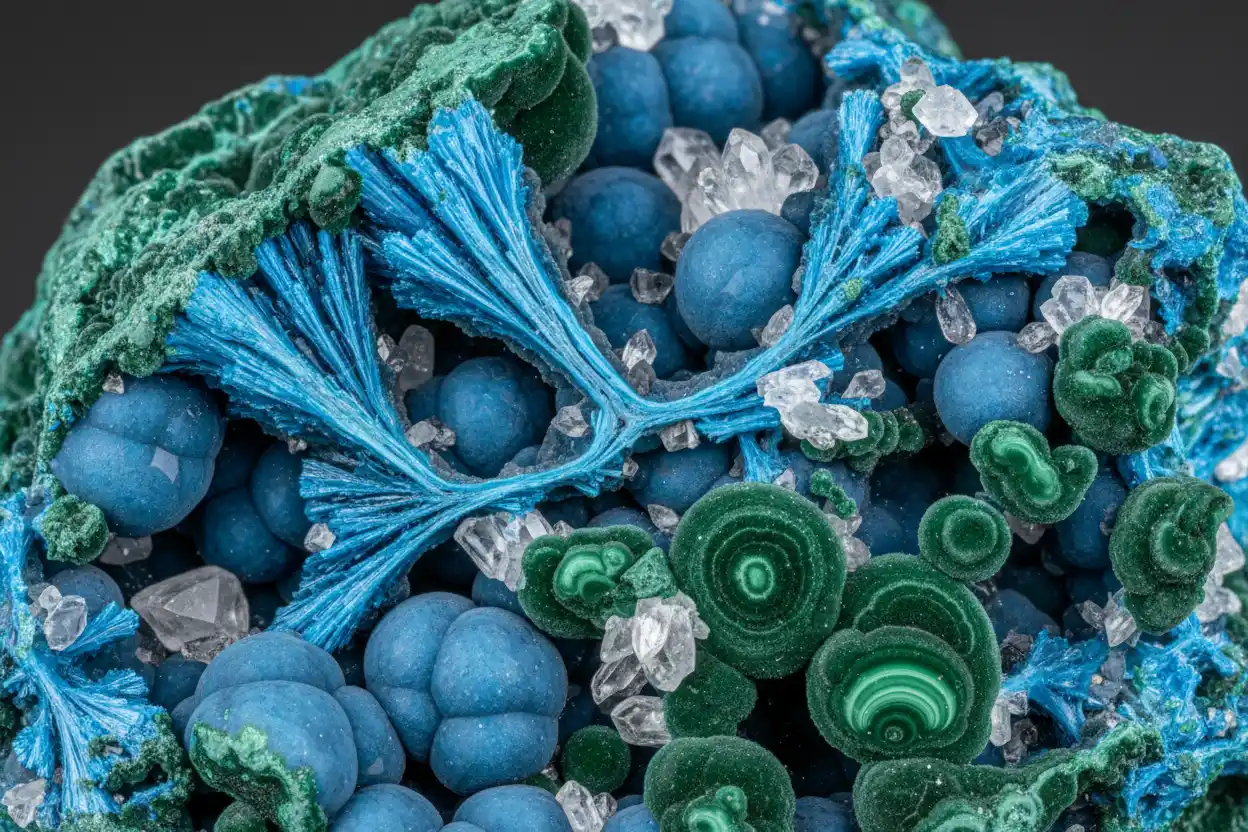
Shattuckite is a rare secondary copper silicate known for deep azure, turquoise-blue, and blue-green fibrous aggregates. It commonly forms in the oxidized zones of copper deposits, where slender orthorhombic crystals gather into silky sprays, rounded crusts, vein fillings, and pseudomorphs after earlier copper minerals.
Although compact material can be polished into striking cabochons, most shattuckite remains a collector mineral. Its low hardness, perfect cleavage, brittleness, and frequent association with softer copper minerals require careful handling.
Shattuckite at a Glance
| Property | Shattuckite |
|---|---|
| Composition | Copper silicate hydroxide, Cu₅(SiO₃)₄(OH)₂ |
| Group or type | Secondary copper silicate mineral |
| Color | Medium blue, deep blue, turquoise blue, blue-green |
| Crystal system or texture | Orthorhombic |
| Habit | Acicular, fibrous, radiating, spherulitic, botryoidal, massive, pseudomorphic |
| Luster | Silky, vitreous, dull, or pearly |
| Transparency | Semitransparent to opaque |
| Mohs hardness | Approximately 3.5 |
| Cleavage | Perfect in two directions |
| Tenacity | Brittle |
| Common uses | Mineral specimens, cabochons, slabs, beads, carvings, occasional-wear jewelry |
| Primary care concern | Scratching, cleavage, fractures, copper-bearing dust, and mixed-mineral sensitivity |
What Is Shattuckite?
Shattuckite is a copper-bearing silicate that develops during the alteration of copper deposits near the Earth’s surface. Its blue color comes from copper in the mineral structure rather than from dye or reflected light.
The mineral was named after the Shattuck Mine in Bisbee, Arizona, where it was recognized in the early twentieth century. Material from the type locality included shattuckite replacing earlier malachite while preserving parts of the original external form.
That replacement process produces a pseudomorph. The new mineral changes the internal chemistry and structure, yet the specimen retains the shape of the mineral that existed before it.
Shattuckite belongs among specialized copper minerals rather than a broad family of mainstream faceted gems. The types of gemstones guide provides the wider classification, while this page focuses on shattuckite’s individual mineralogy and lapidary use.
It also appears in the crystals that start with S and gemstones that start with S directories.
Composition and Crystal Structure
Shattuckite contains copper, silicon, oxygen, and hydroxyl groups. Copper accounts for its strong blue color and relatively high density.
The mineral crystallizes in the orthorhombic system. Well-formed individual crystals are uncommon and generally small, while radiating groups of needles or fibers are much more characteristic.
Its measured specific gravity is about 4.1, which is unusually high for a nonmetallic blue mineral. A compact piece may therefore feel heavier than similarly sized chrysocolla, dyed howlite, or glass.
Two directions of perfect cleavage run through the structure. These planes create a significant weakness even when the material looks dense and solid from the outside.
How Shattuckite Forms
Shattuckite forms in oxidized copper deposits, usually above or near the water table where oxygen-rich fluids alter primary copper sulfides and earlier secondary minerals.
Rainwater and groundwater move through fractured ore, carrying dissolved copper and silica. As temperature, acidity, and chemical conditions change, shattuckite precipitates in cavities, fractures, porous rock, or replacement zones.
The mineral commonly forms after other copper minerals have already developed. It may replace malachite, chrysocolla, dioptase, or earlier silicates while preserving part of their textures.
Because several alteration reactions can occur in one deposit, a single specimen may contain blue shattuckite intergrown with green malachite, turquoise chrysocolla, dark iron oxides, clear quartz, or sparkling dioptase.
These associations make specimens visually attractive, but they complicate identification. A polished stone sold under one name may contain several copper minerals rather than chemically pure shattuckite.
Color and Optical Appearance
Shattuckite ranges from light turquoise blue to saturated azure and dark navy blue. Greenish areas usually reflect mineral intergrowth, chemical variation, or associated malachite and chrysocolla.
Fibrous aggregates can produce a silky or softly chatoyant appearance. Light reflects from aligned crystals, causing pale bands or moving highlights across a polished cabochon.
The color is generally natural. However, oil, wax, resin, or strong photographic saturation can make blue areas appear darker and more uniform.
Shattuckite fits naturally into collections of blue crystals and blue gemstones. Its diagnostic character, though, depends on composition, texture, density, and mineral association rather than color alone.
Crystal Habits and Internal Features
Radiating sprays are among the mineral’s most recognizable forms. Fine needles may gather into rounded spherules, fibrous seams, fan-like groups, or botryoidal crusts.
Compact massive material often contains curved blue patterns crossed by green, black, white, or brown veins. These areas may represent chrysocolla, malachite, quartz, calcite, iron oxides, or remnants of the host rock.
Open cavities can contain delicate crystal fibers that should not be touched. Even light pressure from a finger or cleaning brush can flatten or break the needles.
Polished material commonly shows fractures, uneven porosity, fibrous undercutting, and differences in luster between mineral zones. Resin may collect in these openings during stabilization or polishing.
Important Shattuckite Localities
The Shattuck Mine at Bisbee, Arizona, is the type locality and remains historically important. Other Arizona copper districts, including the Ajo area, have produced shattuckite-bearing material.
Namibia’s Kaokoveld region is famous for vivid blue botryoidal and fibrous specimens. Shattuckite from this region may occur with malachite, chrysocolla, quartz, dioptase, and plancheite.
The Democratic Republic of the Congo and the Republic of the Congo have produced attractive copper-mineral associations, including shattuckite with dioptase, calcite, chrysocolla, and malachite.
Mexico supplies mixed shattuckite-chrysocolla material suitable for slabs, cabochons, and decorative polishing. Smaller occurrences are known from South Africa, Greece, Germany, and other copper-bearing regions.
A dealer should provide a mine, district, or region whenever provenance contributes to price. A country name alone may describe the export route rather than the exact geological source.
Shattuckite and Chrysocolla
Chrysocolla is the material most frequently confused or mixed with shattuckite in polished stones. Both occur in oxidized copper deposits and can show similar turquoise-to-deep-blue colors.
Shattuckite is a recognized crystalline mineral with an orthorhombic structure. Chrysocolla is more compositionally variable and may occur as poorly crystalline or amorphous copper-bearing material.
Pure shattuckite is substantially denser than most chrysocolla. However, a mixed cabochon may not produce a diagnostic bulk density because quartz, malachite, host rock, and resin alter the reading.
Fibrous radiating structure supports shattuckite, whereas chrysocolla frequently forms smooth botryoidal coatings, earthy masses, crusts, or silica-rich aggregates.
Many products described as “chrysocolla shattuckite” genuinely contain both. The combined trade description can be more honest than forcing a mixed rock into one mineral name.
Other Lookalikes
Azurite can produce equally intense blue color, but it is a copper carbonate rather than a silicate. Azurite commonly forms tabular or prismatic crystals and has a different streak, density, optical behavior, and acid response.
Plancheite is structurally and visually close to shattuckite. It often forms pale blue radiating fibers and may occur in the same copper deposits. Reliable separation can require Raman spectroscopy, X-ray diffraction, or chemical analysis.
Ajoite is another blue-green copper silicate. It is especially known as an inclusion in quartz but differs from shattuckite in structure and physical properties.
Dioptase usually has vivid emerald-green color and more glassy individual crystals. It may grow directly on shattuckite, creating valuable contrasting specimens.
Dyed howlite, dyed magnesite, glass, and resin composites can imitate the general color. Uniform pore staining, bubbles, mold lines, or unnatural repeated patterns may reveal them.
How to Identify Shattuckite
Visual identification begins with blue color, fibrous or radiating habit, silky luster, and association with other secondary copper minerals.
Its high density provides a useful clue. A genuine compact specimen often feels unusually heavy compared with plastic, dyed howlite, or many silica-rich blue stones.
Shattuckite produces a blue streak. Nevertheless, streak testing removes material and should not be attempted on polished cabochons or valuable specimens.
A hardness near 3.5 means the mineral scratches more easily than quartz, feldspar, glass, and steel. Scratch testing remains destructive and may expose copper-bearing dust.
Magnification can reveal radiating fibers, perfect cleavage, replacement textures, natural fractures, and intergrowths. However, it cannot always distinguish shattuckite from plancheite or identify every blue component in a mixed cabochon.
Raman spectroscopy, X-ray diffraction, and chemical analysis offer the strongest confirmation. The how to identify crystals guide explains why several independent observations are preferable to one home test.
Treatments and Stabilization
Routine heat treatment is not an established method for improving shattuckite. Most natural specimens are sold without intentional color enhancement.
Compact lapidary material may be impregnated with resin or polymer before cutting. Stabilization strengthens porous zones, fills fractures, improves polish, and reduces crumbling.
Wax and oil can deepen color or create a wetter-looking surface. These coatings may also conceal chalky areas and minor scratches temporarily.
Thin slices can be backed with another stone or resin. A backing may provide useful structural support, but it should be disclosed.
Dye is possible in pale porous matrix or associated minerals. Color concentrated in cracks, drill holes, and soft white areas deserves closer examination.
The gemstone treatments explained guide provides the broader terminology for stabilization, filling, dyeing, coating, and assembly.
Synthetic Shattuckite and Imitations
Shattuckite can be synthesized for mineralogical research, but laboratory-grown gem material does not have an established commercial jewelry market.
Most questionable products are imitations or misidentified mixtures rather than true synthetic shattuckite. Dyed carbonate, dyed howlite, reconstructed powder, glass, resin, and low-grade mixed copper rock may receive the name.
Pressed composites can contain genuine shattuckite or chrysocolla fragments held together with resin. Such material should be sold as reconstructed or composite rather than solid natural stone.
A seller-issued authenticity card does not replace analytical testing. The distinction among natural, synthetic, imitation, and assembled materials is discussed in lab-grown vs natural gemstones.
Cutting and Polishing Behavior
Shattuckite is normally cut as a cabochon, tablet, freeform, bead, or polished slab. Transparent faceting material is not a meaningful commercial category.
Before sawing, a lapidary studies the direction of the fibers, distribution of color, fractures, and associated minerals. The strongest blue area may be too thin or fragile to survive as a finished stone.
Soft fibrous areas grind faster than quartz-rich sections. This uneven wear can produce pits, ripples, undercut zones, and a wavy polish.
Cleavage and brittleness create further risk around thin edges. Rounded cabochon outlines generally survive better than sharp corners or narrow points.
Resin-stabilized material often accepts a more even polish. Buyers should still know whether the appearance depends partly on polymer filling.
Durability and Jewelry Suitability
Shattuckite is not a durable everyday gemstone. Its hardness of approximately 3.5 leaves it vulnerable to scratches from household dust and nearly every common jewelry stone.
Perfect cleavage and brittleness make impact damage more serious. A blow can split a cabochon or detach a blue layer from its matrix.
Pendants, earrings, brooches, and protected display jewelry are more practical than rings or bracelets. A full bezel can guard the edges, although it cannot prevent surface abrasion.
Beads may rub against one another and lose polish. Large drilled pieces can also crack around the hole.
A jeweler should avoid direct torch heat, aggressive pressure, steam, and ultrasonic cleaning. Treatment disclosure becomes particularly important before repair.
Shattuckite Value and July 2026 Asking Prices
Shattuckite is usually priced by the specimen or finished piece rather than through a standardized per-carat system.
As of July 2026, small tumbled pieces and commercial cabochons commonly carry asking prices around $5–$40. Mixed shattuckite-chrysocolla slabs and small polished display pieces often appear around $20–$75.
Attractive thumbnail and miniature specimens with recognizable blue botryoidal or fibrous formation commonly ask $40–$150. Larger, cleaner pieces with strong color contrast, intact fibers, and documented locality may range from $150–$750.
Exceptional associations with dioptase, quartz, or malachite can exceed $1,000. Historic, museum-grade, or unusually large pseudomorphic specimens may reach several thousand dollars, with rare dealer offerings extending beyond $8,000.
High weight does not ensure high value. A smaller undamaged specimen with vivid color and precise locality can be worth more than a large fractured slab containing only a small amount of shattuckite.
Buying Shattuckite
First determine whether the item is a pure mineral specimen, mixed copper-mineral rock, stabilized cabochon, slab, or composite.
Ask the seller to identify associated minerals. Labels such as “shattuckite chrysocolla,” “shattuckite with malachite,” or “copper mineral mix” may be appropriate when the material is visibly intergrown.
Request front, back, edge, and magnified photographs. These views can reveal resin, backing, open fractures, weak fibers, repaired areas, and the thickness of the blue layer.
For a specimen, ask for exact locality, dimensions, condition, and repair disclosure. Fine needles should be inspected for broken tips or flattened areas.
For jewelry, prioritize a protected setting and a clear return policy. The how to buy gemstones online guide covers seller claims, photography, measurements, and independent testing.
Cleaning and Storage
Dust a natural crystal specimen with a gentle hand blower. Avoid wiping or brushing exposed fibrous formations.
A stable polished cabochon can be cleaned with a barely damp soft cloth and a small amount of mild soap. Dry it immediately.
Do not soak shattuckite. Water may enter fractures, affect matrix minerals, loosen repairs, or carry dissolved copper compounds from weathered surfaces.
Steam and ultrasonic cleaning are unsuitable. The guide to gemstones in ultrasonic cleaners explains why vibration and heat threaten cleaved, fractured, or composite material.
The wider crystals you can put in water guidance distinguishes brief surface cleaning from prolonged immersion.
Store shattuckite separately in a padded compartment. A fitted specimen box should support the matrix without touching delicate blue fibers.
Shattuckite Meaning and Symbolism
Shattuckite’s symbolic traditions are modern rather than ancient because the mineral was recognized scientifically only in the twentieth century.
Its deep blue color has encouraged associations with thoughtful communication, honesty, careful listening, and expressing complex ideas clearly. Fibrous patterns may also symbolize connections between separate experiences or perspectives.
Contemporary crystal practices sometimes describe shattuckite as a stone of intuition, spiritual study, self-reflection, and responsible speech. These themes overlap with the symbolism often assigned to blue copper minerals generally.
The mineral’s geological origin can provide a grounded metaphor of its own. Shattuckite forms through alteration and replacement, so some people view it as a reminder that change can preserve parts of an earlier identity while creating something structurally new.
These meanings belong to personal and spiritual belief systems. Scientific evidence does not show that shattuckite treats disease, improves organs, or produces guaranteed psychological effects.
Frequently Asked Questions
1. Is shattuckite a type of chrysocolla?
No. They are distinct copper-bearing materials, although they frequently occur together and may be combined in one polished stone.
2. What gives shattuckite its blue color?
Copper within the mineral’s crystal structure produces its blue-to-blue-green coloration.
3. Is shattuckite the same as plancheite?
No. They are closely related-looking copper silicates, and laboratory analysis may be needed to separate fine fibrous examples.
4. Why is shattuckite so heavy?
Its structure contains a high proportion of copper, giving pure material a specific gravity around 4.1.
5. Can shattuckite form pseudomorphs?
Yes. At its type locality, shattuckite is known to replace malachite while retaining aspects of the earlier mineral’s form.
6. Is shattuckite naturally turquoise blue?
Yes. Natural material ranges from turquoise and medium blue to deep azure and blue-green.
7. Is polished shattuckite commonly stabilized?
Porous or fractured lapidary material may be resin-stabilized to improve strength and polish.
8. Can shattuckite be worn in a daily ring?
No. Its low hardness, perfect cleavage, and brittleness make daily ring wear impractical.
9. How can shattuckite be separated from dyed howlite?
Shattuckite is much denser and may show natural fibrous copper-mineral textures, while dyed howlite often concentrates color in pale veins and pores.
10. Does shattuckite occur with dioptase?
Yes. Blue shattuckite and green dioptase can occur together in oxidized copper deposits and form valuable collector specimens.
11. Can shattuckite go in drinking water?
No. Copper-bearing mineral material should not be used to prepare drinking water or elixirs.
12. What most affects shattuckite specimen value?
Color, intact crystal structure, mineral association, locality, condition, repairs, size, and overall aesthetics are the main factors.
The strongest shattuckite purchase is therefore not simply the bluest piece. It is the specimen or cabochon whose mineral mixture, stabilization, condition, and locality have been described accurately.
Shattuckite contains copper and may occur with other copper minerals. Do not ingest it, prepare drinking water with it, or inhale dust from cutting, sanding, drilling, or broken fibrous material. Lapidary work requires wet methods, local exhaust ventilation, eye protection, suitable respiratory protection, and careful waste handling.