
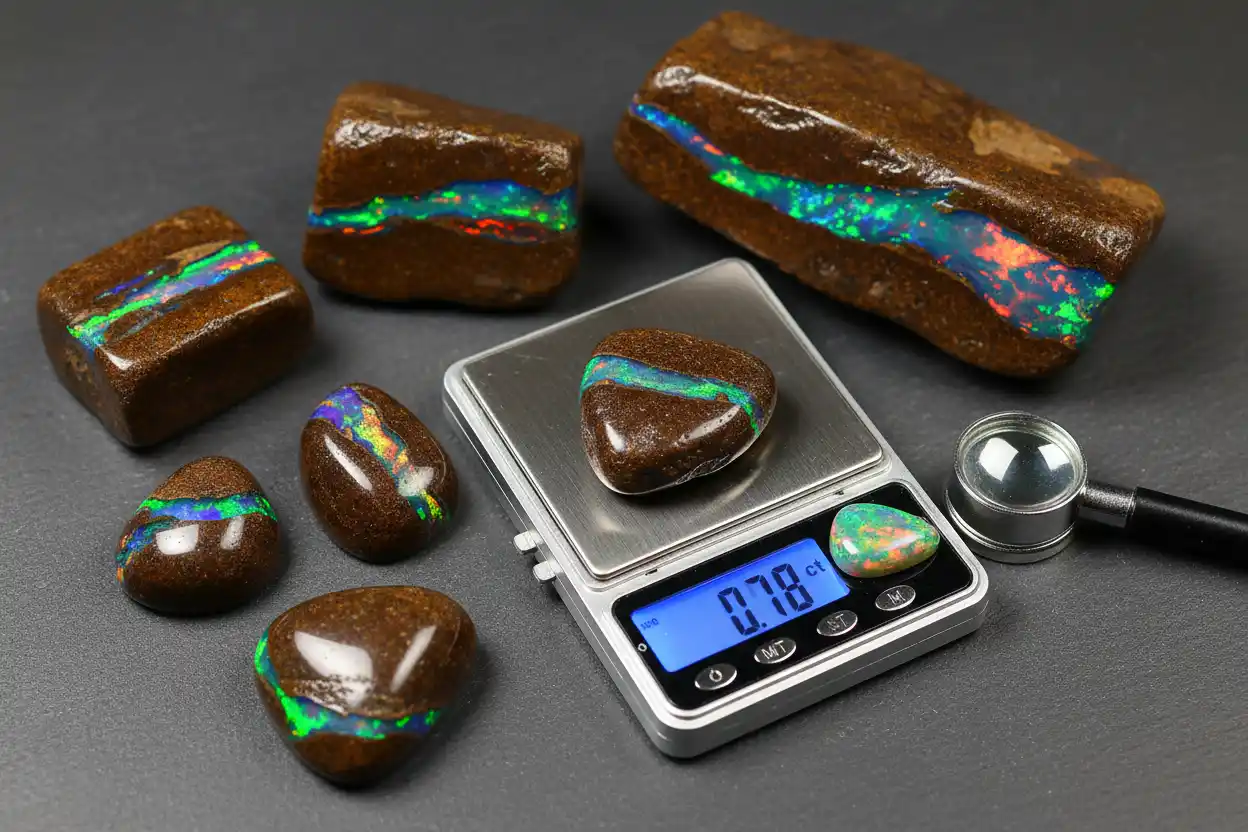

Boulder Opal prices in 2026 typically range from about $20 to $400 per carat for commercial-to-fine stones, while exceptional full-face or vividly patterned material can reach $500 to $3,500 per carat or more. In practice, many Boulder Opals are priced by the individual piece rather than strictly by weight because natural ironstone forms a substantial part of the finished gem.
Brightness, visible play-of-color and composition matter more than carat weight alone. A lighter small stone with intense red and green can be worth far more than a heavy piece dominated by ordinary brown ironstone.
Boulder Opal Prices in 2026
The following bands represent broad U.S. retail expectations for natural Queensland Boulder Opal.
| Boulder Opal quality | Typical characteristics | Approximate 2026 retail price |
|---|---|---|
| Entry commercial | Limited color, substantial plain ironstone, small flashes or pinfire | $10–$50 per carat |
| Good commercial | Visible blue or green, attractive natural matrix and moderate brightness | $50–$200 per carat |
| Fine | Strong brightness, broader color coverage and balanced composition | $200–$600 per carat |
| Extra fine | Vivid multicolor display, desirable pattern and limited distracting matrix | $600–$2,000 per carat |
| Exceptional collector grade | Full-face intense color, dominant red or rare artistic pattern | $2,000–$3,500+ per carat |
These per-carat ranges should be used cautiously. A Boulder Opal containing considerable ironstone can weigh many carats without having a correspondingly high gem-value surface.
The universal value framework appears in How Gemstone Prices Are Determined, but Boulder Opal requires an additional factor: the visual composition of opal and host rock.
What Is Boulder Opal?
Boulder Opal forms as seams, veins and pockets of opal within ironstone concretions. Cutters retain part of the natural ironstone because the precious-opal layer may be too thin to separate safely.
The ironstone is therefore not automatically an artificial backing. In genuine Boulder Opal, it is the host rock in which the opal formed.
Two broad visual styles dominate the market. Full-face Boulder Opal presents a layer of opal across most of the front, while matrix-style pieces show ironstone interwoven visibly with precious-opal seams or patches.
The completed Boulder Opal guide explains its geological identity. The completed Types of Opal page places Boulder Opal within the wider opal family.
Why Boulder Opal Is Often Sold by the Piece
Carat weight includes both precious opal and ironstone. A twenty-carat stone may contain only a thin color seam, while a five-carat gem may show a nearly full face of brilliant opal.
As a result, two stones with identical weight can have radically different values. Buyers should compare face dimensions, color area, brightness and composition before considering carat weight.
Specialist dealers commonly price Boulder Opal as an individual artwork. Per-carat figures remain useful for broad market comparison, but they should not override what the stone actually shows.
Dimensions can be more informative than weight. A thin freeform with a broad colorful face may offer greater visual presence than a heavy domed stone carrying substantial ironstone underneath.
Brightness Drives the Price
Brightness measures how intensely the play-of-color appears. Fine Boulder Opal should show visible color without requiring harsh direct light.
A dark ironstone background can strengthen contrast, but it does not create value when the opal itself is dull. The most valuable stones combine a naturally supportive background with bright, active color.
A stone that performs only under one concentrated lamp should be priced below one that remains vivid in daylight-equivalent and ordinary indoor conditions.
Videos should show movement rather than a single favorable angle. Because Boulder Opal surfaces can undulate, different sections may activate at different times.
Play-of-Color and Predominant Hue
Red generally receives the strongest premium, followed by orange and yellow. Blue and green are more common, although exceptional brightness can make them highly valuable.
Multicolor stones tend to attract stronger demand because they provide greater visual complexity. A full spectrum covering much of the face can lift a stone into a collector tier.
Nevertheless, a vivid blue-and-green Boulder Opal may outperform a weak red example. Color priority should never be separated from intensity and coverage.
Dark ironstone often makes blue and green appear especially saturated. In some stones, the contrast creates a visual effect similar to Black Opal, although the materials have different structures and markets.
The Black Opal Price Guide explains that variety’s separate body-tone valuation.
Pattern and Artistic Composition
Boulder Opal is valued not only as a gemstone but also as a natural composition. Ironstone may frame the color, divide it into rivers, create landscape-like forms or produce intricate abstract patterns.
A larger proportion of visible ironstone is not always a flaw. Balanced matrix can make a stone more distinctive, particularly in Koroit and Yowah material prized for picture-like or web-like designs.
However, plain brown areas that overwhelm the color generally reduce value. The matrix should contribute to the design rather than appear as unused weight.
Central placement also matters. Bright color concentrated near the middle is usually more visually effective than isolated flashes at the corners.
Rare patterns such as well-defined harlequin-like blocks, broad flashes and unusual natural scenes can receive substantial premiums, though pattern descriptions remain subjective.
Full-Face Boulder Opal
Full-face material shows precious opal across most or all of the visible surface. The ironstone remains behind the opal layer but may not be visible from the front.
Fine full-face stones can resemble Black Opal because the dark backing strengthens color contrast. They often occupy the highest Boulder Opal price tier when brightness, color and stability are strong.
The opal layer should still be evaluated for thickness. An extremely thin layer may be vulnerable to polishing or setting damage, even when the face looks impressive.
Buyers should inspect side views to understand how the color layer relates to the backing. An irregular natural boundary supports Boulder Opal identity, whereas a perfectly straight glue line may indicate a doublet.
Koroit, Yowah, Winton and Other Localities
Queensland’s Boulder Opal fields produce visually different material. Winton and Opalton are associated with bright color seams and full-face stones, while Koroit and Yowah are widely known for intricate ironstone matrix patterns.
Locality can influence collector preference, yet it does not replace visual quality. An ordinary stone from a famous field remains ordinary.
Yowah nuts form within rounded ironstone concretions and may reveal pockets, seams or striking central patterns when opened. Their market overlaps Boulder Opal but retains a distinct collector identity.
The completed Yowah Opal guide provides that material-specific background. Locality claims should be supported by a reputable seller rather than inferred solely from appearance.
Boulder Opal Price Examples
| Example | Approximate per-carat range | Approximate total |
|---|---|---|
| 8 ct commercial blue-flash Boulder Opal | $20–$75 | $160–$600 |
| 6 ct good multicolor matrix stone | $75–$250 | $450–$1,500 |
| 5 ct fine full-face Boulder Opal | $250–$800 | $1,250–$4,000 |
| 10 ct extra-fine artistic matrix stone | $500–$1,500 | $5,000–$15,000 |
| Exceptional red-dominant collector stone | $2,000–$3,500+ | Individually negotiated |
The table demonstrates why total weight must be interpreted carefully. A heavy stone with extensive ironstone may carry a modest per-carat figure, while a smaller full-face gem receives a higher one.
Dealers may also quote one total price without publishing a per-carat calculation. That approach is reasonable when the stone’s artistic composition dominates its appeal.
Cut, Shape and Surface
Boulder Opal follows natural color seams, so freeform shapes are normal. Forcing the rough into a calibrated oval may destroy valuable color or remove an attractive section of matrix.
A freeform should still look intentional. Awkward projections, weak balance and unusable mounting shapes can reduce jewelry demand.
The surface may be flat, gently domed or naturally undulating. A skilled cutter follows the opal layer closely while maintaining enough support for durability.
Polish quality matters. Scratches, pits and poorly finished edges reduce value, while overpolishing can remove a thin color seam entirely.
Matching pairs are uncommon and can command premiums. When a seam splits cleanly, its two halves may create mirrored patterns suitable for earrings.
Thickness, Stability and Condition
The natural ironstone backing often gives Boulder Opal better structural support than an unsupported thin opal layer. However, the precious-opal portion remains relatively soft and vulnerable to impact.
Buyers should inspect for crazing, cracks, separation and cottoning. Lifting occurs when the opal layer begins to detach from the ironstone along a weak natural boundary.
Existing damage affects value sharply because repair may require removing part of the color layer. A stone with a hidden crack beneath the surface can also fail during setting.
Condition should be documented before purchasing a valuable loose stone. Videos and close photographs create a useful reference if a dispute arises later.
Complete cleaning and maintenance advice belongs to How to Clean Boulder Opal Jewelry Safely.
Natural Boulder Opal vs Doublets
A Boulder Opal doublet may consist of a thin piece of opal cemented to ironstone. From the face, it can closely resemble natural Boulder Opal.
The distinction appears at the join. A manufactured doublet commonly has a straight, even boundary and may show a thin adhesive line. Natural Boulder Opal usually has a more irregular connection where opal formed within the host rock.
A doublet should not be priced as a solid natural Boulder Opal. It uses less precious-opal material and introduces an adhesive layer that can be affected by moisture, heat and age.
The complete construction comparison belongs to Gemstone Doublets and Triplets. The Real vs. Fake Opal guide covers broader imitation risks.
Treatments and Disclosure
Most high-value Queensland Boulder Opal is sought in natural, untreated form. Still, sellers must disclose impregnation, coloring, resin, backing or repair when present.
Some treated matrix opal is darkened to increase contrast. This material should not be represented as naturally dark Queensland Boulder Opal.
Surface coatings can also create misleading color or gloss. A laboratory or experienced opal specialist may be needed when the treatment is not visible under simple magnification.
The planned How to Spot Treated or Synthetic Opal page owns treatment identification, while Gemstone Treatments Explained provides the general disclosure framework.
Boulder Opal vs Black Opal Price
Fine Black Opal generally occupies the highest opal price tier. Its dark body tone can support extremely vivid play-of-color, and top Lightning Ridge material attracts strong collector demand.
Boulder Opal is often more affordable, but exceptional pieces can compete with fine Black Opal when they show bright red, broad coverage and rare pattern.
The important pricing difference is weight. A Black Opal’s carat weight primarily represents opal, while Boulder Opal includes natural ironstone.
Therefore, a direct price-per-carat comparison can understate Boulder Opal’s face-up value or overstate the importance of its weight. Compare visual dimensions and quality instead.
Boulder Opal vs Ethiopian and Fire Opal
Boulder Opal’s ironstone backing, Queensland origin and cutting style separate it from hydrophane Ethiopian Opal. Their care behavior and price structures should not be treated as equivalent.
The planned Ethiopian Opal Price Guide owns that market. Likewise, the Fire Opal Price Guide should evaluate orange-to-red body color and faceted transparency rather than ironstone composition.
The family-level Opal Price Guide should summarize those distinctions without replacing the dedicated variety pages.
Boulder Opal Jewelry Prices
| Jewelry type | Broad 2026 retail range | Main price drivers |
|---|---|---|
| Silver Boulder Opal pendant | $150–$900 | Commercial stone, size and silver work |
| Fine gold pendant | $1,000–$8,000 | Color quality, custom fitting and gold |
| Boulder Opal earrings | $700–$7,500 | Matching quality, brightness and setting |
| Boulder Opal ring | $1,200–$10,000+ | Stone grade, protective design and workmanship |
| Collector designer jewel | $8,000–$40,000+ | Exceptional opal, one-off composition and brand |
Freeform Boulder Opal often requires a custom setting, increasing labor costs. A bezel or protective border can reduce the chance of edge damage.
The Opal Ring guide, Opal Earrings guide and Opal Necklace guide should own design and style intent.
The Opal Bracelet guide is relevant when considering impact exposure, since bracelets place opal closer to hard surfaces than pendants do.
Certification and Provenance
A laboratory report can confirm natural opal, identify composite construction and disclose detectable treatment. Depending on the report, it may also describe the matrix and record dimensions.
Laboratory identification does not assign an artistic-quality grade. Two natural untreated Boulder Opals with similar dimensions may differ dramatically in value.
For expensive pieces, retain photographs of the face, back and sides. The original invoice should state that the gem is solid natural Boulder Opal rather than a doublet.
The Gemstone Certification Labs comparison explains what laboratory documentation can and cannot establish.
Is Boulder Opal a Good Value?
Boulder Opal can deliver bright Australian play-of-color at lower prices than comparable fine Black Opal. The natural ironstone also creates distinctive designs unavailable in other opal types.
Value is strongest when the buyer appreciates the whole composition rather than viewing every matrix area as wasted material. A dramatic Koroit pattern may be worth more because of its ironstone, not despite it.
At the same time, buyers should avoid paying a high per-carat price for ordinary brown backing. The premium should correspond to brightness, color coverage, artistry and condition.
Price Guide vs Buying Guide
This page owns Boulder Opal’s price structure and value factors. Detailed stone inspection, seller questions and mounting considerations belong to the Boulder Opal Buying Guide.
The general Opal Buying Guide should compare varieties, solid stones and composites. Online shoppers should also use How to Buy Gemstones Online Without Getting Scammed.
The wider Buying & Value hub connects these commercial guides without mechanically repeating their individual advice.
Frequently Asked Questions
1. How much is Boulder Opal worth per carat in 2026?
Commercial material may cost $10 to $200 per carat, while fine stones commonly range from $200 to $600. Exceptional pieces can exceed $2,000 or $3,500 per carat.
2. Why is Boulder Opal often priced by the piece?
Its carat weight includes natural ironstone, so weight does not directly measure the amount or quality of visible precious opal.
3. What makes Boulder Opal expensive?
Strong brightness, red or multicolor play-of-color, broad coverage, rare pattern, balanced matrix composition and good condition create the strongest premiums.
4. Is red Boulder Opal the most valuable?
Red generally receives the highest color premium, but vivid brightness and attractive coverage matter more than a weak isolated red flash.
5. Is visible ironstone a defect?
Not necessarily. Attractive ironstone can frame the color or create a valuable picture-like composition. Plain matrix that overwhelms the opal usually lowers value.
6. What is full-face Boulder Opal?
It has precious opal covering most of the visible front while natural ironstone remains behind as support. Fine full-face stones can occupy the highest price tier.
7. Is Boulder Opal more durable than other opals?
Its ironstone backing can provide structural support, but the opal surface remains vulnerable to scratches, impact and sudden temperature changes.
8. How can I tell Boulder Opal from a doublet?
Natural Boulder Opal usually has an irregular opal-to-ironstone boundary. A doublet often shows a straight join and an adhesive layer.
9. Does Koroit Boulder Opal cost more?
Exceptional Koroit material can command premiums for distinctive matrix patterns. Locality alone does not guarantee high quality.
10. Does carat size increase Boulder Opal’s value?
Only when visible color quality and composition remain strong. Extra ironstone can add weight without adding meaningful value.
11. Does Boulder Opal need a laboratory report?
A report is useful for expensive stones or when natural construction and treatment are uncertain. It does not provide a universal artistic-quality grade.
12. Does Boulder Opal hold its value?
Exceptional documented pieces may attract collectors, but ordinary jewelry often resells below retail. No opal should be purchased on a guarantee of appreciation.
The Face of the Stone Matters More Than Its Weight
Boulder Opal is one of the few gems where the host rock can become part of the finished design. Its best examples balance opal and ironstone so effectively that the stone resembles a miniature abstract landscape.
In 2026, attractive wearable pieces remain available within a few hundred dollars, while vivid full-face and collector-pattern stones can reach several thousand dollars per carat. The most reliable comparison uses brightness, face dimensions, color coverage and composition—not carat weight by itself.