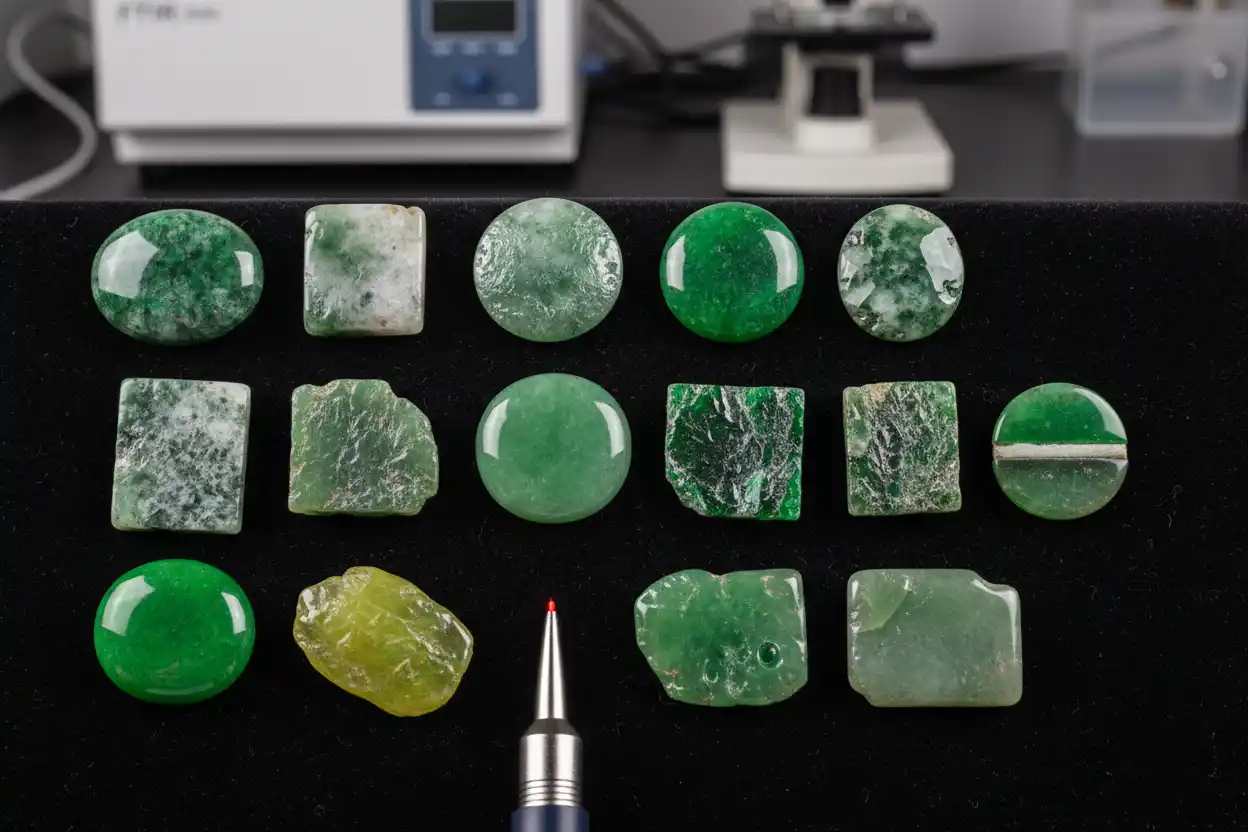
How to Spot Treated or Synthetic Jade
Jade is not one mineral. The name properly covers two tough ornamental materials: Jadeite Jade and Nephrite Jade.
Jadeite is a sodium aluminum pyroxene aggregate. Nephrite is a dense interlocking aggregate of tremolite-actinolite amphiboles. Both can occur naturally in green, white, gray, black, yellow, brown, lavender, and other colors.
Their treatment markets are not identical. The familiar Type A, B, C, and B+C terminology is used primarily for Jadeite. Nephrite can also be dyed, waxed, bleached, filled, coated, or reconstructed, but the same letter system should not automatically be applied to every Nephrite product.
The correct identification begins by determining whether the material is Jadeite or Nephrite. Treatment, composite construction, laboratory growth, and imitation should be addressed only after the jade species has been established.
Jade treatment categories at a glance
| Category | What it is | Common evidence | Correct description |
|---|---|---|---|
| Type A Jadeite | Natural Jadeite untreated except traditional surface wax | Natural texture, Jadeite spectrum, no polymer impregnation | Natural or wax-polished Jadeite |
| Type B Jadeite | Acid-bleached Jadeite impregnated with wax or polymer | Etched grain boundaries, polymer absorption, altered texture | Bleached and impregnated Jadeite |
| Type C Jadeite | Dyed Jadeite | Color in grain boundaries, fractures, pits, and veins | Dyed Jadeite |
| Type B+C Jadeite | Bleached, impregnated, and dyed Jadeite | Polymer plus introduced color | Treated Jadeite |
| Coated Jadeite | Jadeite covered with a colored or transparent film | Surface-only color, scratches, peeling, warm plastic-like feel | Coated Jadeite |
| Type D or composite Jade | A trade term sometimes used for assembled Jade products | Join planes, backing, adhesive, separate layers | Jade composite or doublet |
| Treated Nephrite | Nephrite altered with dye, wax, oil, resin, bleach, or filler | Dye or polymer within fibrous aggregate | Treated Nephrite |
| Reconstructed Jade | Jade fragments or powder bonded with resin or glass | Binder, bubbles, molded construction | Composite containing Jade |
| Laboratory-grown Jadeite | Human-grown crystalline Jadeite material | Synthetic growth and analytical evidence | Synthetic Jadeite |
| Jade imitation | Serpentine, quartz, Aventurine, glass, ceramic, resin, or another material | Different composition and physical properties | Jade simulant |
The two kinds of genuine Jade
Jadeite and Nephrite are both genuine Jade, but they differ in composition, crystal structure, density, hardness, refractive properties, texture, and market history.
The complete distinction appears in Jadeite vs Nephrite, while the broader umbrella definition appears in Jade: Meaning, Healing Properties & Uses.
Jadeite is generally harder, denser, and more granular in microscopic texture. Its finest vivid chromium-green material is known as Imperial Jade.
Nephrite is composed of tightly interwoven amphibole fibers. Its exceptional toughness made it suitable for tools, carvings, ritual objects, bangles, and jewelry over thousands of years.
The individual profiles appear in Jadeite: Meaning, Properties & Symbolism and Nephrite: Meaning, Properties & Symbolism.
Why species identification comes first
The Type A, B, and C classification developed around treated Jadeite. Applying it casually to all green ornamental stones causes confusion.
A piece described as Type A should first be proven to be Jadeite. Serpentine, dyed quartz, glass, Aventurine, and Nephrite do not become Type A Jadeite merely because they are untreated.
Likewise, a Nephrite bangle can be natural, dyed, filled, or coated without fitting neatly into the Jadeite-centered letter system.
The focused naming distinction appears in Jade vs Jadeite.
A professional report should identify the material first and describe treatment in words rather than relying entirely on a letter grade.
Type A Jadeite
Type A Jadeite generally means natural Jadeite that has not been bleached, polymer impregnated, dyed, or otherwise materially altered.
Traditional surface waxing after polishing is normally permitted within the Type A category. Wax fills tiny surface pores and improves luster but is not intended to replace the internal structure.
The term does not describe quality. A low-color opaque piece can be Type A, while a bright translucent stone can be heavily treated Type B+C.
Type A therefore refers to treatment status, not color, transparency, craftsmanship, rarity, or value.
The Jade Buying Guide owns the separate quality questions involving color, translucency, texture, size, carving, and documentation.
Waxing
Wax is commonly applied to Jadeite and Nephrite after polishing.
A thin surface layer can improve luster, reduce a dry appearance, and fill minute openings. The treatment is generally accepted when it remains a normal finishing process.
Excessive wax impregnation can enter deeper fractures or porous areas. Under ultraviolet light, wax may fluoresce strongly, although natural minerals and other treatments can also react.
Heat can soften or remove wax. Harsh solvents and aggressive repolishing may change the surface appearance.
Because some trade classification systems allow waxed material within Type A while others focus on the extent of impregnation, laboratory wording should be read carefully.
Type B Jadeite
Type B Jadeite has been chemically bleached and then impregnated with wax, resin, or another polymer.
The bleaching stage commonly uses acid to remove brown, yellow, gray, or dark material from grain boundaries and fractures. This can make low-quality Jadeite look cleaner, brighter, and more translucent.
However, acid treatment also weakens the aggregate by removing material from between the grains.
Polymer impregnation then fills the enlarged voids, improving transparency, luster, and apparent stability.
The product contains genuine Jadeite, but its appearance and structure depend substantially on treatment.
How Type B Jadeite may look
Under magnification, acid-bleached material may show widened grain boundaries, a frosted or etched texture, irregular surface pits, web-like fractures, and altered luster.
The polymer can reduce the visibility of those features. Bubbles, smooth filler, flow structures, or differences between treated and untreated areas may still appear.
Some Type B Jadeite looks waxy, glassy, or unnaturally translucent. Other examples are convincing enough to pass casual visual examination.
Ultraviolet fluorescence may reveal bluish, white, greenish, or other reactions from resin or wax. Yet not every polymer fluoresces strongly, and untreated Jadeite can contain fluorescent minerals.
FTIR provides the most dependable routine evidence because organic polymers show characteristic absorptions that natural Jadeite lacks.
Type C Jadeite
Type C Jadeite has been dyed.
Green, lavender, red, yellow, brown, black, and other colors may be introduced to improve pale or uneven material.
Dye commonly enters grain boundaries, fractures, pits, pores, drill holes, and weathered areas. Under magnification, color may appear concentrated around the boundaries between Jadeite grains rather than evenly distributed within them.
Green dye can produce an unnaturally bright or uniform surface, but natural Imperial-green Jadeite can also be highly saturated.
Color intensity alone is therefore unreliable. The examiner studies how the color relates to the aggregate texture.
UV-visible spectroscopy, Raman analysis, chemical testing, and microscopy help identify introduced color.
Type B+C Jadeite
Type B+C Jadeite combines bleaching and polymer impregnation with dye.
The acid and polymer improve apparent transparency, while dye creates or strengthens the desired color.
This combination can produce an attractive stone that looks far better than the starting material.
Detection requires evidence of both polymer and introduced color. FTIR can identify impregnation, while microscopy and spectroscopy evaluate the dye.
The product should not be described merely as Jadeite or enhanced Jade. Both structural and color treatments must be disclosed.
Type D Jade terminology
Type D is sometimes used in parts of the trade for Jade doublets, triplets, or other assembled products.
Unlike Type A, B, and C terminology, Type D is not applied consistently across all laboratories and markets.
A clearer description states exactly what the object contains: a thin Jadeite layer over glass, a Jade cabochon bonded to plastic, a backed Nephrite carving, or another composite.
The general construction framework appears in Gemstone Doublets and Triplets.
Precise component descriptions are more useful than relying on a letter that different sellers may interpret differently.
Coated Jadeite
Low-quality Jadeite can receive a thin colored or transparent organic coating to improve color, translucency, and luster.
Possible clues include scratches in the film, peeling, a plastic-like surface, color concentrated only in the outer layer, and worn edges revealing paler material beneath.
A coated bangle may feel warmer than uncoated Jadeite because the polymer has lower thermal conductivity. However, temperature sensation is subjective and should not become a home authentication test.
Raman spectroscopy and FTIR identify the organic coating, while surface microscopy shows its thickness and wear.
Coating differs from polymer impregnation because it lies mainly over the surface rather than filling the entire bleached aggregate.
Heat treatment
Heat can change some Jade colors, remove organic staining, alter coatings, or assist other treatments.
However, heat is not the defining Jadeite treatment in the way it is for Sapphire or Tanzanite.
Uncontrolled heat can cause fractures, discoloration, wax loss, polymer damage, or changes in associated minerals.
A seller should not use heat treated as a vague explanation for every unusually bright Jade product. Dye, coating, bleaching, polymer impregnation, or imitation is generally more important.
Treated Nephrite
Nephrite can be dyed green, black, yellow, brown, or another color. Dye may enter fractures, fiber boundaries, porous weathered areas, pits, and drill holes.
Wax, oil, or polymer can improve luster and reduce the visibility of cracks. Cavities may be filled with resin, while damaged areas can be repaired with adhesive.
Bleaching may remove stains or alter weathered surfaces. Coatings can create a stronger green or more uniform polish.
Because Nephrite’s fibers are tightly interwoven, treatment distribution differs from Jadeite’s granular boundaries. The report should state Nephrite and name the detected treatment directly rather than applying Jadeite-specific Type B or C labels without explanation.
Filled cavities and repairs
A Jadeite or Nephrite bangle, bead, or carving can contain resin-filled cavities.
Filler may hide a chip, close a drill break, improve a carving, or reduce the visibility of natural voids.
Under magnification, possible clues include round bubbles, smooth resin surfaces, different luster, shrinkage gaps, and abrupt texture changes.
Ultraviolet fluorescence and FTIR can identify the organic material.
A repaired bangle may remain wearable, but the repair affects durability and value. A seller should disclose it rather than describing the piece as one intact natural object.
Reconstructed Jade
Jade fragments, powder, resin, glass, pigment, and other minerals can be bonded into bangles, beads, cabochons, tablets, and carvings.
The finished object may contain genuine Jadeite or Nephrite, but it did not exist as one natural block.
Microscopy may reveal angular grains separated by transparent binder, repeated particle sizes, round resin bubbles, molded seams, or artificial matrix.
A reconstructed product can be attractive and durable enough for decorative use when described accurately.
It should not receive the price or description of a solid Type A Jadeite bangle.
Laboratory-grown Jadeite
Synthetic Jadeite has been produced under high-pressure laboratory conditions and studied gemologically.
However, laboratory-grown Jadeite is not a routine mass-market jewelry category comparable to synthetic Ruby, Sapphire, Emerald, Diamond, or quartz.
Synthetic production is technically difficult because commercial Jade is generally a polycrystalline aggregate rather than one simple transparent crystal.
Some experimental material forms crystals or aggregates whose texture, inclusions, chemistry, and growth structures differ from natural Jadeite rock.
Consequently, a retail product called synthetic Jade is more likely to be glass, ceramic, resin, reconstructed material, Serpentine, quartz, or another imitation unless a laboratory report proves synthetic Jadeite.
“Synthetic Jade” as a misleading retail term
Retailers sometimes use synthetic Jade to mean any artificial green carving.
This wording hides the product’s actual composition. A glass bangle is not synthetic Jadeite. A resin bead containing mineral powder is not laboratory-grown Nephrite.
A strict synthetic material should reproduce the essential chemical and structural properties of the natural gem.
The broader distinction appears in Lab-Grown vs Natural Gemstones and Gemstone Treatments Explained.
Demand the exact material name rather than accepting synthetic as a catch-all word.
Jade imitations
Serpentine is one of the most familiar Jade imitations. It can be green, waxy, carvable, and visually convincing, but it is generally softer and has different composition and density. Its profile appears in Serpentine: Meaning, Properties & Symbolism.
Green Aventurine is quartz containing reflective mica or related inclusions. The direct comparison appears in Aventurine vs Jade, while its broader material profile appears in Green Aventurine: Meaning, Healing Properties & Uses.
Amazonite, dyed quartzite, Prehnite, Chrysoprase, glass, ceramic, plastic, Calcite, and other materials can also be sold as Jade.
The broad authentication workflow belongs to Real vs Fake Jade, while this page remains focused on treatment and synthetic terminology.
White Jade
White Jade can be Jadeite or Nephrite, depending on its mineral composition.
It can also be imitated by marble, quartzite, Calcite, glass, ceramic, Serpentine, and resin.
The separate material and naming context appears in White Jade: Meaning, Properties & Symbolism.
Bleaching can make Jadeite appear whiter or remove brown and gray material. A white color therefore does not prove Type A status.
FTIR and Raman testing remain important when a white bangle or carving carries a substantial premium.
Microscopic texture
Natural Jadeite is an interlocking granular aggregate. Under appropriate magnification and lighting, grain boundaries and crystalline texture may be visible.
Nephrite has a much finer interwoven fibrous texture that contributes to its exceptional toughness.
Acid bleaching can etch Jadeite grain boundaries and create a looser-looking structure. Polymer can then smooth or conceal those openings.
Glass generally lacks the same natural aggregate texture. Resin composites may show fragments suspended in binder, while Serpentine produces different mineral grains and fracture behavior.
Texture provides a strong clue but not a complete treatment conclusion.
Refractive index and density
Jadeite commonly provides a spot refractive-index reading near the mid-1.6 range, while Nephrite generally reads closer to the low 1.6s.
Their densities also differ, with Jadeite generally denser than Nephrite.
These measurements help separate the two genuine Jades from glass, Serpentine, quartz, Calcite, and resin.
Polymer impregnation, cavities, backing, metal settings, and mixed rocks can alter density results. Spot readings on a curved bangle may also be difficult.
Refractive index confirms material identity more readily than treatment. FTIR remains central for polymer detection.
FTIR spectroscopy
FTIR is the primary routine technique for identifying polymer-impregnated Type B Jadeite.
Organic resins show carbon-hydrogen absorption features within regions where untreated Jadeite should not produce the same pattern.
The method can detect polymer even when microscopy reveals no obvious bubbles or filled fissures.
Wax, resin, body oils, surface contamination, and adhesives can produce related organic signals. A laboratory interprets intensity, distribution, sample preparation, and spectral shape before reaching a conclusion.
FTIR also helps identify coatings and fillers in Nephrite or composite products.
Raman and X-ray methods
Raman spectroscopy confirms Jadeite, Nephrite, Serpentine, quartz, glass, resin, and associated mineral phases.
It can test several areas of a multicolored carving to determine whether the entire object has one composition.
X-ray diffraction provides crystal-structure information and helps analyze fine-grained aggregates.
X-ray fluorescence and related chemical methods identify chromium, iron, manganese, cobalt, copper, and other coloring elements. Unexpected pigment chemistry can support dye or coating detection.
No single test answers species, treatment, color origin, and construction simultaneously.
Laboratory reports
A valuable bangle, cabochon, bead strand, or carving should receive an independent Jade identification report.
The report should state Jadeite Jade or Nephrite Jade and describe detectable polymer impregnation, dye, coating, filling, or composite construction.
Avoid documents that say only Jade, natural stone, genuine gemstone, or Grade A without identifying the laboratory method and species.
The completed Gemstone Certification Labs Compared explains report providers. How to Read a Gem Lab Report helps match dimensions, weight, photographs, material name, and treatment wording.
Buying Jade
Color is important, but transparency, texture, uniformity, craftsmanship, thickness, fractures, treatment, and provenance also shape value.
Type A does not mean top quality. A coarse opaque Type A carving may be inexpensive, while a fine translucent Imperial-green cabochon can be exceptionally valuable.
The Jade Buying Guide owns quality and seller evaluation. Market differences appear in the Jade Price Guide.
The broader color and variety structure appears in Types of Jade.
Jewelry care
Warm water, mild soap, and a soft cloth or brush provide the safest general cleaning method for Jade.
Steam, high heat, harsh solvents, bleach, acids, and prolonged ultrasonic cleaning can damage dye, wax, polymer, coating, filler, or adhesive.
Type B and B+C Jadeite require especially cautious care because the aggregate’s appearance and stability depend partly on polymer.
The complete maintenance process appears in How to Clean Jade Jewelry Safely.
The jeweler should know whether a bangle, ring, or pendant is treated before repair. The relevant design pages include Jade Bracelets, Jade Rings, and Jade Necklaces and Pendants.
Frequently Asked Questions
1. What is Type A Jade?
Type A generally means natural Jadeite that has not been bleached, polymer impregnated, or dyed; traditional surface waxing is commonly permitted.
2. Does Type A mean high-quality Jade?
No. It describes treatment status, not color, transparency, texture, craftsmanship, or value.
3. What is Type B Jade?
Type B Jadeite has been acid bleached and then impregnated with wax, resin, or another polymer.
4. What is Type C Jade?
Type C Jadeite has received introduced dye.
5. What is B+C Jade?
It is Jadeite that has been bleached and polymer impregnated as well as dyed.
6. What is Type D Jade?
The term is sometimes used for doublets or other composites, but it is not applied consistently. The exact components should be stated.
7. Can Nephrite be dyed?
Yes. Nephrite may be dyed, waxed, filled, coated, bleached, or reconstructed.
8. Is waxed Jade still Type A?
Traditional surface waxing is commonly allowed within the Type A Jadeite category, although reports should be read carefully.
9. Can ultraviolet light identify Type B Jade?
It may reveal wax or resin fluorescence, but reactions vary and ultraviolet light is not conclusive.
10. What is the best test for polymer-impregnated Jadeite?
FTIR spectroscopy is the principal routine method for detecting organic polymer impregnation.
11. Is laboratory-grown Jade common?
No. Synthetic Jadeite has been produced experimentally, but most retail “synthetic Jade” is an imitation or reconstructed product.
12. When is a laboratory report essential?
A report is essential when treatment status, Jadeite-versus-Nephrite identity, Imperial color, bangle value, or natural solid construction creates a meaningful financial difference.
Conclusion
Jade treatment begins with correct material identification. Jadeite and Nephrite are both genuine Jade, but their structures and treatment markets differ.
For Jadeite, Type A means natural or traditionally wax-polished material. Type B indicates bleaching and impregnation, Type C indicates dye, and B+C combines both processes. Coatings, fillers, repairs, reconstruction, and composites add further categories.
Synthetic Jadeite exists in specialized laboratory contexts, but most products marketed as synthetic Jade are glass, resin, ceramic, Serpentine, quartz, or reconstructed material.
A dependable conclusion combines microscopy, refractive index, density, Raman analysis, FTIR polymer detection, and precise report wording. Color, cold touch, sound, or a seller’s Grade A card cannot replace that evidence.