Jade Bracelets: How to Choose and Wear
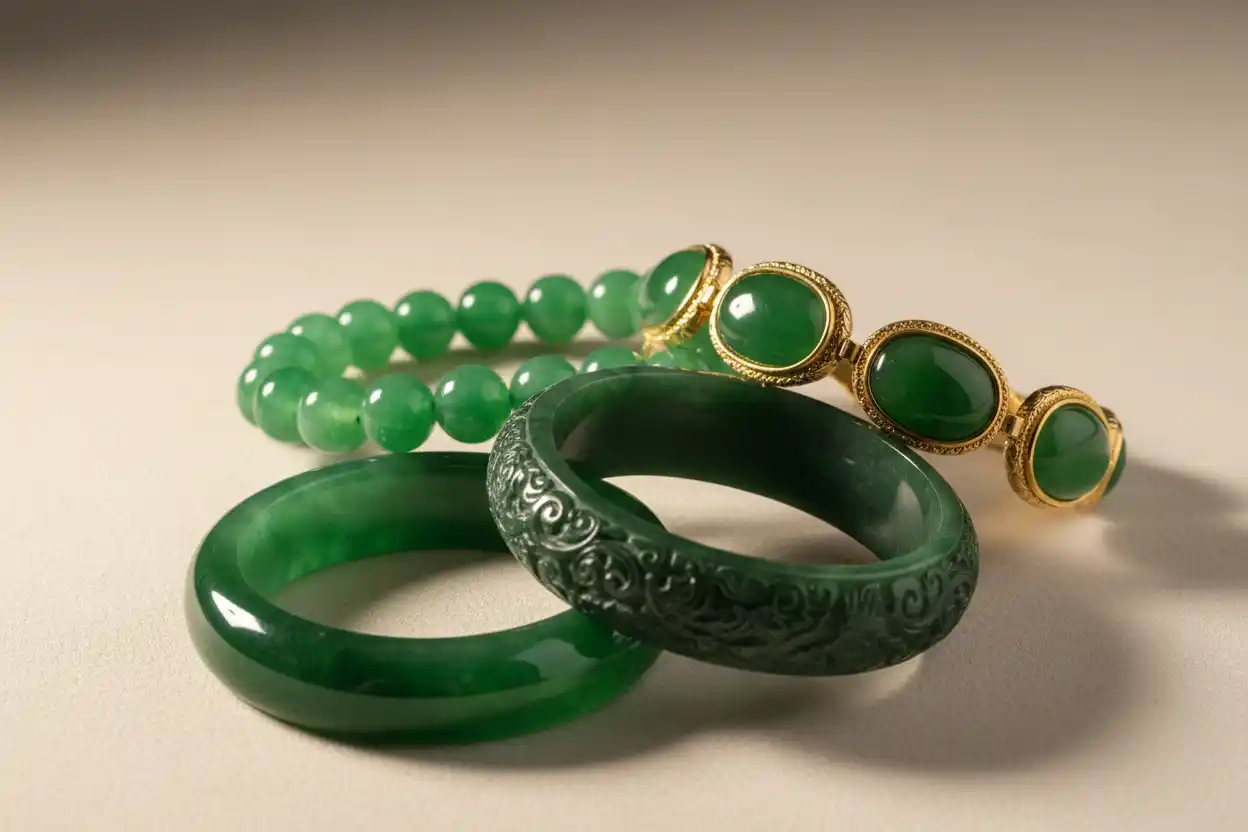
Jade bracelets range from seamless bangles carved from one piece of stone to matched bead strands, hinged cuffs, carved plaques, and modern metal-link designs. Their appeal comes from more than color: surface polish, translucency, texture, carving, treatment status, construction, and fit all determine whether a bracelet feels refined, wears comfortably, and justifies its price.
The word jade covers more than one material. The broader jade meaning guide explains the family and its cultural background, while the direct comparison of jadeite and nephrite separates the two recognized jade materials. For bracelet buyers, that distinction matters because jadeite and nephrite differ in appearance, market positioning, treatment patterns, and typical carving styles.
What Counts as a Jade Bracelet?
A properly described jade bracelet should identify the material as jadeite jade or nephrite jade whenever the seller knows the species. “Jade” should not be used loosely for serpentine, dyed quartz, aventurine, glass, calcite, or another green material.
Jadeite belongs to the pyroxene mineral group and can occur in green, lavender, white, yellow, orange-red, gray, black, and mixed colors. The jadeite gemstone guide covers its material-specific properties. Nephrite is an exceptionally tough aggregate of amphibole fibers, usually seen in green, cream, white, brown, gray, or black; its separate characteristics appear in the nephrite guide.
Both can make durable bracelets because their interlocking structures resist breakage unusually well. However, neither is immune to scratches, impact damage, internal fractures, or treatment-related weakness.
Main Jade Bracelet Styles
| Bracelet style | Construction | Fit and wear | Main buying concern |
|---|---|---|---|
| Solid bangle | One continuous jade ring | Close, fixed fit | Correct inner diameter and hidden fractures |
| Half-round bangle | Rounded exterior with flatter inner wall | Comfortable for many wrists | Wall thickness and symmetry |
| Round “princess” bangle | Circular cross-section | Traditional, substantial feel | Hand clearance and weight |
| Flat or “peace” bangle | Wider, flatter profile | Stable and visually broad | Edge chips and even polish |
| Hinged bangle | Jade sections with metal hinge and clasp | Easier to put on | Hinge strength and matched sections |
| Bead bracelet | Drilled beads on elastic, cord, or wire | Flexible and adjustable | Matching, drill holes, and restringing |
| Carved-link bracelet | Interlocking or joined carved components | Decorative and articulated | Thin carved areas and repairs |
| Metal-link bracelet | Jade cabochons or plaques in metal | Modern, size-adjustable | Secure settings and metal quality |
| Charm bracelet | Jade charms on chain or cord | Personalized, mobile | Bail wear and impact between charms |
Solid Jade Bangles
A solid bangle is carved from one piece of rough. Because the cutter must find an unbroken circular path through the material, sound large bangles consume substantial rough and can carry significant value.
Fine bangles are judged as complete objects rather than as loose stones. Color distribution, translucency, texture, polish, symmetry, cross-section, wall thickness, fractures, and treatment all matter. A concentrated green area may look attractive, but a crack crossing the wall creates a more serious issue than uneven color.
Round-section bangles feel traditional and substantial. Flat inner walls often sit more comfortably, while wider flat profiles show more color and carving. Whatever the style, the inner diameter must clear the wearer’s knuckles without becoming so loose that the bracelet repeatedly strikes furniture.
Jade Bead Bracelets
Bead bracelets offer easier sizing and a lower entry price than fine seamless bangles. Round beads remain the most common, although barrels, tubes, disks, carved beads, and mixed shapes also appear.
Matching adds value. A carefully assembled strand should show compatible color, translucency, texture, polish, diameter, and drill-hole quality. Perfect uniformity at a very low price can be a warning sign for dye, glass, or mass-produced imitation material.
Elastic bracelets are convenient but require periodic restringing. Knotted cord or flexible jewelry wire generally provides more controlled construction. Examine every drill hole because cracks beginning at the hole can widen under repeated tension.
Hinged and Metal-Set Jade Bracelets
A hinged bracelet suits someone who cannot comfortably pass a fixed bangle over the hand. It can also preserve valuable jade sections that were not large enough for a hololith bangle.
The metalwork becomes part of the durability equation. Hinges should move smoothly without lateral play, clasps should close positively, and safety chains should not pull against thin jade. When several segments form one bracelet, their color and curvature should appear deliberately matched.
The guide to metals and gemstones for sensitive skin helps buyers evaluate nickel content, plating, and alloy disclosure. Jade itself is not a substitute for checking the metal that touches the skin.
Carved Jade Bracelets
Carved bangles may feature clouds, flowers, dragons, bamboo, gourds, vines, animals, or abstract relief. Good carving follows the material, uses color zones intentionally, and avoids leaving fragile projections where they will catch.
Deep carving can conceal fractures, repaired areas, dye concentration, or coarse texture. Inspect recessed surfaces under strong neutral light and magnification. Tool marks should support the design rather than create rough cavities that collect dirt.
The full range of recognized materials and trade colors appears in Types of Jade. That guide is useful when a seller uses names such as imperial, icy, lavender, mutton-fat, black, yellow, or flower jade.
How to Measure for a Jade Bangle
Fixed bangles are sized by inner diameter, usually in millimeters. Wrist circumference alone does not determine the fit because the bangle must pass over the widest compressed part of the hand.
To estimate size:
- Bring the thumb and little finger together as though putting on a bangle.
- Wrap a flexible tape around the widest part of the compressed hand.
- Compare that hand circumference with the seller’s sizing chart.
- Measure a comfortable existing bangle across the inside, not the outside.
- Confirm whether the listing uses inner diameter, inner circumference, or outer dimensions.
A close-fitting bangle usually moves less, knocks against fewer surfaces, and feels more secure. Nevertheless, forcing a bangle over the hand can injure the wearer or crack a compromised piece. Do not rely on soap, oil, or plastic-bag techniques until the size and stone condition are known.
Wide bangles need more clearance than thin bangles. In addition, arthritis, swelling, previous hand injuries, and temperature-related changes may make a hinged style more practical than a fixed circle.
Choosing Jadeite or Nephrite
Jadeite often provides brighter greens, lavender, orange-red, and semitransparent “icy” appearances. Fine jadeite can command extremely high prices, particularly when intense color, fine texture, and translucency align.
Nephrite generally has a softer, waxier visual character. It excels in creamy white, spinach green, celadon, gray-green, brown, and black. Fine-grained nephrite takes an excellent polish and is exceptionally resistant to breakage, which makes it well suited to bangles and carved bracelets.
Neither material is automatically better for every buyer. Choose jadeite when vivid color, translucency, and high-end collectability are priorities. Choose nephrite when tactile smoothness, restrained color, toughness, and traditional carving appeal more strongly.
The Jade Buying Guide covers species, quality, disclosure, and seller evaluation in greater depth.
Evaluate Color Without Chasing One Shade
Green remains the best-known jade color, but quality depends on more than greenness. Look for an attractive hue, useful saturation, even or artistically placed distribution, and a color that remains appealing in daylight and indoor light.
Lavender jadeite can range from pale gray-lilac to stronger purple. White jade may be bright, creamy, grayish, or slightly green; the white jade guide explains the material and symbolism behind that trade description. Yellow, orange-red, black, and mottled bangles can also be desirable when the material is natural, well polished, and honestly represented.
The separate guide to jade color meaning owns symbolic color associations. In a purchase decision, color should first be evaluated as a physical quality factor rather than proof of spiritual effect or geographic origin.
Transparency, Texture and Polish
Fine jadeite may transmit enough light to create a soft internal glow. Transparency can make color appear deeper and more mobile, although an opaque bracelet can still be beautiful when its color and texture are strong.
Texture describes the fineness and evenness of the interlocking grains. Fine texture supports a smooth polish and clear luster. Coarse material can look granular, sugary, or uneven beneath the surface.
Check the entire circumference. An excellent polish should not disappear around the inner wall, carving recesses, or edges. Wax is commonly used as a traditional finishing step on otherwise untreated jadeite, but thick surface coatings and polymer impregnation require different disclosure.
Check for Cracks, Stone Lines and Repairs
Not every visible line has the same significance. Color boundaries, grain variation, and healed structural features may be stable, while an open fracture crossing the bangle wall can threaten durability.
Rotate the bracelet under a focused light. A fracture may flash brightly as the angle changes and can sometimes be felt with a fingernail. Pay close attention to holes, thin carved sections, sharp corners, and areas beneath metal caps.
A sharp ringing sound is sometimes promoted as a home authenticity test for bangles. Sound varies with species, thickness, shape, fractures, mounting, and how the piece is suspended. Striking jade can chip it, so sound should never replace visual examination or laboratory testing.
Understand A, B and C Jade Disclosure
The commercial A, B, and C terminology is commonly applied to jadeite:
- Type A jadeite has not been chemically bleached or polymer impregnated; traditional surface waxing may still be present.
- Type B jadeite has undergone acid bleaching followed by polymer impregnation.
- Type C jadeite has been dyed.
- B+C material combines bleaching, impregnation, and dye.
These treatments can dramatically change appearance and value. Acid treatment may weaken the original structure, while polymers and dyes can change with heat, chemicals, light, and time.
The dedicated page on treated jade explains detection and disclosure without turning every bracelet purchase into a laboratory lesson. The broader gemstone treatments guide places bleaching, impregnation, dyeing, coating, and wax within standard trade practice.
Nephrite can also be dyed, coated, assembled, or misrepresented, even though the A/B/C terminology is most strongly associated with jadeite.
How to Check Whether a Bracelet Is Real Jade
Color, cold feel, weight, sound, and scratch resistance can all mislead. Glass, quartz, serpentine, and other materials can imitate one or more jade characteristics.
Begin with the seller’s description. It should state jadeite or nephrite, disclose treatment, give accurate dimensions, identify metal components, and provide a return period. Then compare the piece with the warning signs in Real vs. Fake Jade.
Aventurine is a frequent green lookalike. The direct guide to aventurine versus jade explains why sparkle, granular texture, refractive properties, and structure matter more than color.
For a high-value bangle, an independent report is sensible. The guide to gemstone certification laboratories explains what a report can establish about identity and detectable treatment.
Price and Value Context
Jade bracelet prices range from inexpensive treated beads and commercial nephrite to exceptional jadeite bangles valued as major collector pieces. Consequently, “price per carat” often gives little practical help.
A solid bangle is valued as a complete carving. Color placement, translucency, texture, wall thickness, symmetry, treatment, soundness, and demand can outweigh simple weight. Matched bead strands become more expensive as bead size, color quality, transparency, and matching difficulty increase.
Use the dedicated jade price guide for value analysis. During bracelet shopping, concentrate on whether the price is consistent with the disclosed species, treatment, workmanship, and documentation.
How to Wear a Jade Bracelet
A close bangle works well alone because its uninterrupted circle already creates a strong visual line. Bead bracelets are easier to layer, while hinged and metal-link designs coordinate naturally with watches and other jewelry.
There is no gemological rule requiring jade on the left or right wrist. Some cultural and spiritual traditions assign receptive meaning to the left side and outward expression to the right, but these are belief-based customs rather than physical effects of jade.
For practical wear, use the non-dominant wrist when possible. It generally encounters fewer impacts. Keep a valuable bangle away from watches, diamond bracelets, and hard metal edges that can scratch its polish.
The guide to best gemstones for everyday wear explains why jade’s extraordinary toughness does not eliminate abrasion or treatment concerns.
Stacking Jade With Other Bracelets
Stacking creates friction. Harder gemstones, exposed diamonds, sharp metal links, and rough-textured beads can mark jade over time.
Place a soft spacer bracelet between jade and harder jewelry, or wear the jade alone. Two jade bangles can also knock together, creating edge wear despite their toughness.
When coordinating a full set, jade earrings repeat color near the face, while a jade necklace can carry a related carving or bead shape. A future jade ring should be chosen more conservatively because rings receive greater impact than wrist-hugging bangles.
Cleaning and Maintenance
Warm water, mild soap, and a soft cloth or brush provide the safest general care, particularly when treatment status is uncertain. Avoid warm acids, harsh chemicals, jewelry dips, and exposure to a jeweler’s torch.
Untreated jade can tolerate more aggressive equipment than many gems, but treated jade, glued components, elastic, antique metalwork, and fracture-prone construction change the answer. Follow the detailed procedure in How to Clean Jade Jewelry Safely.
Inspect bead cord, elastic, clasps, hinges, and safety chains regularly. Restring beads before the material becomes brittle or permanently stretched. When a solid bangle develops a new crack, stop wearing it and seek a jade specialist rather than applying household glue.
Buying Checklist
| Check | What a responsible listing should provide |
|---|---|
| Material | Jadeite jade or nephrite jade, not only “green jade” |
| Treatment | Wax, dye, bleaching, impregnation, coating, repair, or assembly |
| Size | Inner diameter, width, thickness, and weight |
| Condition | Fractures, chips, repairs, and natural lines |
| Color | Neutral-light photographs and video |
| Construction | Cord, elastic, clasp, hinge, metal, or glue details |
| Documentation | Report details for higher-value pieces |
| Fulfillment | Confirmation that the pictured bracelet is the delivered item |
| Returns | Sufficient inspection time without destructive testing |
The directory of green gemstones can help place jade among other color options, but a seller should never use color alone to support identity.
Frequently Asked Questions
1. Is a jade bangle supposed to fit tightly?
Traditional bangles often fit close enough to avoid excessive movement. The bracelet should still pass over the hand without dangerous force, numbness, or pain. A hinged design is safer when hand joints or swelling make a fixed bangle difficult.
2. How do I know my jade bangle size?
Measure the widest part of the compressed hand and compare it with the seller’s chart, then verify the inner diameter of a comfortable existing bangle. Do not confuse outer diameter with the usable opening.
3. Is jadeite better than nephrite for a bracelet?
Neither is universally better. Jadeite offers a wider range of vivid colors and translucent high-value material, while nephrite provides exceptional toughness and a smooth waxy character. Treatment, condition, and workmanship matter more than the name alone.
4. Can I wear a jade bracelet every day?
A sound untreated jade bracelet can handle regular wear, especially when it fits close to the wrist. Remove it for exercise, heavy work, contact sports, cleaning, and any activity involving repeated impact or strong chemicals.
5. Which wrist should I wear jade on?
Choose the wrist that is most comfortable and least exposed to impact. Left-versus-right spiritual rules vary among traditions and are not gemological requirements.
6. Why are seamless jade bangles expensive?
They require a sufficiently large, sound section of rough with usable color and texture around the entire circle. Cutting removes substantial material, and one hidden fracture can ruin the piece.
7. Can a cracked jade bangle still be worn?
A superficial stable line may not require retirement, but an open or growing crack can fail suddenly. Stop wearing the bangle until a jade specialist has inspected it.
8. Are elastic jade bead bracelets durable?
The beads can be durable, but elastic deteriorates from stretching, skin oils, water, and time. Restring the bracelet when the cord looks thin, loose, discolored, or slow to recover.
9. Does real jade always feel cold?
Jade often feels cool initially because it conducts heat away from the skin, but glass, quartz, and other stones can do the same. Temperature is not an authenticity test.
10. Can jade change color while I wear it?
Surface oils, wax, dirt, lighting, and increased translucency from contact can alter appearance temporarily. Dye or polymer may also age. A permanent unexplained change deserves professional evaluation.
11. Should a jade bracelet come with a laboratory report?
A report is appropriate when treatment or identity materially affects a high purchase price. Low-cost commercial bracelets may not justify the expense, but the seller should still provide a clear description and return policy.
12. Can a broken jade bangle be repaired?
Metal wraps, pins, caps, and specialist adhesive repairs can make some bangles wearable or displayable. Repair rarely restores the original value, and every intervention should be disclosed during resale.
A successful jade bracelet purchase begins with material identity and treatment disclosure, then moves to color, texture, soundness, construction, and fit. Choose a bracelet that suits the wearer’s hand and routine rather than forcing a traditional form that cannot be worn safely. When the piece is well documented and properly sized, jade’s tactile polish and exceptional toughness can make it one of the most satisfying forms of colored-stone jewelry.