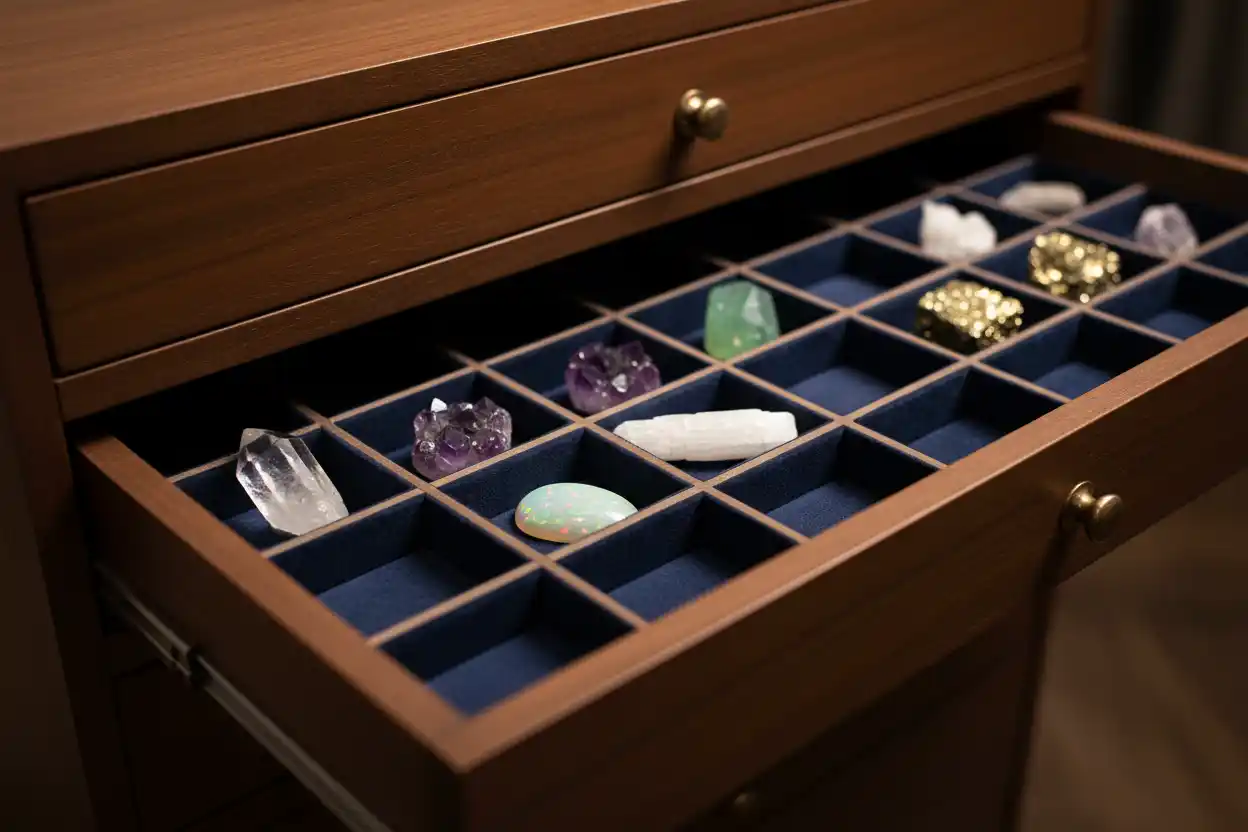
How to Store Crystals Safely: Prevent Scratches, Fading and Damage
Storing crystals safely is less about finding one perfect box and more about preventing four common types of damage: scratching, impact, excessive light and unsuitable moisture conditions. A hard quartz point can scratch fluorite, calcite or selenite, direct sunlight can fade some colored stones, and a damp cabinet can create problems for moisture-sensitive minerals such as pyrite.
The safest general method is to keep crystals clean and dry, separate pieces that can scratch or chip one another, cushion fragile specimens, protect light-sensitive stones from prolonged direct sun, and avoid basements, bathrooms, hot windowsills and other unstable environments.
One important exception is opal. Extremely hot or dry storage can contribute to moisture loss and crazing in susceptible opal, so adding strong desiccants to every crystal box is not a good universal strategy.
Crystal Storage at a Glance
| Crystal Type | Main Storage Risk | Safer Approach |
|---|---|---|
| Hard quartz-family stones | Scratching softer crystals | Keep separated from softer material |
| Fluorite | Scratching, cleavage, impact | Padded individual compartment |
| Calcite | Scratching, abrasion, acids | Soft wrap or separate tray |
| Selenite / gypsum | Very easy scratching, water exposure | Dry, padded, separate storage |
| Amethyst | Prolonged intense light | Store away from direct sunlight |
| Kunzite and some colored gems | Light-related fading | Closed drawer or shaded cabinet |
| Opal | Heat, extreme dryness, scratching | Stable moderate environment; avoid strong desiccation |
| Pyrite | High humidity and oxidation | Keep dry; monitor for deterioration |
| Crystal clusters | Broken points | Support base; prevent movement |
| Polished stones | Surface abrasion | Separate pouches or divided compartments |
| Jewelry | Scratches, tangles, damaged settings | Individual padded slots or pouches |
| Large specimens | Falls and unstable shelves | Low, sturdy shelving with secure support |
Why Crystal Storage Matters
Minerals look solid and permanent, but their physical properties vary enormously.
Diamond defines Mohs hardness 10, while gypsum is only 2 and calcite is 3. Fluorite is about 4, whereas quartz reaches 7.
When stones of different hardnesses rub together, the harder mineral can scratch the softer one.
Storage damage can also come from:
cleavage, brittleness, thermal changes, sunlight, humidity and unstable supports.
Consequently, putting every crystal into one bowl or drawer may look convenient but can slowly damage the collection.
The Gemstone Hardness Chart is particularly useful when deciding which stones should never be stored in direct contact.
Rule 1: Do Not Let Hard Crystals Rub Against Soft Ones
The most important rule is simple:
separate stones that can scratch each other.
Quartz is especially relevant because it is common in crystal collections and has Mohs hardness 7.
This includes:
clear quartz, amethyst, citrine, smoky quartz and many quartz-rich stones.
A quartz point can scratch:
fluorite, calcite, selenite, apatite, opal and numerous other softer materials.
Therefore, storing a polished fluorite palm stone in a pouch together with quartz points is not safe merely because both pieces feel smooth.
Movement during:
carrying, opening drawers or moving house
can cause repeated abrasion.
Over time, the softer stone may develop dull patches and fine scratches.
Do Crystals Need Individual Bags?
Not every specimen requires a separate pouch, but many benefit from one.
Individual soft pouches work well for:
polished stones, cabochons, small carvings and crystal jewelry.
For rough crystals, however, fabric bags can create other problems.
Sharp terminations may catch on fibers, while delicate clusters can break if pressure is applied through the pouch.
For fragile specimens, a small rigid box lined with soft inert padding is usually safer than a loose fabric bag.
Best Storage Containers for Crystals
Useful options include:
divided jewelry trays, shallow specimen drawers, small rigid boxes, padded cases and cabinets with stable shelves.
The most important feature is not the price of the storage system.
It is whether each crystal is:
supported, separated and protected from movement.
A divided tray works particularly well for tumbled stones because each compartment prevents direct contact.
Larger mineral specimens need enough space that protruding points do not touch the cabinet wall or neighboring crystals.
Avoid stacking heavy specimens on top of delicate ones.
Use Soft, Clean Padding
Padding reduces impact and prevents specimens from sliding.
Useful materials include:
soft acid-free tissue, stable polyethylene foam and clean fabric intended for jewelry storage.
For ordinary home collections, the goal is simply to avoid abrasive or chemically unstable materials touching the specimen for years.
Do not wrap damp crystals in sealed padding.
Any stone that has been cleaned should be fully dry before long-term storage unless its care requirements specifically call for a different environment.
Avoid Rough Paper and Dirty Fabric
Storage material itself can scratch polished surfaces.
Paper contaminated with mineral dust can become abrasive.
Likewise, old fabric may contain:
sand, grit or hard particles.
Even a soft cloth becomes unsafe if quartz dust is trapped in it.
Before wrapping a polished gemstone, make sure the material is clean.
This is particularly important for softer stones such as fluorite and calcite.
Store Crystal Points So They Cannot Knock Together
Quartz points are relatively hard, but the terminations can still chip.
A common mistake is placing several points loose in one wooden box.
Every time the box moves, the terminations strike:
other crystals, walls or the base.
Instead, position points so that each one has its own space.
For important specimens, cradle the base in padding and leave clearance around the termination.
Do not support the entire weight of a large crystal on one narrow point.
How to Store Crystal Clusters
Clusters require more protection than simple tumbled stones.
Their individual crystals may be:
thin, sharp and mechanically vulnerable.
Place the specimen upright in the orientation in which it rests naturally.
Support the matrix or broad base rather than delicate terminations.
Then make sure nothing can fall onto it.
A deep shelf with heavy crystals stored above fragile clusters creates unnecessary risk.
If possible, keep valuable clusters in:
a closed cabinet or stable display case
where dust and accidental contact are reduced.
Keep Fragile Minerals Low
Heavy and fragile specimens should not be stored on high shelves unless the shelving is extremely secure.
A fall can destroy:
crystal points, cleavable minerals and delicate matrices.
For large specimens, choose low shelves and make sure the furniture cannot tip.
The heavier the specimen, the more important shelf strength becomes.
Do not rely on a thin decorative glass shelf for a dense mineral collection unless it is specifically rated for the load.
Separate Crystals by Hardness
One practical storage system is to divide crystals into broad physical groups.
Very Soft
Examples include gypsum or selenite.
These need the most protection from abrasion.
Soft to Moderate
Calcite and fluorite belong here.
They should generally be separated from quartz.
Moderate to Hard
Apatite, feldspar and similar materials still benefit from individual storage.
Hard
Quartz-family stones and harder gemstones can tolerate more abrasion, but they can damage almost everything below them on the Mohs scale.
The objective is not to create a scientifically perfect filing system.
It is to prevent a hard mineral from repeatedly rubbing against a softer one.
How to Store Selenite
Selenite is a crystalline variety of gypsum and ranks only about Mohs 2.
That makes it exceptionally easy to scratch.
Long blades and fibrous satin-spar pieces can also chip or fray at the edges.
Store selenite:
separately, dry and on soft padding.
Avoid putting quartz, metal jewelry or other hard objects in the same compartment.
Because gypsum is water sensitive, storage in persistently damp environments is also undesirable.
The Is Selenite Safe in Water and Sunlight? guide covers that material’s specific exposure limits.
How to Store Fluorite
Fluorite is beautiful but physically vulnerable.
It has:
Mohs hardness 4 and perfect octahedral cleavage.
Therefore, a hard blow can do more than scratch the surface—it can break the crystal along cleavage planes.
Keep fluorite away from quartz points and other hard specimens.
A padded rigid compartment is preferable for:
cubes, octahedrons and polished fluorite pieces.
Do not pack a collection so tightly that fluorite must be forced into or out of a drawer.
How to Store Calcite
Calcite is even softer at approximately Mohs 3.
Polished calcite can quickly lose its surface finish if it rubs against harder minerals.
Keep calcite separate from quartz, feldspar and metal objects.
Because calcite also reacts with acids, avoid storing it near leaking household chemicals or acidic cleaning products.
For ordinary home storage, a clean dry padded tray is usually sufficient.
Protect Crystals From Direct Sunlight
Some gemstone colors are stable in ordinary light.
Others can fade after prolonged exposure to intense illumination.
This matters especially when a collection sits permanently on:
a sunny windowsill.
Amethyst is a classic example. GIA notes that some amethyst can fade after prolonged exposure to intense light.
Other gems can also change under excessive light.
Therefore, a sunny window is usually a poor long-term storage location for a mixed collection.
The Crystals That Fade in Sunlight guide owns the detailed sunlight-sensitivity list.
Display Light Is Still Light
Moving a crystal away from direct sunlight does not mean light exposure becomes irrelevant.
Very intense artificial display lighting can also add:
heat and cumulative light exposure.
For sensitive specimens, a shaded cabinet or drawer is safer than permanent bright display.
Collectors who want to show vulnerable stones can rotate them.
Display the specimen for a period, then return it to protected storage.
This reduces cumulative exposure while still allowing the collection to be enjoyed.
Avoid Hot Windowsills
Heat can create several problems.
Some gems may fracture after rapid temperature change, while heat can alter or destabilize certain materials.
GIA specifically warns that high heat and sudden temperature changes can damage several gemstones.
A window ledge can become much hotter than the surrounding room.
Therefore, even a window with no obvious direct beam during part of the day may not provide stable storage.
Avoid placing sensitive crystals:
next to radiators, heating vents or high-temperature display lights.
Stable Temperature Is Better Than a Perfect Temperature
For most ordinary mineral collections, a stable indoor environment is more important than maintaining one exact temperature.
Frequent extremes create greater risk.
An air-conditioned room that becomes very hot whenever the system is turned off is less stable than a consistently moderate room.
Basements and attics can be problematic because they often experience:
large humidity changes, temperature swings or water leaks.
A normal interior room is usually a better choice.
Humidity Matters More for Some Minerals Than Others
Most common quartz crystals tolerate normal household humidity reasonably well.
However, some minerals need much more attention.
Pyrite is an important example.
Under sufficiently humid conditions and in the presence of oxygen, unstable pyrite can oxidize.
The deterioration can create:
powdery iron sulfates and acidic by-products.
For collectors, this phenomenon is sometimes called pyrite decay or pyrite disease.
Therefore, pyrite specimens deserve monitoring rather than being treated like inert quartz.
How to Store Pyrite
Keep pyrite in a clean, relatively dry, stable environment.
Avoid:
damp basements, closed boxes containing moisture and humid bathrooms.
The Canadian Conservation Institute notes that pyrite can be particularly vulnerable above about 50% relative humidity.
That does not mean every pyrite crystal will immediately decay at 51% RH.
Stability depends on specimen history, composition and environmental conditions.
However, persistent high humidity is an unnecessary risk.
If a pyrite specimen begins producing:
white, yellowish or powdery corrosion products,
isolate it from the rest of the collection and seek conservation advice for important material.
Do Not Use Desiccant With Every Crystal
Silica gel can be useful for controlling moisture-sensitive specimens.
However:
do not automatically put strong desiccants into every crystal box.
Different materials have different needs.
What protects pyrite may create an unnecessarily dry environment for other specimens.
Opal is the clearest example.
GIA warns against extreme heat and dryness for opal because moisture loss can contribute to crazing in susceptible material.
A mixed collection therefore requires selective storage rather than one environmental rule applied universally.
How to Store Opal
Opal contains water within its structure and is physically softer than many common gemstones.
Store opal away from:
strong heat, intense prolonged light and extremely dry environments.
Do not assume that sealing it beside large quantities of fresh silica gel is helpful.
GIA specifically notes that excessively dry storage can sometimes do more harm than good to opal.
At the same time, storing every opal submerged in water is not a universal requirement.
The safest everyday strategy is a stable moderate environment.
For jewelry, use a soft pouch or padded compartment so harder stones cannot scratch the surface.
The How to Clean Opal Jewelry Safely article covers cleaning rather than long-term storage.
Do Crystals Need to Be Stored in Water?
Generally, no.
Most crystals should not be stored submerged in water.
Some minerals dissolve, react, weaken or change when exposed to prolonged moisture.
Even when a material itself tolerates water, containers can develop:
algae, mineral deposits or contamination.
Opal occasionally creates confusion because of its water content.
However, water storage is not a general crystal-preservation technique.
Identify the mineral before intentionally storing any specimen wet.
Avoid Bathrooms for Long-Term Storage
Bathrooms combine several undesirable conditions:
humidity swings, condensation, cosmetics, cleaning chemicals and frequent temperature changes.
Even if a quartz display seems unaffected, the environment is not ideal for a mixed collection containing:
pyrite, soft minerals, metal-bearing specimens or jewelry.
A bedroom drawer, interior cabinet or dedicated specimen case is generally more predictable.
Avoid Storing Crystals Beside Household Chemicals
Perfumes, aerosols, cleaners and cosmetics do not belong inside a mineral-storage cabinet.
Jewelry may include:
metals, coatings, fillers, adhesives and porous gemstones
that react differently from the bare mineral.
GIA advises keeping jewelry away from household chemicals because they can damage both metals and delicate gem materials.
Use crystal storage for crystals—not cleaning supplies.
Clean Crystals Before Long-Term Storage
Dust itself can be abrasive.
Before storing a specimen for months, remove loose dust using a method appropriate for that mineral.
Do not automatically rinse every crystal.
Water-safe quartz and water-sensitive selenite should not receive identical cleaning.
Likewise, treated jewelry may require different methods from rough mineral specimens.
Physical cleaning and spiritual cleansing are separate processes.
If you use crystals in a spiritual practice, the How to Cleanse Crystals guide addresses symbolic cleansing methods without replacing physical mineral care.
Let Cleaned Crystals Dry Before Packing
If a mineral has been safely washed, allow it to dry completely before putting it into a closed container.
Trapped moisture can create:
condensation, corrosion of metal settings or an unnecessarily humid microenvironment.
Do not seal damp cloth around a crystal.
Instead, dry the specimen appropriately and make sure both the storage container and padding are dry.
Cleansing and Charging Do Not Replace Safe Storage
Some people cleanse or charge crystals as part of spiritual practice.
Those routines do not change mineral hardness, cleavage or chemical stability.
A quartz point that has been spiritually cleansed can still scratch fluorite.
A charged selenite wand can still be damaged by water.
A stone left in sunlight for a spiritual practice can still experience color fading if its mineral chemistry is light sensitive.
If charging is part of your practice, the How to Charge Crystals guide provides symbolic options while physical storage should continue to follow mineral-care principles.
Can Crystals Touch Each Other?
Yes, when their physical properties and shapes make contact low risk.
Several smooth quartz tumbles stored together usually present less concern than:
quartz mixed with polished fluorite.
However, even equally hard stones can chip each other if they have sharp points or brittle edges.
Therefore, contact decisions should consider:
hardness, shape, cleavage, weight and fragility.
For valuable pieces, individual compartments remain the safest option.
Should You Wrap Every Crystal?
No.
Wrapping is useful when it prevents:
scratching and movement.
It becomes counterproductive when a fragile cluster catches on fabric or when the wrap traps moisture.
Small polished stones work well in soft pouches.
Delicate clusters are usually better supported inside rigid padded boxes.
Very large specimens may simply need:
stable shelving and enough clearance from neighboring pieces.
Choose the method based on the specimen rather than following one rule for every crystal.
Best Way to Store Tumbled Stones
Tumbled stones are relatively easy to store.
A divided tray is ideal.
Group stones by broad hardness and keep very soft pieces away from quartz.
For example, avoid mixing:
selenite, calcite and fluorite
loose with quartz tumbles if the container will be moved frequently.
If the collection is mostly decorative and rarely handled, shallow padded compartments keep the stones visible while reducing contact.
Best Way to Store Raw Crystals
Raw crystals need more space.
Sharp edges and natural points can:
scratch neighboring specimens or break themselves.
Use rigid boxes or drawers with individual zones.
If a specimen has a heavy matrix and delicate crystals, make sure the weight rests on the matrix rather than the crystal growth.
Do not cram specimens into foam so tightly that removing them requires force.
How to Store Crystal Jewelry
Jewelry needs both gemstone protection and setting protection.
GIA recommends individual:
padded slots, boxes or pouches
rather than tossing jewelry into one drawer.
Hard diamonds or sapphires can scratch softer colored stones.
Chains can tangle around prongs.
Metal surfaces can also scratch each other.
Store rings in individual slots and necklaces so the chains do not knot.
For delicate gemstones, keep the piece in its own soft compartment.
How to Store Crystals While Traveling
Travel introduces vibration and impact.
Wrap polished stones individually or use a divided padded case.
Do not place loose points in a single bag.
For clusters, choose a rigid container and immobilize the specimen without pressing on fragile crystal growth.
Leave enough cushioning to absorb movement.
Then pack the crystal case where heavy luggage cannot crush it.
If a specimen is particularly valuable, consider whether transporting it is necessary at all.
Label Important Specimens
Safe storage is not only physical protection.
Documentation matters.
For collector-grade minerals, preserve:
mineral name, locality, mine or district, acquisition date and seller information.
Keep labels with the specimen but avoid acidic or unstable paper directly contacting vulnerable mineral surfaces.
Photographing the specimen together with its label creates a useful backup record.
This becomes especially important when several similar minerals share a drawer.
Inspect Stored Crystals Periodically
A collection should not disappear into storage for years without inspection.
Every few months, look for:
new fractures, fading, tarnish, corrosion, powdery deposits, moisture, mold on storage material or damaged padding.
Pyrite deserves particular attention because deterioration can progress after it begins.
Jewelry should also be checked for:
loose prongs and damaged settings.
Early detection usually gives you more options than discovering severe damage years later.
A Practical Crystal Storage System
A simple home system can use four zones.
Zone 1: Hard, Stable Tumbles
Quartz-family stones and other durable polished material.
They can share a divided tray if they are unlikely to damage one another.
Zone 2: Soft and Cleavable Stones
Fluorite, calcite, selenite and other vulnerable materials.
Give them individual padded compartments.
Zone 3: Light-Sensitive Display Stones
Amethyst and other materials known to fade under intense prolonged light.
Keep them in drawers or shaded cabinets when not actively displayed.
Zone 4: Environment-Sensitive Material
Pyrite, opal and other specimens with particular humidity or dryness considerations.
Store these according to their individual needs instead of using the same environment as every other crystal.
This system is more useful than arranging storage solely by:
color, chakra or alphabet
because it addresses the mechanisms that physically damage minerals.
Common Crystal Storage Mistakes
The most common mistake is filling a decorative bowl with every crystal in the collection.
It looks attractive, but hard stones rub directly against soft ones.
Another mistake is permanent windowsill display.
A sunny location exposes stones to:
light, heat and repeated temperature changes.
Sealing every specimen with silica gel is also a poor universal practice because very dry conditions are inappropriate for some materials, especially opal.
Finally, avoid assuming that polished stones are tougher than rough ones.
Polishing changes the surface shape.
It does not change the mineral’s fundamental hardness, cleavage or stability.
Frequently Asked Questions
1. What is the safest way to store crystals?
Keep them in a stable indoor environment, separate hard stones from softer ones, use padded compartments for fragile specimens, protect light-sensitive material from direct sun and follow special humidity requirements for sensitive minerals.
2. Can I store all my crystals together?
You can store compatible durable stones together, but mixing hard quartz with soft crystals such as fluorite, calcite or selenite can cause scratches. Valuable and fragile specimens are safest in individual compartments.
3. Should crystals be stored in individual pouches?
Soft pouches work well for polished stones and jewelry. Fragile clusters and sharp points are usually safer in rigid padded boxes because fabric can snag delicate terminations.
4. Should crystals be stored in the dark?
Most do not require total darkness, but prolonged intense light can fade or alter some gemstones. A shaded cabinet or drawer is safer for light-sensitive material than a sunny windowsill.
5. Can I store crystals on a windowsill?
It is not ideal for long-term storage. Direct sun can fade some stones, while window areas can experience excessive heat and temperature fluctuations.
6. Should I put silica gel in my crystal storage box?
Only when the mineral actually benefits from lower humidity. Silica gel can help protect moisture-sensitive specimens such as unstable pyrite, but extreme dryness is inappropriate for some materials, including susceptible opal.
7. How should I store selenite?
Store selenite dry, separately and on soft padding. Its Mohs hardness is only about 2, so harder crystals and metal objects can scratch it easily.
8. How should I store fluorite?
Use an individual padded compartment. Fluorite is Mohs 4 and has perfect cleavage, so it can scratch, chip or break when knocked against harder stones.
9. How should pyrite be stored?
Keep pyrite in a clean, relatively dry and stable environment. Persistent high humidity can promote oxidation in vulnerable specimens, so damp basements and bathrooms are poor locations.
10. Should opal be stored with silica gel?
Usually not as a default. Excessive heat and extreme dryness can contribute to moisture loss and crazing in susceptible opal, so avoid strongly desiccating its storage environment without a specific conservation reason.
11. Can crystals damage each other in storage?
Yes. Hard minerals can scratch softer ones, while heavy or sharp specimens can chip fragile crystals. Hardness, cleavage, shape and weight should all influence how pieces are separated.
12. What is the best room for storing a crystal collection?
Choose a clean interior room with relatively stable temperature and humidity, limited direct sunlight and low risk of leaks. Avoid damp basements, hot attics, bathrooms and sunny windowsills for mixed collections.
Conclusion
Safe crystal storage starts with the physical properties of the minerals rather than the appearance of the collection.
The most important principle is separation. Hard quartz-family stones can scratch fluorite, calcite, selenite, opal and other softer materials, so vulnerable specimens should have their own padded compartments.
Next, control the environment.
Avoid permanent direct sunlight for light-sensitive colors, prevent unnecessary heat and sudden temperature changes, and keep the collection away from leaks and household chemicals.
Humidity requires more nuance. Pyrite can deteriorate in persistently humid conditions, while opal should not automatically be placed in an extremely dry desiccated box.
Finally, give fragile crystals physical support. Clusters, long points and cleavable minerals need enough space that they cannot strike one another when drawers are opened or cases are moved.
There is no single perfect storage method for every crystal.
A safe collection is one in which each specimen is stored according to its hardness, toughness, light stability, moisture sensitivity and shape.