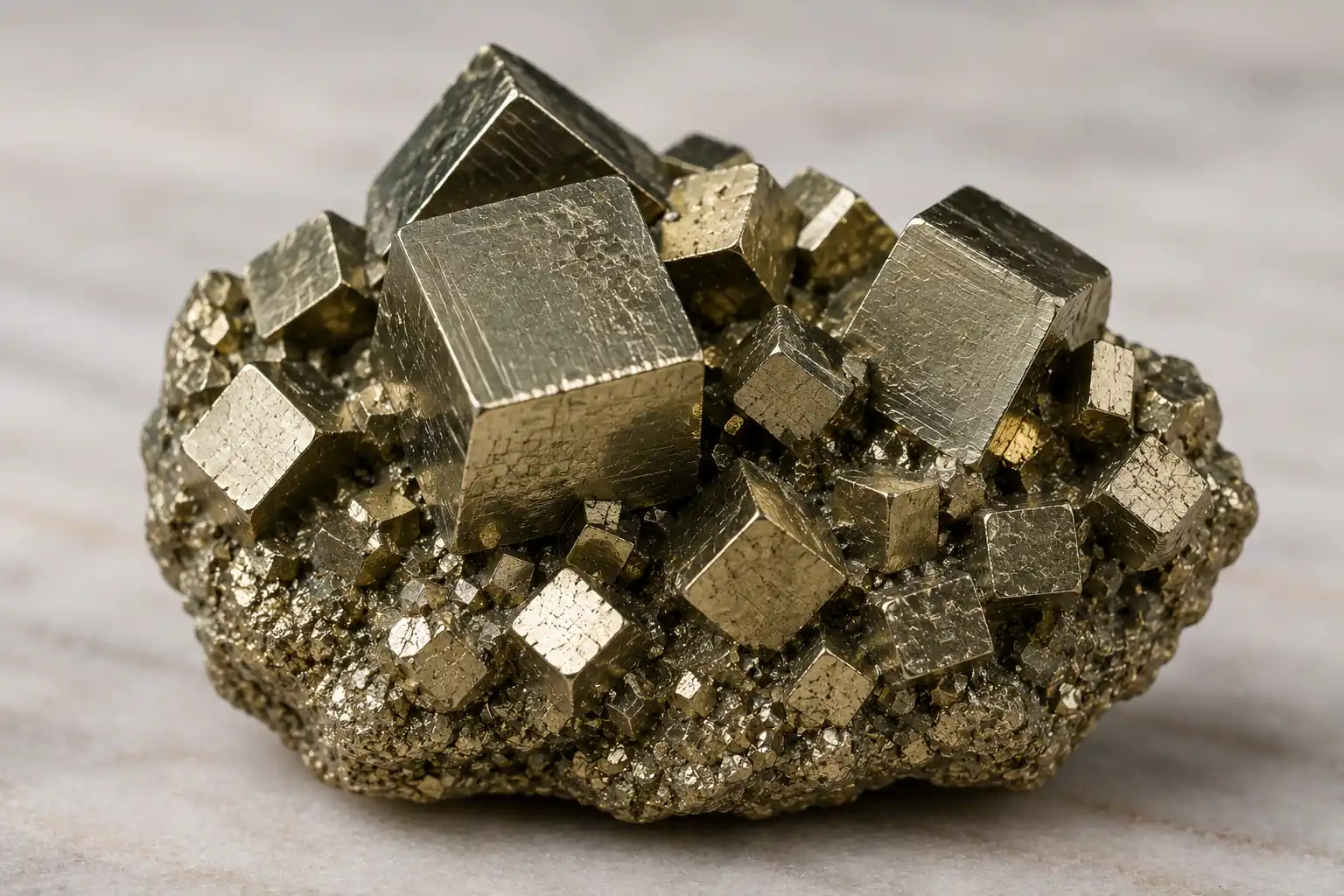
Pyrite: Meaning, Healing Properties & Uses
Pyrite is an iron sulfide mineral recognized by its metallic luster, brass-yellow color and sharply geometric crystals. Cubes, pyritohedrons, striated faces, radiating disks and dense granular masses can all occur, giving the mineral far more structural variety than its familiar “fool’s gold” nickname suggests.
Although pyrite can resemble gold at first glance, the two materials differ in color, streak, hardness, density, malleability and crystal form. Pyrite is harder but brittle, while gold is much denser, softer and capable of being flattened or bent without breaking.
Contemporary crystal traditions associate pyrite with confidence, planning, prosperity, determination and protection. Those meanings are symbolic rather than scientifically demonstrated effects. Pyrite should also be handled according to its real mineral properties: avoid generating dust, do not ingest it, and keep unstable or weathered specimens away from prolonged moisture.
Pyrite at a Glance
| Property | Pyrite |
|---|---|
| Mineral class | Sulfide |
| Chemical composition | Iron disulfide, FeS₂ |
| Crystal system | Cubic |
| Common color | Pale brass yellow to golden brass |
| Luster | Metallic |
| Transparency | Opaque |
| Streak | Greenish black to brownish black |
| Mohs hardness | Approximately 6–6.5 |
| Tenacity | Brittle |
| Cleavage | Poor or indistinct |
| Fracture | Uneven to conchoidal |
| Specific gravity | Approximately 4.9–5.2 |
| Common habits | Cubes, pyritohedrons, octahedrons, disks, concretions and granular masses |
| Common associations | Quartz, calcite, galena, sphalerite, chalcopyrite, hematite and coal |
| Main care concern | Oxidation, moisture, crumbling and abrasive metallic surfaces |
| Common symbolism | Confidence, strategy, prosperity, determination and protection |
What Is Pyrite?
Pyrite is the most widespread iron sulfide mineral. Its formula contains one iron atom for every two sulfur atoms, but its crystal structure differs from that of chemically identical marcasite.
The mineral can form in igneous, metamorphic, sedimentary and hydrothermal environments. It appears in metallic ore veins, coal seams, shale, limestone, volcanic rocks, metamorphic deposits and fossil replacements.
Well-formed crystals often display the symmetry of the cubic system. Some develop as simple cubes, while pyritohedrons have twelve pentagonal faces. Other specimens combine cubes, octahedrons and pyritohedral faces into complex geometric forms.
Pyrite is not a variety of gold. Its metallic color comes from the way its opaque surface reflects light rather than from elemental gold content.
Why Pyrite Is Called Fool’s Gold
The nickname arose because inexperienced prospectors could mistake brass-yellow pyrite for native gold.
Fresh pyrite usually looks paler and more brassy than rich yellow gold. Its crystal faces may show straight parallel striations, sharp corners and rigid geometric shapes that native gold rarely develops.
Pyrite is also brittle. A hard blow can fracture or crush it into angular fragments. Gold bends, flattens and deforms because it is highly malleable.
The streak provides another clue. Pyrite leaves a dark greenish-black or brownish-black mark on an appropriate unglazed test surface, whereas gold leaves a yellow streak. Streak testing should not be performed on a finished collectible crystal because it creates permanent surface damage.
The upcoming real-versus-fake pyrite guide owns the complete identification workflow. A valuable metallic specimen should not be scratched, crushed or exposed to acids merely to settle an informal test.
How Pyrite Forms
Pyrite can crystallize when iron and sulfur become available under reducing or hydrothermal conditions.
In hydrothermal veins, hot fluids moving through fractures may deposit pyrite beside quartz, calcite, galena, sphalerite, chalcopyrite and precious-metal minerals. These associations make pyrite important in economic geology even when the pyrite itself is not the primary target.
Sedimentary pyrite commonly forms where oxygen is limited and sulfur-producing microorganisms interact with iron-bearing material. Framboidal pyrite consists of microscopic spherical aggregates resembling raspberries and is common in sedimentary rocks.
Metamorphism can recrystallize fine pyrite into larger grains or crystals. Igneous rocks may also contain disseminated pyrite that crystallized from sulfur-bearing magma or late-stage fluids.
Pyrite Crystal Shapes
Cubic pyrite crystals are among the most recognizable mineral specimens. Their faces may show fine parallel grooves, and the direction of the striations often changes from one face to the next.
Pyritohedrons have twelve roughly pentagonal faces. Combinations of cube and pyritohedron can produce stepped or beveled forms.
Octahedral pyrite is less common but highly collectible. Some crystals develop penetration twins or irregular combinations of several forms.
Pyrite suns or dollars are flattened radiating aggregates associated particularly with sedimentary deposits. Their spoke-like crystal growth creates a circular metallic form that differs markedly from a conventional cube.
Concretions and fossil replacements may preserve shells, plant structures or other biological forms while the original material is partly or completely replaced by pyrite.
Pyrite Color, Luster and Tarnish
Fresh pyrite has a pale brass-yellow color and strong metallic luster. It may appear almost silvery under cool lighting or warmer gold beneath incandescent light.
Exposure to air, humidity and surface reactions can darken the mineral. Tarnish may appear brown, bronze, blue, purple or iridescent.
Not every colorful metallic specimen sold as peacock ore is naturally tarnished pyrite. The trade name may refer to bornite, treated chalcopyrite or another sulfide whose surface has developed or received an iridescent film.
Pyrite’s natural brass color should not be confused with a rainbow coating applied for decorative effect. The treated-pyrite guide owns coatings, artificial tarnish, composites and synthetic-material boundaries.
Pyrite Versus Marcasite
Marcasite has the same FeS₂ composition as pyrite but crystallizes in the orthorhombic system.
Marcasite commonly forms spear-like, cockscomb, radiating or tabular aggregates. It is less stable than pyrite under many ordinary environmental conditions and may break down more readily.
Much jewelry sold historically or commercially as “marcasite jewelry” contains small faceted pyrite pieces rather than true marcasite. Pyrite’s greater stability makes it more practical for that style.
The two minerals cannot always be separated reliably by color alone. Crystal habit, structure and professional testing may be needed when the material is massive or altered.
Pyrite Versus Chalcopyrite
Chalcopyrite is a copper iron sulfide with a richer yellow color and lower hardness than pyrite.
Pyrite commonly forms sharper cubes and pyritohedrons, whereas chalcopyrite often occurs as irregular masses, tetrahedral forms or granular material. Chalcopyrite also tarnishes readily into blue, purple and green colors.
A steel point may scratch chalcopyrite more easily than pyrite, but destructive hardness testing is inappropriate for a collectible specimen.
Commercially rainbow-colored “peacock ore” is often acid-treated chalcopyrite. Its vivid surface does not represent the fresh interior color.
Pyrite Versus Bornite
Bornite is a copper iron sulfide whose fresh surface is bronze to copper-brown. It develops colorful iridescent tarnish readily.
Pyrite begins with a more distinctly pale brass-yellow surface and is considerably harder. Bornite is softer and usually lacks pyrite’s sharp cubic habits.
Because sellers may use peacock ore for bornite, chalcopyrite or treated sulfides, the trade name does not establish exact mineral identity. The tracker’s alias rules therefore keep peacock ore from being assigned automatically to one canonical mineral.
Pyrite in Lapis Lazuli
Fine lapis lazuli may contain small metallic pyrite flecks within a blue lazurite-rich rock.
The pyrite can resemble stars against a dark-blue background. Moderate, well-distributed flecks may add visual interest, although excessive pyrite can interrupt the blue color or indicate a lower proportion of lazurite.
Pyrite alone does not prove that a blue stone is genuine lapis. Imitations can contain metallic particles, and dyed materials may be manufactured to copy the expected appearance.
The real-versus-fake lapis lazuli guide owns the complete identification boundary.
Pyrite and Gold Deposits
Pyrite can occur in the same geological systems as gold. In some ores, microscopic gold may be trapped within pyrite or associated with fractures and grain boundaries.
That association does not mean an ordinary pyrite cube contains economically recoverable gold. Most decorative specimens have no meaningful precious-metal value.
Assays and specialized analysis are required to determine gold content in ore. Color, weight and crystal shape cannot establish whether invisible gold is present.
Claims that every pyrite specimen is “gold-bearing” should therefore be treated cautiously.
Pyrite Oxidation
Pyrite can oxidize when exposed to oxygen and moisture. The reaction may create iron sulfates, iron oxides and acidic products.
At a mine or rock-exposure scale, this process contributes to acid mine drainage. Within a collection, susceptible specimens may develop white, yellow or greenish crusts, a sulfurous odor, cracking or complete disintegration.
Fine-grained, porous, fractured and marcasite-bearing specimens are often less stable than dense, well-crystallized pyrite. However, even an apparently solid specimen can change when stored in high humidity.
Oxidation is not a spiritual cleansing reaction. It is chemical deterioration that can damage the specimen and nearby labels, boxes or minerals.
Is Pyrite Toxic?
An intact pyrite specimen is not normally a poisoning hazard merely because it sits on a shelf or is handled briefly.
Risk increases when the mineral is crushed, ground, drilled or sanded because fine dust can be inhaled. Weathered material may also contain acidic residues or associated metals whose composition is unknown.
Wash hands after handling crumbly or oxidized specimens. Keep them away from food-preparation surfaces, children who may place objects in their mouths and pets.
Never lick pyrite, swallow fragments or use it to prepare drinking water. Do not burn or heat sulfide minerals.
The crystal water-safety guide explains why hardness alone does not make a mineral appropriate for soaking or elixir preparation.
Can Pyrite Go in Water?
Brief accidental contact does not guarantee immediate destruction, but intentional soaking is unnecessary and can encourage oxidation in vulnerable material.
Water may enter fractures, porous matrix and tiny spaces between crystals. Slow drying can then create surface changes or internal expansion.
Salt water is particularly unsuitable because dissolved salts can remain behind and attract further moisture.
For spiritual practice, choose a dry method. The dedicated pyrite cleansing and charging guide owns the complete material-safe ritual workflow.
Does Pyrite Fade in Sunlight?
Pyrite does not normally fade like kunzite or some dyed crystals, but long exposure to outdoor conditions is still a poor storage method.
Sunlight can heat the specimen unevenly, while condensation, rain, humidity and temperature cycles increase the risk of oxidation and cracking.
Coated or artificially tarnished pyrite may respond differently from an untreated specimen. The broader sunlight-sensitive crystal guide explains why treatment history and heat matter as much as color stability.
Pyrite Jewelry
Pyrite can be cut into small rose cuts, faceted accents, cabochons, beads and geometric pieces. Its metallic surface creates a dark gold or gunmetal-like sparkle.
The mineral is hard enough to resist light scratching but brittle enough to chip from a blow. Small faceted stones should be set securely and inspected for looseness.
Bracelets and rings expose pyrite to moisture, perspiration and repeated impact. Earrings, brooches and pendants are less demanding.
Jewelry should not be soaked. Wipe it with a dry or barely damp soft cloth and dry it immediately.
Buying Pyrite
Well-formed crystals should have sharp geometry, attractive luster and a stable matrix. Minor contact marks may be normal, but extensive crumbling, powdery crusts and active oxidation deserve caution.
Ask whether the specimen is natural, repaired, glued, coated or artificially tarnished. Clusters assembled from separate crystals should not be represented as one naturally formed group.
The where-to-buy-pyrite guide owns seller selection, specimen grading and purchase channels.
For an unknown metallic object, begin with the crystal-identification guide rather than relying on the seller’s use of “fool’s gold.”
Pyrite Meaning and Symbolism
Pyrite’s gold-like appearance has made it a symbol of wealth, ambition and material opportunity.
Its geometric crystals also encourage associations with order, planning and mental discipline. A cube can represent structure, while a dense cluster may symbolize many coordinated actions supporting one objective.
Protection symbolism arises partly from pyrite’s reflective metallic surface and historical use of reflective objects as talismans.
These meanings vary across modern practitioners. They do not establish that pyrite changes financial markets, blocks physical danger or emits a measurable protective field.
Pyrite Healing Properties
Contemporary crystal traditions associate pyrite with confidence, motivation, determination and overcoming hesitation.
The mineral has not been scientifically demonstrated to treat depression, fatigue, endocrine problems, respiratory illness or low self-esteem.
A grounded use connects the specimen with one observable behavior. It might remind someone to prepare for a meeting, track spending, complete an application or speak clearly during a negotiation.
The crystals-for-confidence guide owns the wider roundup, while crystals for career and success covers work-focused intentions.
Pyrite for Money and Abundance
Pyrite frequently appears in crystal practices for money and abundance.
Its metallic gold-like color makes the association intuitive, but the stone cannot create income independently, guarantee business success or reverse debt.
A practical prosperity ritual might place pyrite beside a written budget, business plan or savings target. The stone then functions as a visual cue for repeated financial action.
Do not overspend on a wealth crystal. A purchase that undermines necessary expenses conflicts with the stability the ritual is intended to represent.
Pyrite for Manifestation and Success
Within the crystals-for-manifestation guide, pyrite may symbolize translating an intention into a plan.
A useful manifestation statement includes a defined outcome, the next action, a realistic deadline and factors outside the user’s control.
The crystals-for-success guide provides the broader roundup. Success remains dependent on preparation, circumstances, skills and other people’s independent decisions.
Pyrite for Protection
Pyrite appears in the crystals-for-protection guide because of its reflective luster and assertive geometric structure.
A grounded protection practice might connect the stone with checking locks, using protective equipment, reviewing digital security or maintaining interpersonal boundaries.
The specimen does not replace safety planning, medical treatment, legal protection or emergency services.
Pyrite and the Solar Plexus Chakra
Pyrite is commonly associated with the solar plexus chakra because of its yellow-gold color and confidence symbolism.
The solar plexus chakra crystals guide owns the complete stone roundup.
Within this belief system, pyrite may represent agency, decision-making and directed action. Chakras are spiritual concepts rather than anatomical structures.
Pyrite and the Root Chakra
Some practitioners also connect pyrite with the root chakra because of its density, metallic appearance and grounding symbolism.
The root chakra crystals guide compares stones associated with stability, security and practical routines.
A grounded root-focused intention can involve building an emergency fund, organizing essential documents or completing a home-safety task.
Meditation and Placement
A stable pyrite cube can be placed on a desk during planning or reflective work. It should sit where it cannot fall onto a hard floor or expose delicate crystals to impact.
Notice the mineral’s geometry, metallic reflection and weight. Then identify one practical objective that requires structure.
Pyrite can also be displayed near financial records or a project schedule. Avoid placing unstable specimens in humid bathrooms, kitchens, plant pots or outdoor locations.
Cleaning and Storage
Do not soak pyrite. Remove loose dust with a soft dry brush used only for minerals.
A smooth, stable specimen may be wiped gently with a dry microfiber cloth. Avoid metal polishes, acids, abrasive powders, ultrasonic cleaners and steam.
Store the mineral in a dry, ventilated area with stable temperature. Acid-free paper and inert boxes are preferable to damp cardboard.
Keep actively oxidizing specimens isolated from the rest of the collection. Affected storage materials may also need replacement.
Frequently Asked Questions
1. What does pyrite symbolize?
Pyrite commonly symbolizes confidence, planning, prosperity, determination and protection.
2. Is pyrite real gold?
No. Pyrite is iron disulfide, while gold is a native metallic element with different density, streak, hardness and malleability.
3. Why is pyrite called fool’s gold?
Its brass-yellow metallic appearance caused it to be mistaken for gold by inexperienced prospectors.
4. How can I distinguish pyrite from gold?
Pyrite is harder, brittle, commonly geometric and leaves a dark streak. Gold is much denser, softer, malleable and leaves a yellow streak.
5. Is pyrite the same as marcasite?
No. They share the FeS₂ formula but have different crystal structures and stability.
6. Can pyrite go in water?
Intentional soaking is not recommended because moisture can encourage oxidation, especially in porous, fractured or unstable specimens.
7. Is pyrite safe to touch?
Stable intact pyrite is generally safe to handle briefly. Wash afterward if it is dusty, crumbly or weathered, and avoid inhaling generated dust.
8. Can pyrite be used in crystal water?
No. Do not place pyrite in drinking water or ingest mineral fragments.
9. Does pyrite attract money?
There is no scientific evidence that pyrite attracts money. It can serve as a reminder to follow a financial plan or pursue an opportunity.
10. Which chakra is pyrite associated with?
Modern practitioners commonly connect it with the solar plexus chakra and sometimes the root chakra.
11. Why is my pyrite turning dull or powdery?
Moisture and oxygen may be causing oxidation. Isolate the specimen, lower humidity and avoid washing it.
12. How should pyrite be stored?
Keep it dry, stable and separated from moisture-sensitive labels or minerals. Avoid bathrooms, plant displays and unventilated damp containers.
Pyrite deserves more than its fool’s-gold nickname. Its cubes, pyritohedrons, fossil replacements and hydrothermal associations reveal a widespread mineral with a distinct geological identity. Symbolically, it can represent structured ambition, but its most useful lesson is practical: valuable outcomes require planning, realistic action and attention to the conditions that preserve what has already been built.
Pyrite appears in Crystals That Start With P and Gemstones That Start With P.
Pyrite healing, chakra, protection and abundance claims belong to cultural or contemporary spiritual practices. Pyrite does not diagnose, prevent or cure illness or guarantee financial outcomes. Avoid inhaling mineral dust, ingesting fragments or using pyrite in drinking water.