How to Clean Opal Jewelry Safely: Water, Soap & Care Guide
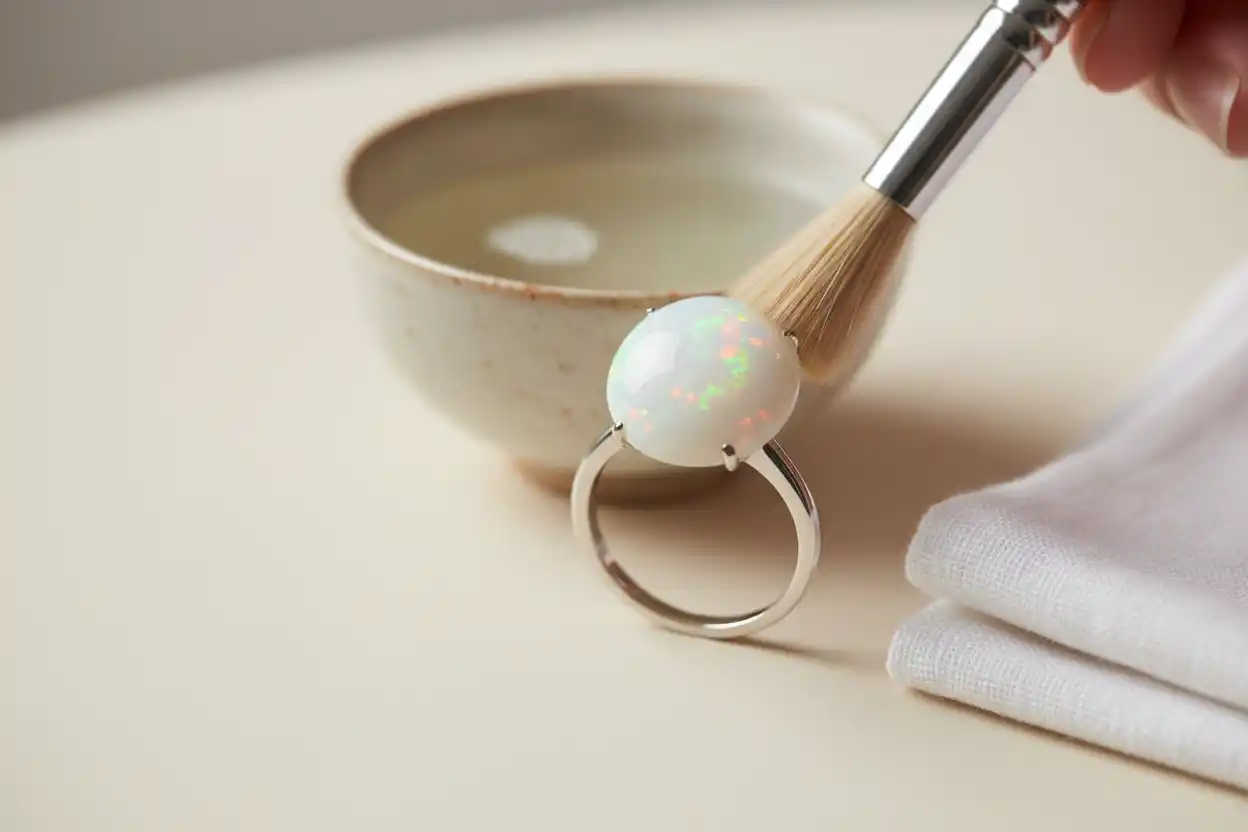
Learning how to clean opal jewelry correctly matters because opal is more delicate and structurally variable than many popular jewelry gemstones. For most sound solid opal, the safest approach is simple: lukewarm water, a tiny amount of mild liquid soap, gentle contact with a soft cloth or very soft brush, a brief rinse, and natural drying at room temperature.
Knowing how to clean opal jewelry also means identifying what you actually own. Solid Australian black opal, Ethiopian hydrophane opal, boulder opal naturally attached to ironstone, transparent fire opal, an opal doublet, and an opal triplet can look similar from the front yet react differently to water, heat, solvents, and cleaning equipment.
Opal is hydrated silica with an amorphous or poorly crystalline structure rather than a conventional crystalline mineral. The broader opal meaning profile explains its composition, play-of-color, geology, symbolism, and durability, while types of opal separates precious, common, black, boulder, fire, crystal, hydrophane, and assembled materials.
The safest way to learn how to clean opal jewelry is therefore to match the method to the stone, its treatment, its construction, and the complete jewelry setting.
How to Clean Opal Jewelry at a Glance
| Cleaning method | Recommendation |
|---|---|
| Soft dry cloth | Excellent for routine care |
| Slightly damp soft cloth | Safest conservative option for many pieces |
| Lukewarm water | Suitable for brief cleaning of many stable solid opals |
| Mild liquid soap | Suitable in very small amounts |
| Very soft brush | Use gently around settings when needed |
| Long soaking | Avoid |
| Ultrasonic cleaner | Avoid |
| Steam cleaner | Avoid |
| Hot or boiling water | Avoid |
| Vinegar or lemon juice | Avoid |
| Toothpaste | Avoid |
| Baking-soda scrub | Avoid |
| Bleach | Avoid |
| Acetone or strong solvents | Avoid unless specifically handled by a professional |
| Salt-water soaking | Avoid |
| Hair dryer or radiator | Avoid |
The basic rule for how to clean opal jewelry is to use the least aggressive method that removes ordinary dirt.
Why Opal Needs More Care Than Many Gemstones
To understand how to clean opal jewelry, it helps to understand why opal can be vulnerable.
Most opal is around 5 to 6.5 on the Mohs hardness scale. That means quartz, topaz, sapphire, ruby, and diamond can scratch it. Opal also has brittle tenacity, so a hard impact can chip an exposed edge even though the material has no cleavage.
Crazing is another concern. Crazing describes networks of cracks that can develop through instability, internal stress, drying, thermal change, cutting stress, or a combination of factors. Cleaning cannot repair crazing.
Water behavior also varies. Some Ethiopian opal is hydrophane and readily absorbs liquid. Other opal may be dyed, smoked, impregnated, filled, coated, glued, or assembled. The treated opal overview explains how those modifications can affect appearance, value, and care.
That variability is why how to clean opal jewelry cannot be reduced to “opal can go in water” or “opal must never get wet.”
What You Need
You need very little equipment to learn how to clean opal jewelry safely. Prepare a shallow bowl, lukewarm water, a tiny amount of mild liquid soap, two clean lint-free cloths, a very soft brush if required, and a folded towel.
Work over the towel instead of directly over an open sink. Opal can fracture or chip if dropped onto porcelain, tile, stone, or metal.
Avoid concentrated jewelry cleaner unless the manufacturer specifically states that it is suitable for the exact opal construction and every other material in the piece. Mild cleaning is preferable to chemical experimentation.
Step 1: Inspect the Opal Before Cleaning
The first step in how to clean opal jewelry is inspection.
Look at the stone in bright, neutral light. Check for chips, fine craze lines, open fractures, damaged facet edges, cloudy areas, loose movement, visible glue, straight layer boundaries, coatings, or changes in the stone’s surface.
Then inspect the setting. Check prongs, bezels, clasps, chains, soldered areas, drill holes, stringing, thread, elastic, and accent stones.
If the opal moves when touched gently or the setting looks damaged, stop. Knowing how to clean opal jewelry includes knowing when cleaning should wait until a jeweler has secured the piece.
Step 2: Determine Whether the Opal Is Solid or Assembled
One of the most important parts of how to clean opal jewelry is identifying whether the gemstone is solid, naturally matrix-backed, or assembled.
A solid opal is fundamentally one piece of opal, although natural potch or matrix may remain attached.
An opal doublet usually combines a thin layer of precious opal with a dark backing. A triplet adds a transparent cap above a thin opal layer and backing.
Doublets and triplets can contain genuine natural opal. Their assembled construction, not authenticity alone, changes the cleaning requirements because adhesives are involved.
The real vs fake opal guide explains how side views, backing layers, regular seams, synthetic patterns, and other observations can help distinguish solid, assembled, synthetic, and imitation material.
Boulder opal is different. Its brown ironstone backing formed naturally with the opal and is not a glued doublet layer.
Step 3: Prepare Mild Lukewarm Soapy Water
Temperature matters when learning how to clean opal jewelry.
Use lukewarm rather than hot water. Add only a few drops of mild liquid soap. You need enough to loosen oil, cosmetics, and ordinary residue—not a concentrated bath.
Avoid moving a very cold gemstone directly into warm water or a sun-heated stone into cool water. Rapid temperature changes add unnecessary stress.
How to clean opal jewelry safely is largely about avoiding extremes.
Step 4: Clean Gently
For a stable solid opal, dampen a soft cloth with the mild solution and wipe the stone gently.
If dirt has accumulated around the setting, use a very soft brush with minimal pressure. Concentrate on areas beneath cabochons, around prongs, along bezel edges, near pendant bails, around bead holes, and behind earrings.
Do not try to scrub away internal cloudiness, natural matrix, inclusions, color patches, or play-of-color structures. Those features are inside the gem.
An important part of how to clean opal jewelry is recognizing that more pressure does not create better results.
Step 5: Rinse Briefly When Appropriate
How to clean opal jewelry after using soap depends on construction.
A stable solid non-hydrophane opal in a secure setting can generally receive a quick rinse with clean lukewarm water.
For hydrophane opal, doublets, triplets, glued pieces, uncertain treatments, antique jewelry, or pieces containing moisture-sensitive materials, use another slightly damp cloth to remove soap instead.
Do not soak simply because the stone appears dirty. A few minutes of careful cleaning usually accomplishes more than hours of immersion.
Step 6: Dry Naturally
The last basic step in how to clean opal jewelry is gentle drying.
Blot the piece with a clean lint-free cloth. Allow hidden moisture around settings, seams, and drill holes to evaporate at normal room temperature.
Do not use a hair dryer, radiator, heater, oven, strong lamp, or prolonged direct sunlight.
If hydrophane opal has absorbed liquid, its appearance may change temporarily during drying. Do not try to force the process with heat.
How to Clean Opal Jewelry Made From Solid Opal
Knowing how to clean opal jewelry made from stable solid material is relatively straightforward.
Inspect the gem first. Use lukewarm water and mild soap. Wipe gently, brush only where necessary, rinse briefly, and let the piece dry naturally.
Solid does not mean indestructible. A solid opal can still be crazed, fractured, scratched, unstable, treated, or mounted in a fragile setting.
Even when you know how to clean opal jewelry made from solid opal, prolonged soaking offers little benefit.
How to Clean Hydrophane Opal Jewelry
Extra caution is necessary when learning how to clean opal jewelry containing hydrophane material.
Hydrophane opal has connected pore spaces that allow it to absorb liquid relatively readily. This behavior is particularly associated with much Ethiopian Wollo opal, although individual stones vary. The Ethiopian opal profile explains why water, skin oil, perfume, dye, and other liquids deserve special attention.
When hydrophane opal absorbs water, transparency, body tone, weight, and visible play-of-color can temporarily change. Foreign oils, cosmetics, or dyes may cause more persistent changes.
The safest approach for how to clean opal jewelry containing hydrophane stone is a barely damp soft cloth. Avoid intentional soaking.
If accidental wetting occurs, blot the jewelry and allow it to dry slowly at room temperature. Do not heat it.
Hydrophane behavior itself does not mean an opal is fake. It is a real material property of some natural opals.
How to Clean Black Opal Jewelry
How to clean opal jewelry made from black opal depends on whether the dark appearance is natural, treated, or created by assembly.
Natural black opal has a dark body tone that increases contrast with play-of-color. A stable solid black opal can generally receive brief cleaning with mild soap, lukewarm water, and a soft cloth.
However, not every dark-looking stone is untreated solid black opal. Dark appearance may result from smoke treatment, dye, dark backing, a doublet, a triplet, coating, or natural matrix.
If you do not know which construction you own, the conservative answer to how to clean opal jewelry is to use a damp cloth rather than immersion.
Fine black opal can also be highly valuable. If the stone is crazed, heavily included, antique, unusually expensive, or mounted in a complex setting, professional inspection is sensible before deep cleaning.
How to Clean Boulder Opal Jewelry
Understanding how to clean opal jewelry made from boulder opal starts with recognizing its natural host rock.
Boulder opal contains opal that remains attached to ironstone or another natural matrix. That geological backing is not equivalent to the glued backing of a doublet.
Use a damp soft cloth with mild soap, keep water exposure brief, and dry the piece thoroughly.
Pay particular attention where precious opal meets ironstone. Natural surface depressions and irregular boundaries can hold residue. Brush those areas gently rather than scrubbing aggressively across thin seams of opal.
The ironstone backing may provide structural support, but it does not make the exposed opal resistant to abrasion, impact, or thermal shock.
How to clean opal jewelry containing boulder material therefore follows the same principle as other opal care: gentle cleaning and minimal unnecessary exposure.
How to Clean Fire Opal Jewelry
How to clean opal jewelry containing fire opal requires the same conservative approach.
Fire opal is defined primarily by yellow, orange, reddish-orange, or red body color. It may or may not display play-of-color.
Stable solid fire opal can be wiped with mild soapy water and a soft cloth, then rinsed briefly and dried naturally.
Transparent fire opal is often faceted rather than cut only as cabochons. Protect facet junctions and pointed ends from impact while cleaning. A bright orange color does not make fire opal harder or less brittle.
Avoid ultrasound, steam, prolonged soaking, strong heat, rapid temperature changes, bleach, acids, alcohol, acetone, and abrasive cleaning.
Learning how to clean opal jewelry made from fire opal is less about its color and more about the stone’s physical condition, porosity, treatment, and setting.
How to Clean an Opal Doublet
One rule matters more than almost any other when learning how to clean opal jewelry containing a doublet: do not soak it.
An opal doublet uses adhesive to join a relatively thin opal layer to a backing. Water reaching the seam repeatedly can affect the assembly.
Dampen a soft cloth with mild soapy water and wipe the exposed surfaces. Use a second cloth slightly dampened with plain water to remove soap. Then dry immediately.
Do not scrub the junction between layers.
If the edges begin separating, appear cloudy, or show obvious adhesive deterioration, stop wearing the piece and have it evaluated.
How to Clean an Opal Triplet
How to clean opal jewelry containing a triplet is similar to caring for a doublet.
A triplet typically contains a backing, a thin opal layer, and a transparent upper cap made from another material. The top surface may therefore appear more scratch-resistant than exposed opal, but the glued assembly remains vulnerable.
Do not immerse an opal triplet.
Use a slightly damp cloth with mild soap, remove residue with another damp cloth, and dry it promptly. Keep moisture away from the side seams.
Never assume that a clear domed cap means the entire piece can tolerate aggressive cleaning.
How to Clean Treated Opal Jewelry
Treatment is one reason how to clean opal jewelry requires more than a single universal method.
Opal may be dyed, smoked, sugar-acid treated, impregnated with oil or resin, fracture filled, coated, or otherwise modified. Some treatments exploit the porosity of hydrophane material.
The treated opal guide explains why disclosure matters for both value and care.
If treatment is known or suspected, avoid soaking, strong soap, solvents, alcohol, acetone, bleach, steam, ultrasonic cleaning, and aggressive brushing.
Use a dry or barely damp soft cloth unless a reliable treatment-specific care instruction states otherwise.
If a high-value stone depends on treatment status for its price, laboratory identification may be more reliable than home experiments.
How to Clean Precious Opal Jewelry
Precious opal displays play-of-color caused by ordered microscopic silica structures.
How to clean opal jewelry containing precious opal depends more on construction and stability than on the fact that the stone shows spectral colors.
A stable solid precious opal can usually receive gentle lukewarm soapy cleaning. Hydrophane, treated, crazed, doublet, and triplet precious opal need more conservative care.
Play-of-color is not dirt. Do not try to polish or scrub a stone because one angle appears less colorful than another. Many opals naturally display directional color.
Can Opal Jewelry Get Wet?
The answer depends on the piece.
Many sound solid opals can tolerate brief contact with lukewarm water. Hydrophane opal can absorb it. Doublets and triplets contain adhesive. Treatments may react differently. A jewelry setting may also contain glue, thread, pearls, enamel, or other materials with stricter limits.
That is why understanding how to clean opal jewelry is more useful than asking whether all opal is simply “water safe.”
Brief controlled cleaning and prolonged soaking are not the same thing.
Should You Soak Opal Jewelry?
Generally, no.
Long soaking offers little physical-cleaning advantage and adds unnecessary exposure for hydrophane, assembled, treated, fractured, antique, or mixed-material jewelry.
When learning how to clean opal jewelry, choose targeted cleaning instead of leaving the piece in a bowl for hours.
A stubborn deposit beneath a setting may require professional attention rather than a longer soak.
Can You Use an Ultrasonic Cleaner?
Ultrasonic cleaning is not recommended for opal.
How to clean opal jewelry safely should not depend on high-frequency vibration. Ultrasound can aggravate fractures and crazing, disturb filler, loosen settings, weaken adhesives in doublets and triplets, and expose hydrophane material to cleaning fluid.
Opal’s moderate hardness does not make an ultrasonic cleaner appropriate.
Use controlled hand cleaning instead.
Can You Steam Clean Opal?
No routine home-care reason justifies steam cleaning opal.
Steam combines high temperature, moisture, and rapid thermal change. Those conditions can increase risks for unstable opal, glue, coatings, fillers, solder, and companion gems.
Anyone learning how to clean opal jewelry should treat steam as an unnecessary complication.
Can You Clean Opal With Vinegar?
Vinegar offers no useful advantage for normal opal care.
Its acidity may also affect metal, filler, coatings, adhesives, or other materials in the piece. Lemon juice presents similar concerns.
Mild soap is enough for ordinary skin oil and residue.
Can You Clean Opal With Toothpaste or Baking Soda?
No. Toothpaste and baking-soda pastes can be abrasive.
Opal is softer than many popular gemstones, and polishing compounds intended for another surface can dull or scratch it. Metal settings and plating can also suffer.
Knowing how to clean opal jewelry means avoiding improvised abrasives even when they are commonly recommended for household cleaning.
How to Clean an Opal Ring
An opal ring receives more impact, abrasion, soap, lotion, sanitizer, and household exposure than most opal jewelry.
Before cleaning, check prongs or bezel edges and look for chips around the girdle. If the stone is solid and stable, use mild soap, lukewarm water, and a soft cloth or brush.
How to clean opal jewelry worn as a ring also involves prevention. Remove the ring before gardening, exercise, cleaning, dishwashing, bathing, swimming, mechanical work, or handling abrasive materials.
A protective setting reduces impact risk but does not make opal scratch-proof.
How to Clean Opal Earrings
Opal earrings usually face less impact than rings but accumulate makeup, skin oil, hairspray, perfume, and residue around posts and backs.
How to clean opal jewelry in earring form depends on the opal type and setting. Clean stable solid stones gently with mild soapy water. Use a damp cloth for hydrophane or assembled opal.
Remove detachable backs where appropriate and dry metal components thoroughly.
Apply perfume and hairspray before putting the earrings on, especially when the opal is hydrophane.
How to Clean an Opal Necklace
An opal necklace normally receives fewer knocks than a ring or bracelet, making pendants a practical format for delicate or valuable opals.
Check the bail, chain, bezel, prongs, backing, and any adhesive.
How to clean opal jewelry in pendant form remains the same: brief and gentle for solid stable opal, damp-cloth care for assembled or uncertain material.
Do not soak beaded strands without considering the thread, knots, spacers, and other materials.
How to Clean an Opal Bracelet
An opal bracelet experiences repeated contact with desks, clothing, walls, and other surfaces.
How to clean opal jewelry worn on the wrist should account for both the stones and the construction. Stretch cord, thread, glued components, doublets, and triplets make prolonged immersion especially undesirable.
Clean individual areas gently and dry the bracelet flat.
Remove opal bracelets before exercise, showering, swimming, gardening, cooking, or housework.
How Often Should You Clean Opal Jewelry?
There is no fixed schedule.
Clean opal when skin oil, dust, cosmetics, or residue become noticeable. Jewelry worn frequently may need a gentle wipe every few wears and occasional deeper cleaning.
How to clean opal jewelry successfully is partly about preventing buildup. Put opal on after perfume, hairspray, sunscreen, lotion, and cosmetics have dried.
Frequent aggressive cleaning is unnecessary.
Hand Sanitizer, Perfume, and Cosmetics
Hydrophane opal deserves particular caution around oils and colored liquids because porous material may absorb substances.
For all opal jewelry, repeated exposure to perfume, hairspray, sunscreen, cosmetics, cleaning sprays, and hand sanitizer can leave residue or affect other components.
If you are learning how to clean opal jewelry because it repeatedly becomes dull, changing the wearing routine may solve more than stronger cleaning would.
Put jewelry on last and take it off before messy or wet activities.
What If the Opal Changes Color After Getting Wet?
Hydrophane opal may become more transparent, cloudy, less colorful, or uneven after absorbing water. The appearance often changes again as the stone dries.
Do not panic and do not apply heat.
Place the jewelry in a safe room-temperature location and allow natural drying. Depending on the stone and exposure, this can take time.
If the appearance does not return or the stone has absorbed oil, dye, perfume, or another contaminant, professional assessment may be appropriate.
This is one of the most important differences to understand when learning how to clean opal jewelry.
What If You See Crazing?
Crazing looks like fine cracks or a network of fractures within the opal.
Stop soaking and avoid ultrasound, steam, temperature changes, and aggressive cleaning. Cleaning cannot reverse structural cracks.
A crazed opal may remain wearable in some protected settings, but its condition should be evaluated, particularly if the jewelry is valuable or the cracks are expanding.
Knowing how to clean opal jewelry includes recognizing when the problem is damage rather than dirt.
Storing Opal After Cleaning
Allow the piece to become completely dry before storage.
Store opal separately from harder gemstones. Sapphire, ruby, diamond, quartz, and many other stones can scratch it when jewelry rubs together.
Use a padded compartment or soft pouch. Keep the piece away from direct heat, prolonged intense sunlight, air vents, and extreme environmental changes.
Normal household conditions are generally more appropriate than attempting to store opal submerged in water.
Physical Cleaning vs Spiritual Cleansing
How to clean opal jewelry refers to physical removal of oil, dust, cosmetics, and residue. Spiritual cleansing is a separate symbolic practice.
Opal does not scientifically require energetic cleansing. If symbolic cleansing is personally meaningful, choose methods that do not expose the stone to unnecessary salt, heat, water, chemicals, or prolonged sunlight.
A dry reflective practice, sound, visualization, or simply restating an intention avoids many physical-care problems.
The material’s care requirements should take priority over a cleansing ritual.
Frequently Asked Questions
What is the safest way to clean opal jewelry?
The safest general method for how to clean opal jewelry is gentle wiping with a soft cloth and mild lukewarm soapy water when the stone is stable and solid. Hydrophane, treated, doublet, and triplet opal need more conservative care.
Can opal jewelry go in water?
Many solid stable opals tolerate brief water contact, but hydrophane opal absorbs liquid and assembled opals contain adhesive. Long soaking is therefore not recommended.
Can I soak opal overnight?
No. Prolonged soaking offers little cleaning benefit and creates unnecessary risks for hydrophane, treated, assembled, fractured, or mixed-material jewelry.
Can black opal be cleaned with water?
Stable solid natural black opal can generally be cleaned briefly with mild soap and lukewarm water. If the stone may be treated, backed, or assembled, use a damp cloth instead.
How should boulder opal be cleaned?
Use mild soap and a soft damp cloth, clean irregular matrix boundaries carefully, keep water exposure brief, and dry completely.
How should fire opal be cleaned?
Stable solid fire opal can be cleaned gently with lukewarm water and mild soap. Avoid soaking, ultrasound, steam, heat, and sudden temperature changes.
How should Ethiopian opal be cleaned?
Hydrophane Ethiopian opal is best cleaned with a barely damp soft cloth. Avoid deliberate soaking because the stone can absorb water and other liquids.
Can opal doublets get wet?
Brief accidental moisture may not immediately damage every doublet, but they should not be immersed. Use damp-cloth cleaning and keep water away from bonded seams.
Can an opal triplet be soaked?
No. Triplets contain glued layers and should be cleaned with a damp cloth rather than immersion.
Can opal go in an ultrasonic cleaner?
Ultrasonic cleaning should be avoided for opal because vibration, cleaning fluid, and heat can aggravate cracks, crazing, treatments, glue, and assembled construction.
Can you steam clean opal?
Steam cleaning is not recommended because heat and rapid temperature change add unnecessary risk.
Can you use alcohol on opal?
Alcohol and other solvents are poor routine choices, particularly for hydrophane, treated, coated, filled, or glued opal.
Why did my opal change after getting wet?
Hydrophane opal can absorb water, temporarily changing transparency, body tone, weight, and play-of-color. Allow it to dry naturally at room temperature.
Why does my opal still look dull after cleaning?
The cause may be scratches, crazing, surface abrasion, internal characteristics, poor polish, contamination beneath an inaccessible setting, or permanent absorption of another substance.
How often should I clean opal?
Clean only when needed. Gentle wiping after wear and avoiding lotion, perfume, household chemicals, and rough activities can reduce the need for deeper cleaning.
Keep Opal Care Gentle
The safest answer to how to clean opal jewelry is deliberately uncomplicated: identify the material, inspect the piece, use minimal moisture and mild soap where appropriate, apply very little pressure, and let the jewelry dry naturally.
The details matter. Solid opal generally tolerates brief gentle washing better than hydrophane material. Black opal must be distinguished from darkened or backed products. Boulder opal has natural matrix rather than an adhesive backing. Fire opal can be faceted but remains vulnerable to heat and impact. Doublets and triplets should not be soaked. Treated opal deserves additional caution.
Once those differences are understood, how to clean opal jewelry becomes less about finding a powerful cleaner and more about preventing avoidable damage.
How to clean opal jewelry safely ultimately comes down to restraint. Use the gentlest method that works, protect the stone from impact and temperature extremes, and seek professional assessment when the opal is valuable, damaged, unstable, treated, assembled, or difficult to identify.