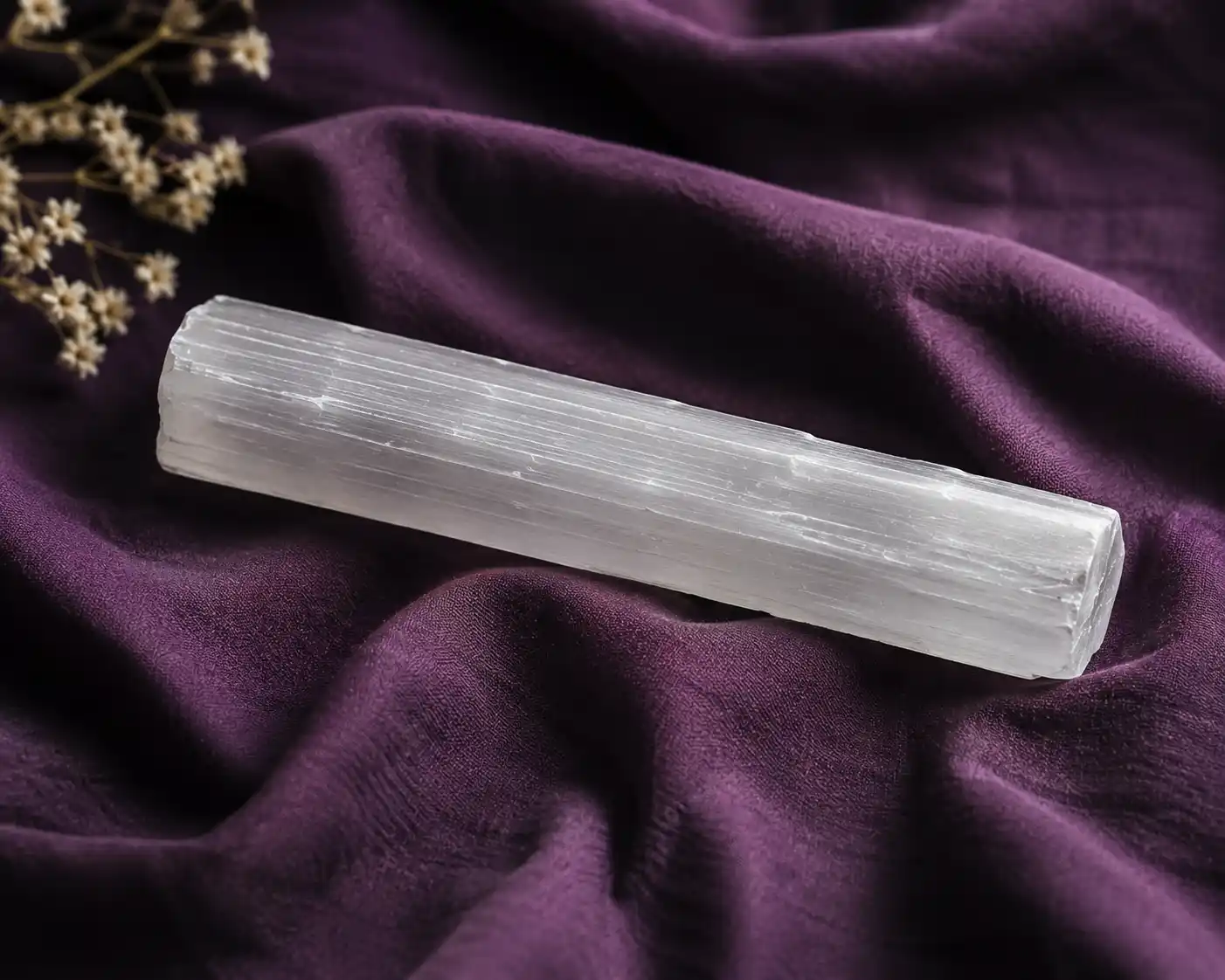
Is Selenite Safe in Water and Sunlight?
Selenite should not be soaked, rinsed routinely, placed in saltwater, or used directly in drinking water. It is a crystalline form of gypsum, a very soft hydrated calcium sulfate mineral that is measurably soluble in water. Repeated wetting can dull its luster, etch polished surfaces, weaken fibrous edges, enter cleavage planes, and leave the specimen rough or cloudy.
Normal indirect daylight is far less damaging. Pure clear or white gypsum is not generally known for rapid light-induced fading. Nevertheless, prolonged direct sunlight is unnecessary because it can heat the specimen, dry or discolor adhesives and coatings, and expose a soft mineral to repeated temperature changes.
The gypsum guide explains the parent mineral. This page focuses specifically on water, sunlight, humidity, cleaning, and exposure management.
Selenite Is Gypsum
True selenite is a transparent to translucent crystalline variety of gypsum. Satin spar is the fibrous variety commonly cut into white wands, towers, bowls, plates, and decorative objects.
Retailers frequently use “selenite” as an umbrella name for both. The difference is covered in selenite versus satin spar, while the guide to types of selenite explains transparent crystals, satin spar, desert rose, and alabaster-related forms.
Both selenite and satin spar share gypsum’s basic vulnerabilities:
- Mohs hardness around 1.5 to 2
- Perfect cleavage in one direction
- Easy scratching
- Water solubility
- Susceptibility to edge crushing and splintering
- Structural water within the mineral
Consequently, a polished satin spar wand and a transparent selenite blade may look different, but neither should be treated as water-safe.
What Happens When Selenite Gets Wet?
Water begins dissolving a small amount of gypsum from the surface. One brief splash may leave no obvious damage, yet repeated exposure gradually changes texture and optical quality.
On transparent selenite, water can produce:
- Cloudiness
- Fine etching
- Loss of glassy or pearly luster
- Rough cleavage surfaces
- Deposits from hard water
- Weakening along pre-existing cracks
On satin spar, water may affect the fine parallel fibers unevenly. A once-silky surface can become fuzzy, dull, ridged, or chalky. Thin splinters may separate at edges when the wet piece is rubbed.
The broad guide to crystals that can and cannot go in water places gypsum among the materials that should remain dry.
Will One Splash Destroy Selenite?
Usually not. A brief accidental splash does not cause an intact selenite crystal to vanish or collapse immediately.
The correct response is simple:
- Lift the piece away from the wet surface.
- Blot it gently with a dry lint-free cloth.
- Do not rub along fibrous edges.
- Allow it to air-dry in a shaded place.
- Inspect it after drying for cloudiness, soft areas, or loose splinters.
Do not use a hair dryer, radiator, heat gun, oven, or direct afternoon sun. Rapid drying with heat adds thermal stress and can affect glue, paint, felt pads, or repaired areas.
Can Selenite Be Rinsed Under a Tap?
Routine rinsing is not recommended. Running water combines dissolution with physical force, especially on fibrous satin spar, desert rose clusters, thin crystal plates, and pieces with cleavage cracks.
A quick rinse may cause no visible damage to a thick crystal, but it provides no advantage over dry cleaning. Fine dirt should be lifted with a soft dry brush, air bulb, or clean microfiber cloth.
When the specimen contains stubborn grime, a mineral conservator should evaluate the dirt, coating, repair, and exact gypsum form before liquid cleaning.
Can Selenite Be Soaked?
No. Do not soak selenite in a bowl, bath, sink, moon water, aquarium, fountain, or cleaning solution.
Longer immersion allows more surface dissolution. Moreover, water enters cleavage planes, matrix, repaired cracks, felt pads, drilled holes, and glue joints. After drying, dissolved minerals may recrystallize as a dull residue.
Soaking is particularly damaging to:
- Thin transparent blades
- Satin spar fibers
- Desert rose formations
- Selenite on matrix
- Carved bowls and plates
- Glued decorative pieces
- Dyed or coated material
- Jewelry with adhesive-set stones
Is Saltwater Safe for Selenite?
Saltwater is not safe. The underlying water already attacks gypsum, while salt adds residue and abrasive crystals.
As the solution dries, salt can crystallize in grooves and cleavage openings. Those crystals may expand locally, scratch the soft surface, and become difficult to remove without further water exposure.
Dry salt is also unsuitable. Selenite is soft enough to be marked by many common particles, and rubbing it in salt can destroy a polished or silky surface.
Can Selenite Go in Pool or Ocean Water?
No. Pool water combines water exposure with chlorine, stabilizers, dissolved salts, and other chemicals. Ocean water adds salt, sand, biological material, and strong loss risk.
Selenite jewelry should be removed before swimming, showering, washing hands, applying lotion, or cleaning. Even when the mineral survives one exposure, repeated wetting will shorten its usable life.
Can Selenite Be Put in Drinking Water?
Do not place a mineral specimen directly into water intended for drinking. Gypsum itself has controlled industrial and food-related applications, but a decorative specimen is not prepared, tested, or sold as a food-grade ingredient.
Natural and commercial pieces may carry:
- Soil and microbial contamination
- Cutting and polishing residue
- Glue or resin
- Dye or paint
- Metal from tools and findings
- Associated minerals
- Dust from storage and shipping
Fibrous satin spar can also shed sharp splinters. Anyone following a personal crystal-water ritual should use an indirect method in which the stone remains outside a sealed drinking-water container.
Is Selenite Safe in Sunlight?
Pure clear and white gypsum generally tolerates ordinary room light and indirect daylight without rapid color fading. Therefore, a brief period near a window is unlikely to cause a dramatic change.
However, direct sunlight is not an ideal storage or charging method. The main concerns are not immediate bleaching of pure gypsum but heat, thermal cycling, surface contamination, and non-gypsum components.
The general guide to crystals that fade in sunlight distinguishes light-sensitive color centers from minerals whose primary risk lies elsewhere. For selenite, water and physical softness are usually more immediate concerns than fading.
Does Sunlight Dehydrate Selenite?
Gypsum contains water within its crystal structure. Under sufficiently elevated temperatures, it can lose that structural water and convert toward calcium sulfate hemihydrate and eventually anhydrite.
Ordinary room-temperature daylight does not rapidly transform a selenite wand into plaster. The temperatures associated with significant controlled gypsum dehydration are much higher than a normally ventilated room.
Nevertheless, avoid using that fact as permission to bake the specimen in sun. A closed vehicle, hot display case, radiator shelf, exterior stone ledge, or concentrated beam can produce unnecessary heating and repeated expansion cycles. Adhesives, dyes, coatings, and display materials may fail well before the gypsum undergoes major mineralogical transformation.
Can White Selenite Turn Yellow in the Sun?
Pure gypsum does not typically turn yellow merely from brief daylight. Yellowing may instead result from:
- Dust or smoke
- Skin oils
- Aging adhesive
- Resin or varnish
- Iron-bearing surface contamination
- Dyed backing
- Packaging chemicals
- Heat-damaged felt or foam
Before cleaning a yellowed piece, determine whether the discoloration lies on the surface, within a coating, or inside the mineral. Water-based cleaning can worsen the damage.
Colored Selenite and Sunlight
Some gypsum is naturally colored by inclusions and impurities. Commercial objects may also be dyed, coated, lacquered, or sold under invented color names.
Those added materials may fade even when the gypsum host remains stable. Pink, blue, orange, rainbow-coated, or intensely colored “selenite” deserves seller disclosure and shaded storage.
The selenite buying guide helps separate natural forms from misleading product descriptions. Do not assume that every color treatment is lightfast.
Selenite, Satin Spar and Desert Rose in Sun
| Material | Water exposure | Indirect light | Prolonged direct sun |
|---|---|---|---|
| Transparent selenite | Keep dry | Generally acceptable | Avoid unnecessary heat |
| Satin spar wand | Keep dry; fibers can roughen | Generally acceptable | Avoid heating, yellowing of glue, and surface dust |
| Desert rose | Never soak | Display under stable indoor light | Avoid heat and fragile-edge exposure |
| Gypsum on matrix | Avoid liquid cleaning | Usually acceptable | Associated minerals and matrix may respond differently |
| Dyed or coated material | Avoid water | Use subdued light | Fading or coating damage possible |
| Glued carving or jewelry | Avoid immersion | Indoor display preferred | Adhesive can soften or discolor |
Humidity and Condensation
Ordinary indoor humidity does not dissolve selenite as rapidly as immersion, but persistent dampness and condensation are undesirable.
High humidity can encourage dust to adhere, affect cardboard labels and felt pads, and leave moisture on a cool specimen. Repeated condensation produces the same surface-dissolution mechanism as other water contact.
Store selenite:
- Away from bathrooms, kitchens, aquariums, and humidifiers
- Above floor level in flood-prone areas
- Inside a dry cabinet or enclosed display
- On acid-free tissue, inert foam, or clean fabric
- Away from windows that develop condensation
- Separate from harder crystals
A small cabinet hygrometer can help when protecting valuable mineral specimens.
Why Selenite Scratches So Easily
Selenite’s Mohs hardness is approximately 1.5 to 2. A fingernail can scratch it. Dust may contain quartz, which is dramatically harder and can mark the surface during wiping.
The gemstone hardness chart provides numerical context. Meanwhile, toughness versus hardness explains why cleavage, fiber direction, shape, and construction also matter.
Do not test selenite by scratching it. The low hardness is already established, and intentional testing causes permanent damage.
How to Clean Selenite Without Water
Use the least aggressive method that removes the dirt.
For Loose Dust
Hold the specimen securely over a padded surface. Use a clean soft artist’s brush or cosmetic brush to lift dust away. Brush in the direction of satin spar fibers rather than across them.
For Smooth Transparent Surfaces
A clean dry microfiber cloth may be used with almost no pressure. Stop if the cloth catches on an edge or cleavage crack.
For Grooves and Carvings
Use a hand-operated camera air blower, not high-pressure canned air. Strong compressed air can propel loose splinters or force dirt deeper into cracks.
For Sticky Residue
Do not apply water, alcohol, acetone, oil, or household cleaner without professional advice. Sticky residue may be adhesive, coating failure, wax, or degraded packaging material.
The general identification guide, How to Identify Crystals, can help confirm that the piece is gypsum before a care decision is made.
Avoid Ultrasonic and Steam Cleaning
Ultrasonic cleaning is inappropriate for selenite. Vibration can exploit cleavage, loosen fibers, and worsen fractures. The liquid bath also creates direct water exposure.
Steam cleaning combines water, heat, and pressure, making it equally unsuitable. A soft dry brush is safer and usually sufficient.
Selenite Jewelry and Water
Selenite is rarely a practical everyday jewelry stone. Its softness allows rapid scratching, while cleavage and fibrous textures make impact damage likely.
Protected earrings or pendants may survive occasional wear. Rings and bracelets receive far more contact with water, desks, doors, clothing, and household surfaces.
The guide to best gemstones for everyday wear places selenite outside the group of durable high-wear choices.
When selenite jewelry gets wet, remove it immediately, blot the piece, and air-dry it. Do not manipulate a softened cord, glue joint, or fibrous edge until dry.
Dry Cleansing and Charging Practices
Some owners use selenite in spiritual or personal rituals. Those traditions are belief-based and are not established mineralogical effects.
The dedicated guide to cleansing and charging selenite provides material-safe options. Dry approaches may include placing the piece in a clean location, using sound nearby, visualization, or brief indirect moonlight without dew or condensation.
The broader guides to cleansing crystals and charging crystals should always be filtered through the physical properties of the specific mineral.
Avoid water, salt, smoke residue, soil burial, direct candle heat, and exposed overnight placement where rain or dew may occur.
Storing Selenite Safely
Wrap individual pieces in acid-free tissue or soft clean fabric. Do not place selenite directly beside quartz, garnet, feldspar, metal tools, or other harder objects.
Transparent plates need support across their full length because point pressure can initiate cleavage. Satin spar wands should lie flat rather than stand where they can fall.
Carved bowls should not be used to hold loose hard crystals unless a protective liner separates them. Movement can scratch the bowl quickly.
For cataloging, the Crystals That Start With S directory and Gemstones That Start With S directory place selenite among related entries without changing its care requirements.
Clear Quartz Is Not a Care Substitute
Transparent selenite can resemble clear quartz in photographs, but the materials respond very differently to water and scratching. Quartz ranks about 7 on the Mohs scale and does not share gypsum’s water solubility.
The guide to clear quartz versus selenite owns that identification comparison. When an unknown clear specimen might be selenite, use the more conservative dry-care method until its identity is confirmed.
Frequently Asked Questions
1. How long can selenite stay in water?
It should not be intentionally submerged at all. Damage develops cumulatively, and the rate depends on surface area, water chemistry, temperature, polish, fibers, and existing fractures.
2. Will a quick rinse ruin selenite?
Not necessarily, but it can dull a delicate surface and provides no care advantage. Blot accidental water immediately and use dry cleaning in the future.
3. Can satin spar go in water?
No. Satin spar is fibrous gypsum. Water can roughen its silky surface, enter between fibers, and contribute to splintering or cloudiness.
4. Can desert rose selenite be washed?
No. Desert rose formations have delicate blades and often contain sand or matrix. Running water and brushing can remove or break structural material.
5. Can selenite go in moon water?
Do not immerse it. Keep the specimen outside a sealed water container and protect it from dew, rain, and overnight condensation.
6. Can I leave selenite outside overnight?
Outdoor exposure is risky because of dew, rain, humidity, windblown grit, temperature change, animals, and loss. A dry indoor windowsill is safer, provided condensation does not form.
7. Does sunlight fade selenite?
Pure clear or white gypsum is not generally known for rapid fading in ordinary light. Dyed, coated, glued, or impurity-colored pieces may behave differently.
8. Can selenite be placed in direct sunlight to charge?
A short dry exposure may not visibly damage pure gypsum, but direct sun offers no physical-care benefit. Indirect light avoids heating, coating damage, and accidental weather exposure.
9. Why did my selenite become cloudy?
Water etching, hard-water residue, skin oils, fine scratches, humidity, or abrasion by dust can reduce transparency. Do not try to restore it with additional water or polish.
10. Can damaged selenite be polished again?
Specialist lapidary work may improve some massive or transparent gypsum, but the material is soft, cleavage-prone, and difficult to finish. Minor water damage may be impractical to reverse.
11. Is selenite toxic when wet?
Gypsum is not generally regarded as a highly toxic mineral, but decorative specimens are not food-grade and may contain contaminants, coatings, glue, or associated minerals. They should not be placed in drinking water.
12. What is the safest place to keep selenite?
Use a dry, shaded, stable shelf or enclosed cabinet away from bathrooms, kitchens, humidifiers, direct heat, condensation, and harder minerals.
Selenite’s care requirements follow directly from gypsum’s structure: it is soft, cleavage-prone, and water-soluble. Keep it dry, clean it with minimal mechanical contact, and use indirect stable light for display. Those precautions preserve transparent crystal faces and satin spar’s silky fibers far better than soaking or prolonged sun exposure.
Keep selenite and satin spar out of drinking water, saltwater, cleaning baths, steam, ultrasonic equipment, and uncontrolled outdoor exposure. Fibrous pieces can shed sharp splinters, while commercial specimens may contain matrix, dyes, coatings, glue, or contaminants not apparent from appearance alone.