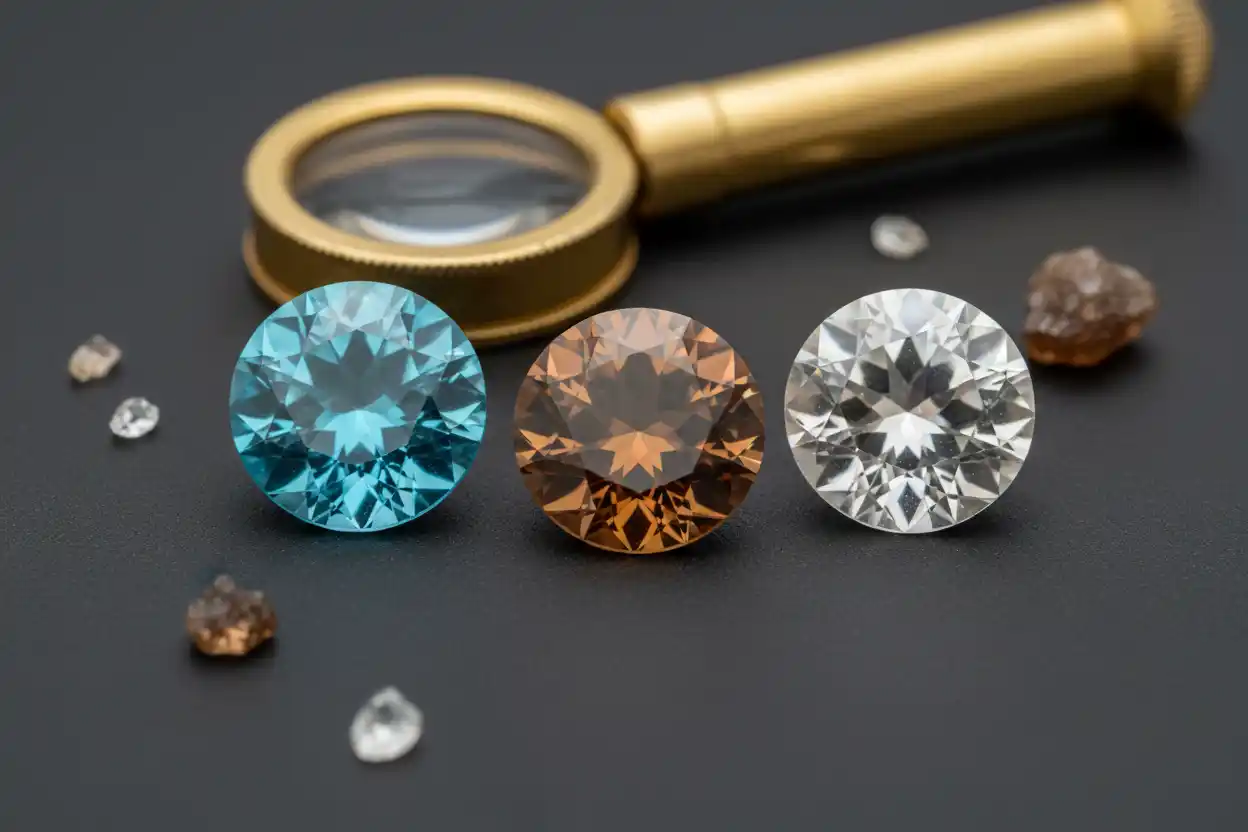
How to Spot Treated or Synthetic Zircon
Zircon is a natural gemstone, but a large share of the zircon sold in jewelry has been heat treated—especially vivid blue and near-colorless material. Treatment does not make a zircon fake. Instead, the important questions are whether the stone is genuinely zircon, whether its color has been enhanced, and whether the seller has disclosed that treatment accurately.
Confusion becomes more complicated because zircon is often mistaken for cubic zirconia. Despite the similar names, they are completely different gem materials. Understanding that distinction is the first step toward identifying treated, synthetic, or misrepresented zircon.
Treated Zircon at a Glance
| Feature | Natural Untreated Zircon | Heat-Treated Natural Zircon | Synthetic Zircon | Cubic Zirconia |
|---|---|---|---|---|
| Basic material | Natural zircon | Natural zircon | Laboratory-grown zircon | Laboratory-made cubic zirconia |
| Composition | ZrSiO₄ | ZrSiO₄ | ZrSiO₄ | ZrO₂ with stabilizers |
| Natural origin | Yes | Yes | No | No |
| Common in jewelry | Yes | Very common in some colors | Rare | Very common |
| Typical treatment status | None | Heat treatment | Man-made growth | Not a zircon treatment |
| Blue material | Naturally uncommon | Very common commercially | Possible in principle | Common in many colors |
| Colorless material | Natural examples occur | Frequently produced by heating | Possible | Extremely common |
| Reliable visual treatment test | Not applicable | Usually no | Usually requires gemological testing | Usually distinguishable gemologically |
| Main buying concern | Correct identification | Treatment disclosure | Correct laboratory-grown disclosure | Not being sold as natural zircon |
The broader Zircon meaning and properties guide covers the mineral itself, while this page focuses specifically on treatment and laboratory-grown material.
Is Most Blue Zircon Treated?
Yes. Commercial blue zircon should generally be expected to have undergone heat treatment.
Much natural zircon rough occurs in brown, reddish brown, yellowish, or related tones. Controlled heating can modify the stone’s color, and suitable brown zircon may become bright blue after treatment under appropriate conditions. Near-colorless zircon can also be produced by heating suitable material.
Consequently, an attractive electric-blue zircon is not automatically suspicious. In fact, heat treatment is routine enough in the blue-zircon market that buyers should approach blue stones with the expectation that treatment has probably occurred unless reliable documentation establishes otherwise.
This distinction is important because treatment changes color rather than identity. A heat-treated zircon is still natural zircon.
For a broader look at natural color groups rather than treatment status, see Types of Zircon.
What Treatments Are Used on Zircon?
Heat Treatment
Heat is by far the most important zircon treatment in the jewelry market.
Suitable material may be heated at roughly 900–1,000°C under controlled atmospheric conditions. Depending on the starting material and treatment environment, heating can produce blue or near-colorless appearances and can modify other colors as well.
Because zircon can contain trace radioactive elements over geological time, some crystals experience structural damage known as metamictization. Heating can partly restore crystallinity in suitable material while also changing its color.
The resulting gem remains natural zircon because the crystal itself formed in nature.
Fracture Filling
Transparent gemstones can sometimes be filled to reduce the visibility of surface-reaching fractures. Zircon may receive this type of clarity enhancement, although fracture filling is considered uncommon compared with heat treatment.
A filled stone requires more cautious handling because fillers can respond differently to heat, chemicals, repair procedures, and cleaning.
Other Color Modification
Zircon can show complicated responses to radiation and light. However, buyers should not assume that every unusual color represents a commercial treatment.
For ordinary retail identification, the most important disclosure question remains whether the zircon has been heated. Unusual stones with uncertain treatment histories are better evaluated by a gemological laboratory than tested experimentally at home.
Can You See Heat Treatment in Zircon?
Usually not with confidence.
Color alone can suggest that treatment is likely, but it cannot prove how an individual zircon acquired its appearance. A vivid blue stone, for example, is highly likely to be heated, yet visual inspection does not provide a complete treatment history.
Likewise, inclusions seen through a loupe may reveal useful information about a gem, but there is no simple inclusion that appears in every heated zircon and proves treatment by itself.
Advanced laboratories may combine several methods, including spectroscopy, chemical analysis, and structural examination, when treatment determination matters.
Therefore, a seller who claims that a loupe alone can guarantee that a zircon is completely untreated should be treated cautiously.
First Confirm That the Stone Is Actually Zircon
Before asking whether zircon is treated, make sure the material really is zircon.
Natural zircon has high refractive properties and strong dispersion, which can create considerable brilliance and flashes of spectral color. In many high-type zircons, strong double refraction can make facet junctions appear doubled when viewed through the stone.
However, zircon’s properties vary because natural radiation damage can alter its crystal structure over time. Gemologists describe material along a range that includes high, intermediate, and low zircon.
For that reason, no single visual feature should be used as a universal authenticity test.
Professional testing becomes especially valuable when a stone is expensive, unusually large, represented as untreated, or accompanied by a significant price premium.
Zircon Is Not Cubic Zirconia
One of the most persistent gemstone naming mistakes is treating zircon and cubic zirconia as though they were versions of the same material.
They are not.
Natural zircon is zirconium silicate, with the formula ZrSiO₄. Cubic zirconia, commonly abbreviated CZ, is a manufactured crystalline form based on zirconium dioxide.
The Cubic Zirconia guide covers that material separately.
Calling cubic zirconia “synthetic zircon” is therefore inaccurate. A synthetic gemstone should have essentially the same fundamental chemical composition and crystal structure as the natural gem it reproduces. Cubic zirconia does not meet that definition for zircon.
This distinction matters when reading listings. Phrases such as “created zircon,” “lab zircon,” or “synthetic zirconia” can be used inconsistently, so buyers should ask for the exact material name rather than relying on abbreviated marketing language.
Does True Synthetic Zircon Exist?
Laboratory-grown zircon is technically possible, but true synthetic zircon is not the common mass-market jewelry material that cubic zirconia is.
A genuine synthetic zircon would be laboratory-grown ZrSiO₄ with the essential properties of zircon. It should therefore be described as laboratory-grown or synthetic zircon rather than cubic zirconia.
In everyday jewelry shopping, however, buyers are much more likely to encounter natural zircon, heat-treated natural zircon, or cubic zirconia than a true synthetic zircon gemstone.
As a result, any expensive stone specifically represented as laboratory-grown zircon deserves clear documentation identifying the material.
Treated Zircon vs Synthetic Zircon vs Cubic Zirconia
The terminology becomes easier once the categories are separated.
Treated zircon started as natural zircon in the earth. A process such as heating was later used to alter its appearance.
Synthetic zircon is zircon created through a laboratory growth process rather than mined from the earth.
Cubic zirconia is a different man-made gemstone material and is not zircon.
That difference also affects value. Treatment disclosure matters, but a treated natural zircon still belongs to the natural-zircon market. Cubic zirconia belongs to a separate manufactured-gem market.
Anyone comparing purchase prices should therefore use the Zircon Price Guide rather than comparing zircon directly with inexpensive CZ listings.
How to Check a Zircon Before Buying
Start with the seller’s description rather than trying to diagnose treatment from photographs.
The listing or invoice should state that the material is zircon and should disclose known treatments. For a blue zircon, heat treatment is not unusual, so disclosure itself is not a negative sign. A vague description is more concerning than an openly disclosed treatment.
Next, compare the seller’s terminology with the price and claimed origin. If a listing describes an inexpensive mass-produced stone as “synthetic zircon,” ask whether the material is actually cubic zirconia.
For a valuable purchase, request an independent gemological report. A reputable laboratory can determine whether a stone is natural or laboratory-grown and may report detectable treatments.
The Zircon Buying Guide covers cut, color, clarity, size, seller evaluation, and purchasing considerations in greater detail.
Signs That a Zircon Listing Deserves More Scrutiny
One warning sign is a seller advertising vivid blue zircon as definitely unheated while providing no supporting laboratory report. Natural blue material is sufficiently unusual that strong claims deserve evidence.
Another concern is terminology that switches between “zircon,” “zirconia,” and “CZ” as though the names were interchangeable.
Be cautious when a seller claims that treatment can always be detected from a photograph, guarantees natural origin from color alone, or refuses to describe known enhancements.
Extremely high prices based mainly on an “untreated” claim also warrant independent confirmation. Treatment status can influence desirability, but documentation should support a substantial rarity premium.
Does Heat Treatment Lower Zircon’s Value?
Not necessarily.
Heat treatment is so established in parts of the zircon market that attractive heated stones can still be desirable and valuable. Blue zircon is a good example: the vivid blue appearance that makes the gem commercially popular is commonly associated with heating.
Value depends on several factors working together, including color, saturation, clarity, cut, carat weight, condition, origin when relevant, treatment status, and documentation.
An untreated stone with an unusual desirable natural color may attract collector interest, especially when its treatment status can be documented. However, “untreated” by itself does not guarantee high value.
Can Heat Treatment Affect Zircon’s Stability?
Some treated zircon can show color instability under particular lighting conditions.
Research has documented blue zircon temporarily developing brownish coloration after exposure to strong long-wave ultraviolet radiation. Visible light can reverse certain changes in affected material.
That phenomenon should not be used as a home treatment test. Exposing a gemstone deliberately to intense UV or heat can create unpredictable results and may damage a setting or alter the stone.
Zircon can also be brittle, and heat can affect its color. Therefore, avoid experimental heating even if an online source suggests it as an identification technique.
How to Care for Treated Zircon
Warm water, mild soap, and a soft brush are appropriate for routine zircon cleaning. Harsh scrubbing should be avoided because zircon can show abrasion along exposed facet edges over time.
Ultrasonic and steam cleaning are not recommended. Sudden temperature changes and unnecessary heat exposure should also be avoided.
Keep zircon separate from harder gemstones during storage so their surfaces do not rub together. The dedicated zircon jewelry cleaning guide explains the safest routine in more detail.
When taking a zircon ring or other setting for repair, tell the jeweler that the stone may be heat treated so unnecessary exposure to a jeweler’s torch can be avoided.
Should You Avoid Treated Zircon?
No. Treatment is not automatically a reason to reject a gemstone.
A well-cut, attractive heat-treated zircon can be an excellent jewelry stone when its identity and treatment are represented accurately. The important issue is disclosure.
Buyers who specifically collect untreated natural material may prefer documented unheated zircon. Someone primarily interested in vivid color and brilliance, meanwhile, may be perfectly comfortable with a disclosed heat-treated blue stone.
The choice should depend on what you want to own rather than on the assumption that every treatment makes a gemstone undesirable.
For stones intended for everyday wear, setting design can matter as much as treatment history. Zircon is brilliant but can be brittle, so protective designs are worth considering when choosing a zircon ring.
Treatment Questions for Zircon Jewelry
Treatment status matters whether a zircon appears in a ring, pendant, bracelet, or earrings, but the practical risk varies with how the piece is worn.
Rings experience more knocks and abrasion, while pendants and earrings usually receive less mechanical wear. Consequently, treatment disclosure should be considered alongside durability and setting security rather than viewed in isolation.
Specific style and setting considerations are covered in the guides to zircon bracelets, zircon earrings, and zircon necklaces.
Frequently Asked Questions
Is blue zircon natural?
The zircon crystal itself can be natural even when its blue color was produced by heat treatment. Commercial blue zircon is generally presumed to have been heated unless reliable evidence indicates otherwise.
Is treated zircon fake?
No. A treated zircon is still zircon. Treatment modifies a natural gemstone after mining; it does not automatically turn that gemstone into an imitation.
Is synthetic zircon the same as cubic zirconia?
No. True synthetic zircon would be laboratory-grown zirconium silicate, ZrSiO₄. Cubic zirconia is based on zirconium dioxide and has a different crystal structure and set of gemological properties.
Can a jeweler tell if zircon has been heated?
A jeweler may recognize that treatment is probable based on color and market experience, but proving heat treatment in an individual stone can require laboratory analysis. Visual inspection alone is not always conclusive.
Is all colorless zircon treated?
No. Naturally colorless zircon exists. However, heating can also produce near-colorless material, so color alone cannot establish treatment history.
Is fracture-filled zircon common?
Fracture filling is possible but is much less important commercially than heat treatment. If filling is present, it should be disclosed because it can affect care and repair procedures.
Can I test zircon treatment with UV light?
Deliberate UV exposure is not a recommended home identification test. Some blue zircon can undergo temporary color changes under strong long-wave ultraviolet radiation, but the response does not provide a simple universal treatment test.
Does untreated zircon cost more?
Sometimes, particularly when an attractive uncommon natural color has reliable documentation. However, color quality, cut, clarity, size, condition, and market demand still play major roles in value.
How can I know whether an expensive zircon is natural?
For a significant purchase, an independent gemological laboratory report provides much stronger evidence than photographs, seller claims, or home testing. Laboratory examination can establish the gemstone’s identity and determine whether it is natural or laboratory-grown while reporting detectable treatments.
Final Takeaway
The most important fact about treated zircon is that heat treatment is common and does not make natural zircon fake. Vivid blue and many near-colorless stones are commonly heated, and treatment may not be identifiable through ordinary visual inspection.
At the same time, zircon should never be confused with cubic zirconia. True synthetic zircon and CZ are different materials, while treated zircon remains a natural gemstone.
When treatment status affects price or collectability, rely on clear seller disclosure and independent laboratory documentation rather than color, photographs, or home experiments.