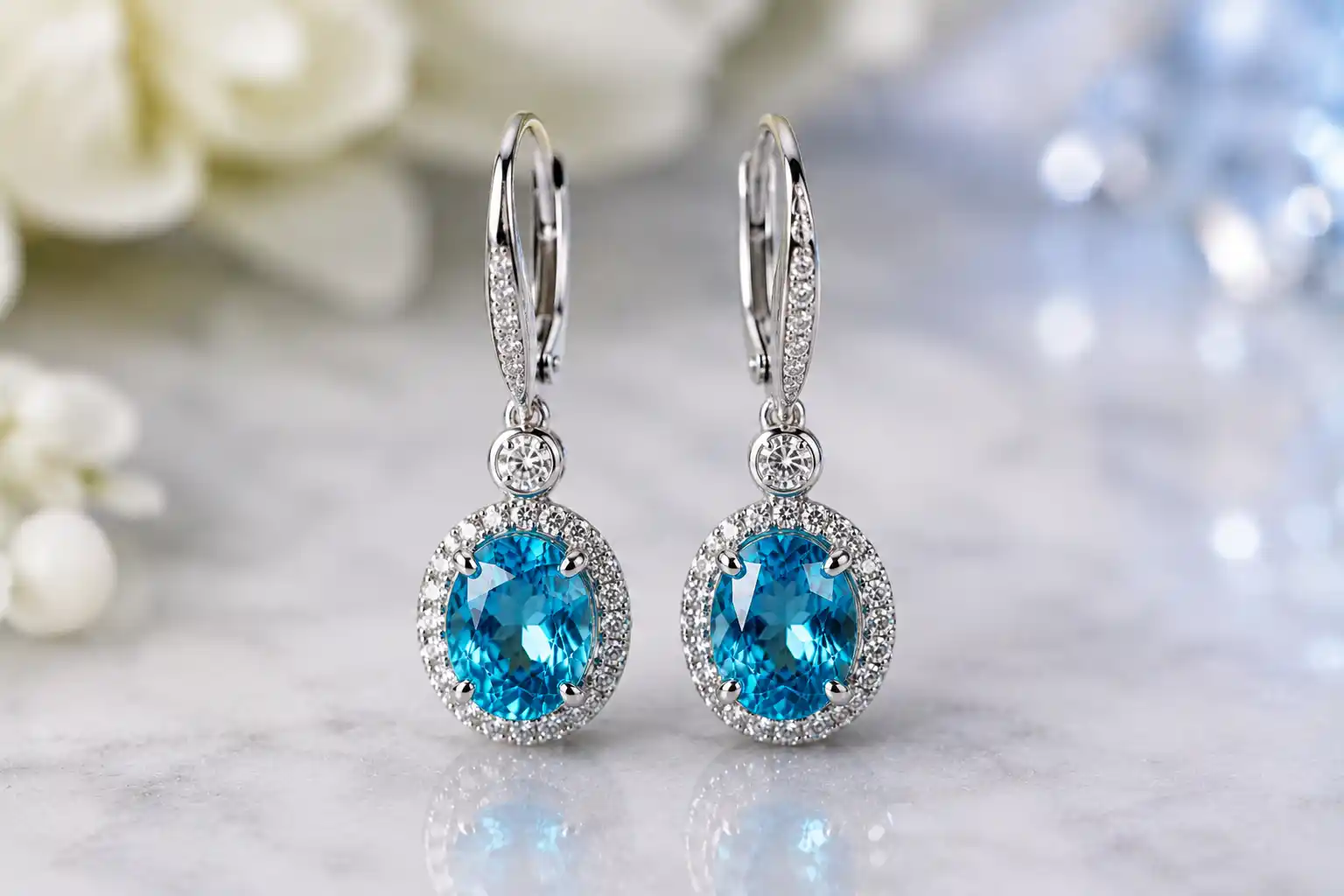
Zircon Earrings: Styles, Colors and Buying Guide
Zircon earrings showcase a natural gemstone known for high brilliance, noticeable fire and a broad color palette. Blue Zircon is the most widely recognized modern choice, but colorless, golden, yellow, green, orange and reddish-brown stones can suit designs ranging from small everyday studs to elaborate formal drops.
Earrings place Zircon in a relatively protected part of the body. They receive less routine impact than rings or bracelets, making them one of the most practical ways to wear this sometimes-brittle gemstone.
The main buying issues are correct identification, pair matching, treatment disclosure, comfortable weight and secure closures. Natural Zircon must also be distinguished from Cubic Zirconia, a manufactured material with a similar name.
The Zircon meaning and properties guide covers the gemstone’s mineral identity and symbolism. This guide owns earring styles, pair selection, settings, closures and practical wear.
Zircon Earring Buying Summary
| Factor | Strong practical choice | Main concern |
|---|---|---|
| Everyday style | Small stud or low halo | Exposed girdles and thin prongs |
| Formal style | Drop or chandelier design | Weight, movement and stone contact |
| Stone shape | Round, oval or cushion | Pointed corners can chip |
| Pair matching | Similar color, cut and face-up size | Zircon color and doubling may vary |
| Setting | Bezel or secure multi-prong mount | Loose stones and worn prongs |
| Backing | Screw back, locking back or quality friction back | Loss and stretched ear piercings |
| Color | Blue, colorless, yellow, brown, green or mixed | Heat treatment is common |
| Cleaning | Warm mild soapy water | Avoid ultrasonic and steam cleaning |
| Verification | Clear natural-Zircon disclosure | Confusion with Cubic Zirconia |
| Storage | Separate padded compartments | Earrings can scratch one another |
Why Earrings Suit Zircon
Zircon’s hardness ranges from approximately 6 to 7.5, but the gem can be brittle and prone to facet-edge abrasion.
The gemstone hardness chart explains scratch resistance, while the gemstone toughness-versus-hardness guide explains resistance to breaking.
Earrings avoid much of the impact experienced by hand and wrist jewelry. They rarely strike tables, tools or door handles during normal wear.
Consequently, Zircon earrings can use somewhat larger or more exposed stones than a daily-wear Zircon ring.
Nevertheless, long drops may strike the neck, shoulder or one another. Large hoops and chandeliers can also catch on clothing or hair.
The safest design combines moderate stone size, secure settings and manageable movement.
Zircon and Cubic Zirconia Are Different
Natural Zircon is zirconium silicate formed through geological processes.
Cubic Zirconia is manufactured zirconium oxide used widely as a Diamond simulant.
Natural colorless Zircon can show high brilliance and fire, which explains its historical use as a Diamond substitute. However, its strong double refraction and natural inclusion features distinguish it gemologically.
Cubic Zirconia is singly refractive, generally produced with highly consistent color and clarity, and usually costs far less.
A seller should never shorten Cubic Zirconia to “Zircon” in a product title. The wording can make manufactured earrings appear to contain a natural gem.
The Moissanite versus Cubic Zirconia guide provides additional context for common Diamond simulants without redefining natural Zircon.
Zircon Stud Earrings
Stud earrings are the most practical Zircon style.
They place the stone close to the earlobe and reduce leverage, swinging and impact.
Round brilliant Zircon studs produce a classic appearance with strong face-up sparkle. Oval and cushion stones can provide more visible color for the same width.
Bezel-set studs protect the girdle and create a smooth outline. Four- or six-prong designs admit more side light but expose more of the stone.
A basket should support the pavilion without pressing against the culet.
For everyday wear, moderate sizes usually balance brilliance and comfort better than oversized studs that pull forward.
Zircon Halo Earrings
Halo earrings surround a center Zircon with smaller accent stones.
The halo can:
- Increase apparent size
- Protect the center stone’s edge
- Add contrast
- Strengthen color
- Create a formal appearance
- Allow a smaller natural center stone
Colorless Diamond or Sapphire accents can make blue Zircon look brighter. White Cubic Zirconia may also be used as accent material when disclosed.
A halo should not trap the center stone so deeply that dirt collects beneath it without access for cleaning.
Check that small accent prongs are smooth and do not scratch the neck.
Zircon Drop Earrings
Drop earrings suspend one or more Zircons below the earlobe.
They allow the stones to move and catch light, making good use of Zircon’s brilliance and dispersion.
A simple drop may use one oval or pear-shaped stone. More elaborate designs can combine graduated stones, Diamonds or colored gems.
The connecting links should move freely without allowing stones to collide.
A heavy drop can stretch the piercing or tilt forward. Ask for the total gram weight of each earring rather than relying only on stone carats.
Pear-shaped Zircons need protective V-prongs or partial bezels at their points.
Zircon Chandelier Earrings
Chandelier earrings use several articulated tiers.
They can display mixed Zircon colors or combine Zircon with other December birthstones.
Their beauty depends on controlled movement. Too many loose joints can cause stones and metal elements to strike one another.
Check every connection ring, solder point and hinge.
Large designs should distribute weight across the earring rather than concentrating it at one narrow hook.
Chandeliers are best reserved for deliberate occasion wear rather than sleep, exercise or crowded events where they can catch.
Zircon Hoop Earrings
Hoop earrings can contain pavé, channel-set or individually prong-set Zircon.
Inside-out hoops place stones on the outer front and inner rear surfaces so the gems remain visible from normal angles.
Small huggie hoops offer the most secure everyday format.
Large thin hoops flex more easily and can release stones if the metal bends.
Inspect the hinge and closure. The post should align cleanly with the receiving notch without forcing the hoop sideways.
Channel settings protect stone edges but require precise calibration. One undersized stone can loosen the complete row.
Zircon Cluster Earrings
Cluster earrings arrange several Zircons in flower, starburst or geometric patterns.
A cluster can use different colors without requiring one large expensive gem.
The design should have a coherent center and balanced outline. Randomly crowded stones can look dark because their pavilions interfere with light entry.
Inspect the underside for access points that allow cleaning.
Each stone needs its own secure support. Shared prongs can loosen more than one gem after a single failure.
Cluster earrings are practical when the overall structure remains low and close to the ear.
Choosing Color
The types of Zircon guide covers the full color range.
Blue Zircon earrings
Blue Zircon ranges from pale sky blue to intense greenish or electric blue.
Most blue material is heat-treated, which is accepted when disclosed.
Blue Zircon works well in white gold and platinum, while yellow gold creates warmer contrast.
The blue gemstones guide compares Zircon with Aquamarine, Sapphire, Topaz and other blue gems.
Colorless Zircon earrings
Colorless Zircon produces bright, fiery earrings with a vintage Diamond-alternative appearance.
Facet abrasion is easier to see in colorless stones, so inspect junctions under magnification.
The white gemstones guide provides broader colorless-gem context.
Yellow and golden Zircon earrings
Yellow Zircon can look lemon, honey, straw or golden.
Warm stones pair naturally with yellow gold and can complement autumnal clothing palettes.
The completed yellow gemstones guide compares Zircon with Citrine, Topaz and Sapphire.
Red and orange Zircon earrings
Red, reddish-orange and orange Zircon can be striking and less familiar than blue material.
Color may be natural or modified by heat.
The red gemstones guide and orange gemstones guide provide broader comparisons.
Green and brown Zircon earrings
Green Zircon can be collectible and may have unusual structural properties. A premium pair deserves strong identification.
Brown Zircon ranges from champagne to deep cinnamon and can show excellent fire.
The green gemstones guide and brown gemstones guide place these less common colors within their wider jewelry categories.
Matching a Pair
Earrings are viewed together, so matching is more demanding than selecting one pendant.
Compare:
- Face-up hue
- Tone
- Saturation
- Transparency
- Cut shape
- Millimeter dimensions
- Depth
- Brilliance
- Double refraction
- Inclusion visibility
- Treatment category
- Total weight
Exact carat matching is less important than visual matching. Zircon’s high density means two stones can have similar face-up sizes despite slight weight differences.
Rotate both earrings under the same light. One stone should not remain dark while the other flashes brightly.
For drops, confirm that pear or oval stones point and hang in the same direction.
Natural inclusions need not match perfectly, but one heavily included stone should not be paired with a completely eye-clean gem at a premium price.
Cut Quality and Doubling
Zircon’s double refraction can make the rear facets appear doubled.
Cutters may orient the stone to reduce this effect through the face.
In earrings, some doubling may add visual liveliness without being distracting because the stones are viewed from normal conversational distance.
Judge overall brightness rather than expecting Diamond-like optics.
Avoid stones with:
- Large windows
- Misaligned culets
- Uneven outlines
- Severely abraded facets
- Chipped girdles
- Excessive extinction
- Poor symmetry
- Rough polishing
The completed Zircon buying guide owns the detailed color, clarity and cutting evaluation.
Choosing Stone Size
Small studs can provide strong sparkle because Zircon has high refractive index.
Medium stones offer more visible color without excessive weight.
Very large Zircons can make earrings heavy because the mineral has high specific gravity.
Compare dimensions and total earring weight before ordering.
A pair of large deep-cut Zircons may face up smaller than expected while pulling heavily on the ear.
For drops and chandeliers, distribute weight across several moderate stones instead of using one extremely deep gem.
Choosing Earring Backs
Friction backs
Quality friction backs are suitable for small-to-medium studs when the post and back fit closely.
Replace backs that slide too easily.
Screw backs
Screw backs offer additional security for valuable studs.
However, they take longer to put on and can irritate users who overtighten them.
Locking backs
Mechanical locking backs combine ease of use with strong retention.
They are useful for larger studs and halo earrings.
Lever backs
Lever backs suit drops and small hoops. The closure should snap securely without pinching.
French hooks
French hooks create an elegant drop but offer less loss protection unless paired with silicone or metal stoppers.
Omega backs
Omega backs distribute weight across the earlobe and work well for large button-style earrings.
The clip pressure should be adjusted professionally rather than bent repeatedly at home.
Metal Choices
White gold and platinum create a cool setting for blue and colorless Zircon.
Yellow gold complements golden, orange, red-brown and greenish stones.
Rose gold works well with champagne, cinnamon and pale blue material.
Sterling silver offers an affordable option, although tarnish and thin prongs require maintenance.
Sensitive wearers should ask about nickel content, plating and the composition of posts and backs. The best gemstones and metals for sensitive skin guide provides wider material considerations.
The stone may be natural while the metal still causes irritation.
Treatment Disclosure
Heat treatment is common in Zircon, particularly for blue and colorless stones.
It may also produce or modify yellow, orange and red colors.
Some heat-treated colors can change after prolonged exposure to intense light or additional heat.
Fracture filling is possible but uncommon. Coatings and assembled stones should be disclosed separately.
The gemstone treatments guide explains enhancement terminology and care.
Treatment should affect price and disclosure rather than automatically disqualifying an attractive pair.
Zircon Earrings as December Birthstone Jewelry
Zircon is one of December’s recognized birthstones.
The December birthstone guide covers Zircon alongside Turquoise and Tanzanite.
Blue Zircon studs offer a practical birthstone gift because they combine December symbolism with a lower-impact jewelry form.
Mixed December earrings can pair blue Zircon with Turquoise or Tanzanite, although the three materials have different care requirements.
The December birthstone jewelry guide covers gift selection and mixed designs.
Styling Zircon Earrings
Studs work for everyday wear, work settings and layered ear arrangements.
Small blue Zircon studs can sit beside plain gold or silver hoops without overwhelming the complete look.
Halo earrings suit formal events and bridal styling.
Drops add movement and work well with open necklines or hair worn away from the ears.
Chandeliers should be allowed to stand alone rather than competing with a large statement necklace.
The Zircon color meaning guide explains traditional color symbolism, although personal wardrobe and visual preference should control styling choices.
Buying Vintage Zircon Earrings
Vintage colorless Zircon was sometimes used as a Diamond alternative.
Older settings may show:
- Abraded facet edges
- Thin worn prongs
- Replaced stones
- Mismatched pairs
- Repaired posts
- Converted clips
- Foil or closed backs
- Incorrect Cubic Zirconia labels
- Antique-cut asymmetry
A gemologist should confirm the stones before a major purchase.
Do not assume that an old “white Zircon” label means Cubic Zirconia. Natural colorless Zircon was used before CZ entered the jewelry market.
Likewise, age alone does not prove natural identity because glass and synthetic stones also occur in vintage pieces.
Reports and Price
The Zircon price guide owns detailed value ranges.
Price depends on color, treatment, matching, total weight, cut, clarity, metal, workmanship and brand.
A laboratory report may be appropriate for:
- Large matched green Zircons
- Rare red pairs
- Allegedly untreated blue stones
- Expensive antique earrings
- Unusually large colorless stones
- Origin-specific claims
- Pairs confused with Diamond
The gemstone certification guide explains testing and reports.
For commercial blue studs, a reputable seller’s disclosure and return policy may be sufficient.
Ethical Buying
Ask whether the seller can identify the rough source, cutting location and jewelry manufacturer.
Zircon comes from Cambodia, Sri Lanka, Myanmar, Tanzania, Australia and other regions.
Exact origin can be difficult to confirm once stones have been mixed and calibrated.
The ethically sourced gemstones guide provides realistic supply-chain questions.
Avoid unsupported labels such as fully traceable or mine-direct when the seller cannot document the chain.
Cleaning and Storage
The completed Zircon jewelry cleaning guide owns the full cleaning procedure.
Use lukewarm water, mild soap and a soft brush. Support the earring by its metal setting rather than pressing on the stone.
Avoid steam and ultrasonic cleaners.
Remove earrings before hair coloring, swimming, applying hairspray or using strong cleaning products.
Store each earring in a separate padded section so the stones and posts do not scratch each other.
Check backs, posts and prongs regularly.
Frequently Asked Questions
1. Are Zircon earrings made from natural stones?
They can be, but the seller should specify natural Zircon rather than Cubic Zirconia.
2. Is Zircon the same as Cubic Zirconia?
No. Natural Zircon is zirconium silicate, while Cubic Zirconia is manufactured zirconium oxide.
3. Are Zircon earrings suitable for everyday wear?
Studs and low-profile halos can be worn regularly with care because earrings receive less impact than rings and bracelets.
4. Is blue Zircon heat-treated?
Most commercial blue Zircon is produced through heat treatment of brownish rough.
5. Which Zircon earring style is safest?
Small bezel-set studs provide strong edge protection and minimal movement.
6. Why do some Zircons show doubled facets?
Zircon is doubly refractive, so rear facet edges can appear doubled when viewed through the stone.
7. Are large Zircon earrings heavy?
They can be because Zircon has relatively high density. Compare dimensions and total earring weight before buying.
8. What backing is best for expensive Zircon studs?
Screw backs or quality locking backs provide additional security when the posts and settings are well made.
9. Can Zircon earrings go in an ultrasonic cleaner?
No. Warm soapy water is safer, while ultrasonic and steam cleaning are not recommended.
10. Can blue Zircon change color?
Some heat-treated stones may shift toward their earlier brownish color after prolonged exposure to intense light.
11. Are colorless Zircon earrings Diamond earrings?
No. Colorless Zircon is a natural gemstone with different physical and optical properties from Diamond.
12. What should I inspect in a matched pair?
Compare color, millimeter size, cut, brilliance, clarity, treatment, setting height, posts and backs.
Let Movement Enhance the Gem Without Endangering It
Zircon works especially well in earrings because the stones catch light without facing the repeated impacts of hand jewelry. The strongest pair combines visual matching, manageable weight and secure settings.
The Zircon bracelet guide covers wrist-specific wear, while the Zircon necklace guide explains pendants and chain construction. The Zircon ring guide addresses the most demanding setting format. The Z crystal directory and Z gemstone directory provide alphabetical context.