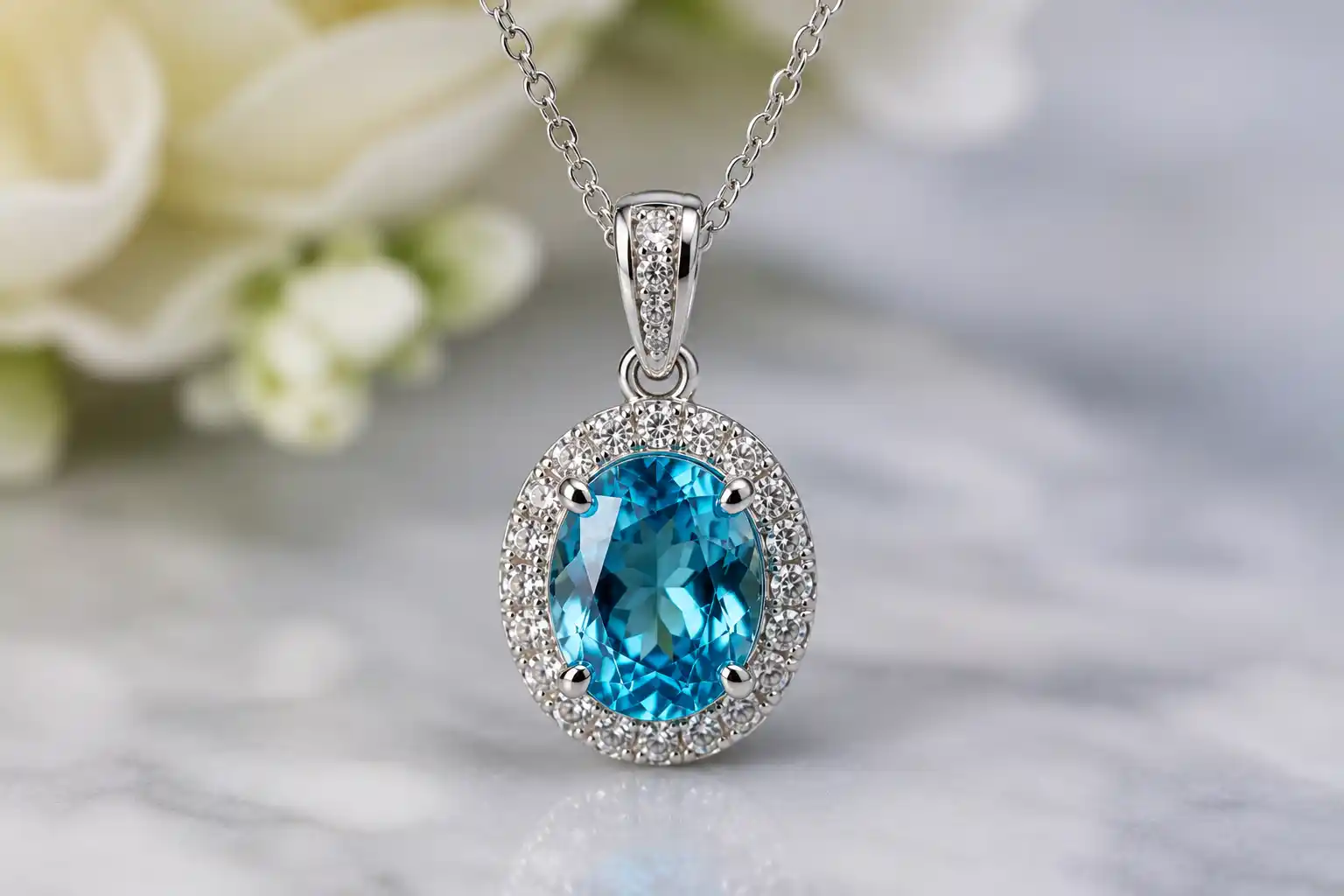
Zircon Necklaces and Pendants: Styles and Buying Guide
Zircon necklaces place a naturally brilliant gemstone in a relatively protected jewelry format. The stone sits away from the repeated impact experienced by rings and bracelets, while its high refractive index and dispersion produce visible sparkle at the neckline.
Blue Zircon is the most familiar choice, particularly for December birthstone jewelry. Nevertheless, colorless, yellow, golden, orange, green, red and brown Zircon can create pendants ranging from understated everyday solitaires to vivid collector pieces.
The main purchase decisions involve natural-versus-manufactured identity, treatment, pendant setting, bail size, chain strength, stone orientation and necklace length.
The Zircon meaning and properties guide covers geology and traditional symbolism. This page focuses on necklace and pendant design, construction, styling and care.
Zircon Necklace Buying Summary
| Factor | Strong practical choice | Main concern |
|---|---|---|
| Everyday pendant | Small bezel or secure halo | Exposed edges and weak bails |
| Formal necklace | Graduated line or cluster | Weight and stone-to-stone contact |
| Stone shape | Round, oval, cushion or protected pear | Sharp points and corners |
| Chain | Solid, well-soldered chain matched to pendant weight | Thin links and open jump rings |
| Bail | Large enough for chain and clasp | Wear, twisting and restricted movement |
| Color | Blue, colorless, golden, green, red or brown | Heat treatment and light sensitivity |
| Length | Chosen for neckline and pendant size | Pendant striking hard surfaces |
| Cleaning | Mild soap and lukewarm water | Avoid steam and ultrasonic cleaning |
| Storage | Flat or hanging separately | Chain tangles and facet abrasion |
| Verification | Natural-Zircon disclosure | Confusion with Cubic Zirconia |
Why Necklaces Suit Zircon
Zircon generally has Mohs hardness between 6 and 7.5, while its toughness ranges from fair to good.
The gemstone hardness chart explains resistance to scratching. The gemstone toughness-versus-hardness guide explains resistance to chipping and breaking.
Zircon can be brittle, and facet edges may abrade through hard rubbing. A pendant usually avoids these conditions more effectively than a ring.
However, long necklaces can strike desks, counters and seat belts. Pendants can also hit one another when several necklaces are layered.
A good Zircon necklace keeps the gem supported, separated and high enough to avoid repeated impacts.
Natural Zircon Versus Cubic Zirconia
Natural Zircon is zirconium silicate formed within Earth.
Cubic Zirconia is a manufactured zirconium oxide gemstone used widely as a Diamond simulant.
Both can be colorless, blue, yellow, green or other colors. Nevertheless, they have different structures, refractive behavior and market values.
Natural Zircon may show visible double refraction, natural inclusions and variations associated with its structural condition.
Cubic Zirconia is usually highly uniform and singly refractive.
A necklace description should never use “Zircon” as shorthand for Cubic Zirconia.
The completed Cubic Zirconia price guide provides market context for the manufactured material.
Zircon Solitaire Pendants
A solitaire pendant uses one center Zircon.
This style places all attention on color, cut and brilliance.
Round stones produce a classic symmetrical appearance. Ovals provide larger-looking outlines, while cushions can intensify color through their broader facet patterns.
Pear-shaped Zircon creates an elegant drop but needs a V-prong or protective bezel at the point.
Emerald-cut stones emphasize color and clarity rather than fire. They reveal windows and inclusions easily, so cut quality matters.
A solitaire should hang straight without rotating continually.
The setting’s center of gravity, bail placement and chain thickness determine whether the stone faces outward or flips.
Bezel-Set Zircon Pendants
A bezel surrounds the stone’s girdle with metal.
It offers strong protection against impact and snagging and creates a smooth pendant outline.
A full bezel is suitable for everyday blue or colorless Zircon.
A partial bezel leaves more of the sides open while still protecting vulnerable areas.
The metal rim should remain even and should not conceal chips or significant repairs.
Check the back. A completely closed setting may hide foil, filler or a composite stone.
An open-back bezel permits cleaning and allows transmitted light, although the gem’s face-up brilliance depends primarily on correct cutting.
Zircon Halo Pendants
A halo surrounds the center Zircon with smaller stones.
Diamond, Sapphire, Moissanite or Cubic Zirconia may be used as accents, provided each material is disclosed.
A white halo can intensify blue Zircon through contrast. Yellow-gold halos can warm brown, orange and golden stones.
The halo also provides some side-impact protection.
However, small accent stones add prongs and cleaning surfaces. Inspect the entire border for loose or misaligned gems.
The pendant should have enough open space beneath the center to permit cleaning without weakening the structure.
Zircon Cluster Necklaces
Cluster pendants arrange multiple Zircons in flowers, stars, geometric shapes or organic compositions.
The stones may match or use several natural colors.
A cluster can create a larger visual presence without requiring one rare large Zircon.
The design should maintain separation between stone edges. Crowded girdles can rub or chip during movement.
Each gem needs a secure seat. Shared prongs should be thick enough that one worn tip does not release several stones.
Inspect the underside for cracks, solder repairs and areas that trap residue.
Zircon Station Necklaces
A station necklace distributes individually set Zircons along a chain.
This style is lighter and more versatile than a complete line necklace.
Each station should be connected through secure closed loops or soldered links.
The stones should face outward rather than flipping because of uneven setting depth.
A longer station necklace can be layered, although Zircon stations should not rub against Diamond or Sapphire strands.
Small bezel settings provide the best balance of protection and movement.
Zircon Line and Tennis Necklaces
A line necklace places a continuous sequence of Zircons around part or all of the neckline.
Graduated designs use larger stones at the center and smaller stones toward the clasp.
Flexibility is essential. Each link should articulate smoothly without twisting the adjoining setting.
A rigid segment can press girdles together and cause damage.
Because Zircon has high density, a complete line necklace may be heavier than expected. Ask for total gram weight as well as total carat weight.
The clasp should include a secondary safety mechanism for a high-value piece.
Zircon Bead Necklaces
Faceted or polished Zircon beads can create substantial color and sparkle.
However, direct bead-to-bead contact increases abrasion.
Inspect drill holes for chips and cracks. A sharply edged hole can cut the stringing material.
Knots between valuable beads reduce contact and limit loss if the strand breaks.
For smaller beads, durable coated wire may be more practical than silk, depending on the design.
Ask whether every bead is natural Zircon or whether the strand includes glass, Cubic Zirconia or other minerals.
Uniformity alone does not establish quality because manufactured beads can be perfectly matched.
Choosing Zircon Color
The types of Zircon guide covers the complete palette.
Blue Zircon necklaces
Blue Zircon ranges from pale sky blue to vivid greenish or electric blue.
Most blue material has been heat-treated, which should be disclosed.
Blue pendants work well in white metal for a cool appearance or yellow gold for warm contrast.
The blue gemstones guide compares it with Aquamarine, Topaz, Sapphire and Tanzanite.
Colorless Zircon necklaces
Colorless Zircon can produce a bright Diamond-alternative pendant.
Its fire may be visible in strong lighting, although facet wear affects long-term crispness.
The white gemstones guide explains its position among colorless jewelry stones.
A vintage colorless Zircon pendant should not be assumed to contain Cubic Zirconia because natural Zircon was used as a simulant before CZ became common.
Yellow, golden and orange Zircon
Warm Zircon colors create distinctive pendants and often cost less than vivid blue or rare red material.
Yellow gold strengthens warmth, while white metal creates sharper contrast.
The yellow gemstones guide and orange gemstones guide provide broader comparisons.
Red and reddish-brown Zircon
Red Zircon is uncommon and can command significant premiums when attractive and correctly identified.
Brown and cinnamon Zircon are more available and can show strong fire.
The red gemstones guide and brown gemstones guide provide additional color context.
Green Zircon
Transparent green Zircon can be collectible. Some stones have radiation-related structural alteration that affects optical and physical properties.
An expensive green pendant should have reliable gemological identification.
The green gemstones guide compares it with Peridot, Tourmaline, Sapphire and other green stones.
Choosing the Cut
Zircon has high refractive index, noticeable dispersion and potentially strong double refraction.
Round brilliant cuts produce familiar sparkle.
Oval and cushion cuts often give good face-up size and color.
Radiant cuts can intensify saturation in blue, golden and red stones.
Emerald cuts emphasize transparency and color evenness but show windows and inclusions clearly.
Pear, marquise and princess shapes need protected points or corners.
The stone should not have a broad transparent window through the center.
Inspect facet junctions for wear, especially in vintage and previously worn necklaces.
The completed Zircon buying guide owns full quality evaluation.
Double Refraction
Many Zircons are strongly doubly refractive.
Rear facet edges can look doubled when viewed through the stone.
This phenomenon helps identify Zircon but can make a poorly oriented gem look visually blurred.
Cutters often orient the optic direction to reduce face-up doubling.
In a pendant, view the stone from normal distance and under several lighting conditions.
A small amount of doubling may add liveliness, while severe doubling can reduce apparent crispness.
It should not be confused with a doublet seam or two stones joined together.
Choosing Pendant Size
Pendant dimensions should suit both the wearer and the chain.
A small Zircon can produce visible brilliance without excessive weight.
Large stones show color more clearly but require stronger bails and chains because Zircon has relatively high density.
Compare millimeter size rather than carat weight alone.
A deep five-carat Zircon may face up smaller than a shallower stone of similar weight.
A large drop should sit high enough that it does not strike tables when the wearer leans forward.
For everyday wear, moderate stones in low settings provide the most practical balance.
Choosing a Bail
The bail connects the pendant to the chain.
It should be large enough for the chain and clasp to pass through without scraping.
A fixed bail keeps the pendant aligned but may restrict movement.
A hinged bail helps the pendant lie flat and adapt to the chain’s angle.
A hidden bail creates a cleaner appearance but can wear where the chain rubs inside a narrow opening.
Inspect the bail’s solder seam and the joint connecting it to the pendant.
Heavy pendants benefit from double bails or reinforced structures.
A decorative bail should not contain sharp edges that abrade the chain.
Choosing the Chain
The chain must support the pendant’s total weight, not merely match its color.
Cable chains
Cable chains are versatile and relatively easy to repair. Choose solid links rather than extremely thin hollow construction.
Box chains
Box chains provide a clean geometric appearance but can kink when very fine.
Wheat and rope chains
These offer greater visual texture and can support heavier pendants.
Their surface may compete with an elaborate cluster design.
Snake chains
Snake chains create a smooth line but can kink permanently if sharply bent.
Curb and Figaro chains
These work well with larger warm-colored pendants and more substantial designs.
The chain’s weakest point is often the jump ring or clasp rather than the main links.
Choose soldered connectors whenever practical.
Necklace Length
Common necklace lengths include:
| Length | Typical position | Best Zircon use |
|---|---|---|
| 14–16 inches | Choker to base of neck | Small studs-on-chain and compact pendants |
| 17–18 inches | Collarbone area | Most everyday Zircon solitaires |
| 20–22 inches | Upper chest | Medium statement pendants |
| 24 inches | Mid-chest | Larger pendants and layering |
| 30 inches or longer | Lower chest | Station necklaces and occasional long designs |
Actual placement depends on neck size, body proportions, clothing and pendant weight.
A longer pendant moves more and faces greater impact risk.
A shorter necklace keeps Zircon visible and protected but should not feel restrictive.
Use an extender when several necklines need to be accommodated.
Layering Zircon Necklaces
Zircon can be layered when chains remain separated.
Use different lengths to reduce tangling.
Avoid placing Zircon directly beside a Diamond or Sapphire pendant that can strike its facets.
A plain metal chain can pair safely when it does not have sharp textured links.
Keep one statement pendant as the focal point. Several large gem pendants create visual competition and increase contact.
A necklace separator or layered clasp can keep chains aligned.
Remove the complete stack before exercise, sleep or travel.
Metal Choices
White gold and platinum provide a cool setting for blue and colorless Zircon.
Yellow gold enhances golden, brown, red and orange stones and creates contrast with blue.
Rose gold suits champagne, cinnamon and warm pinkish-red material.
Sterling silver offers accessibility but requires strong bails and periodic tarnish care.
The setting and chain do not need to use the same metal purity, but the color and wear pattern should remain compatible.
Ask about nickel content and plating when skin sensitivity matters.
Zircon as December Birthstone Jewelry
Zircon is one of December’s recognized birthstones.
The December birthstone guide covers Zircon alongside Turquoise and Tanzanite.
A necklace can include:
- One blue Zircon solitaire
- A three-stone December pendant
- Family birthstones
- Initial and birthstone charms
- A December constellation design
- A vintage colorless Zircon
- A mixed blue-gem station chain
The December birthstone jewelry guide covers gift formats and material differences.
The birthstones-by-month guide places Zircon within the complete calendar.
Traditional Color Meaning
The Zircon color meaning guide covers cultural and modern symbolic interpretations.
Blue Zircon is commonly associated with calm communication and reflection.
Colorless material is linked with clarity and honesty.
Yellow and golden stones are associated with optimism and confidence, while red-brown material can symbolize steadiness or vitality.
These meanings are personal and cultural rather than scientifically established effects.
Choose a necklace for its beauty, history and personal significance without presenting it as a medical or psychological treatment.
Treatment Disclosure
Heat treatment is common for blue and colorless Zircon and can also modify yellow, orange and red colors.
Some heated stones may change toward their earlier brownish color after prolonged exposure to bright light.
Avoid professional repair procedures that expose Zircon to unnecessary heat without informing the jeweler of the gemstone.
Fracture filling is possible but comparatively rare.
Coating, foil backing, doublets and imitation materials require separate disclosure.
The gemstone treatments guide explains the relevant terminology.
Reports and Authentication
A gemological report may be useful for:
- Large green Zircon
- Rare red material
- Expensive natural-color stones
- Allegedly untreated blue Zircon
- Antique colorless pendants
- High-value origin claims
- Large stones confused with Diamond
- Suspicious composites
- Collector-grade structural types
The gemstone certification guide explains independent testing.
A report for the center stone does not identify every accent gem automatically.
Request separate disclosure when the halo or chain stations contain Diamond, Sapphire, Moissanite or Cubic Zirconia.
Price and Value
The completed Zircon price guide owns detailed market ranges.
Necklace cost depends on:
- Zircon color
- Treatment
- Stone size
- Cut
- Clarity
- Structural condition
- Metal
- Chain quality
- Setting labor
- Accent stones
- Brand
- Report
- Provenance
- Condition
A large pendant can be affordable compared with Diamond because Zircon has lower market recognition.
However, high carat weight partly reflects Zircon’s density, so compare face-up dimensions.
A strong chain and well-made bail may add more long-term value than choosing a slightly larger stone.
Ethical and Responsible Sourcing
Zircon comes from Cambodia, Sri Lanka, Myanmar, Tanzania, Australia and other locations.
Ask whether the seller knows the country of origin, cutting location and manufacturer.
Exact mine traceability may be difficult for calibrated stones and antique jewelry.
The ethically sourced gemstones guide provides a realistic due-diligence framework.
Claims such as ethically guaranteed, mine-direct or conflict-free should be supported by records rather than assumed from the stone’s color.
Cleaning a Zircon Necklace
The completed Zircon jewelry cleaning guide owns the full procedure.
Use lukewarm water, mild soap and a soft brush.
Support the pendant by its metal body rather than gripping the stone.
Clean the pavilion and underside where skin oils and cosmetics reduce brilliance.
Avoid steam and ultrasonic cleaning.
Rinse carefully, pat dry and let hidden moisture evaporate before storage.
Perfume, lotion and hairspray should be applied before putting on the necklace.
Storage and Maintenance
Lay the necklace flat in a padded compartment or hang it where the pendant cannot strike other jewelry.
Close the clasp before storage to reduce tangling.
Wrap the pendant separately when traveling.
Do not place Zircon beside Diamond, Sapphire or other harder gems.
Inspect the bail, jump ring, clasp and prongs every few months when the necklace is worn regularly.
A jeweler should examine any pendant that begins rotating unexpectedly, rattling or catching fibers beneath a prong.
Frequently Asked Questions
1. Is a Zircon necklace made from a natural gemstone?
It can be, but the seller should state natural Zircon clearly and distinguish it from Cubic Zirconia.
2. Is Zircon the same as Cubic Zirconia?
No. Zircon is a natural zirconium silicate mineral, while Cubic Zirconia is manufactured zirconium oxide.
3. Is Zircon suitable for necklaces?
Yes. Necklaces are one of the safer Zircon formats because they receive less impact than rings and bracelets.
4. Is blue Zircon naturally blue?
The stone is natural, but most commercial blue color is produced by heat treatment.
5. Which pendant setting protects Zircon best?
A full or partial bezel provides strong girdle protection and reduces snagging.
6. What chain should I use for a Zircon pendant?
Choose a solid chain whose thickness and clasp comfortably support the pendant’s total weight.
7. Why is a Zircon pendant heavier than expected?
Zircon has relatively high density, so a stone can weigh more than another gem with similar face-up dimensions.
8. Can colorless Zircon replace Diamond?
It can provide a natural bright alternative, but it has different durability, optics and market value.
9. Can Zircon necklaces be layered?
Yes, provided chains remain separated and harder gemstones do not strike the Zircon.
10. Can Zircon be cleaned with steam?
No. Warm soapy water is recommended, while steam and ultrasonic cleaning should be avoided.
11. Can heat-treated blue Zircon fade?
Some stones may shift toward their original brownish color after prolonged exposure to intense light.
12. What should I ask before buying?
Ask about natural identity, color treatment, stone dimensions, chain construction, bail, metal, accent stones, reports and return terms.
Build the Necklace Around the Pendant’s Weakest Point
A Zircon necklace succeeds when the chain, bail and setting protect the stone rather than merely displaying its brilliance. A large gem on a thin open jump ring is less secure than a smaller stone supported by sound construction.
The Zircon bracelet guide covers higher-impact wrist wear, while the Zircon earrings guide focuses on matching and closures. The Zircon ring guide addresses protective hand settings. The Z crystal directory and Z gemstone directory provide broader alphabetical context.