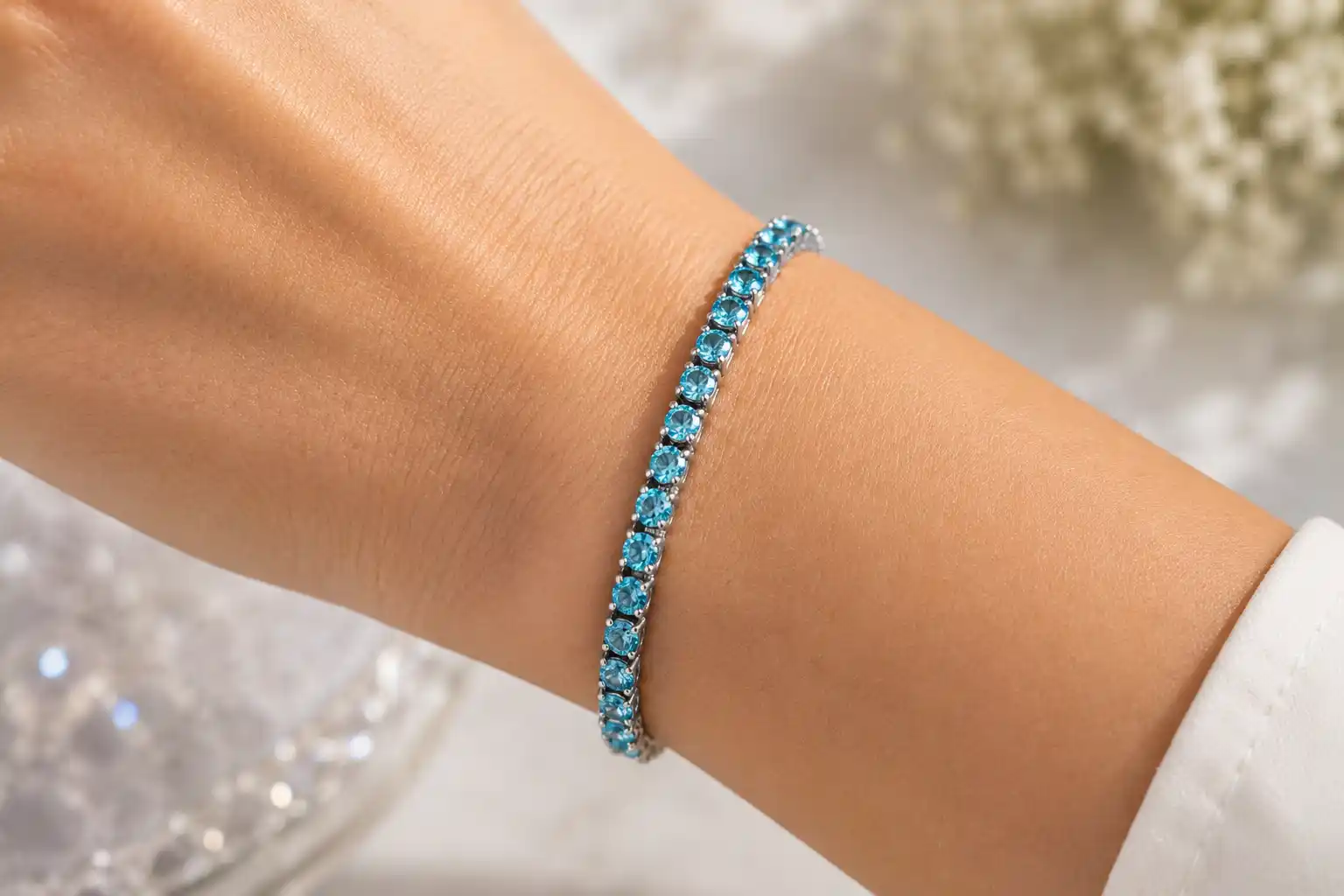
Zircon Bracelets: How to Choose, Style and Wear Them
Zircon bracelets combine strong brilliance, noticeable fire and a wide range of natural and heat-treated colors. Blue is the most familiar modern choice, although colorless, yellow, green, orange, reddish-brown and red Zircon can create equally distinctive designs.
Natural Zircon is a zirconium silicate gemstone. It is not Cubic Zirconia, despite the similarity between their names. This distinction affects rarity, physical properties, value and long-term care.
Bracelets expose gemstones to desks, door frames, bags, metal watch cases and neighboring jewelry. Therefore, choosing a Zircon bracelet requires more attention to setting protection, link flexibility and stone spacing than selecting earrings or a pendant.
The Zircon meaning and properties guide covers the mineral’s geology and symbolism. This guide focuses on bracelet construction, fit, color, treatment, styling and wear.
Zircon Bracelet Buying Summary
| Factor | Best practical choice | Main concern |
|---|---|---|
| Bracelet style | Flexible tennis or station bracelet | Stones must not strike one another |
| Setting | Bezel, partial bezel or sturdy multi-prong setting | Exposed girdles can chip |
| Stone shape | Round, oval or cushion | Sharp corners abrade more quickly |
| Stone size | Small-to-medium calibrated gems | Large stones add leverage and weight |
| Color | Blue, colorless, yellow, brown, orange or mixed | Blue and colorless material is commonly heated |
| Metal | Gold, platinum or well-made sterling silver | Weak links and thin prongs |
| Fit | Close enough not to rotate excessively | Tightness, impact and circulation |
| Cleaning | Warm water, mild soap and soft brush | Avoid steam and ultrasonic cleaning |
| Storage | Separate padded compartment | Zircon facets can abrade against other jewelry |
| Verification | Seller disclosure or gemological report | Confusion with Cubic Zirconia |
Natural Zircon Is Not Cubic Zirconia
Natural Zircon is the mineral ZrSiO4. It forms in igneous, metamorphic and sedimentary geological environments and occurs in several structural conditions and colors.
Cubic Zirconia is manufactured zirconium oxide. It is commonly produced as a Diamond simulant and can be created in almost any color.
The two materials differ in crystal structure, density, optical behavior and market identity.
Natural colorless Zircon was historically used as a Diamond substitute because it can show high brilliance and strong fire. However, it is a distinct natural gemstone and should be sold under its own name.
A listing that says only “zircon bracelet” should clarify whether the stones are natural Zircon or Cubic Zirconia. The completed Cubic Zirconia buying guide explains the manufactured material’s quality and disclosure requirements.
How Durable Is a Zircon Bracelet?
Zircon generally ranges from 6 to 7.5 on the Mohs hardness scale, depending partly on its structural condition.
The gemstone hardness chart explains that this rating measures resistance to scratching rather than complete durability.
Zircon can be brittle, and exposed facet edges may abrade when they rub against harder stones or metal surfaces. The gemstone toughness-versus-hardness guide explains why a gem can resist some scratches yet remain vulnerable to chipping.
Zircon does not have the same prominent easy cleavage associated with Topaz, but brittle fracture and worn facet junctions remain important concerns. The gemstone cleavage guide provides broader structural context.
Bracelets are one of the more demanding forms of Zircon jewelry. They can still be worn successfully when the stones are small, securely set and protected from rough activity.
Best Zircon Bracelet Styles
Zircon tennis bracelets
A tennis bracelet places a continuous or nearly continuous line of matched Zircons around the wrist.
This style displays brilliance effectively because each stone moves with the bracelet and catches light from a changing angle.
However, the construction must remain flexible. Rigid or poorly articulated links place stress on prongs and can force neighboring stones against one another.
Check that every setting moves independently without twisting sharply. The bracelet should lie flat rather than rolling onto its edge.
Round Zircons are common because they distribute setting pressure evenly. Oval and cushion stones can also work when the links protect their girdles.
Zircon station bracelets
A station bracelet separates individual Zircons with lengths of chain.
This design reduces the number of stones, keeps the bracelet lighter and limits direct gem-to-gem contact.
Station bracelets are practical for buyers who want natural Zircon without the cost or maintenance of a complete tennis line.
Each station should have a closed-back or well-supported setting. Thin open wires can bend and expose the stone to impact.
Bezel-set Zircon bracelets
A bezel surrounds all or most of the stone’s edge with metal.
It provides better impact protection than narrow prongs and reduces snagging on sleeves.
A full bezel may slightly reduce side-entry light, but Zircon’s high refractive index can still produce lively face-up brilliance.
Partial bezels balance protection with a more open appearance.
Bezel-set designs are particularly suitable for colorless or blue stones intended for regular wear.
Zircon charm bracelets
A charm bracelet may use one Zircon pendant or several small gem charms.
The design can represent December birthdays, anniversaries or personal milestones.
The stone should not hang low enough to strike metal charms constantly. A rigid protective frame or small bezel helps prevent abrasion.
Large exposed Zircon drops are better reserved for occasional wear.
Zircon bead bracelets
Faceted Zircon beads exist, although they are less common than faceted stones mounted in metal.
Beads can abrade one another as the bracelet bends and moves. Inspect drill holes for chips, fractures and rough edges.
Small spacer beads can reduce direct contact, but hard metal separators may also scratch poorly polished surfaces.
Elastic bracelets require periodic restringing because high-density Zircon beads place more stress on the cord than lightweight Quartz beads.
Choosing Zircon Color
The types of Zircon guide explains the mineral’s major colors and structural varieties.
Blue Zircon
Blue Zircon is the best-known jewelry color and one of December’s recognized birthstone options.
Its shades range from pale sky blue and greenish blue to intense electric blue.
Most blue Zircon has been heat-treated from brownish rough. The treatment is accepted in the trade, but sellers should disclose it.
Some heated blue stones can change toward a browner appearance after prolonged exposure to intense light. Therefore, avoid storing the bracelet permanently on a sunny windowsill.
The blue gemstones guide compares Zircon with Sapphire, Aquamarine, Topaz and other blue jewelry stones.
Colorless Zircon
Colorless Zircon can show impressive brilliance and fire.
It may resemble Diamond, Moissanite or Cubic Zirconia at first glance, although its physical and optical properties differ.
Colorless material is also commonly produced by heating brown Zircon.
A line bracelet made from colorless stones can provide a vintage-inspired Diamond-alternative appearance. However, worn facets become noticeable more quickly in colorless stones because crisp surface reflection is central to their appeal.
The white gemstones guide places colorless Zircon within the wider white-jewelry category.
Yellow and golden Zircon
Yellow Zircon can appear lemon, straw, honey or golden.
Its warm color works well in yellow gold and can create a more distinctive bracelet than standard blue material.
Some yellow, orange and red colors may also result from heat treatment.
The completed yellow gemstones guide provides wider comparisons with Citrine, Sapphire, Topaz and Chrysoberyl.
Brown and reddish-brown Zircon
Brown Zircon occurs naturally and can range from pale champagne to dark cinnamon or earthy reddish brown.
These colors are sometimes undervalued compared with blue. However, well-cut stones can show exceptional fire and work beautifully in yellow or rose gold.
The brown gemstones guide provides additional styling context.
Green Zircon
Green Zircon can be natural and may reflect varying degrees of radiation-related structural alteration.
Fine transparent green material is collectible, although some low-type green Zircon has different physical and optical properties from high-type jewelry Zircon.
A significant green Zircon bracelet should have reliable identification and treatment disclosure.
The green gemstones guide helps distinguish it from Peridot, Tourmaline, Sapphire and other green gems.
Matching Stones in a Bracelet
A bracelet contains enough stones for differences to become visible.
Matched stones should have reasonably consistent:
- Hue
- Tone
- Saturation
- Face-up size
- Cut style
- Brilliance
- Clarity
- Treatment category
- Structural condition
- Fluorescence when relevant
Perfect natural uniformity is unnecessary. Slight variation can make the bracelet look more organic.
However, one gray, dark or windowed stone can interrupt a continuous line noticeably.
Compare the bracelet in daylight-equivalent lighting, warm indoor light and diffuse shade.
Blue Zircon can shift slightly in appearance under different lighting. Matching should be judged across normal environments rather than one intense showroom lamp.
Cut Quality and Double Refraction
Zircon has high refractive index and can display strong dispersion.
Many Zircons are doubly refractive. When viewed through the crown, rear facet edges may appear doubled.
This doubling is a natural optical property rather than evidence of poor cutting. Nevertheless, cutters often orient the stone to reduce distracting face-up doubling.
In a bracelet, stones should return light evenly when viewed from ordinary wrist distance.
Reject pieces with:
- Large transparent windows
- Uneven dark extinction
- Severely abraded facets
- Chipped girdles
- Crooked settings
- Poorly matched depths
- Excessive hidden weight
- Burned or rough polish
The Zircon buying guide owns the full quality-factor evaluation.
Choosing Stone Size
Small Zircons generally make the most durable bracelets.
Stones between approximately melee size and a few millimeters across sit close to the wrist and place less leverage on their settings.
Larger gems offer stronger color and fire but increase total bracelet weight. They also expose more girdle and crown area to impact.
A single large center stone can work in a cuff or station design when protected by a substantial bezel.
For a continuous tennis bracelet, many moderate-size stones usually wear more comfortably than fewer oversized gems.
Carat weight is not a direct indicator of visual size because Zircon has high density. Compare millimeter dimensions rather than relying only on total carat weight.
Metal Choices
Yellow gold
Yellow gold complements golden, orange, brown and greenish Zircon.
It can also make blue stones appear more saturated through warm contrast.
Fourteen-karat gold generally provides greater resistance to bending than high-purity gold, although alloy composition and workmanship matter.
White gold
White gold creates a bright, contemporary background for blue and colorless Zircon.
Rhodium plating can wear over time and may require renewal.
Check that any replating process is performed with appropriate care around treated Zircon and delicate settings.
Rose gold
Rose gold pairs naturally with champagne, red-brown, peach and golden Zircon.
Its warmth can soften the appearance of pale blue stones and create an antique-inspired palette.
Platinum
Platinum offers secure setting potential and develops a surface patina rather than losing metal in the same way as some gold alloys.
Its weight can make a complete bracelet feel substantial.
Because platinum is expensive, it is used more often with higher-quality matched Zircon.
Sterling silver
Sterling silver makes Zircon bracelets more affordable.
However, thin silver prongs and links can bend if construction is weak. Tarnish may also accumulate around stone settings.
Choose substantial links and ensure that cleaning methods do not expose the Zircon to aggressive compounds or mechanical polishing.
Bracelet Fit
A bracelet should move slightly without sliding far down the hand.
Excessive looseness increases impact because the piece rotates and strikes objects. Excessive tightness can strain links and become uncomfortable as the wrist changes during the day.
For a tennis bracelet, a common fitting approach leaves room for approximately one finger beneath the bracelet, although personal comfort and design vary.
Measure the wrist at the point where the bracelet will sit. Then add an allowance suited to the style:
- Minimal allowance for fitted tennis bracelets
- Moderate allowance for station bracelets
- Greater allowance for charm bracelets
- Enough space for rigid bangles to pass over the hand
A jeweler should resize a line bracelet by adjusting complete links rather than bending settings or forcing irregular spacing.
Clasps and Safety Features
A secure clasp is essential because a Zircon bracelet may contain many individually valuable stones.
Good options include:
- Box clasp with side safety
- Lobster clasp with sturdy jump ring
- Fold-over clasp
- Hidden clasp with secondary lock
- Double-latch mechanism
- Safety chain on vintage designs
Test the clasp several times. It should close decisively without excessive force.
Inspect solder points and connecting rings. A strong clasp cannot prevent loss when the terminal link is thin or partly open.
A safety chain provides additional security but should not be long enough to catch on objects.
Styling a Zircon Bracelet
Blue Zircon pairs naturally with white metal, navy clothing, cool gray and crisp white.
Golden and brown Zircon work well with cream, olive, rust, camel and warm metallic accessories.
Colorless Zircon can provide a formal line of brightness without dominating a watch or ring.
Mixed-color bracelets can highlight the full Zircon palette. However, random colors should still share a coherent cut, stone size or setting design.
The Zircon color meaning guide covers traditional symbolism without determining fashion rules.
A bracelet should coordinate with the wearer’s own wardrobe and comfort rather than a universal color prescription.
Stacking Zircon Bracelets
Zircon should not rub continuously against Diamond, Sapphire or other harder gemstone bracelets.
A smooth gold bangle or soft leather bracelet can provide visual contrast, but raised edges should not strike the Zircon crowns.
When stacking:
- Place the Zircon bracelet away from a watch crown
- Avoid hard pavé edges directly beside it
- Limit the number of moving metal pieces
- Keep bracelets similar in fit
- Remove the stack during physical work
- Inspect facet edges regularly
A fitted Zircon tennis bracelet is often safer worn alone.
Treatment Disclosure
Heat treatment is common in Zircon, particularly for blue and colorless stones.
Heating can also produce or modify yellow, orange and red colors.
The treatment is generally accepted, but it affects rarity and should be disclosed.
Some heated stones may change under prolonged intense light. Therefore, sellers should provide realistic stability advice.
Fracture filling is possible but comparatively uncommon. Coatings, assembled stones and imitation materials should be disclosed separately.
The gemstone treatments guide explains how enhancement affects care and value.
Reports and Seller Verification
An independent laboratory report may be worthwhile for:
- High-value natural-color Zircon
- Large matched suites
- Green Zircon
- Unusually vivid red material
- Allegedly untreated blue stones
- Vintage bracelets represented as natural Zircon
- Pieces confused with Diamond or Cubic Zirconia
- Origin-specific claims
- Expensive antique jewelry
The gemstone certification guide explains the role of independent laboratories.
A report should match the stones being sold. One loose-stone report does not automatically apply to every gem in a bracelet.
For ordinary commercial blue Zircon, a detailed seller disclosure and return policy may be more practical than testing each small stone.
Zircon as a December Birthstone Bracelet
Zircon is one of December’s recognized birthstones, alongside Turquoise and Tanzanite.
The December birthstone guide covers the three materials’ history, colors and symbolism.
A Zircon bracelet can serve as:
- A December birthday gift
- A birth-of-a-child keepsake
- An anniversary piece
- A family birthstone bracelet
- A blue bridal accessory
- A personalized charm bracelet
The December birthstone jewelry guide provides wider gift-format comparisons.
The birthstones-by-month guide places Zircon within the complete calendar.
Price and Value
The completed Zircon price guide owns detailed market values and color premiums.
Bracelet price depends on:
- Natural versus manufactured material
- Color
- Matching
- Total carat weight
- Individual stone size
- Clarity
- Cutting
- Treatment
- Metal
- Setting labor
- Clasp quality
- Brand
- Report
- Condition
A matched natural blue Zircon tennis bracelet can cost substantially more than a similar-looking Cubic Zirconia bracelet.
However, retail value does not guarantee strong resale. Buy the bracelet for wear, craftsmanship and personal meaning rather than treating it as a liquid investment.
Ethical and Responsible Buying
Ask where the Zircon was mined, where it was cut and who manufactured the bracelet.
Cambodia, Sri Lanka, Myanmar, Tanzania, Australia and other regions have produced gem Zircon.
Exact mine origin may be difficult to prove in a finished multi-stone bracelet.
The ethically sourced gemstones guide provides questions about supply-chain records, cutting labor and seller transparency.
Avoid unsupported claims that every stone is conflict-free, mine-direct or fully traceable without documentation.
Cleaning and Storage
The completed Zircon jewelry cleaning guide owns the detailed cleaning workflow.
For routine care:
- Close the bracelet and inspect loose stones.
- Place it in lukewarm water with a small amount of mild soap.
- Use a very soft brush around the underside of each setting.
- Rinse carefully without exposing the piece to an open drain.
- Pat dry with a lint-free cloth.
- Allow moisture beneath the stones to evaporate fully.
Avoid ultrasonic and steam cleaning.
Remove the bracelet before gardening, sports, dishwashing, heavy lifting, cleaning and sleep.
Store it flat in a separate padded compartment. Do not place it loose beside Diamond or Sapphire jewelry.
Frequently Asked Questions
1. Is a Zircon bracelet made from natural gemstones?
It can be, but the seller must clarify whether the stones are natural Zircon or manufactured Cubic Zirconia.
2. Is Zircon the same as Cubic Zirconia?
No. Zircon is a natural zirconium silicate mineral, while Cubic Zirconia is manufactured zirconium oxide.
3. Is blue Zircon natural?
The mineral is natural, but most commercial blue color is produced by heat-treating brown Zircon.
4. Can Zircon bracelets be worn every day?
They can be worn regularly with care, although bracelets expose Zircon to more impact and abrasion than earrings or pendants.
5. What is the safest setting for Zircon?
A bezel or sturdy low-profile multi-prong setting provides better edge protection than thin exposed prongs.
6. Do Zircon bracelets scratch easily?
They resist some scratches but can develop worn facet edges when rubbed against harder gems or metal surfaces.
7. Can I stack Zircon with a Diamond bracelet?
It is better to separate them because Diamond can scratch and abrade Zircon.
8. What clasp is best for a Zircon tennis bracelet?
A box clasp with a secondary safety latch is a strong option when links and solder joints are also well made.
9. Can Zircon go in an ultrasonic cleaner?
Ultrasonic and steam cleaning are not recommended. Use warm soapy water and a soft brush.
10. Can blue Zircon fade?
Some heat-treated stones may change toward their earlier brownish color after prolonged exposure to intense light.
11. How can I tell whether a bracelet contains Zircon or Cubic Zirconia?
A gemologist can compare refractive properties, double refraction, density and microscopic features.
12. What should I ask before buying?
Ask about natural or manufactured identity, color treatment, total carat weight, stone dimensions, metal, clasp, repairs and return terms.
Choose Protection as Carefully as Color
A Zircon bracelet should display the gemstone’s brilliance without forcing brittle facet edges into constant contact with desks, watches or harder stones. Secure settings, appropriate fit and careful storage matter as much as color.
The Zircon earrings guide and Zircon necklace guide cover lower-impact formats, while the Zircon ring guide focuses on hand-worn setting protection. The Z crystal directory and Z gemstone directory provide broader alphabetical context.