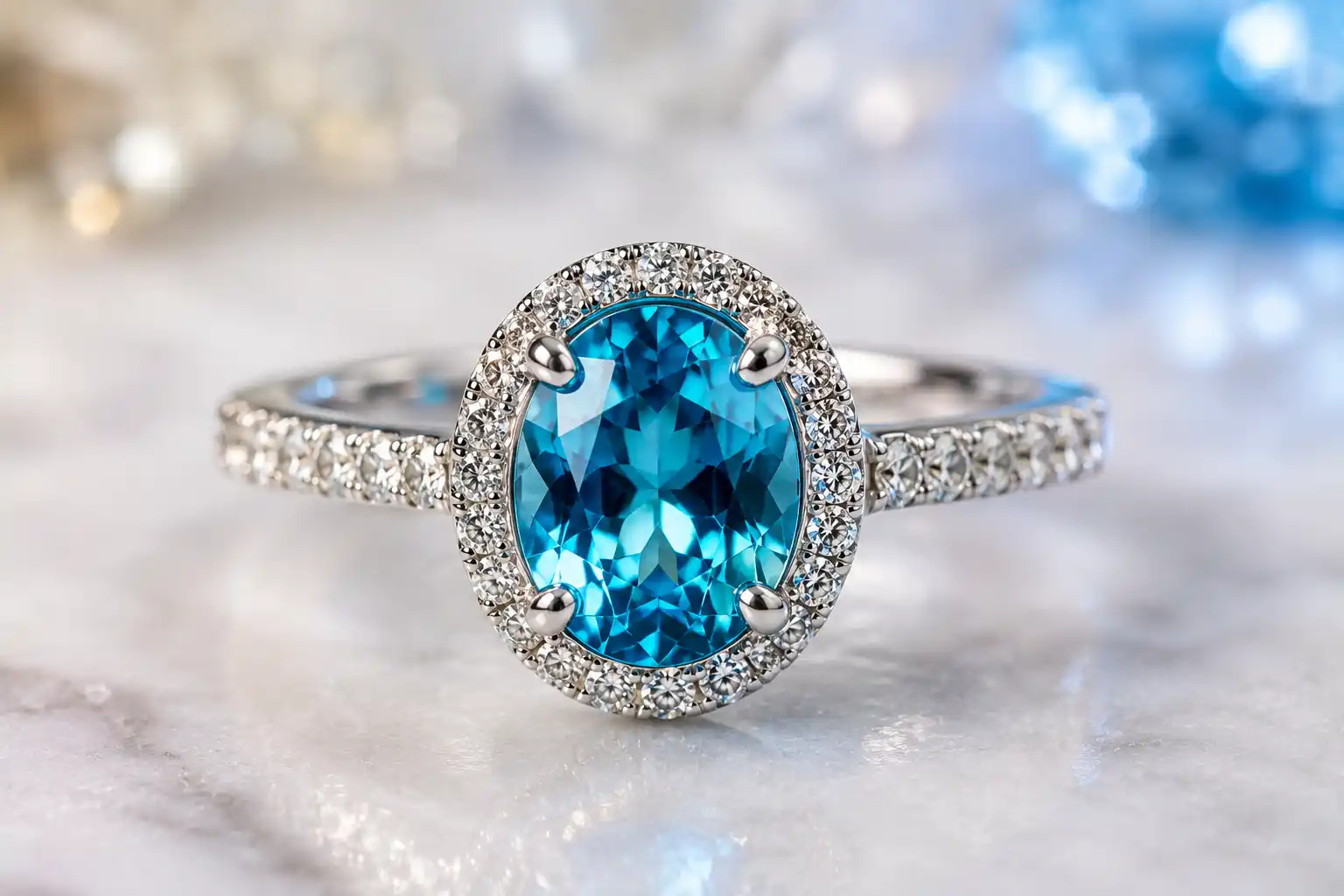
Zircon Rings: Styles, Settings and Buying Tips
Zircon rings display a natural gemstone known for strong brilliance, rainbow fire and colors ranging from electric blue to colorless, yellow, green, orange, red and cinnamon brown. A well-cut Zircon can look exceptionally lively under direct light, yet its durability requires more attention than Diamond, Sapphire or Moissanite.
Natural Zircon is zirconium silicate formed through geological processes. It is not Cubic Zirconia, despite the similarity between their names. That distinction affects origin, optical properties, price and long-term wear.
Rings expose gemstones to desks, door handles, tools, bags and household surfaces. Therefore, Zircon performs best when the setting protects its girdle and the wearer removes the ring before impact-prone activities.
The Zircon meaning and properties guide covers the mineral’s geology and traditional symbolism. This guide focuses on ring styles, settings, colors, treatments, sizing, daily wear and buying decisions.
Zircon Ring Buying Summary
| Factor | Practical recommendation | Main concern |
|---|---|---|
| Everyday setting | Low bezel, partial bezel or protective halo | Exposed girdles can chip |
| Stone shape | Round, oval or cushion | Sharp points abrade more readily |
| Stone size | Moderate rather than oversized | Larger stones add leverage and weight |
| Ring profile | Low to medium | Tall settings catch and strike objects |
| Color | Blue, colorless, yellow, red, brown or green | Heat treatment is common |
| Band metal | Platinum, gold or substantial sterling silver | Thin prongs and worn shoulders |
| Cleaning | Lukewarm water and mild soap | Avoid steam and ultrasonic cleaners |
| Storage | Separate padded compartment | Harder gemstones can abrade Zircon |
| Verification | Natural-Zircon disclosure or report | Confusion with Cubic Zirconia |
| Maintenance | Regular prong and girdle inspection | Brittle edges and facet wear |
Natural Zircon Is Not Cubic Zirconia
Natural Zircon has the chemical formula ZrSiO4.
Cubic Zirconia is manufactured zirconium oxide, commonly abbreviated CZ. It is produced in laboratories and used widely as a Diamond simulant.
The two materials differ in:
- Chemical composition
- Crystal structure
- Geological origin
- Refractive behavior
- Double refraction
- Density
- treatment history
- Market value
Natural colorless Zircon was used as a Diamond alternative long before Cubic Zirconia entered modern jewelry markets.
A listing that says “Zircon ring” should contain natural Zircon unless the description explicitly states Cubic Zirconia. Sellers should never use the two names interchangeably.
The completed Cubic Zirconia buying guide explains the manufactured material separately.
Is Zircon Durable Enough for a Ring?
Zircon generally falls between 6 and 7.5 on the Mohs hardness scale. Its exact properties vary partly because natural radiation from trace elements can alter its crystal structure over geological time.
The gemstone hardness chart explains that Mohs hardness measures resistance to scratching rather than complete durability.
Zircon has fair-to-good toughness but can be brittle. Facet junctions and girdle edges may abrade or chip when the stone rubs against harder materials.
The gemstone toughness-versus-hardness guide explains why a gem can withstand some scratches yet still break after impact.
Zircon can be worn in rings when:
- The setting protects the edge
- The ring sits relatively low
- Major fractures are absent
- The stone is not excessively large
- The wearer removes it for physical work
- Prongs receive regular inspection
- Harder rings are stored separately
A Zircon ring is less forgiving than Sapphire but more practical than many soft collector minerals.
Zircon Solitaire Rings
A solitaire places one Zircon at the center of the ring.
This style reveals the gemstone’s color, fire and double refraction without visual competition.
Round brilliant Zircon works particularly well because the shape has no vulnerable points and supports even setting pressure.
Oval and cushion cuts provide larger-looking outlines and can strengthen face-up color.
Emerald cuts offer a quieter appearance with broad flashes, although they reveal windows and inclusions more easily.
Pear, marquise and princess shapes need protected points or corners.
A solitaire should sit low enough that the pavilion clears the finger without raising the crown unnecessarily.
Four-prong settings expose more of the stone but leave more girdle vulnerable. Six prongs offer additional security for round stones.
Bezel-Set Zircon Rings
A full bezel surrounds the stone’s girdle with metal.
It is one of the safest settings for Zircon because it:
- Protects the edge
- Reduces snagging
- Supports existing minor abrasions
- Keeps the stone low
- Works with active lifestyles
- Creates a clean modern outline
A partial bezel protects two sides while admitting more lateral light.
Zircon’s brilliance comes mainly from its refractive properties and cutting, so a well-designed bezel can remain lively.
Inspect the bezel edge for even pressure. Excessive force during setting can chip a brittle Zircon.
A closed back may conceal repairs, foil or composite construction. Request photographs of the loose stone or the underside before purchasing an expensive ring.
Halo Zircon Rings
A halo surrounds the Zircon with smaller accent gems.
This design can increase apparent size while protecting part of the center stone’s perimeter.
Colorless Diamond, Sapphire, Moissanite or Cubic Zirconia may be used as accents. Each material should be disclosed accurately.
A white halo can make blue Zircon look more saturated. Yellow gold accents can enhance golden, brown and orange material.
The center stone should not sit so high above the halo that its girdle remains exposed.
Inspect shared prongs carefully. One worn shared prong can loosen several small stones.
A halo also creates more spaces where lotion and soap can collect, so the underside should remain accessible for cleaning.
Three-Stone Zircon Rings
A three-stone ring places a center Zircon between two side stones.
The design can represent a personal past, present and future, although that interpretation is optional rather than inherent.
Side stones may include:
- Smaller matched Zircons
- Diamonds
- White Sapphires
- Moissanite
- Garnets
- Tanzanite
- Turquoise
- Other December birthstones
The side stones should not press against the center Zircon’s girdle.
Trillion or pear-shaped side stones need corner protection, while round side stones are easier to secure.
When combining several gem species, care instructions should follow the most sensitive stone in the ring.
Cluster and Floral Zircon Rings
Cluster rings arrange several Zircons into flowers, stars or geometric patterns.
The style can create a large visual presence without relying on one oversized center stone.
Small stones experience less leverage, but the design contains more prongs and stone contacts.
Each Zircon should sit independently rather than rubbing against neighboring girdles.
A low cluster is more practical than a high domed arrangement.
Vintage cluster rings may contain replaced stones, worn prongs or a mixture of natural Zircon and later Cubic Zirconia repairs.
A gemologist should inspect valuable antique pieces before purchase.
Vintage Zircon Rings
Colorless and blue Zircon appeared in Victorian, Edwardian, Art Deco and later jewelry.
Older colorless Zircon was sometimes used for its Diamond-like brilliance.
Vintage rings may show:
- Worn facet junctions
- Chipped girdles
- Recut stones
- Thin prongs
- Replaced shanks
- Closed foil backs
- Converted brooch or pendant settings
- Mismatched accent stones
- Later Cubic Zirconia replacements
- Heat-related repair damage
Antique-cut asymmetry is not automatically poor workmanship. Older cutting styles followed different optical and weight-retention priorities.
However, surface abrasion and significant chips should influence value.
Confirm whether the gemstone is Zircon, Diamond, white Sapphire, glass or Cubic Zirconia rather than relying on an old shop label.
Zircon Engagement Rings
Zircon can serve as an engagement-ring stone for a careful wearer who accepts maintenance and removes the ring during rough activities.
It is not as durable as Diamond, Sapphire or Moissanite.
A Zircon engagement ring should preferably use:
- A full or partial bezel
- A low halo
- A round, oval or cushion stone
- Protected corners
- A moderate center size
- A substantial band
- Accessible underside for cleaning
- An affordable replacement plan
- Regular professional inspections
The best gemstones for engagement rings guide compares stronger daily-wear alternatives.
Colorless Zircon also appears in the white engagement-ring stones guide, while yellow material appears in the yellow engagement-ring stones guide.
A Zircon engagement ring makes the most sense when the wearer values the natural gemstone’s fire and history more than maximum durability.
Blue Zircon Rings
Blue is the best-known modern Zircon color.
Shades include:
- Pale sky blue
- Bright cyan
- Greenish blue
- Teal blue
- Electric blue
- Deep ocean blue
Most commercial blue Zircon is produced by heating brownish rough. The treatment is widely accepted but should be disclosed.
Some heat-treated stones may move toward their earlier brownish color after prolonged exposure to intense light.
Therefore, avoid leaving a blue Zircon ring on a sunny windowsill or exposing it unnecessarily to jeweler’s torch heat.
Blue Zircon pairs well with white gold and platinum for a cool appearance. Yellow gold produces warmer contrast.
The blue gemstones guide compares Zircon with Sapphire, Aquamarine, Topaz and Tanzanite.
Colorless Zircon Rings
Colorless Zircon can show high brilliance and strong fire.
It may resemble Diamond, Moissanite or Cubic Zirconia from a distance, but its physical and optical properties remain different.
Facet wear is particularly noticeable in colorless material because crisp reflections define its appeal.
A bezel or halo helps protect the girdle, but the crown facets still need care.
Colorless Zircon commonly results from heat treatment of brown material.
The completed white gemstones guide provides the wider comparison, while the Zircon buying guide owns general quality assessment.
Yellow, Golden and Orange Zircon Rings
Yellow Zircon ranges from pale straw to honey and golden yellow.
Orange material can appear amber, fiery orange or reddish orange.
These warm colors pair naturally with yellow and rose gold.
Heat treatment may produce or modify some yellow, orange and red colors.
The yellow gemstones guide and orange gemstones guide provide broader color comparisons.
A warm Zircon can provide strong fire at a lower price than Fancy yellow Diamond, though its durability is lower.
Choose a protective setting and avoid describing it through misleading names such as Zircon Diamond or natural Cubic Zirconia.
Red and Brown Zircon Rings
Bright red Zircon is uncommon and can command a premium.
Reddish-brown, cinnamon, champagne and earthy brown stones are more available and can show attractive brilliance.
Brown Zircon often appears understated in diffuse light and fiery under direct illumination.
Rose gold complements cinnamon and red-brown stones, while yellow gold strengthens golden undertones.
The red gemstones guide and brown gemstones guide provide further styling context.
A rare-color claim should be supported by gemological identification and treatment disclosure.
Green Zircon Rings
Green Zircon can be natural and ranges from yellow-green to deep forest or olive green.
Some green stones have undergone substantial radiation-related structural alteration over geological time. Their gemological properties can differ from those of high-type Zircon.
Transparent attractive green Zircon is collectible.
A significant purchase should receive an independent report because green Zircon can be confused with Tourmaline, Peridot, Sapphire and glass.
The green gemstones guide provides wider comparisons.
Use a protective setting and avoid strong repair heat.
Cut Quality
Zircon has high refractive index and strong dispersion.
Its pronounced double refraction can make rear facet edges appear doubled through the crown.
This is a natural optical property, not a defect. However, cutters often orient the stone to reduce distracting face-up doubling.
Round and oval brilliant cuts are common because they showcase brilliance and fire.
A modification historically known as a Zircon cut adds extra pavilion facets, although it is less common today.
Reject stones with:
- Large central windows
- Excessive dark extinction
- Uneven outlines
- Severely worn facet junctions
- Chipped girdles
- Rough polish
- Tilt windows that dominate normal viewing
- Excessive hidden depth
- Poor symmetry
- Repairs concealed by prongs
The types of Zircon guide explains how color and structural condition affect appearance.
Choosing Carat Weight and Dimensions
Zircon has relatively high density. A Zircon of a given carat weight usually appears smaller than a Diamond of similar weight.
Compare millimeter measurements rather than carat weight alone.
A deep-cut stone may carry significant hidden weight below the finger.
Larger stones provide stronger color and fire but increase leverage against the setting.
For regular ring wear, moderate sizes are generally more practical than oversized gems.
A large statement Zircon works best in an occasional-wear cocktail ring with a full bezel, broad halo or substantial protective frame.
Choosing the Metal
Platinum
Platinum can support secure prongs and bezels and develops a surface patina through wear.
Its weight suits substantial designs but increases overall ring mass.
White gold
White gold creates a cool background for blue and colorless Zircon.
Rhodium plating may require renewal. The jeweler should know the center stone is Zircon before applying heat during repair.
Yellow gold
Yellow gold complements yellow, orange, brown and red Zircon.
It also creates striking contrast around blue stones.
Rose gold
Rose gold suits champagne, cinnamon, orange-red and selected blue material.
Sterling silver
Sterling silver provides an affordable option, especially for modest blue or colorless Zircon.
However, thin silver prongs can bend. Choose substantial settings and inspect tarnish around the stone.
Prongs, Beads and Setting Pressure
Zircon should be set by a jeweler familiar with brittle colored stones.
Prongs must contact the girdle securely without concentrating force at a chipped or thin area.
V-shaped prongs protect pear, marquise and princess points.
Double prongs can add security to large stones but introduce more contact pressure.
Bead-set Zircon in pavé or eternity designs requires precise calibration. One loose stone can damage neighboring gems.
Existing facet abrasion should not be hidden beneath fresh prongs without disclosure.
A ring that rattles should not be worn until inspected.
Ring Sizing and Repair
Resizing may expose Zircon to heat, vibration and mechanical stress.
Inform the jeweler that the ring contains natural Zircon and disclose any known heat treatment or fracture filling.
Depending on the design, the safest approach may involve removing the gemstone before soldering.
Full eternity bands have limited resizing options because stones surround the complete circumference.
Halo and cluster rings may distort if the shank is changed substantially.
Laser welding can reduce heat spread but does not eliminate all risk.
After repair, inspect the stone for new chips, color change, looseness or damaged prongs.
Daily Wear
Remove a Zircon ring before:
- Exercise
- Gardening
- Cleaning
- Dishwashing
- Moving furniture
- Using tools
- Swimming
- Showering
- Applying lotions
- Sleeping
- Contact sports
- Lifting heavy bags
Do not wear it beside a Diamond or Sapphire band that rubs directly against the Zircon.
A smooth spacer band can reduce contact, although the best solution is often to wear the Zircon alone.
Check the girdle and prongs under bright light every few weeks.
Treatment Disclosure
Heat treatment is common, particularly for blue and colorless Zircon.
Heating can also produce or modify yellow, orange and red colors.
The treatment is generally stable under normal wear, although some heated colors can change after prolonged intense light exposure.
Fracture filling is possible but comparatively uncommon.
Coatings, foil backing, doublets and assembled stones should be disclosed independently.
The gemstone treatments guide explains treatment categories and their effect on care and value.
Reports and Authentication
A laboratory report may be worthwhile for:
- Large blue Zircon
- Rare red material
- Transparent green Zircon
- Allegedly untreated blue stones
- Expensive antique colorless Zircon
- Origin-specific claims
- High-value natural-color stones
- Suspected fracture filling
- Zircon represented as Diamond
- Rings containing mixed unidentified gems
The gemstone certification guide explains what independent reports can establish.
A report may identify the stone as natural Zircon and list detectable treatment, but it does not grade Zircon through the same system used for Diamond.
Price and Value
The completed Zircon price guide owns detailed value factors.
Ring price depends on:
- Color
- Natural or treated status
- Structural type
- Clarity
- Cutting
- Size
- Condition
- Metal
- Setting workmanship
- Accent stones
- Brand
- Report
- Provenance
- Vintage history
Blue, bright red and attractive green commonly receive stronger premiums.
Colorless, brown, yellow and orange stones can provide excellent brilliance at more accessible prices.
A well-made bezel and substantial shank may contribute more to long-term ownership value than adding one extra carat of poorly protected stone.
December Birthstone Rings
Zircon is one of December’s recognized birthstones, alongside Turquoise and Tanzanite.
The December birthstone guide covers the three choices and their histories.
A Zircon birthstone ring may use:
- One blue solitaire
- Three December stones
- A family birthstone cluster
- A colorless vintage Zircon
- A signet with a small bezel-set stone
- A stackable birthstone band
- A halo with Diamond accents
- A mixed blue-gem design
The December birthstone jewelry guide provides broader gift-format comparisons.
The birthstones-by-month guide places Zircon within the complete calendar.
Cleaning and Storage
The completed Zircon jewelry cleaning guide owns the full physical-care workflow.
For routine cleaning:
- Inspect the setting for movement.
- Place the ring in lukewarm water with mild soap.
- Clean gently with a very soft brush.
- Pay attention to the pavilion and underside.
- Rinse over a closed container rather than an open drain.
- Pat dry with a lint-free cloth.
- Allow hidden moisture to evaporate fully.
Avoid steam and ultrasonic cleaning.
Store the ring in an individual padded compartment away from Diamond, Sapphire and other harder gems.
Frequently Asked Questions
1. Is Zircon suitable for rings?
Yes, with a protective setting and careful wear. It is more vulnerable to abrasion and impact than Sapphire or Diamond.
2. Is Zircon the same as Cubic Zirconia?
No. Zircon is a natural zirconium silicate, while Cubic Zirconia is manufactured zirconium oxide.
3. Is blue Zircon natural?
The gemstone is natural, but most commercial blue color is created through heat treatment.
4. What is the safest setting for a Zircon ring?
A low full or partial bezel offers strong protection for the girdle and reduces snagging.
5. Can Zircon be used in an engagement ring?
Yes, for a careful wearer who accepts maintenance, protective setting design and lower durability than Sapphire or Diamond.
6. Why does Zircon sometimes show doubled facets?
Zircon is doubly refractive, which can make rear facet edges appear doubled through the stone.
7. Does Zircon scratch easily?
Its hardness is moderate, but exposed facet edges can abrade through rubbing against harder materials.
8. Can blue Zircon fade?
Some heat-treated stones may move toward their earlier brownish color after prolonged exposure to intense light.
9. Can a Zircon ring be resized?
Often yes, but the jeweler must control heat and mechanical stress and may need to remove the stone first.
10. Can Zircon go in an ultrasonic cleaner?
No. Warm soapy water is recommended, while ultrasonic and steam cleaning should be avoided.
11. How can Zircon be distinguished from Cubic Zirconia?
A gemologist can evaluate double refraction, refractive index, density, inclusions and other diagnostic properties.
12. What should I ask before buying?
Ask about natural identity, treatment, dimensions, condition, setting protection, metal, reports, repairs and return terms.
Protect the Fire Before Choosing the Largest Stone
A Zircon ring should preserve the gemstone’s sharp facets and moving fire instead of exposing a large brittle girdle for visual size alone. A moderate stone in a low protective setting usually outperforms a larger gem that requires constant caution.
The Zircon bracelet guide covers wrist-specific abrasion, while the Zircon earrings guide and Zircon necklace guide cover lower-impact formats. The Z crystal directory and Z gemstone directory provide broader alphabetical context.