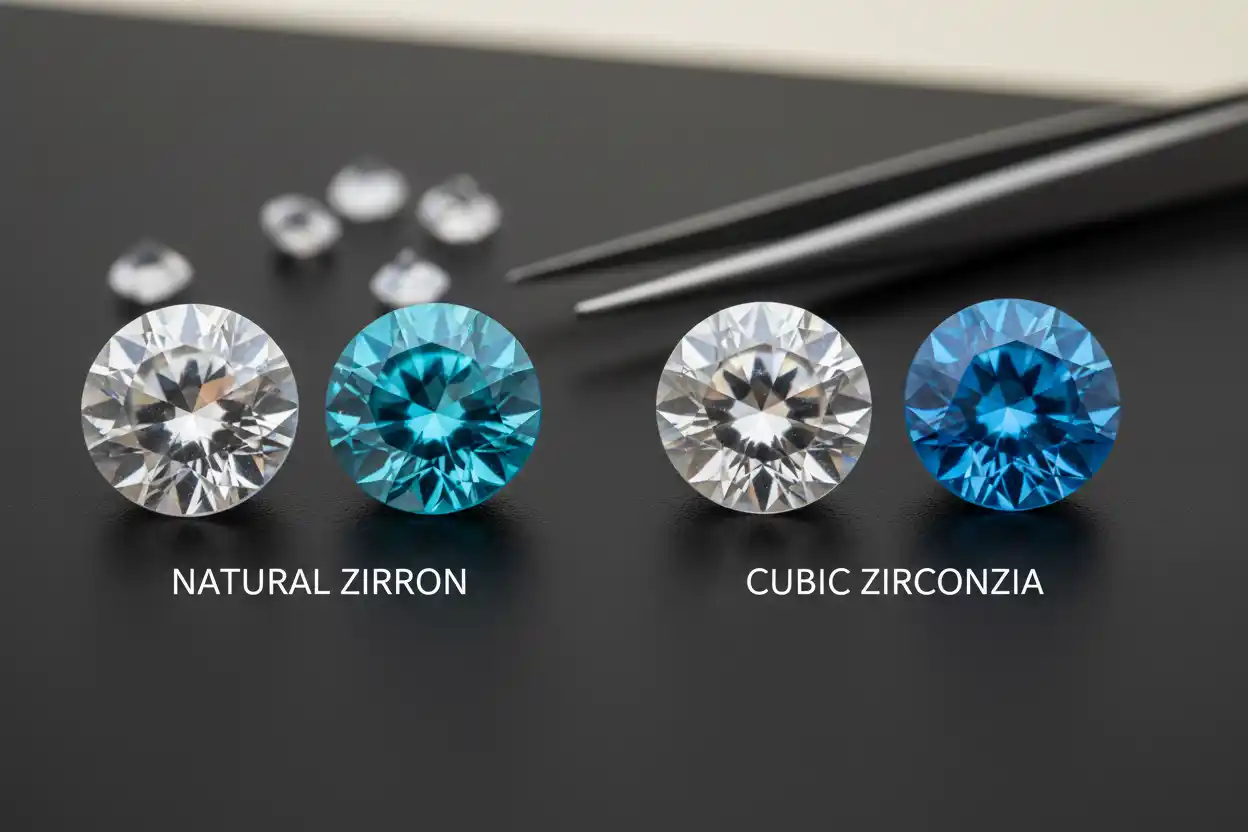
Zircon vs Cubic Zirconia: How to Tell Them Apart
Zircon and cubic zirconia are frequently confused because their names sound similar, but they are completely different gemstone materials. Zircon is a naturally occurring zirconium silicate mineral, ZrSiO₄, whereas the cubic zirconia used in jewelry is a manufactured crystalline zirconium oxide material.
Both can be colorless, brilliant, and fiery, yet their density, refractive behavior, hardness, crystal structure, value, and geological origin differ substantially. Natural zircon can also occur in blue, brown, yellow, orange, red, and green, while cubic zirconia can be manufactured in almost any color.
Zircon vs Cubic Zirconia at a Glance
| Property | Zircon | Cubic Zirconia |
|---|---|---|
| Material type | Natural mineral | Manufactured gemstone material |
| Main composition | ZrSiO₄ | Stabilized ZrO₂ |
| Common abbreviation | Zircon | CZ |
| Crystal system | Tetragonal | Cubic |
| Natural geological origin | Yes | Commercial jewelry CZ is manufactured |
| Refractive index | About 1.810–1.984 depending on zircon type | About 2.15–2.18 |
| Birefringence | 0.000–0.059 | None |
| Refraction | Usually doubly refractive in high zircon | Singly refractive |
| Specific gravity | About 3.90–4.73 | About 5.6–6.0 |
| Mohs hardness | About 6–7.5 | About 8–8.5 |
| Dispersion/fire | Strong | Very strong |
| Facet doubling | Often visible in high zircon | Absent |
| Typical colors | Colorless, blue, brown, yellow, orange, red, green | Nearly any manufactured color |
| Treatment | Heat treatment is common in some colors | Color established during manufacture |
| Market position | Natural gemstone | Low-cost manufactured gem |
| Typical value | Usually higher | Usually much lower |
| Main identification clue | Strong birefringence/facet doubling in high zircon | High density and single refraction |
The Zircon guide covers natural zircon itself, while the Cubic Zirconia guide explains CZ as its own manufactured gem material. Here, the focus is strictly on how the two compare.
Is Zircon the Same as Cubic Zirconia?
No.
Their similar names create one of the most persistent misconceptions in the jewelry market.
Zircon is zirconium silicate:
ZrSiO₄
Cubic zirconia is stabilized zirconium oxide:
ZrO₂
Their atomic structures are different, their physical properties are different, and their origins are different.
Natural zircon formed through geological processes. Commercial cubic zirconia is manufactured.
Therefore, cubic zirconia should never be described as simply another name, synthetic version, or laboratory-grown form of zircon.
Is Cubic Zirconia Synthetic Zircon?
No.
This terminology is especially important.
A synthetic gemstone is a laboratory-grown material with essentially the same fundamental composition and structure as the natural gem it reproduces.
Cubic zirconia does not reproduce zircon.
CZ has a different chemistry and crystal structure.
Therefore:
CZ is not synthetic zircon.
Instead, cubic zirconia is its own manufactured gemstone material that can be used as a simulant for diamond, zircon, sapphire, and other transparent gems.
Is Zircon a Fake Diamond?
No.
Natural colorless zircon has historically been used as a diamond simulant because its high refractive index and dispersion create considerable brilliance and fire.
That does not make zircon fake.
A natural gemstone can resemble another gemstone while remaining completely genuine under its own identity.
Likewise, quartz, white sapphire, and topaz have all been used historically as diamond alternatives.
The issue only becomes misleading when zircon is represented as diamond rather than accurately sold as zircon.
Is Cubic Zirconia Fake?
Cubic zirconia is a legitimate manufactured gemstone material.
It is not inherently “fake” when sold accurately as CZ.
The problem arises when cubic zirconia is represented falsely as diamond, natural zircon, sapphire, or another gemstone.
Therefore, the better terminology is manufactured gemstone or simulant, depending on context.
CZ can be genuine cubic zirconia without being a natural gemstone.
How Zircon Forms
Zircon occurs naturally in igneous, metamorphic, and sedimentary geological environments.
Its crystals can survive extraordinary geological processes because zircon is chemically resistant.
Indeed, ancient zircon grains are among the oldest known terrestrial minerals and play an important role in geochronology because uranium can enter the crystal lattice while lead is largely excluded during original crystallization.
Gem-quality zircon represents only a small portion of natural zircon.
Transparent crystals suitable for cutting occur in several colors and localities worldwide.
How Cubic Zirconia Is Made
Commercial cubic zirconia is manufactured from zirconium oxide stabilized so that the material maintains its cubic crystal structure at ordinary temperatures.
Pure zirconium dioxide changes crystal structure depending on temperature.
Manufacturers add stabilizers such as yttrium or calcium oxides to preserve the cubic phase.
The resulting material can be produced in large quantities with high transparency and relatively consistent properties.
Additional elements can create different colors.
Consequently, CZ can be manufactured as colorless, pink, green, yellow, blue, purple, red, or other jewelry material.
Which Looks More Like Diamond?
Cubic zirconia generally provides the more obvious modern diamond-simulant appearance.
Its refractive index is approximately 2.15–2.18, considerably closer to diamond’s very high refractive power than most natural gemstones.
CZ also has very strong dispersion.
As a result, a well-cut colorless CZ can show strong brilliance and abundant rainbow fire.
Colorless zircon is also highly brilliant and historically served as a diamond substitute. However, zircon has distinctive double refraction that separates it optically from both diamond and CZ.
Zircon Has Strong Double Refraction
One of zircon’s most useful identification characteristics is birefringence.
High-type zircon can have substantial birefringence, reaching approximately 0.059.
As light travels through such a zircon, it separates into two rays.
When you look through the crown of a properly oriented faceted stone, pavilion facet junctions may therefore appear doubled.
This can be striking through a 10× loupe.
Cubic zirconia belongs to the cubic crystal system and is singly refractive.
Consequently, CZ does not show genuine birefringent facet doubling.
The Facet-Doubling Test
If you have a transparent faceted stone represented as zircon, examine it carefully through a loupe.
Look through the crown toward the pavilion facet junctions.
In a strongly birefringent zircon, you may see one facet edge appear as two nearby lines.
That doubling can provide powerful evidence in favor of zircon rather than CZ.
However, the test has limits.
Not every natural zircon shows dramatic doubling.
Why Some Zircons Show Less Doubling
Zircon is unusual because natural radioactive elements within its crystal structure can gradually damage the lattice over geological time.
This process is called metamictization.
Gemologists traditionally discuss zircon using terms such as:
high zircon,
intermediate zircon, and
low zircon.
High zircon retains a relatively ordered crystal structure and generally shows the strongest classic optical properties.
Low zircon has experienced greater radiation-related structural damage and may show substantially lower refractive index, density, and birefringence.
Therefore, the absence of obvious facet doubling does not automatically mean a stone is cubic zirconia.
Refractive Index
Both materials have relatively high refractive indices, but CZ is higher.
Depending on structural condition, zircon ranges approximately from:
1.810 to 1.984
Cubic zirconia is approximately:
2.15 to 2.18
This difference is significant gemologically.
However, many high zircons and CZ stones exceed the normal measurement range of a conventional gem refractometer.
Therefore, a simple “over the limit” result may not distinguish them by itself.
A gemologist instead combines optical character, density, magnification, spectroscopy, and other tests.
Which Is Heavier?
Cubic zirconia is substantially denser.
Natural zircon has a specific gravity of approximately:
3.90–4.73
CZ is approximately:
5.6–6.0
Therefore, when two loose stones have virtually identical dimensions and cutting proportions, the CZ should generally weigh noticeably more.
This can be one of the easiest practical clues when known comparison stones are available.
However, dimensions must be considered.
Comparing only carat weights without measuring the stones can be misleading because cutting depth and proportions vary.
One-Carat Zircon vs One-Carat CZ
Since CZ is denser, one carat of cubic zirconia occupies less volume than one carat of zircon of comparable shape and proportions.
Conversely, two stones with approximately the same physical diameter may differ substantially in carat weight.
That is why buyers should compare both millimeter dimensions and carat weight.
Carat is a unit of mass, not face-up size.
Which Is Harder?
Cubic zirconia is generally harder.
CZ ranks approximately 8–8.5 on the Mohs scale.
Zircon varies much more widely, approximately 6–7.5, depending partly on structural condition.
Therefore, CZ generally resists scratching better than zircon.
However, neither hardness figure tells the whole durability story.
Hardness measures resistance to scratching, not resistance to chipping or breaking.
The Gemstone Hardness Chart provides broader context for comparing these values.
Zircon Can Be Brittle
Zircon requires somewhat more careful wear than its brilliant appearance might suggest.
Facet junctions can abrade, and sharp edges can chip when subjected to hard knocks.
Older zircon jewelry may therefore show worn or softened facet edges.
This characteristic can sometimes assist identification, although it should never be treated as conclusive because wear depends heavily on age and use.
A recently cut zircon may have perfectly sharp facets.
Is Cubic Zirconia More Durable?
CZ’s higher hardness gives it better scratch resistance than zircon.
Nevertheless, CZ is not indestructible.
GIA describes it as somewhat brittle despite its good general wearability.
Hard impacts can still chip a stone.
Furthermore, prolonged everyday wear can eventually produce surface wear and scratches.
For rings worn continuously, protective setting design still helps.
The broader distinction between scratch resistance and breakage is explained in Gemstone Toughness vs Hardness.
Which Has More Sparkle?
Both can sparkle strongly.
The character of that sparkle differs.
High zircon has strong brilliance and noticeable dispersion, making it one of the livelier natural colored gemstones.
CZ has an even higher refractive index and exceptionally strong dispersion.
Consequently, CZ may show more obvious rainbow fire, particularly in larger colorless stones.
This does not necessarily mean CZ is more attractive.
Some buyers prefer zircon’s natural-gem character and optical complexity, while others prefer the intense fire of CZ.
Which Has More Rainbow Fire?
Cubic zirconia normally has stronger dispersion.
GIA reports CZ dispersion around 0.058–0.066.
That is enough to produce highly noticeable spectral flashes.
This abundance of rainbow color can sometimes make a large colorless CZ look different from natural diamond, particularly under strong directional lighting.
Zircon also produces strong fire, but its appearance includes the additional optical effect of double refraction.
Therefore, the two gems can both appear lively without looking identical.
Why Zircon Can Look Slightly Fuzzy
Strong birefringence sometimes gives zircon a subtly softer or “fuzzy” appearance when viewed through the stone.
This happens because rear facet edges can appear doubled.
The effect is not a clarity defect.
Instead, it comes from zircon’s optical structure.
CZ does not show this characteristic because it is singly refractive.
An experienced observer may therefore recognize zircon’s doubled internal facet image even before completing formal testing.
Color Differences
Natural zircon occurs in numerous colors, including:
colorless,
blue,
brown,
yellow,
orange,
red, and
green.
Brownish material is common in nature.
Heating suitable zircon can produce desirable blue or near-colorless colors.
Cubic zirconia can be manufactured in almost any of these colors.
Therefore, color cannot reliably distinguish zircon from CZ.
Blue Zircon vs Blue Cubic Zirconia
Blue zircon is one of the most commercially important zircon colors.
Much modern blue zircon obtains its color through heat treatment of suitable natural material.
That treated gem remains natural zircon.
Blue CZ, meanwhile, receives its color during manufacturing.
Both can appear bright and transparent.
However, zircon’s birefringence, density, RI range, and natural internal characteristics differ substantially from CZ.
A bright blue color by itself does not identify either stone.
Colorless Zircon vs Colorless CZ
This is where confusion is most common.
Colorless zircon can have strong brilliance and fire.
Colorless CZ can also be extremely bright.
However, a loupe examination of high zircon may reveal doubled pavilion facets, whereas CZ will not.
CZ should also be noticeably denser when stones of equal dimensions are compared.
Formal gemological testing can separate the two readily.
Is Blue Zircon Natural?
The underlying gemstone can be completely natural even when its blue color has been produced through heating.
Treatment and material identity are separate concepts.
A heat-treated natural zircon is still zircon.
Likewise, untreated brown or yellow zircon is not somehow “more real” as a mineral than properly disclosed heated blue zircon.
Treatment disclosure mainly affects transparency in the sale and, in some cases, value.
Can CZ Be Heat Treated Like Zircon?
The comparison is not particularly useful because CZ begins as a manufactured material.
Its color and properties are controlled during production using stabilizers and coloring agents.
Natural zircon, by contrast, forms geologically and may later receive treatment.
Therefore, “treated versus untreated” carries a different meaning for the two materials.
Which Has More Inclusions?
Natural zircon can contain inclusions and growth features because it formed geologically.
Some gem zircons show:
growth zoning,
tiny crystals,
particle trails,
fractures,
or other natural internal structures.
Nevertheless, fine zircon can also be remarkably clean.
Cubic zirconia is manufactured under controlled conditions and is commonly very clean.
However, cleanliness alone does not prove CZ.
An eye-clean zircon is completely possible.
Is a Perfectly Clear Stone Probably CZ?
Not necessarily.
High-quality zircon can be eye-clean and sometimes extremely clean under magnification.
Therefore, the rule “real gems have inclusions” should not be used.
Gemologists identify stones by the type of inclusion and by measured physical properties, not simply by whether something appears inside.
Can CZ Have Inclusions?
Yes.
Manufacturing features can occasionally occur in cubic zirconia.
However, commercial CZ is often exceptionally clean because manufacturers can control production much more consistently than nature controls mineral crystallization.
Microscopy can therefore provide clues, but it should not be the only test.
Which Is More Valuable?
Natural zircon generally has substantially greater intrinsic gemstone value than ordinary cubic zirconia.
Zircon’s price depends on:
color,
clarity,
cut,
carat weight,
treatment,
and overall quality.
Fine blue, red, green, and attractive colorless stones can command meaningful gemstone prices.
Cubic zirconia is manufactured in large quantities and generally has a much lower material cost.
The Zircon Buying Guide covers zircon-specific purchase considerations, while the Cubic Zirconia Price Guide keeps CZ’s market-value discussion separate.
Does Cubic Zirconia Have Resale Value?
Ordinary CZ generally has limited standalone material resale value.
In finished jewelry, however, value may come from other components.
A CZ ring made from platinum or high-karat gold can still have meaningful value because of its metal, craftsmanship, designer, or historical significance.
Therefore, the value of the gemstone and the value of the complete jewelry item should not be confused.
Is Zircon Rare?
Zircon as a mineral is widespread, but transparent gem-quality material with desirable color, clarity, and size is much less common.
Certain zircon colors are particularly scarce.
Large fine stones can also become increasingly difficult to source.
Therefore, natural zircon belongs to a fundamentally different supply category from industrially manufactured CZ.
Which Is Better for an Engagement Ring?
For maximum scratch resistance at a low stone cost, CZ has advantages.
However, it is generally chosen as an inexpensive manufactured diamond alternative rather than as a rare gemstone.
Natural zircon offers geological origin, distinctive optical character, and greater rarity, but its lower hardness and brittleness require more careful wear.
For an everyday zircon ring, a protective setting can reduce knocks against vulnerable edges.
Neither material is automatically “better.” The correct choice depends on whether the buyer prioritizes natural origin, cost, durability, rarity, or replacement convenience.
Which Is Better for Earrings?
Both work well in earrings because earrings generally experience much less abrasion and impact than rings.
Zircon’s brilliance makes it particularly attractive in studs and drops.
CZ can provide substantial apparent size and sparkle at relatively low cost.
Because durability concerns are reduced in earrings, aesthetic preference becomes more important.
Which Is Better for Necklaces?
Again, both are practical.
Pendants generally encounter less mechanical wear than rings.
A fine natural zircon can therefore be enjoyed without as much concern about facet abrasion.
CZ offers a more inexpensive option when size and intense brilliance matter more than natural origin.
Which Is Better for Daily Wear?
CZ generally has the advantage in scratch resistance because of its higher Mohs hardness.
Natural zircon, however, can still be worn regularly when treated appropriately.
Avoid hard impacts, abrasive contact, and activities likely to strike the stone.
A zircon worn every day should be inspected periodically for loose settings or damaged facet edges.
How to Tell Zircon From CZ at Home
Home examination cannot replace professional testing, but several observations can help.
First, clean the stone so dirt and oil do not interfere with its optical appearance.
Next, use a 10× loupe and examine the pavilion facets through the crown.
Strong doubling favors high zircon.
Then compare carat weight with dimensions when accurate measurements are available. A stone that is unusually heavy for its physical size may be more consistent with CZ.
Finally, review the seller’s terminology and paperwork.
These observations create evidence, but none should be treated as an absolute stand-alone test.
The Best Home Clue: Facet Doubling
Among non-destructive visual observations, facet doubling is especially useful.
CZ does not possess zircon’s strong birefringence.
Therefore, clearly doubled rear facet junctions strongly favor zircon.
Still, remember that low and intermediate zircons can display much weaker birefringence.
No visible doubling should lead to additional testing rather than an immediate CZ diagnosis.
The Weight Test
When loose stones have almost identical dimensions and cuts, CZ should generally be heavier because its specific gravity is substantially higher.
For example, two round stones with nearly identical diameter and depth should not have identical expected weights if one is zircon and the other CZ.
However, a deep zircon can weigh more than a shallow CZ of a similar face-up diameter.
Therefore, accurate dimensions are essential.
Does a Diamond Tester Separate Zircon and CZ?
A basic thermal diamond tester is not a reliable zircon-versus-CZ identification instrument.
Both are non-diamond materials.
The tester may simply indicate that neither behaves like diamond.
That does not tell you which one is zircon.
More advanced multi-test instruments can provide additional information, but ordinary consumer diamond testers should not replace proper gemological identification.
Does the Fog Test Work?
No reliable gemological diagnosis should depend on a fog test.
Surface cleanliness, temperature, humidity, size, setting, and thermal properties can all influence how quickly condensation disappears.
Even if two stones behave differently, the result does not uniquely identify zircon or CZ.
Use measurable optical and physical properties instead.
Can You Use a Scratch Test?
Do not.
CZ’s approximate Mohs hardness of 8–8.5 is higher than zircon’s 6–7.5 range.
In theory, hardness differences sound useful.
In practice, scratching a gemstone can permanently damage it while still producing an ambiguous result.
Surface condition, pressure, orientation, and the hardness of the test object all create uncertainty.
The test is destructive and unnecessary.
Can UV Light Tell Them Apart?
Not reliably.
Zircon fluorescence varies according to color, chemistry, structural state, and treatment history.
CZ can also show variable responses depending on manufacturing chemistry.
Therefore, a particular UV reaction does not universally identify either material.
UV examination can contribute supporting information in a laboratory but is not a dependable one-step consumer test.
How Gemologists Separate Zircon and CZ
Professional identification uses several properties together.
For zircon, important evidence can include:
strong birefringence,
facet doubling,
specific gravity within the zircon range,
appropriate optical character,
microscopic growth features,
and characteristic spectroscopy.
CZ is singly refractive and much denser.
Its RI is also significantly higher.
When necessary, Raman spectroscopy or other advanced techniques can identify the material directly.
The general How to Identify Crystals guide explains why multiple independent tests are more reliable than appearance alone.
Do You Need a Lab Report?
Usually not for inexpensive CZ.
For valuable natural zircon, however, independent documentation may make sense when the stone is unusually large, expensive, represented as untreated, or accompanied by important provenance claims.
A reputable gemological laboratory can confirm the gemstone species and address relevant treatment information within the limits of available testing.
The Gemstone Certification guide covers report scope and laboratory selection.
Which One Needs More Care?
Zircon generally requires more cautious physical handling.
Its lower hardness and tendency toward facet-edge wear make abrasion more relevant.
CZ has stronger scratch resistance but remains somewhat brittle.
For both materials, warm water, mild soap, and a soft brush provide a sensible basic cleaning method.
Avoid aggressive abrasion.
Material-specific instructions are available in How to Clean Zircon Jewelry Safely and How to Clean Cubic Zirconia Jewelry Safely.
Zircon vs Cubic Zirconia: Which Should You Choose?
Choose zircon if natural geological origin, rarity, distinctive optical character, and collector or gemstone value matter most.
Choose cubic zirconia if low cost, strong rainbow fire, higher scratch resistance, and easy replacement are more important.
For jewelry intended to last for decades, also consider how the piece will be worn.
Earrings and pendants expose either material to relatively little mechanical damage.
Rings experience much more abrasion and impact, making durability differences more important.
Frequently Asked Questions
Are zircon and cubic zirconia the same thing?
No. Zircon is natural ZrSiO₄, while commercial cubic zirconia is manufactured stabilized ZrO₂.
Is cubic zirconia synthetic zircon?
No. CZ has a different chemistry and crystal structure, so it is not a laboratory-grown version of zircon.
Is zircon natural?
Yes. Zircon is a naturally occurring mineral. Some gem zircon is heat treated to modify color, but the underlying material remains natural zircon.
Is cubic zirconia natural?
The cubic zirconia used commercially in jewelry is manufactured.
Which is harder, zircon or cubic zirconia?
CZ is generally harder at about Mohs 8–8.5. Zircon ranges roughly from Mohs 6–7.5.
Which is heavier?
CZ is substantially denser. Its specific gravity is about 5.6–6.0 compared with approximately 3.90–4.73 for zircon.
Which sparkles more?
Both can be brilliant, but CZ generally shows stronger rainbow dispersion. High zircon has its own distinctive brilliance and strong double refraction.
Does zircon show doubled facets?
High zircon commonly does. Strong birefringence can make pavilion facet junctions appear doubled through a loupe.
Does CZ show facet doubling?
No. CZ is cubic and singly refractive.
Is zircon more expensive than CZ?
Usually, yes. Natural gem-quality zircon generally has significantly higher material value than mass-produced CZ.
Is zircon rarer than cubic zirconia?
Yes in the commercial sense. Gem zircon depends on natural geological deposits, whereas CZ can be manufactured in large quantities.
Is colorless zircon the same as CZ?
No. Colorless zircon is natural zirconium silicate. Colorless CZ is manufactured stabilized zirconium oxide.
Is blue zircon cubic zirconia?
No. Blue zircon is natural zircon, although much commercial blue material has been heat treated to produce its color.
Can CZ be blue?
Yes. Cubic zirconia can be manufactured in blue and many other colors.
Can a diamond tester distinguish zircon from CZ?
A basic diamond tester generally cannot identify which of the two materials is present. Both require proper gemological testing for reliable separation.
Which is better for rings?
CZ provides greater scratch resistance, while zircon provides natural-gem rarity and character. A zircon ring requires somewhat more careful protection from abrasion and impact.
Final Takeaway
Zircon and cubic zirconia share part of a name, but gemologically they are entirely different materials.
Zircon is natural zirconium silicate, ZrSiO₄. Depending on its structural condition, it has refractive index values from roughly 1.810 to 1.984, specific gravity of approximately 3.90–4.73, and Mohs hardness around 6–7.5. High zircon can show particularly strong birefringence, creating characteristic doubled facet junctions.
Cubic zirconia is manufactured stabilized zirconium oxide. Its refractive index is approximately 2.15–2.18, its specific gravity is around 5.6–6.0, and its Mohs hardness is approximately 8–8.5. It is singly refractive and therefore does not show zircon’s true facet doubling.
For a quick comparison, doubling favors high zircon, while unusually high weight for the stone’s dimensions favors CZ. However, neither clue replaces professional testing in an important purchase.
From a buying perspective, zircon offers natural origin, geological rarity, and greater intrinsic gemstone value. CZ provides intense fire, higher scratch resistance, and a much lower material cost.
Most importantly, neither should be misrepresented as the other. Zircon is not cubic zirconia, and cubic zirconia is not synthetic zircon.