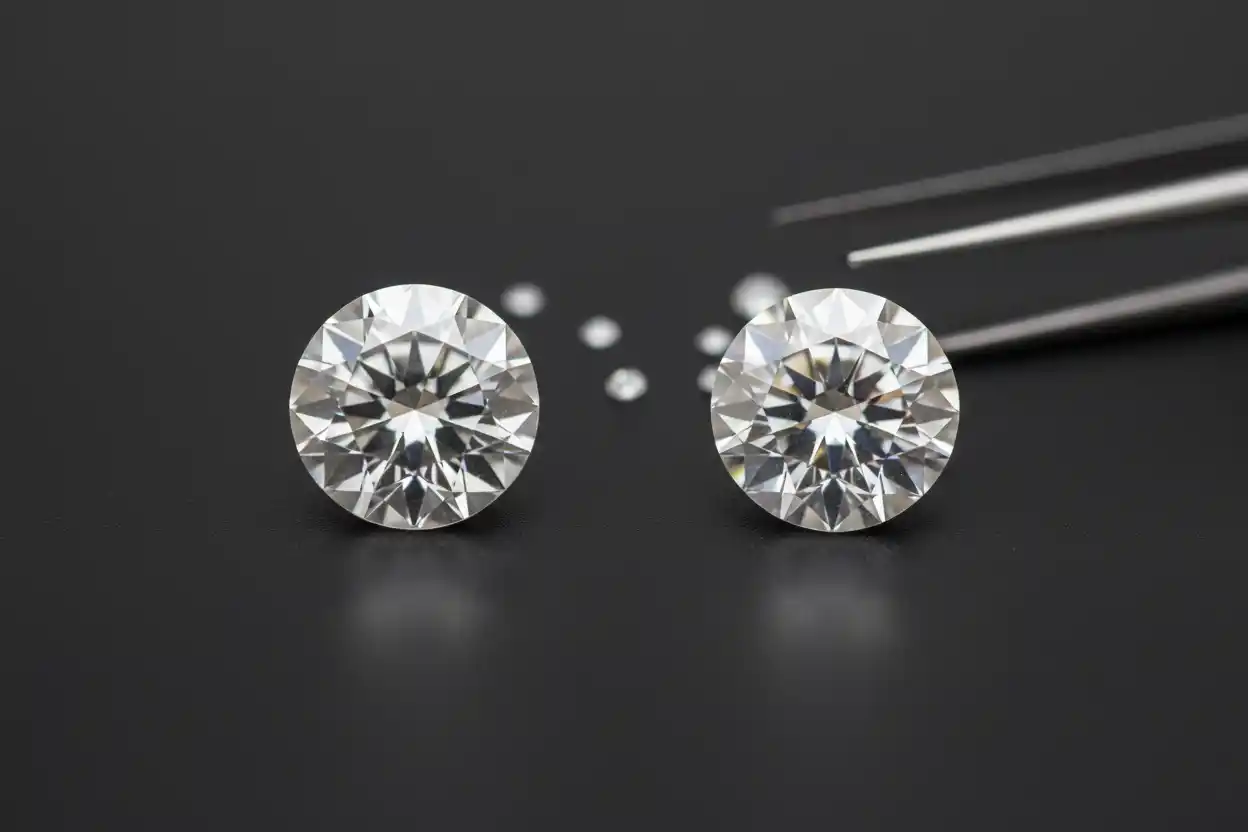
White Topaz vs Diamond: How to Tell Them Apart
White topaz and diamond can both appear transparent and colorless in jewelry, but they are fundamentally different gemstones. White topaz is natural colorless topaz, an aluminum fluorosilicate with Mohs hardness 8, while diamond is crystalline carbon with Mohs hardness 10 and much stronger light-bending ability.
The visual difference is usually noticeable side by side. Diamond tends to look brighter, sharper, and more scintillating, whereas white topaz produces softer brilliance and much less rainbow fire. White topaz compensates with natural-gem appeal, availability in large sizes, and a substantially lower price.
White Topaz vs Diamond at a Glance
| Property | White Topaz | Diamond |
|---|---|---|
| Material | Natural topaz | Natural or laboratory-grown diamond |
| Composition | Al₂SiO₄(F,OH)₂ | C |
| Crystal system | Orthorhombic | Cubic |
| Color | Colorless | Colorless to various colors |
| Refractive index | 1.619–1.627 | 2.42 |
| Birefringence | 0.008–0.010 | None |
| Optical character | Doubly refractive | Singly refractive |
| Specific gravity | About 3.53 | About 3.52 |
| Mohs hardness | 8 | 10 |
| Luster | Vitreous | Adamantine |
| Cleavage | Perfect basal cleavage | Perfect octahedral cleavage |
| Brilliance | Moderate to good | Exceptional when well cut |
| Fire | Relatively restrained | Strong |
| Typical availability | Abundant, including large clean stones | Quality and size strongly affect rarity |
| Typical price | Low to moderate | Much higher for natural diamond |
| Everyday ring durability | Good with protection | Excellent, though chipping remains possible |
| Best identification methods | RI, birefringence, optical testing | RI, thermal properties, spectroscopy |
The White Topaz guide covers the colorless topaz variety itself. This comparison focuses specifically on how white topaz differs from diamond in appearance, identification, durability, value, and jewelry use.
What Is White Topaz?
White topaz is naturally colorless topaz.
Topaz has the chemical composition Al₂SiO₄(F,OH)₂ and belongs to the orthorhombic crystal system. Although topaz occurs in yellow, orange, pink, red, brown, blue, and other colors, chemically pure material is colorless.
In fact, colorless topaz is relatively plentiful.
Much of the topaz mined in nature lacks strong color, and some colorless material is subsequently treated to create commercially popular blue topaz.
White topaz therefore does not require artificial whitening to exist. A transparent colorless stone can be completely natural in both material and color.
The broader Topaz guide covers the mineral family’s colors, formation, and varieties separately.
What Is Diamond?
Diamond is crystalline carbon.
Its atoms form an exceptionally strong three-dimensional structure responsible for diamond’s famous hardness and unusual optical properties.
Natural diamonds formed deep within Earth under high-pressure, high-temperature conditions and were later transported toward the surface by particular volcanic processes.
Laboratory-grown diamond has the same fundamental material identity but forms technologically rather than geologically.
Whether natural or laboratory-grown, diamond remains chemically and structurally different from topaz.
Is White Topaz a Diamond?
No.
White topaz is not a type of diamond, low-grade diamond, or laboratory-created diamond.
The two gemstones differ in chemistry, crystal system, optical behavior, hardness, cleavage, luster, and market value.
White topaz can be used as a diamond alternative because both can be colorless and transparent.
However, visual similarity does not make them the same material.
Is White Topaz a Fake Diamond?
Not when it is correctly sold as white topaz.
A genuine natural gemstone does not become fake merely because it resembles another gem.
White topaz only functions as a diamond imitation when someone presents it as diamond or uses it specifically to reproduce a diamond-like appearance.
Accurate disclosure makes the distinction straightforward.
A ring described as having a “natural white topaz center stone” is selling a legitimate gemstone.
A white topaz deliberately represented as a natural diamond is a misrepresentation.
Which Sparkles More?
Diamond normally sparkles considerably more.
Its refractive index is approximately 2.42, compared with only 1.619–1.627 for topaz.
That difference is substantial.
When a diamond is cut to suitable proportions, a high percentage of incoming light can be reflected and returned through the crown. This creates the strong brightness, contrast, scintillation, and fire associated with diamond jewelry.
White topaz can be brilliant when well cut, but it cannot reproduce diamond’s full optical performance because its refractive properties are fundamentally different.
Diamond Looks Crisper
One of the easiest visual differences is often the character of the light return.
Diamond tends to produce crisp flashes separated by distinct bright and dark areas.
That contrast gives a well-cut diamond a lively appearance even when the jewelry moves only slightly.
White topaz often produces a more even, softer, or glassier brightness.
This does not mean topaz is unattractive. Instead, it creates a different visual style.
Someone who prefers understated sparkle may actually enjoy that softer appearance.
Which Has More Rainbow Fire?
Diamond.
Fire occurs when white light separates into spectral colors.
A well-cut diamond can show distinct flashes of red, orange, yellow, green, blue, and violet under suitable lighting.
White topaz has much more restrained dispersion.
Consequently, its sparkle tends to appear predominantly white rather than intensely rainbow colored.
A large colorless stone showing extraordinary rainbow fire would therefore be less visually typical of white topaz, although appearance alone should never be used for final identification.
White Topaz Can Look Glassier
The word “glassy” is sometimes used negatively when comparing diamond alternatives, but in gemology it reflects a real difference in luster.
Topaz has vitreous luster, meaning polished surfaces reflect light in a glass-like way.
Diamond has adamantine luster, an exceptionally bright surface appearance associated with its high refractive index.
When clean examples are examined side by side, diamond usually has the more intense surface reflection.
The difference becomes particularly obvious under focused jewelry lighting.
Refractive Index Separates Them Easily
The refractive-index difference is large enough to make professional separation straightforward.
White topaz measures approximately:
1.619–1.627
Diamond measures approximately:
2.42
Standard gemological techniques can therefore distinguish the materials without relying on subjective sparkle comparisons.
Topaz also shows measurable birefringence, while diamond does not.
These properties are far more dependable than photographs or seller descriptions.
White Topaz Is Doubly Refractive
Topaz is a doubly refractive gemstone.
Its birefringence is approximately 0.008–0.010.
Diamond belongs to the cubic crystal system and is singly refractive.
However, topaz’s birefringence is fairly low.
Unlike strongly birefringent zircon, white topaz does not ordinarily produce dramatic doubled facet edges that anyone can immediately see through a loupe.
A polariscope and refractometer provide more useful identification evidence.
Which Stone Is Heavier?
Surprisingly, their densities are almost identical.
Topaz has a specific gravity around 3.53.
Diamond is approximately 3.52.
That means a crude “heft test” is almost useless for distinguishing white topaz from diamond.
Two stones with identical dimensions and closely similar cutting proportions could have remarkably similar weights.
This differs sharply from comparisons involving cubic zirconia, which is much denser than either diamond or topaz.
Therefore, do not rely on weight when separating white topaz and diamond.
Which Is Harder?
Diamond is much harder.
White topaz ranks 8 on the Mohs scale.
Diamond defines 10.
The numerical difference may look small, but the Mohs scale is not linear. Diamond’s resistance to scratching and abrasion is dramatically greater.
White topaz remains a relatively hard gemstone and can perform well in jewelry.
However, it will accumulate scratches and facet-edge wear faster than diamond under equivalent long-term exposure.
The site’s Gemstone Hardness Chart provides the broader comparison.
Hardness Does Not Mean Unbreakable
Diamond can still chip.
Likewise, white topaz can break even though Mohs 8 sounds highly durable.
Hardness describes resistance to scratching.
Toughness describes resistance to breaking, chipping, or cracking.
The two concepts should not be confused.
Diamond possesses perfect cleavage along certain crystallographic planes. A sufficiently hard impact in a vulnerable direction can chip or split it.
Topaz has its own significant weakness: perfect basal cleavage.
Therefore, both gems deserve reasonable protection from hard impacts.
The difference between these durability concepts is explained further in Gemstone Toughness vs Hardness.
White Topaz Has Important Cleavage
Topaz’s perfect basal cleavage deserves particular attention.
A hard strike, excessive pressure during setting, or sharp temperature change can cause the gem to split along this structurally weak direction.
Consequently, topaz has poorer toughness than its hardness number alone might suggest.
Cutters orient topaz carefully to reduce risk during faceting.
Jewelers also need to understand its cleavage before setting, resizing, or repairing jewelry.
For everyday rings, a design that protects the stone from direct blows is preferable.
Diamond Also Has Cleavage
Diamond’s extreme hardness does not eliminate cleavage.
Diamond has perfect octahedral cleavage.
This property historically allowed cutters to split rough diamond deliberately along favorable crystallographic planes.
In finished jewelry, a sharp strike against a vulnerable edge or point can produce a chip.
Princess cuts, pears, marquises, and other shapes with exposed points deserve particularly thoughtful protection.
Nevertheless, diamond’s exceptional scratch resistance makes it much better suited to decades of everyday surface wear than white topaz.
Which Is Better for an Engagement Ring?
Diamond is generally the stronger option for continuous everyday wear.
Its extraordinary abrasion resistance helps preserve polished facets over decades.
It also provides the brilliant optical appearance traditionally associated with diamond engagement jewelry.
White topaz can still be used successfully, particularly when budget, natural-gem origin, or a large colorless center stone matters more than maximum durability.
However, expect greater maintenance over time.
A frequently worn white topaz may eventually develop scratches or worn facet junctions and could need professional repolishing.
White Topaz Is Better Protected in Some Settings
A bezel or protective halo can reduce direct impacts against the girdle.
Rounded shapes such as ovals and cushions also lack the vulnerable exposed points found on pears or marquises.
Even so, setting design cannot eliminate topaz’s cleavage.
Someone who works regularly with heavy equipment, tools, stone countertops, weights, or other hard surfaces should remove a white topaz ring during those activities.
Earrings and pendants present far fewer durability concerns.
Which Is Better for Earrings?
Both are excellent candidates.
Earrings normally experience very little impact or abrasion.
Therefore, white topaz’s lower scratch resistance and cleavage are much less concerning than they would be in an everyday ring.
A pair of large white topaz earrings can create substantial visual presence at a relatively low gemstone cost.
Diamond earrings offer much stronger brilliance and higher material value but can become dramatically more expensive as size increases.
Which Is Better for a Necklace?
Both work well in pendants and necklaces.
White topaz benefits especially from these lower-impact settings because they reduce the risk of accidental blows.
A large faceted white topaz can therefore provide an impressive colorless center stone without requiring diamond-level expenditure.
Diamond offers stronger sparkle and prestige but commands a much higher price, particularly when natural origin and high quality are involved.
Does White Topaz Get Cloudy?
White topaz does not normally transform internally into a cloudy gemstone through ordinary wear.
However, it can look cloudy for several reasons.
Skin oils, soap residue, lotion, and cosmetics can build up on the facets.
Surface scratches and edge abrasion can also reduce crispness.
Poorly cut stones may appear sleepy because they leak light rather than returning it through the crown.
Finally, natural inclusions can reduce transparency.
Cleaning can solve residue problems, whereas actual surface wear may require professional repolishing.
Does Diamond Get Cloudy?
Diamond also accumulates oils and residue.
In fact, diamond has an affinity for grease, so fingerprints and skin oils can significantly reduce its brightness.
A dirty diamond can therefore look surprisingly dull.
However, diamond’s exceptional hardness means normal surface abrasion develops much more slowly than it does on topaz.
Cleaning usually restores the sparkle of a sound diamond when surface contamination is responsible.
Which Stays Sparkly Longer?
Diamond generally maintains crisp polished surfaces much longer.
White topaz can remain attractive for many years when protected and cleaned properly, but repeated ring wear exposes it to more abrasion.
Over time, facet junctions can soften and microscopic scratches can scatter light.
This is one reason an old white topaz may appear less brilliant than a freshly polished stone.
A professional lapidary can sometimes repolish worn topaz, depending on the stone and setting.
White Topaz vs Diamond Clarity
Both can appear exceptionally clean.
Topaz frequently forms in large transparent crystals, and colorless topaz used in jewelry is often eye clean.
Diamond clarity varies far more widely and forms part of the standardized 4Cs grading system.
Natural diamonds may contain crystals, feathers, clouds, needles, graining, and other internal characteristics.
Therefore, a perfectly clear appearance does not mean a colorless stone is necessarily diamond or topaz.
Likewise, visible inclusions do not automatically prove natural origin.
Can Inclusions Tell Them Apart?
Sometimes they help.
Natural topaz may contain two-phase inclusions, needles, mineral crystals, growth features, or fractures.
Natural diamond can contain crystals, feathers, clouds, pinpoints, graining, and other diamond-specific features.
An experienced gemologist can interpret these structures under magnification.
However, some examples of both gems can be extremely clean.
Identification should therefore combine microscopy with optical and physical testing.
White Topaz Is Usually Colorless Naturally
White topaz is not normally created by bleaching colored topaz.
Pure topaz is naturally colorless, and colorless material is abundant.
Trace elements, structural defects, and color centers produce other topaz colors.
Some colorless topaz is later irradiated and heated to create blue varieties.
Accordingly, the term white topaz generally refers to a naturally colorless appearance rather than a special whitening treatment.
Are White Topaz Treatments Common?
Colorless topaz itself usually does not need treatment to become white.
However, topaz as a broader gem species is associated with treatments.
Colorless material is frequently used as the starting point for irradiated and heat-treated blue topaz.
Surface coatings can also create unusual appearances such as so-called mystic topaz.
For a straightforward colorless white topaz, treatment tends to be less central to value than it is for certain colored topaz varieties.
Are Diamonds Treated?
Some diamonds receive color or clarity treatments.
Natural and laboratory-grown origin is another separate issue.
A natural diamond can be untreated or treated.
A laboratory-grown diamond is not a treated natural diamond; it is diamond grown technologically.
Therefore, buyers should separate three questions:
Is the stone actually diamond?
Is it natural or laboratory-grown?
Has it received detectable color or clarity treatment?
For significant diamond purchases, independent documentation helps answer those questions.
White Topaz vs Lab-Grown Diamond
Laboratory-grown diamond is still diamond.
It has essentially the same fundamental chemistry, crystal structure, hardness, refractive index, and optical properties as natural diamond.
Therefore, a lab-grown diamond still exhibits diamond-level brilliance and scratch resistance rather than white topaz behavior.
The distinction between natural and lab-grown diamond concerns origin, not whether the material is diamond.
White topaz remains a different natural mineral regardless of which diamond origin it is being compared against.
Can You Tell White Topaz From Diamond by Eye?
Often an experienced observer can suspect the difference, particularly when large stones are compared side by side.
Diamond normally looks more brilliant, fiery, and contrast-rich.
White topaz often appears softer and glassier.
However, visual judgment is not enough for valuable jewelry.
Cut quality, dirt, lighting, size, setting, and photography can significantly alter appearance.
Professional testing provides a definitive answer much more quickly.
Does the Newspaper Test Work?
Do not rely on it.
Online advice sometimes suggests placing a loose colorless stone over printed text and checking whether letters can be seen through it.
The result depends on cut, proportions, viewing angle, stone size, and pavilion geometry.
A poorly cut diamond might behave unexpectedly, while a well-cut non-diamond gemstone could produce another result.
Gem identity should be established by physical properties rather than a print-reading trick.
Does the Fog Test Work?
Not reliably enough for identification.
The rate at which condensation disappears depends on temperature, surface cleanliness, size, airflow, and thermal properties.
Diamond’s thermal conductivity is unusual, but a casual breath test does not provide a controlled measurement.
Professional thermal instruments are more useful.
Even then, identifying a stone as diamond does not establish whether it is natural or laboratory-grown.
Can a Diamond Tester Separate Them?
A conventional thermal diamond tester can often help separate diamond from topaz because diamond has exceptionally high thermal conductivity.
However, an instrument result should be interpreted properly.
A basic tester is designed primarily to screen for diamond-like thermal behavior, not to provide a complete gemstone identification.
Furthermore, a positive diamond result does not distinguish natural diamond from laboratory-grown diamond.
Professional gemological testing is preferable when significant value is involved.
Can You Scratch-Test White Topaz?
Do not.
White topaz is Mohs 8 and diamond is Mohs 10, so diamond can scratch topaz.
That does not make destructive testing sensible.
Scratching an unknown gemstone can permanently damage a genuine white topaz while providing little additional information.
A refractometer, polariscope, microscope, or other non-destructive method is safer and more diagnostic.
How Gemologists Tell Them Apart
White topaz and diamond are relatively easy for a trained gemologist to separate.
Topaz has RI around 1.619–1.627, measurable birefringence, and biaxial optical character.
Diamond has RI 2.42, no birefringence, cubic optical behavior, and exceptionally high thermal conductivity.
Microscopy provides additional evidence.
Professional testing can therefore identify the material without resorting to damaging home experiments.
Which Costs More?
Diamond, by a large margin in most comparable situations.
Colorless topaz is plentiful and generally affordable.
Large clean white topaz stones can therefore be purchased at prices far below natural diamonds of similar visible dimensions.
Natural diamond pricing depends strongly on carat weight, cut, color, clarity, shape, grading report, and market factors.
Laboratory-grown diamond occupies a lower price category than comparable natural diamond but still represents genuine diamond rather than topaz.
The Diamond Price Guide covers that market separately.
Is White Topaz Valuable?
Yes, but its value structure differs from diamond.
White topaz is a genuine natural gemstone, yet abundance keeps ordinary colorless material comparatively inexpensive.
Exceptional cutting, unusually large clean crystals, fine jewelry craftsmanship, provenance, or an important designer can add substantial value to a finished piece.
However, buyers should not assume that a large white topaz carries the same stone value as a comparably sized diamond.
Does White Topaz Have Resale Value?
Ordinary white topaz generally has limited material resale value because supply is abundant.
A finished topaz jewelry piece can still be valuable due to its gold, platinum, craftsmanship, brand, age, or artistic significance.
Natural diamond has a much larger secondary market, but retail price and resale value can still differ considerably.
Neither gemstone should be purchased under an assumption of guaranteed financial appreciation.
Which Gives You a Larger Stone for the Budget?
White topaz.
Colorless topaz occurs in very large crystals, allowing cutters to produce sizable transparent gems without the dramatic per-carat premiums associated with large high-quality diamonds.
Therefore, a buyer who prioritizes physical size over maximum brilliance can obtain a much larger white topaz for the same budget.
This is one of the strongest practical reasons people choose it.
White Topaz vs Diamond for a Budget Ring
White topaz works well when the goal is a genuine natural gemstone with a colorless appearance at a modest price.
The budget can then be allocated toward a better setting, higher-quality metal, or larger center stone.
However, buyers should understand that white topaz is not a permanent optical substitute for diamond.
Its sparkle is softer and its surface will show wear sooner in a heavily used ring.
Choosing it works best when those differences are accepted rather than hidden.
White Topaz vs Diamond vs Moissanite
These materials occupy three distinct positions.
Diamond provides exceptional hardness and the characteristic diamond balance of brilliance, fire, and scintillation.
Moissanite offers extreme brilliance and especially strong rainbow fire, while modern jewelry material is laboratory grown.
White topaz provides the most subdued sparkle but is readily available as a natural gemstone at low cost.
The direct diamond/moissanite purchasing decision belongs in the existing Moissanite vs Diamond guide rather than being repeated here.
How to Buy White Topaz
Prioritize transparency and cutting.
White topaz is plentiful enough that buyers generally do not need to accept heavily included material unless the stone has some unusual collector interest.
Look for crisp polish, attractive symmetry, and reasonably even light return.
Pay attention to excessive depth because a deep stone may carry considerable weight that is invisible from the face-up view.
For transaction-specific guidance, use the Topaz Buying Guide.
How to Buy Diamond
Cut quality deserves especially strong attention because it directly controls light performance.
Next, balance color and clarity against what is actually visible rather than automatically paying for grades beyond your practical needs.
Decide whether natural or laboratory-grown origin matters before comparing prices.
Finally, verify grading documentation on significant purchases.
The Diamond Buying Guide covers that process in detail.
Does White Topaz Need a Certificate?
Most inexpensive white topaz does not justify the cost of a major laboratory report.
However, independent identification may make sense when an unusually expensive stone is represented as something more valuable or when there is genuine uncertainty about material identity.
For a valuable diamond, recognized laboratory grading is much more important because small differences in the 4Cs can substantially influence price.
A report should always be understood according to what it actually tests and states.
How to Clean White Topaz
Warm water with mild soap is the safest routine method.
Use a soft brush around the setting, rinse thoroughly, and dry with a soft cloth.
Avoid steam and ultrasonic cleaning because topaz’s cleavage makes sharp temperature changes and mechanical stress undesirable.
The complete process is covered in How to Clean Topaz Jewelry Safely.
How to Clean Diamond
Diamond tolerates ordinary cleaning well, although the setting and any other gemstones must also be considered.
Warm water, mild detergent, and a soft brush are suitable for routine cleaning.
Pay particular attention beneath the stone because oils and residue often accumulate around the pavilion.
The site’s How to Clean Diamond Jewelry Safely covers the full maintenance process.
White Topaz or Diamond: Which Should You Choose?
Choose white topaz when you want a genuine natural colorless gemstone, a large visible size for the budget, softer sparkle, and lower replacement cost.
Choose diamond when maximum brilliance, exceptional scratch resistance, long-term facet preservation, and traditional diamond appearance matter most.
For earrings and necklaces, white topaz’s durability limitations become relatively minor.
For a ring worn every day for decades, diamond’s superior abrasion resistance becomes much more important.
Neither choice is inherently wrong. The important part is understanding that they offer very different combinations of optics, durability, rarity, and price.
Frequently Asked Questions
Is white topaz the same as diamond?
No. White topaz is aluminum fluorosilicate, while diamond is crystalline carbon.
Is white topaz a real gemstone?
Yes. White topaz is genuine colorless topaz and occurs naturally.
Does white topaz sparkle like a diamond?
It sparkles, but diamond normally produces substantially stronger brilliance, contrast, scintillation, and rainbow fire.
Which is harder, white topaz or diamond?
Diamond is Mohs 10, while topaz is Mohs 8.
Is white topaz heavy like diamond?
Their specific gravities are remarkably similar: about 3.53 for topaz and about 3.52 for diamond. Weight alone is therefore a poor identification test.
Is white topaz good for an engagement ring?
It can be, particularly with a protective setting and realistic expectations about long-term surface wear. Its perfect cleavage also means hard impacts should be avoided.
Does white topaz scratch?
Yes. Although Mohs 8 is relatively hard, sapphire and diamond can scratch it, and repeated wear can eventually abrade polished surfaces.
Does white topaz get cloudy over time?
It may look cloudy because of dirt, oils, scratches, abrasion, inclusions, or poor cutting, but it does not normally turn internally cloudy simply because it ages.
Is white topaz naturally colorless?
Yes. Pure topaz is colorless, and colorless topaz is plentiful in nature.
Is white topaz usually treated?
Colorless topaz generally does not need treatment to appear white. However, colorless material is frequently treated to create blue topaz.
Can a diamond tester distinguish diamond from white topaz?
A thermal diamond tester can often help because diamond has unusually high thermal conductivity, but professional gemological testing provides a more complete identification.
Which is more valuable?
Diamond is normally much more valuable, especially natural diamond of comparable visible size and quality.
Which gives a bigger stone for the money?
White topaz generally provides a dramatically larger center stone at the same budget.
Which is better for everyday wear?
Diamond is better suited to sustained everyday surface wear because of its exceptional scratch resistance. White topaz can still be worn regularly with greater care.
Can white topaz be mistaken for diamond?
Yes, particularly in photographs, small stones, or casual viewing. Gemological testing separates them easily.
Final Takeaway
White topaz and diamond can both create a transparent colorless look, but their similarities largely end there.
White topaz is naturally occurring Al₂SiO₄(F,OH)₂ with refractive index 1.619–1.627, birefringence 0.008–0.010, specific gravity around 3.53, and Mohs hardness 8. It has vitreous luster, relatively restrained fire, and perfect basal cleavage.
Diamond is crystalline carbon with refractive index 2.42, no birefringence, specific gravity around 3.52, and Mohs hardness 10. Its exceptional optical properties produce much stronger brilliance, scintillation, and fire.
Interestingly, the two gems have almost identical densities, so weight is a poor way to separate them. Refractive index and optical testing provide far better evidence.
For jewelry, white topaz offers natural-gem origin, large sizes, and affordability. Diamond offers stronger optical performance and substantially better resistance to long-term surface wear.
For a meaningful purchase, choose based on those real differences rather than expecting white topaz to behave exactly like diamond.