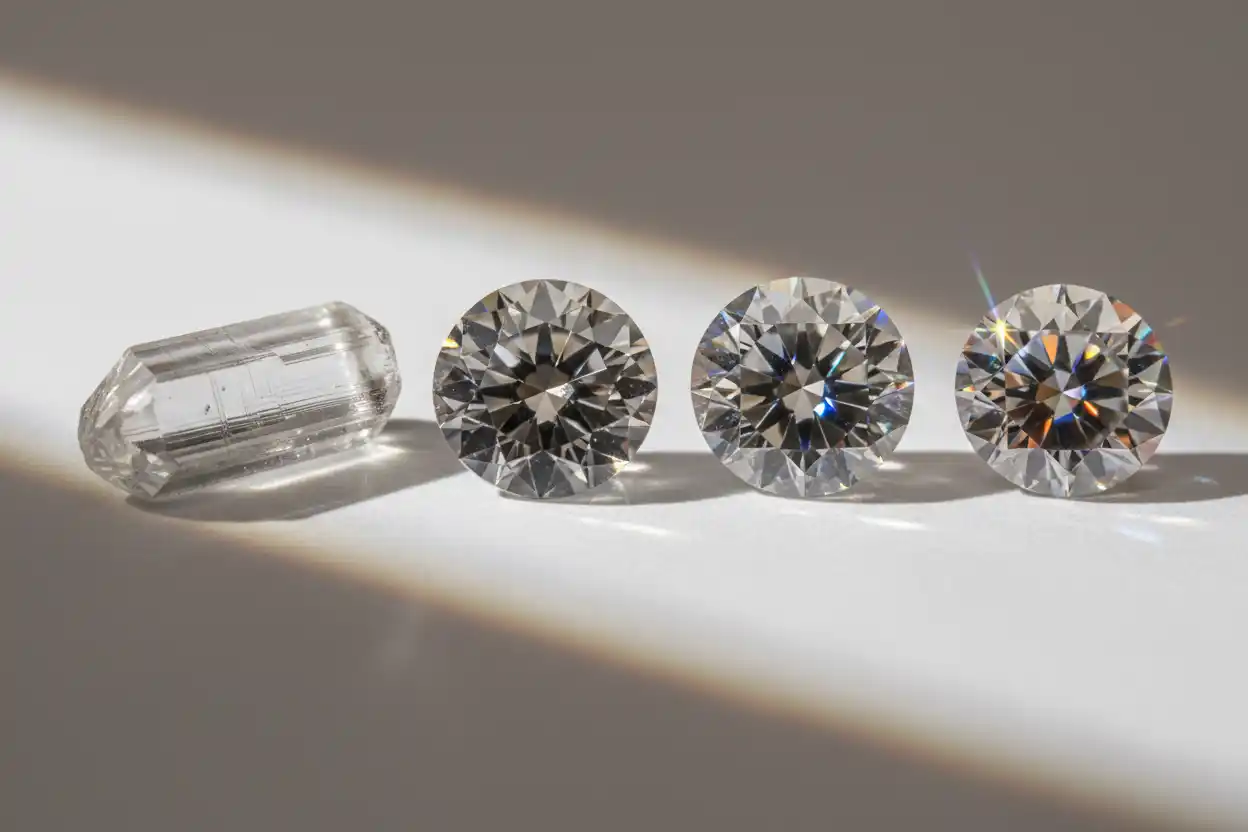
White Topaz Meaning, Properties, Value and Identification
White topaz is transparent colorless topaz, the pure or near-pure expression of an aluminum fluorosilicate mineral. It is widely available in large clean stones and is often used as an affordable diamond alternative, although its perfect cleavage and lower brilliance require realistic expectations.
The material belongs to the broader topaz family, but this page focuses specifically on colorless identity, diamond comparisons, treatment disclosure, price and jewelry durability.
White Topaz at a Glance
| Property | White Topaz |
|---|---|
| Mineral species | Topaz |
| Chemical formula | Al₂SiO₄(F,OH)₂ |
| Trade color | Colorless or near-colorless |
| Crystal system | Orthorhombic |
| Common habit | Prismatic crystals with striated faces and distinctive terminations |
| Luster | Vitreous |
| Transparency | Transparent to translucent |
| Refractive indices | Approximately 1.609–1.643 |
| Birefringence | Approximately 0.008–0.011 |
| Optical character | Biaxial positive |
| Specific gravity | Approximately 3.49–3.57 |
| Mohs hardness | 8 |
| Cleavage | Perfect basal cleavage |
| Tenacity | Brittle with poor-to-fair practical toughness |
| Dispersion | Approximately 0.014 |
| Common cuts | Rounds, ovals, cushions, pears, emerald cuts and fantasy cuts |
| Main care concern | Perfect cleavage, edge abrasion, impact damage and coated or misidentified material |
What Is White Topaz?
White topaz is colorless topaz. The term white is used commercially even though fine stones appear transparent rather than opaque white.
Topaz consists of aluminum, silicon, oxygen, fluorine and hydroxyl.
Pure topaz is colorless. Trace elements, structural defects, radiation and treatment create blue, yellow, brown, pink, orange and other colors.
Colorless material is abundant and frequently serves as the starting rough for treated blue topaz.
The broader color and trade-name system belongs to Types of Topaz and the topaz color meaning guide.
Why Is Pure Topaz Colorless?
The ideal topaz structure does not absorb visible wavelengths strongly enough to create a body color.
Color develops when defects or trace elements create absorption centers within the crystal.
Chromium can contribute pink or red hues, while structural defects and irradiation influence brown and blue.
When these color-producing features are absent or weak, the stone remains colorless.
Natural white topaz can still contain small amounts of trace elements that are invisible to the eye.
Is White Topaz Rare?
Colorless topaz is plentiful compared with imperial, pink or red topaz.
Large transparent crystals occur in several countries, allowing cutters to produce clean stones at relatively low prices.
Size alone therefore does not make white topaz rare. A 20-carat gem can be less expensive than a one-carat topaz of a rare natural color.
Fine crystal form, unusual inclusions, documented locality and exceptional precision cutting can add collector or artistic value.
Ordinary commercial white topaz should remain affordable even when it is eye-clean and relatively large.
White Topaz Versus Diamond
Diamond has a higher refractive index, much stronger dispersion and greater hardness.
It produces sharper white reflections and more spectral fire.
White topaz looks softer and more glass-like, particularly when it becomes dirty.
Diamond measures 10 on the Mohs scale, while topaz measures 8.
Topaz can scratch during long-term wear and may split along perfect cleavage if struck at an unfavorable angle.
The full comparison appears in White Topaz vs Diamond.
White topaz can be attractive in its own right, but it should not be marketed as visually or physically identical to diamond.
White Topaz Versus Cubic Zirconia
Cubic zirconia has a higher refractive index and stronger dispersion than white topaz.
When new and well cut, cubic zirconia often looks more brilliant and diamond-like.
White topaz is a natural mineral, whereas ordinary cubic zirconia is laboratory-manufactured.
Topaz has hardness 8, while cubic zirconia commonly measures approximately 8–8.5.
Cubic zirconia is much denser and generally weighs more at the same dimensions.
Topaz’s perfect cleavage creates a breakage risk that cubic zirconia does not share in the same way.
The complete comparison belongs to White Topaz vs Cubic Zirconia.
White Topaz Versus Moissanite
Moissanite has significantly greater brilliance, fire and scratch resistance.
Its strong dispersion creates frequent rainbow flashes that white topaz cannot match.
Moissanite usually costs more than commercial topaz but less than many diamonds.
White topaz offers natural mineral origin at a low price, while moissanite offers stronger optical performance and better daily durability.
The two materials appeal to different priorities and should not be compared by carat weight alone.
White Topaz Versus White Sapphire
White sapphire is harder, tougher and more suitable for regular ring wear.
Its refractive index is higher than topaz’s, although it still shows less fire than diamond or moissanite.
White topaz is usually much less expensive and more readily available in large sizes.
Sapphire lacks topaz’s perfect cleavage, making it the safer long-term engagement-ring option.
Topaz may offer better size for the budget when the jewelry is reserved for occasional wear.
White Topaz Versus Quartz
Rock crystal or clear quartz can resemble white topaz.
Quartz has hardness 7, while topaz has hardness 8.
Topaz is significantly denser, so it feels heavier for the same dimensions.
Quartz has different refractive indices and may show stronger visible facet doubling in certain orientations.
Topaz crystals commonly have orthorhombic prismatic forms, whereas quartz typically forms six-sided prisms.
Old trade names such as topaz quartz do not make yellow or colorless quartz genuine topaz.
How White Topaz Forms
Topaz forms in fluorine-rich geological environments.
It commonly develops during the late stages of granitic magma crystallization, particularly in pegmatites and cavities within rhyolite.
Fluorine-rich fluids concentrate elements that do not fit readily into early-forming feldspar and quartz.
Topaz may crystallize with quartz, feldspar, mica, tourmaline, beryl, cassiterite and fluorite.
Hydrothermal veins can also produce topaz when hot fluids alter suitable rocks.
Weathering releases durable crystals into river gravels, where alluvial mining can recover rounded gem rough.
Important Sources
Brazil is the dominant commercial source of topaz and produces large colorless crystals alongside blue, yellow, pink and imperial material.
Minas Gerais is particularly important for gem topaz and collector crystals.
Nigeria supplies colorless and pale topaz suitable for faceting.
Sri Lanka produces alluvial colorless, yellow and brown topaz.
Pakistan has yielded fine transparent crystals from pegmatites, sometimes associated with albite and quartz.
Russia, Ukraine, Namibia, Madagascar, Mexico and the United States contain additional deposits.
Texas and Utah are known for natural colorless or pale topaz, including state-gem and collector material.
A locality claim adds value only when it is documented and relevant to the stone’s quality or history.
Inclusions and Internal Features
White topaz is often eye-clean because visible inclusions reduce the appeal of a colorless stone.
Natural inclusions may include fluid cavities, two-phase inclusions, healed fractures and mineral crystals.
Long hollow channels and negative crystals can follow growth directions.
Cleavage planes appear as broad reflective features and can threaten durability.
Some stones contain molybdenite, mica, rutile or other visible mineral inclusions that create collector interest.
Synthetic imitations can show gas bubbles, curved growth features or artificial inclusions, depending on the material.
Identifying White Topaz
A gemologist uses refractive index, birefringence, specific gravity, optical character and spectroscopy.
Topaz has a relatively high density near 3.5, making it heavier than quartz of the same dimensions.
Its hardness of 8 supports identification but should not be tested destructively on finished jewelry.
Perfect basal cleavage is characteristic, though it may not be visible in every fashioned stone.
Under magnification, natural inclusions and growth features can support geological origin.
Raman spectroscopy quickly separates topaz from quartz, glass, cubic zirconia and synthetic corundum.
The consumer workflow appears in Real vs Fake Topaz.
Treatments and Enhancement
Most white topaz is untreated because colorless material is naturally abundant.
However, colorless topaz is often irradiated and heated to produce commercial blue topaz.
A stone sold as white topaz may therefore be untreated natural material or a treated stone whose color has been removed or modified, though treatment intended to preserve a colorless appearance has little ordinary commercial benefit.
Metallic-oxide coatings can create rainbow, pink, green or multicolored material often sold under names such as mystic topaz.
Coatings sit close to the surface and can scratch or wear away during polishing and repair.
Resin filling and oiling are less common but possible in heavily fractured material.
The dedicated Treated Topaz guide retains treatment detection, while Gemstone Treatments Explained provides the broader terminology.
Synthetic Topaz and Imitations
Laboratory-grown topaz has been produced for scientific purposes but is not a major commercial jewelry material.
Most topaz imitations are glass, quartz, cubic zirconia or synthetic sapphire rather than synthetic topaz.
Glass can show rounded bubbles, flow lines and lower hardness.
Quartz is lighter and has different refractive properties.
Cubic zirconia is heavier and more brilliant.
Synthetic sapphire is harder and has a higher refractive index.
The distinction between synthetic equivalents and simulants appears in Lab-Grown vs Natural Gemstones.
Cutting White Topaz
White topaz is available in large clean crystals, allowing a wide range of calibrated and custom cuts.
Round and cushion brilliant cuts create moderate sparkle.
Step cuts emphasize transparency and crisp geometry but reveal windows and inclusions easily.
Fantasy cuts can add visual interest to an otherwise colorless inexpensive material.
Perfect cleavage complicates orientation. Cutters usually position the cleavage direction at an angle to the table to reduce the risk of splitting during cutting and setting.
Excessive pressure, polishing heat and sudden temperature changes can open a cleavage plane.
A deep cut retains weight but may make the stone appear small. A shallow cut creates a broad window.
Hardness, Cleavage and Toughness
Topaz measures 8 on the gemstone hardness chart.
It resists scratching better than quartz, opal and feldspar.
However, topaz has perfect basal cleavage. A sharp impact can split it cleanly.
The difference between surface hardness and breakage resistance is explained in gemstone toughness versus hardness.
The structural weakness is covered further in gemstone cleavage explained.
Topaz should not be struck, exposed to sudden temperature change or clamped under excessive setting pressure.
White Topaz Engagement Rings
White topaz appears in the guide to white gemstones for engagement rings because it is natural, affordable and available in large sizes.
Nevertheless, it is not the strongest choice for continuous daily wear.
Facet junctions may abrade, and a severe blow can activate cleavage.
A protective bezel or low-profile setting reduces risk.
The stone should be removed during exercise, housework, gardening and manual work.
White sapphire and moissanite generally provide better long-term durability, while white topaz provides a lower initial price and natural-gem identity.
White Topaz Jewelry
A protected topaz ring can work for occasional wear.
Topaz necklaces and topaz earrings are safer because they receive fewer impacts.
Topaz bracelets face repeated contact and should use secure settings with limited exposed corners.
Large white topaz pendants offer dramatic size at relatively low cost.
Small calibrated stones can be used as accents, although white sapphire may retain its polish longer in frequently worn jewelry.
White Topaz Prices in 2026
Commercial white topaz is highly affordable.
Current loose-stone listings commonly place ordinary material around $4–$10 per carat.
Small calibrated stones and parcels may sell for approximately $3–$8 per carat.
Better eye-clean individual gems with attractive cutting often range from $8–$20 per carat.
Precision-cut or unusual designer stones may reach approximately $20–$50 per carat, with the premium reflecting labor and artistry rather than mineral rarity.
Large collector cuts or stones with important locality provenance may exceed $50–$100 per carat, but these prices are not representative of ordinary commercial material.
Current listings include untreated Brazilian stones of several carats for less than approximately $10 per carat, confirming the abundant supply of clean colorless topaz.
The broader family ranges remain with the Topaz Price Guide.
What Determines White Topaz Value?
Clarity matters because inclusions are conspicuous in a colorless stone.
Cut quality has an even greater effect. Strong symmetry, balanced depth and crisp polish create the best appearance.
Neutral color is preferable to obvious gray, brown or yellow tint when the stone is marketed as white.
Face-up size should be compared with carat weight because deep stones hide weight below the setting.
Facet abrasion, chips and cleavage fractures reduce value quickly.
Treatment and coating must be disclosed.
Natural crystal form, unusual inclusions and reliable locality can create collector premiums that do not apply to ordinary jewelry stones.
Buying Guidance
Use the Topaz Buying Guide for the full purchase workflow.
Confirm that the gem is topaz rather than quartz, glass or cubic zirconia.
Ask whether it is untreated, irradiated, heated, coated, filled or assembled.
View the stone against white paper under neutral lighting to check for unwanted tint.
Inspect the center for windowing and the facet edges for abrasion.
Compare dimensions with weight. Large carat numbers can hide deep cutting.
Do not pay a major rarity premium for ordinary colorless topaz.
A laboratory report is useful when origin, treatment or unusual value is claimed, but routine inexpensive stones may not justify extensive testing.
Cleaning, Heat and Storage
Clean white topaz with warm water, mild soap and a soft brush.
Do not use steam or ultrasonic cleaning when fractures are visible or treatment status is uncertain.
Sudden temperature changes can cause cleavage-related breakage.
Avoid striking the gem against sinks, tile and metal surfaces.
Coated topaz requires particularly gentle care because abrasive cleaners and polishing can remove the surface layer.
Store topaz separately from sapphire and diamond, which can scratch it.
Also keep it away from softer stones because topaz itself can scratch quartz, feldspar and opal.
Meaning and Symbolism
Modern crystal traditions associate white topaz with clarity, intention, honesty and simplifying a complicated decision.
Its transparent appearance encourages symbolism involving removing distractions and focusing on what can be verified directly.
Because large clean stones remain affordable, white topaz can also represent accessibility and the idea that visual scale does not always equal rarity or status.
Some wearers choose it as a reminder to value practical function over prestigious labels.
These meanings are cultural, spiritual or personal rather than scientifically demonstrated effects.
White topaz belongs among white gemstones, but its perfect cleavage and modest dispersion distinguish it from other colorless jewelry options.
Frequently Asked Questions
1. What is white topaz?
White topaz is transparent colorless topaz, an aluminum fluorosilicate mineral.
2. Is white topaz naturally colorless?
Yes. Pure or near-pure topaz is colorless, and natural white topaz is widely available.
3. Is white topaz the same as diamond?
No. Topaz has different chemistry, lower hardness, less brilliance and perfect cleavage.
4. Does white topaz look like a diamond?
It can resemble a diamond at a distance, but it produces less brilliance and fire and may look glassier.
5. Is white topaz better than cubic zirconia?
White topaz offers natural mineral origin, while cubic zirconia generally offers stronger initial brilliance. Their durability and price differences depend on use.
6. Is white topaz suitable for an engagement ring?
It can be used in a protective setting, but sapphire and moissanite are usually better for continuous daily wear.
7. Is white topaz normally treated?
Most white topaz is untreated, although colorless rough is commonly irradiated and heated to create blue topaz. Coatings can produce other colors.
8. How can white topaz be distinguished from quartz?
Topaz is harder, denser and has different refractive properties. Laboratory testing provides a dependable identification.
9. Does white topaz scratch easily?
It is reasonably scratch-resistant at hardness 8, but facet edges can abrade over time and harder gems can scratch it.
10. Can white topaz split?
Yes. Its perfect basal cleavage means a sharp blow or excessive pressure can split the stone.
11. How much is white topaz worth?
Commercial stones commonly cost about $4–$10 per carat, while better or precision-cut gems may reach $20–$50 per carat.
12. Does white topaz have scientifically proven healing properties?
No. Its symbolism can have personal meaning, but scientific evidence does not establish healing effects.
White topaz offers size, clarity and natural mineral origin at a remarkably low price, but its value depends on accepting what it is rather than presenting it as a diamond substitute with identical performance. A well-cut stone can be attractive and practical when the setting protects its cleavage and the price reflects its abundant supply.
White topaz appears in Crystals That Start With W and Gemstones That Start With W.