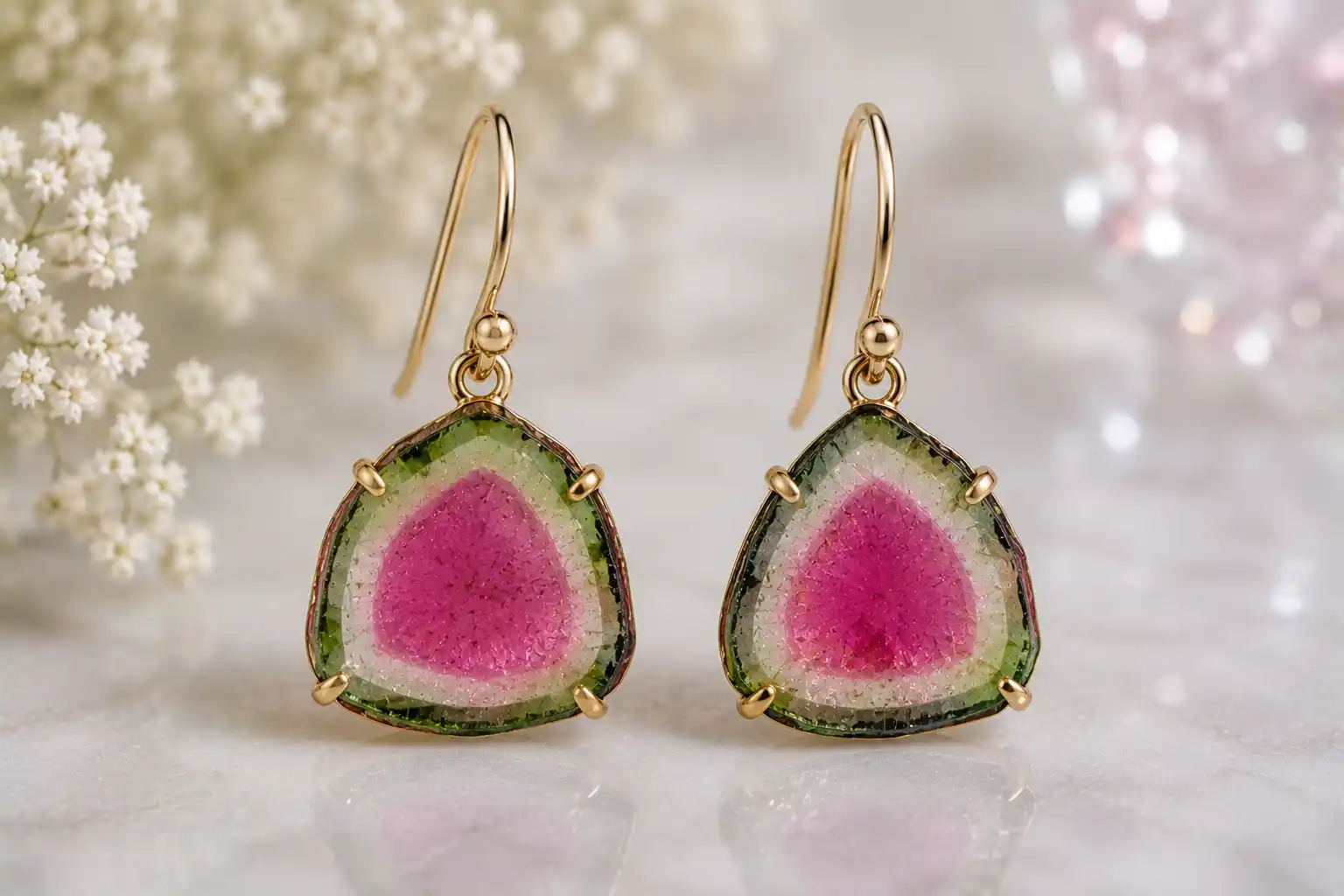
Watermelon Tourmaline Earrings: A Style Guide
Watermelon Tourmaline earrings display pink and green color zoning in one of the safest jewelry positions for this often-included gem. Cross-section slices can show pink centers surrounded by green rims, while elongated cuts reveal parallel bands or transitions running from one end of the stone to the other.
A convincing pair requires more than two pieces sharing the same trade name. Their color proportions, visible dimensions, thickness, outline, transparency, polish and orientation need enough balance to look intentional around the face.
Earrings receive less impact than rings and bracelets, making them especially suitable for thin slices and unusual natural shapes. Settings, attachment loops and backings still need to account for fragile edges, internal fractures and total weight.
Watermelon Tourmaline Earrings at a Glance
| Feature | What to Consider |
|---|---|
| Gem family | Tourmaline |
| Defining pattern | Pink or red center with green exterior or pink-green zoning |
| Mohs hardness | Approximately 7–7.5 |
| Toughness | Fair |
| Common earring forms | Slice studs, bezel studs, drops, hoops, wire wraps and faceted bicolor gems |
| Main matching factors | Color distribution, outline, dimensions, thickness and polish |
| Main durability concern | Thin edges, drill holes and surface-reaching fractures |
| Best protective setting | Full bezel or framed slice |
| Common treatment concerns | Heating, irradiation, filling and imitation |
| Main comfort concern | Weight and forward tipping |
| Safest cleaning | Warm water, mild soap and a soft brush |
| Main advantage | High color visibility with relatively low impact |
Why Watermelon Tourmaline Works Well in Earrings
Earrings avoid much of the surface contact experienced by bracelets and rings.
A thin Tourmaline slice can remain visible without striking desks, countertops and tools throughout the day. This allows cutters and designers to use delicate cross-sections that would need stronger protection on the hand.
Movement also helps translucent slices interact with changing light.
The position does not eliminate all risk. Long drops can catch in hair and scarves, while heavy stones may strain posts, hooks and earlobes.
The Watermelon Tourmaline meaning guide owns the gem’s formation and symbolism. This article focuses on earring design and pair selection.
Watermelon Tourmaline Slice Studs
Slice studs place the color pattern directly on the earlobe.
Small cross-sections can show an entire pink-green arrangement in a compact design. Natural outlines may be triangular, rounded triangular, oval or irregular.
A metal frame or full bezel offers the strongest edge protection.
The post should attach to a structurally sound section of the backing rather than directly to one fragile point on the stone.
Large slice studs need broad supportive backs to prevent forward tipping.
The two earrings should sit at similar angles so their patterns remain equally visible.
Bezel-Set Stud Earrings
A bezel surrounds the slice or cabochon with metal.
This design protects thin edges and prevents the setting from depending on drilled holes.
A full bezel creates the safest smooth outline. A partial frame reveals more of the side while leaving selected areas exposed.
The metal should not hide the green perimeter or cover an important color boundary.
Uneven pressure can extend a fracture, so the setting must follow the stone gently and accurately.
White metal emphasizes the pink-green contrast, while yellow or rose gold creates a warmer frame.
Prong-Set Watermelon Tourmaline
Prongs may hold thicker slices, cabochons and faceted bicolor stones.
They expose more of the gemstone but provide less continuous edge protection than a bezel.
Each claw should remain broad enough to support the stone without pressing into a fracture.
Thin cross-section slices are generally poor candidates for narrow prongs because their perimeter can chip around the contact points.
Pear, marquise and elongated stones need protection at pointed ends.
The two settings should match in height and angle.
Watermelon Tourmaline Drop Earrings
Drops suspend one or more stones beneath the earlobe.
Cross-section slices create colorful natural-form drops, while elongated bicolor Tourmalines work well as vertical faceted centers.
Movement reveals the translucency and color transitions.
Every connecting ring should remain securely closed. Thin open jump rings can separate when caught in hair or clothing.
Short drops balance movement with practicality. Long designs need enough spacing that upper and lower stones do not strike one another.
Longitudinal Bicolor Drops
Longitudinal cuts show pink and green in parallel bands or at opposite ends.
This orientation suits rectangular, tablet, pear and elongated cushion shapes.
The pair should place the colors in the same direction unless the design is intentionally mirrored.
For example, both earrings might show green at the top and pink below. Alternatively, one can reverse the other for symmetrical color blocking.
Neither arrangement is inherently better. The important point is that the orientation appears deliberate.
The settings should not obscure one end of the zoning.
Watermelon Tourmaline Hoop Earrings
Watermelon Tourmaline may appear as small bezel stations or removable slice charms on hoops.
Front-facing stones provide the strongest visibility.
The hoop should close with a positive click, and the charm loop must not slide over the open post.
Thin slices should not swing far enough to strike one another.
A removable charm design allows the wearer to use the hoops separately, but every additional moving component creates another potential failure point.
Small framed charms are safer than unprotected drilled slices.
Wire-Wrapped Earrings
Wire wrapping can hold irregular slices without drilling them.
The wire should support the stone mechanically rather than depending on decorative tension alone.
Sharp ends must remain tucked away from the skin and hair.
The wrapping should not cross the main color zones unnecessarily or place concentrated pressure against a thin edge.
Soft wire can loosen, while overly hard or tight wire can damage the gemstone.
A professional-looking wrap balances protection, pattern visibility and smooth finishing.
Drilled Slice Earrings
Some slices are drilled directly and suspended from hooks or wires.
The hole must remain far enough from the edge to leave adequate supporting material.
Inspect for fractures radiating outward from the opening.
A small metal eyelet or protective wire loop can reduce abrasion against the drill hole.
Drilled construction is simple and visually light, but it is less protective than a complete frame.
The pair should not be worn during activities where long drops may catch or be pulled.
Faceted Watermelon Tourmaline Earrings
Not all Watermelon Tourmaline is cut as slices.
Faceted stones can display pink and green sections within ovals, cushions, emerald cuts, pears and custom shapes.
The cutter may orient the table to show the division face-up while controlling pleochroism and darkness.
Matching two faceted bicolor gems is difficult because the color boundary, depth and brilliance all need to coordinate.
A pair can use mirrored zoning intentionally, especially in elongated drops.
Windowing and extinction should not be accepted merely because the color pattern is rare.
Matching Cross-Section Slices
Matched slices should coordinate in overall outline and visible scale.
One may have a larger pink center and the other a thicker green rim, yet the pair can still look balanced if the proportions complement each other.
Thickness affects darkness and weight. A thin translucent slice may look mismatched beside a thick opaque one.
The polish should remain comparable on both faces.
Natural differences are expected. Matching seeks visual harmony rather than machine-made identity.
Matching Color Intensity
Compare the pink and green zones separately.
The pink centers should have compatible hue and saturation. One vivid magenta center may overpower a pale blush stone.
The green rims should also coordinate in tone. A bright yellow-green edge can look unrelated to a nearly black forest-green rim.
A clear or pale transitional band may help connect the zones.
Examine both earrings together under daylight-equivalent and ordinary indoor light. Product photographs can conceal differences through editing and backlighting.
Matching Shape and Orientation
Tourmaline crystals frequently produce triangular or irregular cross-sections.
Two slices do not need identical outlines, but their visual weight should remain balanced.
If the stones are triangular, decide whether the points should face up, down or outward.
Longitudinal gems need the color boundary oriented consistently.
A pair that appears random on a tray may look even less coordinated when worn on opposite sides of the face.
The setting should reinforce the intended orientation.
Thickness and Edge Strength
Thin slices provide more translucency but less structural strength.
Inspect the complete perimeter for tapering, chips and fractures.
A thick slice may be safer but can become heavy and dark.
The ideal thickness supports the size and setting without eliminating the light effect.
Framed slices can be somewhat thinner than unprotected drilled pieces because the metal absorbs part of the impact.
The stone should not flex or move within the setting.
Clarity and Internal Features
Pink sections often contain more visible inclusions than green Tourmaline.
Thread-like cavities, crystals, feathers and healed fractures may be visible.
These features can create attractive texture, but surface-reaching fractures need careful evaluation.
A crack extending from the center to the edge may divide the slice structurally.
Some unusual internal fractures can produce an iris effect, but visual beauty does not make the stone stronger.
The pair should have compatible transparency rather than one clear stone and one heavily cloudy example.
Pleochroism
Tourmaline can display different colors or darkness when viewed from different directions.
Pleochroism is especially relevant in faceted stones. A gem may appear bright green from one direction and much darker when rotated.
Slices primarily reveal growth zoning, but directional color can still influence their appearance.
Compare the earrings from the angles in which they will hang naturally.
The types-of-Tourmaline guide explains pleochroism and the broader Tourmaline family.
Treatment and Color Stability
Heating may alter or lighten some Tourmaline colors.
Irradiation can create or strengthen pink, red and yellow components. Some irradiation-related colors may be sensitive to high heat or intense light.
Fracture filling can make cracks less visible.
The seller should disclose known treatments.
Treatment does not automatically make earrings undesirable, but it affects value, repair and cleaning.
The Watermelon Tourmaline buying guide provides the detailed purchasing workflow.
Imitations and Assembled Earrings
Glass can be manufactured with pink and green bands.
Resin may reproduce slice shapes and contain bubbles, glitter or artificial inclusions.
Two different stones can also be glued together to imitate natural zoning.
Possible clues include a straight joining plane, adhesive bubbles, molded edges and repeated identical patterns.
A natural Watermelon Tourmaline’s zones developed within one crystal. Laboratory testing can confirm uncertain valuable material.
Evaluating Polish
The main faces should have an even finish without broad scratches or cloudy grinding marks.
A high polish increases color contrast and transparency.
Edges must remain smooth enough not to catch clothing or hair.
Oil or wax can temporarily hide a weak finish, so examine the earrings dry.
One well-polished slice paired with one dull stone creates an obvious mismatch.
Natural inclusions are not a reason to accept poor workmanship.
Earring Weight
Tourmaline slices can become heavier than they appear, particularly when thick or framed in substantial metal.
Studs should not pull forward. Broad disc backs can improve support.
Long drops distribute weight below the lobe but may become uncomfortable after several hours.
Compare the complete earring weight, not only gemstone dimensions.
A visually large thin slice may be more comfortable than a small but deep faceted stone.
Comfort is part of quality because an unworn pair provides little practical value.
Earring Backings
Friction backs suit small studs when they grip securely.
Broad stabilizing backs help support large slices and bezels.
Screw backs offer added security but can take longer to fasten. Their threaded posts may be uncomfortable for some wearers.
Locking backs combine retention with a broad support surface.
Lever backs suit drops. Open hooks should use silicone stoppers when loss is a concern.
The backing should match the earring’s total value and weight.
Choosing the Metal
White gold, platinum and silver create a cool border that emphasizes the pink-green division.
Yellow gold complements warm pink and can soften yellow-green sections.
Rose gold creates a strong connection with the pink center while contrasting against the green exterior.
Metal color should not override construction.
A thin frame, weak post or open jump ring is unsuitable regardless of whether the alloy is precious.
Metal sensitivity also matters because posts and hooks contact pierced skin.
Price Factors
Matched pairs generally cost more than two unrelated slices.
Value rises with attractive color contrast, balanced zoning, transparency, structural soundness, cutting and workmanship.
Large size can add value when the stone remains strong and well patterned.
Rare patterning does not compensate for severe fractures or unstable edges.
The Watermelon Tourmaline price guide provides the dedicated market analysis without duplicating price tables here.
Comparing Other Watermelon Tourmaline Jewelry
A Watermelon Tourmaline bracelet provides repeated color but receives greater surface contact.
The Watermelon Tourmaline necklace guide can display larger slices with similarly low abrasion.
The Watermelon Tourmaline ring guide will require maximum edge protection.
The broader Tourmaline earrings guide covers Rubellite, Indicolite, green, black and rainbow Tourmaline pair matching.
Styling Watermelon Tourmaline Earrings
Slice studs provide strong color without significant movement.
Small drops work with casual and professional clothing, while large natural-form slices create a more artistic statement.
White, cream, black, navy and neutral earth tones allow both colors to remain visible.
Matching jewelry does not need an identical watermelon pattern. A simple pink or green Tourmaline ring can coordinate without competing.
When the earrings have complex zoning, understated surrounding jewelry often keeps the pattern as the main feature.
Cleaning Watermelon Tourmaline Earrings
Use warm water, mild soap and a soft brush.
Work gently behind bezels, around posts and inside attachment loops.
Rinse briefly and dry with a lint-free cloth.
Avoid steam and ultrasonic cleaning. Heat, vibration, internal fractures, fillers and glue can create unnecessary risk.
Do not use abrasive polishing compounds on the slice faces.
The Watermelon Tourmaline jewelry-cleaning guide provides detailed instructions.
Storage
Store each earring separately with its backing.
Do not allow the pair to strike each other.
Keep Tourmaline away from Topaz, Sapphire and Diamond, which can scratch it.
Long drops should remain flat or suspended separately to prevent tangling.
Watermelon Tourmaline also appears in the crystals beginning with W and gemstones beginning with W directories.
Final Perspective
Watermelon Tourmaline earrings are strongest when natural variation is balanced rather than hidden. Two slices can differ in exact pattern while still coordinating through size, color intensity, thickness and orientation.
Structural condition should come before perfect symmetry. A slightly irregular pair with sound framed edges will generally wear better than two visually identical but dangerously thin or fractured slices.
Frequently Asked Questions
1. What are Watermelon Tourmaline earrings?
They are earrings made with Tourmaline showing pink or red and green color zoning within the same crystal.
2. Why is Watermelon Tourmaline often cut into slices?
Cross-section slices reveal the pink center and green exterior produced during crystal growth.
3. Do matched earrings need identical zoning?
No. They should coordinate in size, color balance, thickness and visual weight rather than reproduce identical patterns.
4. Are slice earrings fragile?
Thin, drilled or fractured slices can be vulnerable. A full frame or bezel provides better protection.
5. Which earring style is safest?
Low bezel-set studs or short framed drops provide strong edge protection and limited movement.
6. Are faceted Watermelon Tourmalines available?
Yes. Bicolor and multicolor rough can be faceted into ovals, cushions, pears, rectangles and custom cuts.
7. Can Watermelon Tourmaline be treated?
Tourmaline may be heated, irradiated or fracture filled. Known treatment should be disclosed.
8. How can fake Watermelon Tourmaline earrings be recognized?
Bubbles, mold seams, glued layers, painted surfaces and identical repeated patterns can provide warning signs.
9. Why do some slices have triangular outlines?
Tourmaline commonly grows as three-sided prisms, so cross-sections may be triangular or rounded triangular.
10. Are large slice earrings heavy?
They can be, especially when thick or framed in substantial metal. Total earring weight should be checked before purchase.
11. Can Watermelon Tourmaline earrings be cleaned ultrasonically?
No. Warm soapy water is safer because fractures, fillers, settings and glue may be vulnerable.
12. How should the earrings be stored?
Keep each earring separately in a padded compartment away from harder gemstones and prevent thin slices from striking each other.