Tourmaline Earrings: A Style Guide
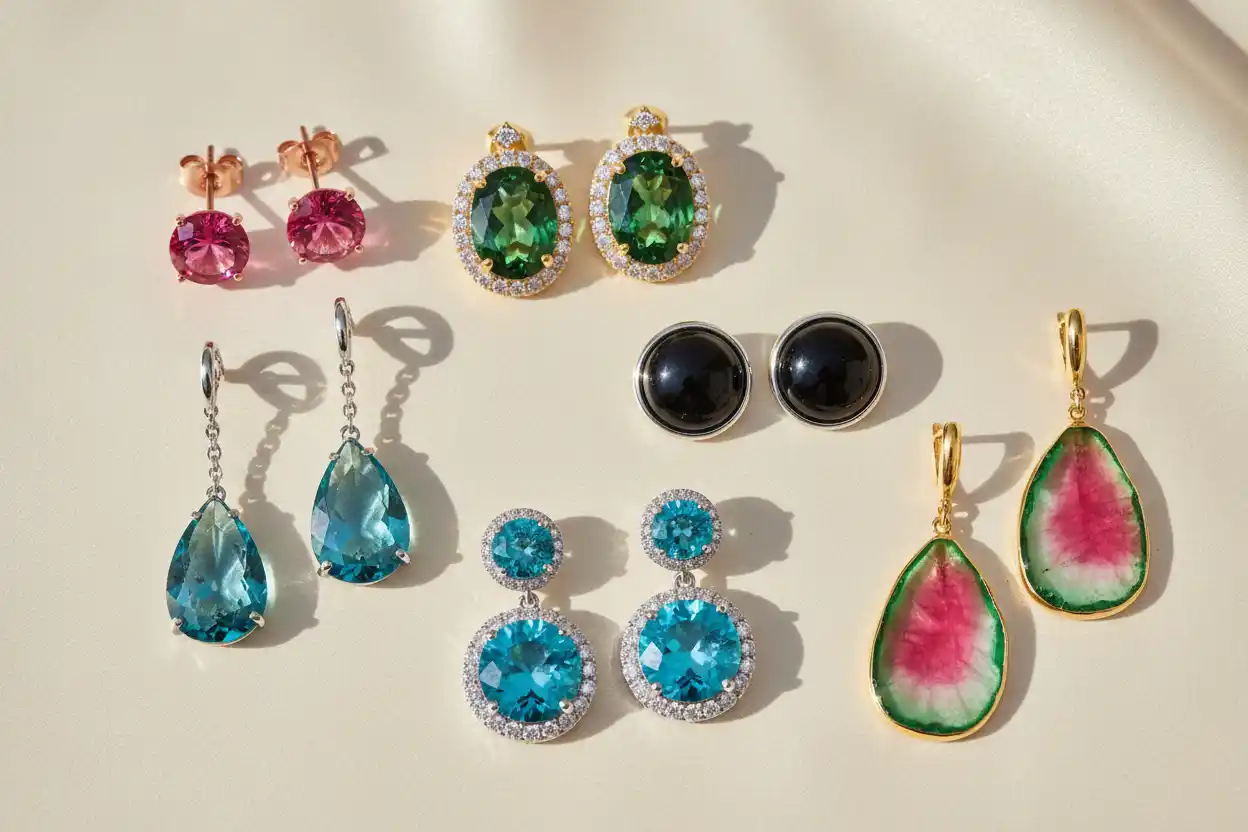
Tourmaline earrings can be subtle pale-pink studs, vivid green solitaires, electric blue Paraíba drops, opaque black cabochons or multicolor slices showing several zones within one crystal. Few other gem families offer the same range without leaving one broad mineral group.
Earrings are physically well suited to Tourmaline because they receive less impact than rings and bracelets. However, creating a convincing pair can be difficult. Strong pleochroism, color zoning, differences in cut depth and varying inclusion patterns mean two stones with equal weights may look noticeably different around the face.
A strong pair should coordinate in visible dimensions, face-up color, brilliance and orientation rather than relying only on a shared trade name.
Tourmaline Earrings at a Glance
| Feature | What to Consider |
|---|---|
| Gem family | Borosilicate Tourmaline group |
| Common gem species | Primarily Elbaite, with Dravite, Uvite and Schorl also used |
| Typical colors | Pink, red, green, blue, black, yellow and multicolor |
| Mohs hardness | Approximately 7–7.5 |
| Toughness | Fair |
| Optical characteristic | Strong pleochroism |
| Popular earring styles | Studs, halos, drops, hoops, clusters and slices |
| Main matching concern | Face-up hue, tone, cut and pleochroic orientation |
| Common treatments | Heat, irradiation and occasional fracture filling |
| Best cleaning | Warm water, mild soap and a soft brush |
| Safest setting | Low bezel or substantial protected prongs |
| Birthstone connection | October |
Why Tourmaline Works Well in Earrings
Tourmaline has sufficient hardness for regular jewelry wear when protected from sharp impacts.
The earring position avoids repeated desk contact, household chemicals and gripping pressure. This makes it suitable for stones that would require more caution in a ring.
Movement also benefits pleochroism. As the head turns, the gem may reveal slightly different proportions of blue, green, red or violet.
The completed Tourmaline meaning guide owns the family’s mineralogy and general history. This page focuses on pair matching, settings, backings and style.
Tourmaline Stud Earrings
Studs place the gemstone directly on the earlobe and provide the simplest format for regular wear.
Rounds create symmetry and are relatively straightforward to match. Ovals provide greater visible length, while cushions offer a softer square outline.
Elongated emerald cuts may suit Tourmaline’s natural crystal habit but can project beyond a small lobe.
A low basket keeps the earring stable. Tall settings may tilt forward, particularly when the stones are large.
Bezel studs protect the girdle and create a smooth outline. Prong settings expose more of the gemstone but require regular inspection.
Bezel-Set Tourmaline Earrings
A bezel surrounds most or all of the gemstone’s edge.
This design protects the girdle, limits snagging and can help a strongly zoned stone retain its intended orientation.
A full bezel gives maximum protection. A partial bezel leaves more of the gem visible while exposing selected sides.
The jeweler must avoid excessive pressure, particularly when the Tourmaline contains surface-reaching fractures.
Yellow gold emphasizes warm pink, red and yellow stones. White metal creates clearer contrast with blue and green material.
A bezel can make the gem appear slightly smaller, but it often improves practical wear.
Prong-Set Studs
Prongs allow more of the stone to remain visible.
Four-prong settings create an open appearance. Six-prong designs provide greater redundancy for larger rounds and ovals.
Each prong should rest away from obvious fractures.
Pointed pears, marquises and trillions need protective V-prongs or reinforced corners.
The baskets should match in height and angle. Even small structural differences can make one earring tilt more than the other.
Halo Earrings
A halo surrounds each Tourmaline with small accent gems.
Colorless Diamond or Sapphire can make pink, green or blue centers appear larger and more saturated.
The accent girdles must not touch the Tourmaline directly. Harder stones can scratch it and may apply concentrated pressure around the edge.
Both halos should have identical proportions and comparable accent quality.
Residue can collect beneath the center and between small prongs, so the design needs enough access for gentle cleaning.
A compact single halo is usually lighter and easier to maintain than a tall double surround.
Tourmaline Drop Earrings
Drop earrings suspend one or more gemstones beneath the lobe.
Pear, oval and elongated cushion cuts work naturally in a vertical format.
Movement reveals pleochroism and helps the facets catch changing light. It can also make slight pair differences less obvious than they would be in fixed studs.
Every connecting ring should remain securely closed. Soldered or mechanically locked links are preferable for valuable stones.
Short drops balance movement and practicality. Long designs may catch in hair, scarves and high collars.
Dangle and Chandelier Earrings
Dangles may combine several Tourmaline colors or create a graduated suite.
A design can progress from pale pink near the lobe to deep Rubellite below, or combine green, blue and yellow in a deliberate sequence.
The stones should coordinate in brightness even when the hues differ.
Total weight matters. Tourmaline can occur in substantial sizes, and several gems combined with metal and accents may become uncomfortable.
The rear surfaces should remain smooth against the neck.
Long earrings should be stored flat or suspended separately to prevent tangling.
Tourmaline Hoop Earrings
Tourmaline may appear as front-facing gems set directly along a hoop or as detachable charms.
Small rounds and ovals suit fixed hoops. The stones need enough separation that their girdles do not strike each other.
Removable charms offer flexibility but depend on secure attachment loops.
Hinged hoops should close with a positive click. Misaligned posts or worn catches create a greater loss risk than gemstone damage.
Inside-out hoops add sparkle along both visible surfaces but increase weight and the number of settings requiring inspection.
Cluster Earrings
Cluster earrings arrange several small Tourmalines into floral, geometric or asymmetrical forms.
The format can create substantial color without requiring two large matched centers.
Rainbow clusters may intentionally use different hues, while single-color clusters need closer tone and saturation matching.
One dark, heavily windowed or poorly polished stone can interrupt the complete design.
The metal framework should provide structural support without creating sharp edges against the skin.
Matching Tourmaline Pairs
Pair matching begins with face-up appearance.
The stones should coordinate in hue, tone, saturation, visible dimensions, brilliance and pattern. Equal carat weights are insufficient because depth can vary.
Strong pleochroism means one gem may appear green while the other looks blue-green from the same direction.
The pair should be viewed together under daylight-equivalent, ordinary indoor and warm evening light.
Slight natural variation is acceptable. The goal is balance rather than mechanical identity.
The completed Tourmaline buying guide explains the family’s broader quality factors.
Pleochroism and Cutting Orientation
Tourmaline can show significantly different colors or darkness along different crystal directions.
Light-colored rough may be oriented to deepen color. Dark rough may be cut to avoid an almost closed, black-looking crystal axis.
This tradeoff affects earrings strongly because two stones sit side by side around the face.
A pair should be matched after cutting, not assumed to match because the rough came from one crystal.
Rotate both earrings slowly. Their color changes should remain harmonious rather than causing one side to darken dramatically.
Pink Tourmaline Earrings
Pink Tourmaline ranges from pale blush to vivid magenta.
The completed Pink Tourmaline guide covers its symbolism and identity.
Pink gems often contain visible thread-like or liquid inclusions. These can be acceptable when they do not create dangerous fractures.
Pale stones may benefit from rose or yellow gold, while highly saturated magenta gems contrast strongly with white metal.
Irradiation can create or enhance some pink colors. Treatment should be disclosed.
Rubellite Earrings
Rubellite is valued for red-to-pinkish-red color that remains attractive under changing light.
Fine Rubellite earrings can be difficult to match because vivid material frequently contains visible inclusions.
The pair should coordinate in red intensity rather than allowing one stone to appear purple and the other brownish.
A halo can define the color of a smaller center, although the setting should remain low and protective.
Value factors belong in the completed Rubellite price guide.
Green Tourmaline Earrings
Green Tourmaline can appear yellow-green, forest green, emerald green or blue-green.
Verdelite is a common name for green Tourmaline.
Dark green stones can suffer from heavy extinction when cut or oriented poorly.
A well-matched pair should remain bright from the front instead of appearing black around the center.
Yellow gold emphasizes olive and warm green shades. White gold and platinum suit blue-green and cooler material.
Green Tourmaline commonly has a higher clarity expectation than red varieties.
Indicolite Earrings
Indicolite covers blue, violetish-blue and greenish-blue Tourmaline.
Fine material is uncommon, and dark rough can be difficult to cut attractively.
Matching requires attention to both hue and the darker pleochroic direction.
A pair should not rely on intense display lighting to reveal its color.
The completed Indicolite buying guide explains the specific color and cutting concerns.
White metal usually provides the strongest cool contrast.
Paraíba Tourmaline Earrings
Copper-bearing Tourmaline can produce electric blue, greenish-blue and blue-green colors.
Because fine gems are rare, small stones may still carry significant value.
Pair matching is particularly difficult when vivid color, copper-bearing identity, origin, clarity and cutting all matter.
The dedicated Paraíba Tourmaline earrings guide owns style and pair selection for this variety.
The completed Paraíba Tourmaline price guide covers value and documentation.
Watermelon Tourmaline Earrings
Watermelon Tourmaline shows pink and green zoning, often displayed in polished slices.
A pair may be cut from neighboring sections of one crystal, but natural zoning still produces differences.
The green rim, pink center and any intervening pale zone should feel balanced.
Thin slices require protected edges and carefully positioned drill holes.
The dedicated Watermelon Tourmaline earrings guide owns slice matching and construction. The Watermelon Tourmaline buying guide covers broader quality.
Black Tourmaline Earrings
Black Tourmaline is commonly fashioned as cabochons, beads or polished crystal sections.
Opaque studs should match in polish, outline and surface texture.
Natural Schorl may contain pits or striations, but the pair should not look unfinished unless a rustic style is intentional.
Black Tourmaline is heavier visually than a transparent colored gem. A bezel or substantial metal frame often suits it.
Verify that the material is not simple black glass or dyed stone when authenticity matters.
Elbaite and Other Species
Most transparent colored Tourmaline used in fine earrings is elbaite.
Brown Dravite, green Uvite and black Schorl also appear in jewelry.
The completed types of Tourmaline guide explains the family without requiring shoppers to identify species from appearance alone.
Species naming should not replace standard gemstone quality evaluation.
A laboratory can identify material more reliably when chemical classification matters.
Cat’s-Eye Tourmaline Earrings
Growth tubes can create a cat’s-eye effect in green, blue or pink Tourmaline.
The stone must be cut as a cabochon with the tubes correctly oriented.
A pair should show similarly positioned and similarly sharp eyes.
Tourmaline’s cat’s-eye band is often softer than the eye in fine Chrysoberyl.
The cabochons should sit straight in their settings. One tilted eye can make the pair appear mismatched even when the colors agree.
Evaluating Color
Bright, pure red, blue and green colors are highly valued, but beauty is not limited to the most expensive hues.
Muted rose, olive, teal and earth colors can create sophisticated earrings.
Judge the pair in realistic lighting. Dark stones may look attractive under concentrated lamps but lifeless indoors.
The planned Tourmaline color meaning guide owns color symbolism, while the completed Tourmaline price guide explains market differences.
Evaluating Clarity
Pink and red Tourmalines commonly have visible inclusions.
Green and blue varieties are generally expected to look cleaner, although rare exceptional colors may be valued despite inclusions.
Surface-reaching fractures around prongs and corners are more concerning than an internal tube in a protected location.
Both earrings should show compatible clarity. One clean stone paired with one heavily fractured gem will appear mismatched.
Oil or resin filling should be disclosed.
Evaluating Cut
Tourmaline’s elongated crystal habit often leads to ovals, emerald cuts, long cushions and rectangular shapes.
A well-cut stone should return light evenly without a large transparent window.
Dark extinction should not dominate the face.
Both stones need similar cutting patterns. One brilliant-cut gem and one noticeably different mixed cut may reflect light unevenly.
Dimensions in millimeters are more useful for matching than weight alone.
Treatments
Heating can lighten dark material or alter color. Heat-related changes are generally stable.
Irradiation can produce or strengthen pink, red and yellow colors. Some irradiation-created color may fade under heat or intense light.
Fracture filling can make surface-reaching cracks less visible.
The seller should state known treatments in writing.
Treatment is one factor among many and should not automatically outweigh attractive color, sound structure and fair pricing.
Choosing Earring Size
Small studs provide practical daily color.
Medium centers reveal pleochroism and zoning more clearly. Large stones can become heavy because Tourmaline may be cut deeply to manage color.
Compare millimeter dimensions and total setting weight.
A halo increases the complete outline without requiring unusually large centers.
Large studs may need broad supportive backs to prevent forward tipping.
Drops distribute weight differently but can still become uncomfortable over several hours.
Earring Backings
Friction backs suit modest studs when they remain tight.
Broad disc backs provide stability for large centers and halos.
Screw backs offer stronger retention but take longer to operate. Their threaded posts may feel uncomfortable to some wearers.
Locking backs combine security with a supportive surface.
Lever backs suit drops and dangles. Open hooks should use silicone stoppers where loss is a concern.
Choosing the Metal
Yellow gold complements pink, red, yellow and warm green Tourmaline.
Rose gold works naturally with pale pink and peach material.
White gold and platinum emphasize blue, blue-green and vivid cool pink gems.
Sterling silver provides a lower-cost option for commercial stones, although the posts and prongs still need adequate strength.
Metal sensitivity should be considered because earring posts contact pierced skin.
October Birthstone Earrings
Tourmaline is an October birthstone alongside Opal.
The completed October birthstone guide explains the two choices.
Earrings are practical gifts because they avoid ring and wrist sizing.
Pink Tourmaline is a familiar October option, but the recipient may prefer green, blue, black or multicolor material.
The completed October birthstone jewelry guide compares earrings with other formats.
Comparing Other Tourmaline Jewelry
A Tourmaline bracelet creates a full row or strand of color but receives more impact.
A Tourmaline necklace can display a larger gem or crystal slice with similarly low abrasion risk.
The planned Tourmaline ring guide will address protective settings and hand wear.
Earrings provide one of the strongest balances of color visibility, pair symbolism and physical safety.
Cleaning Tourmaline Earrings
Use warm water, mild soap and a soft brush.
Work behind the settings and around the posts, where cosmetics and skin oil collect.
Rinse briefly and dry with a lint-free cloth.
Do not use steam or ultrasonic cleaning. Heat, vibration, liquid inclusions and filled fractures may cause damage.
The completed guide to cleaning Tourmaline jewelry provides the full process.
Storage
Keep each earring in a separate padded compartment with its backing.
Do not allow the pair to strike each other or harder gemstones.
Topaz, Sapphire and Diamond can scratch Tourmaline.
Long drops should be stored flat or suspended separately to prevent tangling.
Tourmaline appears in the crystals beginning with T and gemstones beginning with T directories.
Final Perspective
Tourmaline earrings succeed when the two gems look balanced in real wearing conditions. Matching by species, trade name or carat weight alone cannot account for pleochroism, zoning, cutting depth and inclusion pattern.
Compare the pair face-up under several lights, then inspect settings and backs. Smaller well-oriented stones that remain bright and secure will generally provide more lasting satisfaction than larger gems that become dark, tilt forward or differ visibly from one another.
Frequently Asked Questions
1. Is Tourmaline suitable for earrings?
Yes. Its hardness and the low-impact earring position make it suitable for frequent wear with normal care.
2. Why are Tourmaline earrings difficult to match?
Strong pleochroism, color zoning, varied cut depth and inclusion patterns can make two similar stones appear different.
3. Which Tourmaline color is most valuable?
Value varies by variety, but vivid copper-bearing Paraíba colors, fine Rubellite and rare blue Indicolite can command high prices.
4. Are pink Tourmaline earrings usually included?
Pink and red Tourmalines commonly contain more visible inclusions than green and blue stones.
5. Are Tourmaline earrings commonly treated?
Heating, irradiation and occasional fracture filling occur. Treatment depends on the color and material.
6. Which setting protects Tourmaline earrings best?
A low full or partial bezel offers strong edge protection. Substantial prongs can also work.
7. Are Paraíba Tourmaline earrings naturally neon?
Natural copper-bearing material can show vivid color, but identity and origin require proper gemological documentation.
8. How should Watermelon Tourmaline earrings match?
The pair should coordinate in slice size, pink-green zoning, thickness and edge condition.
9. Is Black Tourmaline suitable for studs?
Yes. Polished Schorl cabochons and beads can create durable opaque studs when structurally sound.
10. Do Tourmaline earrings need laboratory reports?
Routine commercial pairs may not. Reports are more useful for valuable Paraíba, Rubellite, Indicolite or unusual treatment claims.
11. Can Tourmaline earrings be cleaned ultrasonically?
No. Warm soapy water is recommended because inclusions and treatments can make ultrasonic vibration risky.
12. How should Tourmaline earrings be stored?
Keep each earring separately with its backing, away from harder gemstones and heavy jewelry.