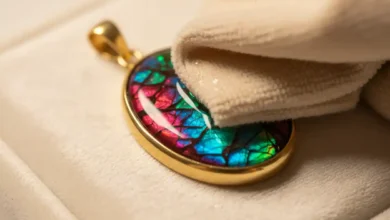

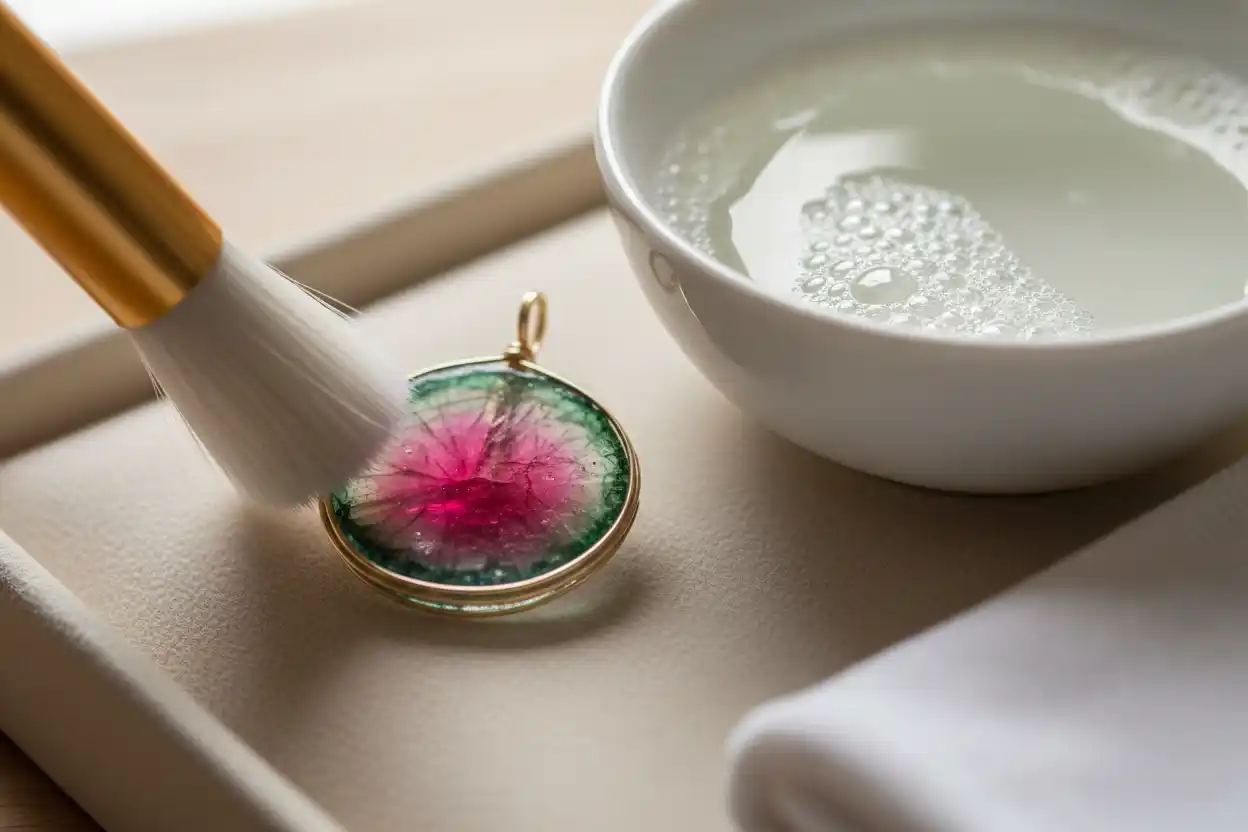

Watermelon Tourmaline jewelry should be cleaned with lukewarm water, mild liquid soap, and a soft-bristled brush or cloth. Ultrasonic and steam cleaners should never be used because Tourmaline may contain liquid inclusions, partially healed fractures, internal stress, thin color-zoned slices, or surface-reaching fissures.
Watermelon Tourmaline is often cut differently from single-color Tourmaline. Thin transverse slices, polished crystal sections, beads, cabochons, and asymmetrical stones can have exposed natural edges and large surface areas that require especially gentle handling.
What Makes Tourmaline “Watermelon”
Watermelon Tourmaline displays pink or red color through the center of a crystal and green around the outside, resembling the flesh and rind of a watermelon.
Its geology, zoning, sources, and symbolic associations belong to the broader Watermelon Tourmaline guide.
The larger mineral group appears in the Tourmaline guide and Types of Tourmaline.
Watermelon zoning can appear concentrically across a slice, longitudinally along a crystal, or in more complex patterns. Some stones include colorless, yellow, white, or darker intermediary bands.
| Property | Cleaning implication |
|---|---|
| Mineral group | Tourmaline |
| Common species | Elbaite or liddicoatite-related material |
| Typical zoning | Pink or red center with a green outer zone |
| Mohs hardness | Approximately 7 to 7.5 |
| Toughness | Fair |
| Cleavage | Indistinct |
| Common cuts | Crystal slices, cabochons, beads, carvings, and faceted gems |
| Safest cleaning method | Lukewarm water, mild soap, and a soft brush |
| Ultrasonic cleaning | Never recommended |
| Steam cleaning | Never recommended |
| Main risks | Liquid inclusions, fractures, thin slices, natural edges, glue, heat, and thermal shock |
The gemstone hardness chart explains Tourmaline’s resistance to ordinary scratches.
However, Watermelon Tourmaline’s cutting style can make it more vulnerable than a compact faceted stone of the same hardness. The distinction between surface hardness and breakage resistance appears in Gemstone Toughness vs Hardness.
Color Zoning Is Internal
The pink-and-green pattern comes from chemical changes as the Tourmaline crystal grew.
Different trace elements and changing growth conditions create zones with different colors. The pattern is not painted onto the surface of natural Watermelon Tourmaline.
Cleaning removes skin oil and residue that may obscure the zoning. It cannot sharpen a diffuse boundary, intensify weak color, or create a missing green rind.
Do not scrub the border between color zones. The boundary itself is not dirt, although structural stress or inclusions may occur near growth transitions.
Why Slices Need Special Care
Designers commonly cut Watermelon Tourmaline across the crystal to display its concentric color pattern.
A slice may be thin, broad, asymmetrical, and partly surrounded by the original crystal surface. Some pieces retain natural edges or only partial polishing.
Thin slices flex less than metal but can fracture if twisted, bent, dropped, or pressed unevenly.
Drilled holes and glued bails create concentrated stress points. Therefore, hold the jewel by its setting or metal fitting rather than gripping the slice.
Do not stack or press heavy jewelry on top of a Watermelon Tourmaline pendant.
Internal Fractures May Create Optical Effects
Watermelon Tourmaline may contain partially healed fractures, stress patterns, tubes, liquid inclusions, feathers, and other internal features.
In some unusual slices, subtle fractures create an iris effect that produces rainbow colors under light.
These fractures are part of the optical phenomenon, but they also make ultrasonic vibration and heat particularly inappropriate.
Do not try to clean a rainbow fracture by forcing liquid or a brush into it. The effect comes from internal light interference rather than removable contamination.
Heat and Irradiation Treatments
Tourmaline may be heated or irradiated to alter color.
Heat treatment can lighten dark material or reduce unwanted color components. Irradiation may create or strengthen pink, red, yellow, or related zones.
Heat-induced changes are generally stable. However, irradiated colors may fade after exposure to high heat or bright light in some stones.
Routine lukewarm cleaning remains safe, but Watermelon Tourmaline should be protected from repair torches, hot lamps, steam, and prolonged intense exposure.
The broader enhancement framework belongs to Gemstone Treatments Explained.
Check for Assembled or Imitation Material
Natural Watermelon Tourmaline can be imitated by layered glass, assembled colored components, resin, dyed quartz, coated material, or joined sections.
A visible adhesive seam, bubbles, peeling surface color, unusually perfect zoning, or a plastic-like natural edge may justify professional examination.
Some genuine slices are glued into metal frames or fitted with glued bails. The adhesive—not the Tourmaline—then becomes the cleaning limit.
Do not use acetone, alcohol, heat, acid, or scratching to test identity. These methods can damage natural and assembled jewelry.
Inspect the Jewel Before Cleaning
Examine the stone beneath bright, indirect light.
Look for open fractures, chipped natural edges, damaged drill holes, movement in the setting, cloudy glue, loose bails, peeling coatings, missing accent stones, and bent metal.
Check thin areas where the pink center meets the green rind. These regions may contain internal stress or fissures.
A natural rough edge may be irregular without being damaged. However, a newly sharp flake, widening fissure, or powdery section requires professional inspection.
Do not wash a loose, cracked, flexing, or visibly unstable slice.
Prepare a Padded Cleaning Area
Place a thick folded towel beneath the jewel.
Fill a shallow bowl with lukewarm water and add a few drops of mild liquid dish soap.
Prepare a second bowl of clean water at approximately the same temperature.
Use a soft toothbrush, fine jewelry brush, makeup brush, or lint-free cloth. Thin slices and natural edges need particularly light pressure.
Do not clean directly over an uncovered sink.
Clean Watermelon Tourmaline Briefly
Hold the jewel by its setting, frame, or metal bail.
Dampen the brush or cloth with the mild solution. Clean the polished faces, natural edge, bezel, prongs, drill holes, gallery, and metal fittings gently.
Do not flex the slice while supporting one end.
Avoid pressing on an internal fracture or color-zone boundary. Likewise, do not insert pins into drill holes or fissures.
A brief cleaning is sufficient. Prolonged soaking may affect glue, filler, coatings, stringing, repairs, or plated metal.
Rinse and Dry Without Stress
Rinse a securely mounted stone briefly in clean lukewarm water or remove soap using a second damp cloth.
Keep the rinse close to the wash temperature.
Blot the jewel while it rests flat on a padded surface. Do not hold a thin slice by one corner and shake it dry.
Allow hidden moisture around drill holes and glued bails to evaporate naturally.
Do not use a hair dryer, radiator, steam jet, hot lamp, or direct concentrated sunlight.
Never Use an Ultrasonic Cleaner
Watermelon Tourmaline should never enter an ultrasonic cleaner.
Vibration may enlarge fractures, stress thin slices, loosen glued bails, damage drill holes, or dislodge the stone from its frame.
The machine may also warm its solution, adding thermal stress to liquid inclusions and internal fractures.
The wider equipment restriction belongs to Which Gemstones Can Go in an Ultrasonic Cleaner?.
Never Steam Clean Watermelon Tourmaline
Steam combines concentrated heat, pressure, and rapid temperature change.
These conditions may fracture the Tourmaline, fade treatment-sensitive color, soften glue, damage filler, and affect solder, plating, enamel, or companion gems.
Lukewarm manual cleaning removes ordinary residue without these risks.
Cleaning a Watermelon Tourmaline Ring
A Watermelon Tourmaline ring faces more impact than earrings or pendants.
Faceted stones and compact cabochons are generally more practical than broad, thin slices in an exposed ring.
Clean beneath the gemstone without pressing on its crown, girdle, or natural edge.
Remove the ring before household cleaning, gardening, exercise, swimming, bathing, and heavy manual work.
Cleaning Watermelon Tourmaline Earrings
Watermelon Tourmaline earrings may use matched slices, beads, faceted drops, glued bails, hooks, posts, or frames.
Support each earring by its fitting while cleaning.
Keep alcohol-based disinfectant on compatible posts or hooks and away from the Tourmaline, glue, coating, filler, and plating.
Store the pair separately so metal posts and hooks cannot strike the slices.
Cleaning a Watermelon Tourmaline Necklace
A Watermelon Tourmaline necklace or pendant is one of the most common formats for displaying a full color-zoned slice.
Apply perfume, sunscreen, lotion, and hairspray before wearing the necklace.
Prevent the chain from rubbing across a natural edge or polished face.
Support a large slice by its frame or bail. Do not lift the complete necklace by the stone.
Cleaning a Watermelon Tourmaline Bracelet
A Watermelon Tourmaline bracelet combines fragile color-zoned components with repeated wrist movement.
Inspect every stone, bead hole, frame, link, knot, elastic section, hinge, and clasp before cleaning.
Support the bracelet flat and wipe each gemstone individually.
Remove it before desk work, exercise, cleaning, travel handling, and activities that repeatedly strike the wrist.
Watermelon Tourmaline Versus Rubellite
Rubellite generally describes saturated red-to-raspberry Tourmaline without requiring the green outer zone associated with Watermelon material.
Its individual profile belongs to the Rubellite guide.
The dedicated physical-care workflow appears in How to Clean Rubellite Jewelry Safely.
Both require lukewarm manual cleaning and protection from heat, ultrasound, and steam.
Watermelon Tourmaline Versus Paraíba
Paraíba Tourmaline is copper bearing and valued for vivid blue-to-green colors rather than concentric pink-and-green zoning.
Its material profile belongs to the Paraiba Tourmaline guide.
The dedicated physical-care page is How to Clean Paraiba Tourmaline Jewelry Safely.
Fine examples of both varieties can contain important fractures and inclusions, so high value never justifies aggressive cleaning.
Family-Wide Tourmaline Care
The tracker’s general How to Clean Tourmaline Jewelry Safely page owns care principles shared across green, pink, blue, black, Rubellite, Indicolite, Paraíba, and Dravite material.
This page remains focused on transverse slices, concentric color zoning, natural crystal edges, thin sections, glued bails, and structural features crossing color boundaries.
Family-wide jewelry considerations appear in the Tourmaline ring guide, Tourmaline earrings guide, and Tourmaline necklace guide.
Buying, Price, and Documentation
The Watermelon Tourmaline buying guide covers color symmetry, rind thickness, pink center, clarity, cut, natural edges, fractures, treatment, construction, and setting quality.
Market factors belong to the Watermelon Tourmaline price guide.
The wider purchase framework appears in the Tourmaline buying guide and Tourmaline price guide.
A laboratory can identify Tourmaline and may disclose certain treatments, although it does not grade beauty or color-zone symmetry.
The gemstone certification guide and How to Read a Gem Lab Report explain laboratory documents.
Tourmaline is one of October’s recognized birthstones, covered in the October birthstone guide.
Frequently Asked Questions
1. What is the safest way to clean Watermelon Tourmaline?
Use lukewarm water, mild liquid soap, and a soft brush or cloth, then rinse briefly and dry it flat.
2. Can Watermelon Tourmaline get wet?
Brief washing is normally safe for a sound stone. Avoid soaking slices with glue, fractures, drilled edges, coatings, or delicate settings.
3. Can Watermelon Tourmaline go in an ultrasonic cleaner?
No. Vibration may damage fractures, liquid inclusions, thin slices, drill holes, and glued bails.
4. Can Watermelon Tourmaline be steam cleaned?
No. Steam introduces heat, pressure, and thermal shock that may fracture the gem or alter treatment-sensitive color.
5. Is the pink-and-green zoning natural?
It can be natural and forms as the Tourmaline crystal’s chemistry changes during growth. Imitations and assembled products also exist.
6. Why is Watermelon Tourmaline often cut in slices?
A transverse slice displays the pink center and green outer zone clearly.
7. Is dish soap safe for Watermelon Tourmaline?
A few drops of mild liquid dish soap are suitable. Avoid bleach, abrasives, acids, and aggressive degreasers.
8. Can toothpaste polish a Tourmaline slice?
No. Toothpaste may scratch metal, wear natural edges, and leave residue in fractures or drill holes.
9. Why does my slice show rainbow colors?
Some pieces display an iris effect created by subtle internal fractures interacting with light.
10. Can a chipped natural edge be repaired at home?
No. Reshaping or repolishing a thin slice requires an experienced lapidary and may change its outline and weight.
11. How often should Watermelon Tourmaline jewelry be cleaned?
Wipe it after wear and wash it when oils or cosmetics visibly obscure its zoning or polish.
12. When should it receive professional care?
Professional attention is appropriate for open fractures, flexing slices, damaged drill holes, cloudy glue, loose settings, valuable matched pieces, or unexplained color change.
Conclusion
Watermelon Tourmaline’s appeal comes from natural color zoning displayed across cuts that are often thin and structurally exposed. Lukewarm manual cleaning preserves that pattern without placing fractures, liquid inclusions, drill holes, or glued bails under vibration and heat. When a slice shows rainbow flashes or complex internal lines, those features should be treated as part of the stone—not scrubbed as residue.