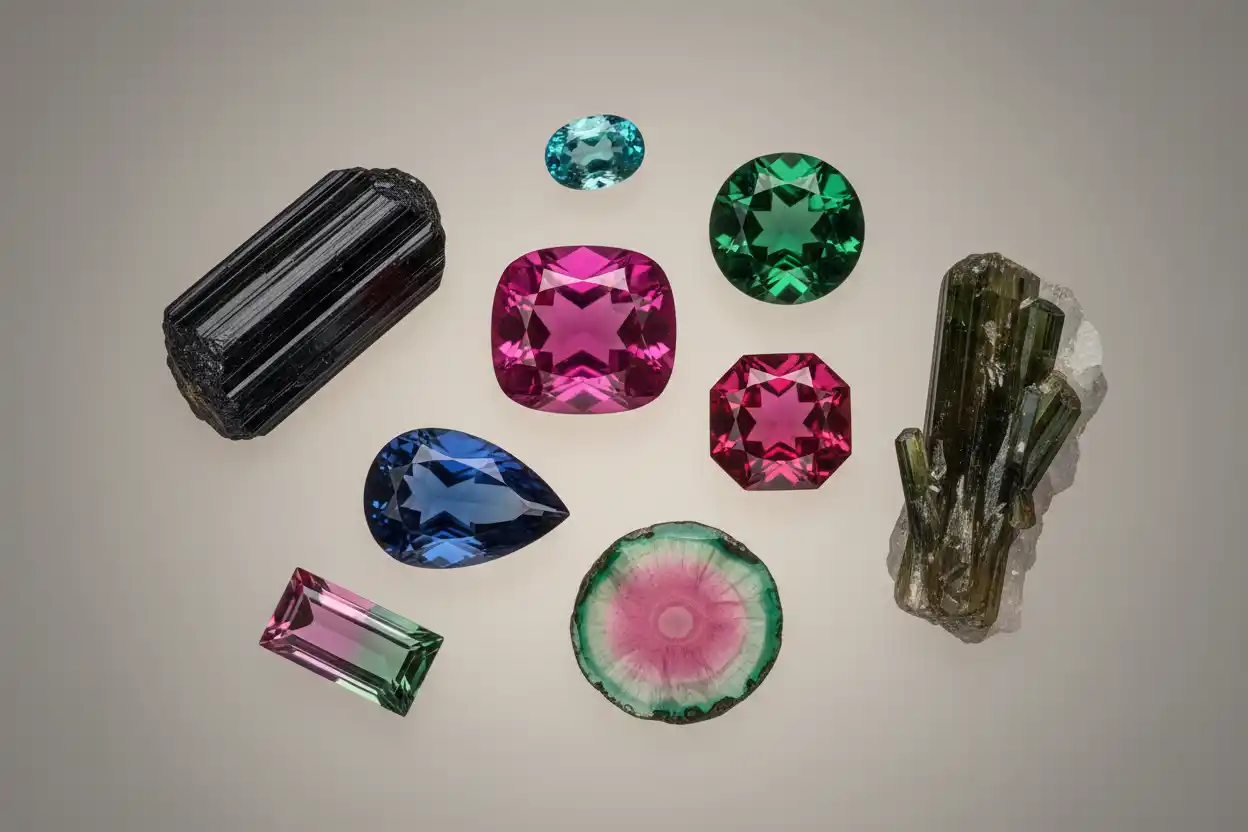
Types of Tourmaline: Colors and Varieties Explained
Tourmaline is not one mineral with a fixed composition. It is a chemically complex mineral group whose members share the same basic crystal structure but can differ enough in chemistry to form distinct species, colors, zoning patterns and optical effects.
This guide classifies the major tourmaline species and trade varieties without duplicating the broader history and symbolism covered in the tourmaline meaning guide.
Tourmaline at a Glance
| Property | Tourmaline |
|---|---|
| Mineral group | Tourmaline supergroup |
| General composition | Complex borosilicates containing variable sodium, calcium, lithium, magnesium, iron, aluminum, manganese, chromium, vanadium, copper, fluorine and hydroxyl |
| Important gem species | Elbaite, fluor-liddicoatite, dravite, uvite and schorl |
| Crystal system | Trigonal |
| Typical colors | Colorless, pink, red, orange, yellow, green, blue, violet, brown, black and multicolored |
| Crystal habit | Long, vertically striated prisms, commonly with triangular or rounded triangular cross-sections |
| Luster | Vitreous |
| Transparency | Transparent to opaque |
| Refractive index | Commonly about 1.624–1.644 in gem material |
| Birefringence | Commonly about 0.018–0.040 |
| Specific gravity | Usually about 3.00–3.26, depending on species and composition |
| Mohs hardness | 7–7.5 |
| Cleavage | Poor to indistinct |
| Tenacity | Brittle; overall toughness generally fair |
| Common cuts | Ovals, cushions, emerald cuts, elongated rectangles, cabochons and polished crystal slices |
| Main care concern | Internal tubes and liquid inclusions can make some stones vulnerable to heat and thermal shock |
What Counts as a Type of Tourmaline?
Tourmaline names fall into several different categories. Mineralogists classify members of the group as species according to chemistry, while gem dealers commonly classify transparent material by color, optical effect or color zoning.
Consequently, elbaite and dravite are mineral species, whereas rubellite and indicolite are gem-trade color names. Watermelon tourmaline describes a zoning pattern, and Paraíba identifies copper-bearing tourmaline with a characteristic blue-to-green appearance rather than a separate mineral species.
This distinction matters because the broad types of gemstones guide classifies materials at a higher level, while this page owns the more specific question of how tourmaline itself is divided.
Tourmaline Mineral Species
Elbaite
Elbaite produces most of the transparent, brightly colored tourmaline used in fine jewelry. Its lithium-bearing chemistry accommodates numerous trace elements and color centers, allowing it to appear colorless, yellow, green, blue, pink, red or multicolored.
Rubellite, indicolite, achroite and many green, pink and parti-colored tourmalines are usually elbaite. Nevertheless, color alone cannot always establish species because visually similar colors can occur in other members of the group.
Fluor-Liddicoatite
Fluor-liddicoatite is a calcium- and lithium-bearing tourmaline species closely related to elbaite. It is particularly associated with Madagascar, where crystals can show complex triangular, concentric or sector-shaped zoning.
The material may be pink, red, green, brown, blue or multicolored. Polished cross-sections are especially collectible because they preserve patterns that would be lost in a conventionally faceted stone.
Older publications and sales descriptions may call the material simply liddicoatite. Modern mineralogical classification separates fluor-liddicoatite according to the dominant anion at a specific structural site.
Dravite
Dravite is a magnesium-rich tourmaline that commonly appears brown, yellow-brown, dark orange or nearly black. Although much dravite is too dark for faceting, lighter transparent crystals can produce attractive cognac, golden-brown and reddish-brown gems.
Some vivid green tourmalines from East Africa also belong to dravite-dominant or mixed dravite-uvite compositions. Therefore, the term dravite describes chemistry rather than one mandatory brown color.
Uvite
Uvite is a calcium- and magnesium-rich species associated with metamorphosed carbonate rocks, skarns and related geological environments. It can occur in brown, reddish-brown, green, dark green and nearly black crystals.
Transparent green uvite may resemble chrome tourmaline, while darker crystals often enter mineral collections rather than jewelry production. Laboratory testing may be necessary to distinguish uvite from dravite because the two form compositional relationships.
Schorl
Schorl is iron-rich and usually black, opaque and highly abundant compared with gem elbaite. In the retail crystal market it is generally sold under the familiar name black tourmaline.
Most schorl becomes polished points, beads, cabochons, carvings or mineral specimens rather than transparent faceted gems. A brown or bluish cast may appear along thin edges, but the bulk stone normally remains black.
Tourmaline Color Varieties and Trade Names
Colorless Tourmaline: Achroite
Achroite is the traditional trade name for colorless or nearly colorless tourmaline, generally elbaite. The name comes from a term meaning “without color,” but it is not a mineral species.
Truly colorless tourmaline is uncommon because even minor trace elements or color centers tend to impart some tint. It may resemble colorless beryl, topaz or quartz, although refractive-index and birefringence testing separate these materials.
Pink Tourmaline
Pink tourmaline ranges from delicate blush and peach-pink to hot magenta. Manganese and radiation-related color centers can contribute to its appearance, while the depth of color often varies within a single crystal.
The name is a broad color description rather than a strict variety definition. The dedicated pink tourmaline guide retains the material’s symbolism and use-focused intent.
Pink tourmaline commonly contains more visible inclusions than many blue or green stones. Fine specimens can still be valuable when their color is attractive and the inclusions do not threaten durability.
Rubellite
Rubellite refers to strongly saturated pinkish-red, red, purplish-red or raspberry-colored tourmaline. Although sellers sometimes apply the word to any pink tourmaline, stricter trade usage reserves it for colors that remain rich and red under different lighting conditions.
Rubellite is usually elbaite and frequently contains healed fractures, fluid inclusions and growth tubes. Fine color often matters more than flawless clarity, provided the stone remains structurally sound.
Red Tourmaline
Red tourmaline is a literal color description that may overlap with rubellite. However, not every red or reddish tourmaline qualifies as fine rubellite in stricter commercial usage.
Stones with weak saturation, strong brown modifiers or a noticeable shift toward ordinary pink may be sold more accurately as red tourmaline, reddish-pink tourmaline or pink tourmaline.
Orange and Peach Tourmaline
Orange, peach, salmon and apricot tourmalines are normally classified by descriptive color terms. Some derive their appearance from manganese-related coloration, while others occupy transitional ranges between pink, yellow and brown.
Names such as sunset tourmaline, papaya tourmaline and mandarin tourmaline are promotional descriptions rather than standardized tourmaline varieties. Buyers should judge the actual hue, saturation and treatment disclosure rather than relying on an evocative label.
Yellow and Canary Tourmaline
Yellow tourmaline ranges from pale lemon to golden yellow and yellowish-orange. The brightest material is sometimes sold as canary tourmaline, particularly when it shows strong saturation without a muddy brown component.
Canary is a trade color name, not a mineral species. Yellow stones may be elbaite, dravite or another composition, and laboratory analysis is required when exact species matters.
Green Tourmaline and Verdelite
Green is one of tourmaline’s broadest color families. It includes pale mint, yellowish-green, forest green, bluish-green and very dark stones that appear almost black when viewed along the crystal’s length.
The traditional name verdelite is used for green gem tourmaline, especially green elbaite. The separate verdelite guide addresses that name in greater depth.
However, many dealers simply use green tourmaline because verdelite has no universally enforced color boundary. A stone’s tone and pleochroism are more useful buying information than the presence or absence of the trade name.
Chrome Tourmaline
Chrome tourmaline is intensely saturated green tourmaline colored primarily by vanadium, often with chromium also present. Despite the commercial name, vanadium can contribute more strongly to the color than chromium.
Most fine chrome tourmaline comes from East Africa, particularly Tanzania and Kenya. The material is commonly associated with dravite-uvite chemistry rather than elbaite.
Chrome tourmaline usually occurs in relatively small sizes and may become very dark if the rough is not oriented carefully. Its name should not be applied to every rich green tourmaline; laboratory spectroscopy or chemical analysis is needed to confirm chromium- or vanadium-related coloration.
Mint, Lagoon and Teal Tourmaline
Mint, lagoon and teal are modern color descriptors used for pale green, blue-green or mixed blue-and-green stones. They can communicate appearance effectively, but they do not define mineral species, geographic origin or copper content.
In particular, the word lagoon should never be treated as proof that a stone is Paraíba-type tourmaline. A vivid blue-green appearance can result from iron, copper or a combination of color causes.
Blue Tourmaline and Indicolite
Indicolite is the traditional name for blue, violetish-blue or greenish-blue tourmaline. Fine examples can show exceptional saturation, although many are dark because tourmaline absorbs light strongly along certain crystallographic directions.
Cutters must orient indicolite carefully to preserve blue color without allowing an overly dark optical axis to dominate the finished gem. Teal stones occupy the boundary between blue and green and may be sold either as indicolite or blue-green tourmaline.
Paraíba Tourmaline
Paraíba tourmaline is copper-bearing tourmaline prized for vivid blue, greenish-blue, turquoise-blue, violet-blue and neon green colors. Manganese may also influence its color.
The name originated with discoveries in Brazil’s Paraíba region. Copper-bearing tourmaline was subsequently found in Rio Grande do Norte, Nigeria and Mozambique, and modern laboratory reports may use Paraíba terminology while separately stating the geographic origin when it can be determined.
Not every bright blue tourmaline is Paraíba-type material. Copper must be confirmed through chemical testing, and origin claims should come from an independent gemological laboratory rather than color alone.
Terms such as African Paraíba or Mozambique Paraíba should not conceal origin. Fine Brazilian material can receive an exceptional provenance premium, but color, saturation, size, clarity and laboratory documentation remain critical.
Violet and Purple Tourmaline
Purple, violet, lavender and grape-colored tourmalines are usually elbaite, including some copper-bearing material. Depending on composition and treatment, heat can reduce a red or violet component and shift certain copper-bearing stones toward blue or green.
Commercial names such as grape tourmaline are descriptive rather than formal. Buyers should also note whether a purple stone has been irradiated, because some irradiation-induced colors can be less stable under heat or prolonged bright light.
Brown Tourmaline
Brown tourmaline commonly belongs to dravite or uvite, although brown elbaite also exists. Colors range from pale champagne and cinnamon to dark coffee brown.
Champagne, cognac and chocolate tourmaline are retail color descriptions. They do not prove a particular species, locality or treatment status.
Black Tourmaline
Most black tourmaline sold in the crystal market is schorl. It may show vertical striations, triangular cross-sections and natural surface corrosion that help distinguish genuine crystals from molded glass or resin.
Because black tourmaline is abundant, ordinary material is inexpensive. Unusually large, complete crystals, aesthetic matrix specimens or polished material with exceptional finish may command more.
Buyers seeking rough or polished material can use the dedicated guide to finding real black tourmaline rather than assuming every black prismatic object is natural schorl.
Multicolored and Zoned Tourmaline
Parti-Colored Tourmaline
Parti-colored tourmaline shows two or more visible colors within one crystal. The zones can run from one end to the other, form concentric layers or create complex geometric sectors.
Pink-and-green combinations are familiar, although blue-green, yellow-green, red-green and three-color stones also occur. Parti-colored is a structural appearance, not a species.
Bi-Color Tourmaline
Bi-color tourmaline contains two dominant color zones. Cutters often use emerald, rectangular or custom fantasy cuts that place the color boundary in an intentional position.
A clean, sharply divided stone with two attractive colors generally commands more than rough-looking material with a muddy transition. Nevertheless, some buyers prefer gradual color blending rather than a strict line.
Tri-Color Tourmaline
Tri-color tourmaline displays three major color zones. Green, colorless and pink combinations are common enough to be recognized, although many other arrangements occur.
The value depends on the attractiveness and balance of the complete pattern, not merely the number of colors. Poorly positioned zoning can make one side of a faceted stone appear dark or visually disconnected.
Watermelon Tourmaline
Watermelon tourmaline has a pink or red center surrounded by a pale or colorless transition and a green outer zone. The name refers to the visual resemblance to a watermelon slice.
The classic pattern is best displayed in thin cross-sectional slices cut perpendicular to the crystal’s length. Faceted stones can also show watermelon zoning, although cutting may remove part of the green rind or distort the original arrangement.
Not every pink-and-green tourmaline is watermelon tourmaline. Longitudinal stones with pink at one end and green at the other are more accurately called bi-color or parti-colored tourmaline.
Optical and Structural Types
Cat’s-Eye Tourmaline
Cat’s-eye tourmaline displays chatoyancy caused by aligned hollow growth tubes or other parallel inclusions. A cutter must orient the base of the cabochon parallel to these features so that a moving band of light crosses the dome.
Green, blue, pink and brown cat’s-eye tourmalines occur. The eye is often broader and softer than the sharply defined line seen in fine chrysoberyl because tourmaline’s tubes are comparatively large.
Color-Change Tourmaline
Rare tourmaline changes apparent color under different light sources. A stone may shift between green, brown, red, violet or related combinations depending on its absorption spectrum and the illumination.
Ordinary pleochroism should not be confused with true color change. Pleochroism appears when the stone is viewed from different directions, whereas color change occurs when the light source changes.
Pleochroic Tourmaline
Nearly all transparent tourmaline shows some degree of pleochroism. One direction may appear lighter or differently colored, while the direction along the crystal’s length can be much darker.
Although pleochroism is an optical property rather than a market variety, it strongly affects cutting. An incorrectly oriented dark green or blue crystal can produce a nearly black finished stone.
Formation and Geological Environments
Most colorful gem elbaite crystallizes in late-stage granitic pegmatites. As magma evolves, unusual elements such as boron, lithium, fluorine, manganese and cesium become concentrated in residual fluids that enter fractures and cavities.
These chemically enriched fluids can grow large tourmaline crystals beside quartz, feldspar, mica, spodumene, beryl and phosphate minerals. Changes in fluid chemistry during growth create the vivid color zones seen in watermelon and parti-colored crystals.
Dravite, uvite and chrome-bearing tourmalines more often form in metamorphic rocks, skarns and altered carbonate-rich environments. Schorl is widespread in granites, pegmatites and metamorphic rocks and is far more common than transparent gem material.
Tourmaline’s resistance to weathering also allows crystals and broken fragments to survive in alluvial deposits. Consequently, some gems are recovered from river gravels after erosion releases them from their original host rocks.
Important Tourmaline Sources
Brazil remains one of the most important sources, particularly Minas Gerais for elbaite and the northeastern states of Paraíba and Rio Grande do Norte for copper-bearing material. The Cruzeiro region is especially associated with pink, green and multicolored crystals.
Mozambique supplies significant quantities of copper-bearing blue-to-green tourmaline, rubellite and other colors. Nigeria has also produced copper-bearing material as well as pink, red and green stones.
Madagascar is known for exceptionally complex fluor-liddicoatite zoning, rubellite and multicolored tourmaline. Meanwhile, Afghanistan and Pakistan produce fine pink, green, blue and bi-color crystals from mountainous pegmatites.
Tanzania and Kenya are major sources of chrome tourmaline and other dravite-uvite material. Namibia has produced attractive blue-green indicolite, while Sri Lanka yields tourmaline from alluvial gem gravels.
Historically important United States localities include Maine and California. Their production is limited compared with major modern sources, but fine crystals retain strong collector interest.
Inclusions and Internal Features
Tourmaline commonly grows in fluid-rich environments, so liquid inclusions, gas bubbles and tiny solid phases may become trapped inside the crystal. Threadlike or branching fluid inclusions are sometimes called trichites.
Long hollow growth tubes can run parallel to the crystal’s length. These tubes may reduce transparency, create cat’s-eye effects or collect polishing compounds when they reach the surface.
Other internal features include partially healed fractures, feathers, negative crystals, color zoning, strain patterns and mineral inclusions such as feldspar, mica, quartz, zircon, apatite or lepidolite. Their identity can sometimes provide clues about the geological environment.
Inclusions are more accepted in rubellite, Paraíba and parti-colored stones than in ordinary green tourmaline because vivid color and rarity can outweigh perfect clarity. However, surface-reaching fractures still require careful inspection for durability and filling.
Identifying Tourmaline and Its Lookalikes
A gemologist combines refractive index, birefringence, pleochroism, specific gravity, spectroscopy and microscopic features to identify tourmaline. Its refractive index is commonly around 1.624–1.644, while its relatively strong birefringence can produce visible facet doubling under magnification.
Rough crystals frequently show vertical striations and a three-sided or rounded triangular cross-section. These features are useful, although broken, polished or reconstructed specimens may not preserve them.
Pink tourmaline can resemble morganite, pink sapphire, spinel or kunzite. Green stones may resemble emerald, peridot, diopside, green sapphire or tsavorite, while blue tourmaline can resemble aquamarine, blue topaz or sapphire.
Paraíba-colored glass, synthetic spinel, apatite and coated stones can imitate neon blue-green tourmaline. Chemical analysis is essential for confirming copper-bearing material and should accompany high-value purchases.
General home tests are not enough for valuable stones. The gemstone identification guide explains why hardness scratching, destructive tests and color alone can create misleading results.
Treatments, Synthetics, Composites and Imitations
Heat and irradiation are the two most important color treatments encountered in tourmaline. Heating can lighten overly dark material, reduce violet or red components in some copper-bearing stones and improve the apparent blue or green color.
Heat treatment can be difficult or impossible to detect after the process. Moreover, liquid-rich stones may fracture during heating, so treaters must select rough carefully.
Irradiation may intensify pink, red or other colors by creating color centers. Some irradiation-related colors can fade under high heat or prolonged bright illumination, which makes disclosure and stability information important.
Fracture filling with oil or resin is less common than it is in emerald, but it does occur in valuable rubellite, Paraíba and bi-color material. Filled fractures may show flash effects, flattened gas bubbles or residue under magnification, while advanced laboratory methods can confirm difficult cases.
The broader gemstone treatment guide explains the difference between heating, irradiation and fracture filling without transferring that complete treatment intent to this classification page.
True laboratory-grown tourmaline exists primarily in research contexts and is not a major commercial jewelry product. Most manufactured “tourmaline” encountered in inexpensive jewelry is more likely to be colored glass, synthetic spinel or another imitation rather than chemically equivalent synthetic tourmaline. The distinction is covered further in the lab-grown versus natural gemstone guide.
Cutting and Polishing Behavior
Tourmaline crystals often grow as long prisms, so elongated rectangles, emerald cuts, baguettes and long ovals can preserve weight efficiently. Shorter rough may become cushions, rounds or custom fantasy cuts.
Pleochroism strongly influences orientation. A pale crystal may be cut with the table perpendicular to its length to deepen color, whereas a dark green or blue crystal often needs an orientation that prevents the darkest optical direction from dominating.
Watermelon material is commonly sawn across the crystal to reveal concentric zoning. By contrast, longitudinal cutting emphasizes color transitions from one end of a crystal to the other.
Tourmaline generally takes a bright polish, but open tubes, fractures and mineral inclusions can cause pits or drag during polishing. Sudden heat from a dry grinding wheel can also extend fractures.
Durability and Jewelry Suitability
Tourmaline’s Mohs hardness of 7–7.5 provides useful scratch resistance, as shown in the broader gemstone hardness chart. Nevertheless, its toughness is only fair, and included stones may chip or fracture when struck.
Transparent tourmaline works well in earrings, pendants and necklaces. Rings are also practical when the stone has good structural integrity and a protective setting; the dedicated tourmaline ring guide covers setting and style considerations in greater detail.
Long corners on emerald cuts and thin ends on pear shapes are vulnerable. Bezels, partial bezels and substantial prongs can protect these areas better than very exposed settings.
Opaque schorl is suitable for beads and pendants, although brittle crystal terminations can chip. Watermelon slices also require care because thin sections may break across natural growth zones or fractures.
Tourmaline Prices in 2026
Tourmaline pricing spans one of the widest ranges in the colored-stone market. Commercial black schorl, included cabochons and small pale faceted stones may cost only a few dollars to several tens of dollars per carat.
Attractive green, pink, yellow and bi-color stones commonly retail around $30–$300 per carat. Fine clean stones with vivid color can reach approximately $300–$1,000 per carat, especially when the cut and size are desirable.
Fine rubellite, indicolite and chrome tourmaline may range from roughly $200 to more than $1,500 per carat. Exceptional stones can exceed those figures substantially, particularly when they combine strong saturation, good clarity and sizes rarely seen in the variety.
Watermelon slices and cabochons may sell from about $20 to $300 per carat, while sharply zoned, well-polished collector material can rise higher. The dedicated watermelon tourmaline price guide covers its separate value factors.
Paraíba-type tourmaline occupies a different market. Lower-saturation or strongly green stones may begin around several thousand dollars per carat, while vivid blue, clean, well-documented material can reach tens of thousands of dollars per carat. Exceptional Brazilian stones and important auction gems can achieve far more.
Because those values change dramatically with origin and quality, consult the dedicated Paraíba tourmaline price guide, rubellite price guide and indicolite price guide rather than applying one average to every variety.
The broader tourmaline price guide retains the complete pricing intent for the family.
Practical Buying Guidance
Begin by identifying what the seller’s name actually describes. Elbaite is a species, rubellite is a color variety, watermelon is a zoning pattern and Paraíba requires copper-bearing chemistry.
Color should appear attractive under daylight-equivalent and indoor lighting. Tourmaline can show strong pleochroism, so rotate a loose stone to check for blacked-out areas, weak color zones or an unattractive change in tone.
Inspect the stone from several directions under magnification. Surface-reaching fractures, open growth tubes and cavities can affect durability even when the face-up appearance looks clean.
A report from an established gemological laboratory is particularly valuable for Paraíba, fine rubellite, important indicolite and stones claimed to have a prestigious origin. The report should identify the material, disclose detectable treatments and, where possible, provide an origin opinion.
The general tourmaline buying guide covers seller evaluation and documentation. High-value copper-bearing stones deserve the additional checks in the Paraíba buying guide, while zoned material requires the pattern-specific assessment explained in the watermelon tourmaline buying guide.
Cleaning, Water, Heat, Sunlight and Storage
Clean durable tourmaline briefly with lukewarm water, mild soap and a soft brush. Rinse without abrupt temperature changes and dry with a lint-free cloth.
Ultrasonic and steam cleaners are not recommended because liquid inclusions, filled fractures and thermal shock can cause damage. The complete procedure appears in the tourmaline jewelry cleaning guide.
Tourmaline tolerates brief contact with clean water, but long soaking is unnecessary, particularly for fracture-filled stones, glued jewelry or porous matrix specimens. Avoid acids, harsh cleaners and strong solvents.
Most natural colors remain stable in ordinary light. However, some irradiation-induced colors may fade after prolonged bright-light exposure, and high heat can alter color or extend fractures.
Store each piece separately from harder gemstones. Cushion thin watermelon slices, protect crystal terminations and prevent faceted stones from rubbing against one another.
Meaning and Symbolism
Tourmaline has accumulated different symbolic associations across cultures, historical periods and modern spiritual practices. Its broad range of colors has encouraged people to connect individual varieties with protection, affection, creativity, confidence or personal balance.
These interpretations are cultural, traditional or personal rather than scientifically established effects. The tourmaline color meaning guide examines those associations separately so that mineral classification remains distinct from belief-based interpretation.
Tourmaline is also recognized as an October birthstone, although birthstone customs vary among traditions and organizations.
Frequently Asked Questions
1. Is tourmaline one mineral or a mineral group?
Tourmaline is a mineral group containing numerous species with a shared structure but different chemical compositions. Elbaite, dravite, uvite, fluor-liddicoatite and schorl are among the members most relevant to gems and collections.
2. Which tourmaline species produces the most gem-quality colors?
Elbaite produces most transparent pink, red, green, blue, colorless and multicolored gem tourmaline. However, dravite, uvite and fluor-liddicoatite can also produce attractive facetable material.
3. Is Paraíba tourmaline a color or a geographic origin?
The name began as a geographic reference to copper-bearing tourmaline from Paraíba, Brazil. Modern trade and laboratory usage can also encompass copper-bearing material from Nigeria and Mozambique, with geographic origin stated separately when it can be determined.
4. Is rubellite the same as pink tourmaline?
Rubellite is a strongly saturated red, purplish-red or rich pinkish-red tourmaline. Ordinary light pink stones are generally called pink tourmaline rather than rubellite, although sellers do not always apply the boundary consistently.
5. What is chrome tourmaline?
Chrome tourmaline is intensely green tourmaline colored by chromium and, often more importantly, vanadium. It is commonly associated with dravite-uvite material from East Africa.
6. Is watermelon tourmaline a separate mineral species?
No. Watermelon tourmaline is usually elbaite with concentric pink, pale and green color zoning that resembles a sliced watermelon.
7. What causes the cat’s-eye effect in tourmaline?
Aligned hollow growth tubes or other parallel inclusions reflect light as a moving band across a correctly oriented cabochon. The eye is commonly broader than the line in fine cat’s-eye chrysoberyl.
8. Is black tourmaline always schorl?
Most commercial black tourmaline is schorl, but very dark dravite, uvite and other tourmaline compositions can also appear black. Exact species identification may require chemical analysis.
9. Is heat-treated tourmaline still natural?
Yes. A heated stone remains natural tourmaline, but the treatment should be disclosed because it altered the color or appearance.
10. Can tourmaline fade in sunlight?
Most natural colors remain stable during ordinary wear. Nevertheless, some irradiation-induced colors can fade after prolonged exposure to bright light or heat.
11. How can a buyer confirm genuine Paraíba tourmaline?
Color is not enough. An established laboratory should confirm copper-bearing tourmaline chemistry and, for important stones, provide an opinion on geographic origin when sufficient evidence exists.
12. Which type of tourmaline is best for an everyday ring?
A well-cut green, blue or pink tourmaline with limited surface-reaching inclusions can work in a protected ring setting. Thin slices, heavily included stones and brittle crystal specimens are better reserved for lower-impact jewelry.
The diversity of tourmaline comes from chemistry, crystal growth and geological setting rather than color names alone. Understanding whether a label identifies a mineral species, optical effect, locality or commercial description makes it far easier to compare stones fairly and recognize when a rare name is being used without supporting evidence.
For alphabetical navigation, tourmaline appears in both Crystals That Start With T and Gemstones That Start With T.