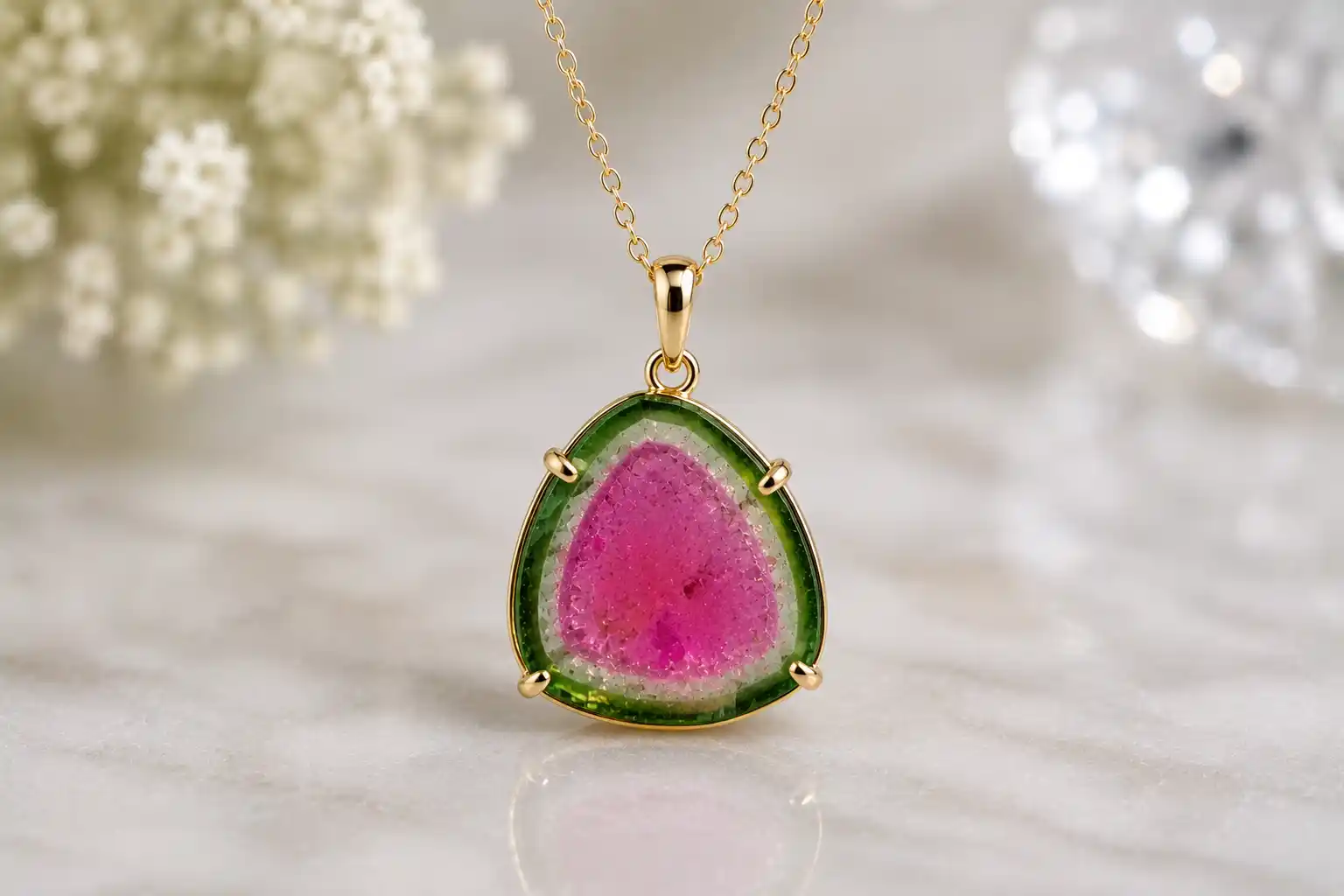
Watermelon Tourmaline Necklaces and Pendants: A Style Guide
Watermelon Tourmaline necklaces display natural pink-and-green color zoning in a format that can preserve unusually large, thin or highly patterned stones more safely than a ring or bracelet. Cross-sectional pendants may show a pink center enclosed by a green rim, while longitudinal cuts reveal parallel bands or a transition from one color at the top to another near the bottom.
A successful necklace depends on more than an attractive pattern. The slice or gemstone must be structurally sound, correctly oriented and supported by a setting, bail and chain capable of carrying its weight. Thin edges, internal fractures, drilled holes and poorly balanced pendants can turn a visually impressive piece into a fragile one.
Watermelon Tourmaline Necklaces at a Glance
| Feature | What to Consider |
|---|---|
| Gem family | Tourmaline |
| Typical composition | Usually Elbaite or related color-zoned Tourmaline |
| Defining appearance | Pink or red interior with green exterior, or pink-green bands |
| Mohs hardness | Approximately 7–7.5 |
| Toughness | Fair |
| Common necklace forms | Cross-section pendant, longitudinal pendant, bead strand, station necklace and lariat |
| Safest slice setting | Full bezel or protective frame |
| Main structural concern | Thin edges, fractures, bail attachment and pendant balance |
| Common treatments | Heating, irradiation and occasional fracture filling |
| Main imitation concerns | Colored glass, resin, dyed stone and assembled layers |
| Safest cleaning | Warm water, mild soap and a soft brush |
| Birthstone connection | October through the Tourmaline family |
What Is a Watermelon Tourmaline Necklace?
A Watermelon Tourmaline necklace contains Tourmaline whose natural growth zoning displays pink and green within one crystal.
The most recognizable pattern appears when a prismatic crystal is cut across its length. This orientation can reveal a pink center, a pale transitional zone and a green outer layer. Tourmaline crystals commonly have rounded triangular cross-sections, so authentic slices are not always circular.
Longitudinal cuts show the zoning differently. Pink and green may run side by side, appear as parallel bands or occupy opposite ends of an elongated gemstone.
The completed Watermelon Tourmaline meaning guide explains how the zoning forms. This article focuses on necklace construction, buying and wear.
Why the Necklace Format Works Well
Necklaces protect Watermelon Tourmaline from much of the impact experienced by rings and bracelets.
A pendant usually rests against the chest rather than contacting desks, tools and hard surfaces. Consequently, designers can use larger slices, thinner sections and more elaborate natural outlines than would be practical on the hand.
The gemstone can still strike counters or sinks when worn on a long chain. It may also catch in seat belts, bag straps, scarves and layered jewelry.
Short and medium lengths generally provide the strongest balance between visibility, movement and protection.
Cross-Section Slice Pendants
Cross-section slices display the classic watermelon pattern most directly.
The pink core may be centered or irregular. A pale or colorless band may separate it from a green rind, while some stones contain additional yellow, white or darker zones.
Thickness has a major effect on durability. A very thin slice may transmit light beautifully but remain vulnerable around its perimeter.
Examine the complete edge rather than viewing the pendant only from the front. One sharply tapered corner or fracture running through the thickness can create a failure point.
A protective frame is preferable to a simple drilled attachment for valuable or highly included slices.
Longitudinal Pendants
Longitudinal pieces are cut along the crystal’s growth direction.
They may display green at one end and pink at the other, or show vertical bands running beside each other. This format suits bar pendants, tablets, elongated pears, emerald cuts and custom geometric designs.
The color transition should remain visible when the pendant hangs naturally. A cap or heavy bezel should not conceal one entire zone.
Long pieces also need balanced suspension. If the bail is positioned poorly, the pendant may rotate until the less attractive side faces outward.
The stone should hang straight without twisting the chain.
Faceted Watermelon Tourmaline Pendants
Watermelon Tourmaline does not have to remain a flat slice.
Thicker bicolor rough may be faceted into ovals, cushions, pears, rectangles and custom cuts. The cutter attempts to display the zoning while controlling Tourmaline’s pleochroism and preserving enough weight.
A well-cut faceted pendant should return light across both color zones.
A large transparent window through the center reduces brilliance, while excessive depth can make green areas look nearly black.
The color boundary should appear deliberate rather than hidden beneath the setting.
The broader types of Tourmaline guide explains how Watermelon Tourmaline fits within the mineral group.
Bezel-Set Watermelon Tourmaline Pendants
A full bezel is the most protective conventional setting for a slice or cabochon.
The metal surrounds the edge, reduces snagging and absorbs some direct impact. It also hides small perimeter irregularities without requiring the stone to be ground into a perfectly standardized shape.
The bezel should follow the stone accurately. Gaps allow movement, whereas excessive pressure can extend an existing fracture.
A partial bezel or open frame reveals more of the edge but offers less continuous protection.
The setting should leave the main green perimeter visible enough that the Watermelon pattern remains clear.
Framed Slice Pendants
A frame can protect an irregular cross-section without covering the front.
Some designs use a narrow metal rim, while others suspend the slice within a larger geometric structure.
The frame should support the stone mechanically rather than relying only on glue.
Small tabs, channels or bezels need to contact sound areas instead of thin corners.
The rear structure should prevent the Tourmaline from flexing. Although the material is rigid, a thin fractured slice can fail when pressure is concentrated unevenly.
A good frame makes the stone safer without making the pendant unnecessarily heavy.
Drilled Watermelon Tourmaline Pendants
Direct drilling creates a visually simple pendant with little metal.
The hole must remain far enough from the edge to leave a substantial bridge of Tourmaline. Cracks radiating outward from the opening indicate risk.
A metal eyelet or protective tube can reduce abrasion between the stone and connecting ring.
The jump ring should be soldered or mechanically secure. Thin open rings may pull apart, especially when the slice is large.
Drilled pendants should be handled by the metal attachment rather than repeatedly pulled by the stone.
Wire-Wrapped Pendants
Wire wrapping can support irregular slices and crystals without drilling.
The wire should form a true structural cage rather than a decorative loop that can loosen.
Contact points must remain smooth and should not press against a major fracture or extremely thin edge.
Overly tight wire can chip the gemstone, while loose wrapping allows it to shift and rub.
The bail formed by the wire needs enough strength for the complete pendant weight.
High-quality wrapping should reveal the color zoning rather than obscuring it with unnecessary crossings.
Natural Crystal Pendants
Some Watermelon Tourmaline pendants preserve part of the original crystal.
A longitudinal crystal may show green outer surfaces and pink material through a polished window or broken termination.
Natural striations and three-sided growth forms can add geological character.
Crystal points deserve careful inspection because terminations may be fractured, repaired or partially stabilized.
A metal cap should fit the crystal mechanically. Adhesive alone may fail after exposure to heat, moisture or repeated movement.
Natural-form pendants should remain smooth enough not to scratch skin or catch clothing.
Watermelon Tourmaline Bead Necklaces
Bead necklaces may combine rounds, faceted beads, barrels, disks or irregular polished nuggets.
The zoning may appear as distinct pink-green sections, concentric bands or mottled multicolor areas.
Inspect the drill holes closely. Chips, pale stress marks and fractures around the openings can weaken the strand.
Natural variation is expected, but the sequence should still look intentional. A strand can graduate from green-dominant beads to pink-dominant ones or alternate distinct patterns.
The beads should have compatible polish and visible quality rather than one exceptional center surrounded by weak material.
Knotted Bead Strands
Knots between beads reduce direct impact and limit loss if the string breaks.
This construction is useful for larger, valuable or highly included beads.
The knots should remain close to the drill holes and consistent in size. Wide gaps make the strand look stretched and permit unnecessary movement.
Silk provides a flexible drape but absorbs cosmetics and moisture. Suitable synthetic cord may offer greater strength, although quality varies.
A stretched or soiled strand should be restrung before the cord fails.
Graduated Watermelon Tourmaline Necklaces
A graduated strand places larger beads, slices or faceted gems near the center.
The transition should remain smooth in size and visual weight.
Because every Watermelon Tourmaline pattern is different, perfect color matching is unrealistic. However, the pink-to-green balance should remain coherent.
One dark opaque center may dominate a necklace made from lighter translucent material.
Larger center components require stronger stringing and a clasp capable of supporting the added weight.
The necklace should curve naturally rather than forming rigid corners around the neck.
Station Necklaces
A station necklace places several individual Watermelon Tourmalines along a chain.
This design gives each slice or faceted stone visual space and uses less material than a continuous strand.
Bezel-set stations offer strong protection and help keep the stones facing outward.
Every setting needs balanced attachment points. A station connected only at one upper corner may flip or twist.
The chain sections should be proportionate to the weight of the stones.
Adjustable station necklaces are practical gifts, although the extension should not permit a large lower station to swing excessively.
Lariat and Y-Necklace Designs
A lariat or Y-necklace emphasizes vertical movement.
An elongated bicolor Tourmaline can form the lower drop, while smaller pink, green or Watermelon stones appear above it.
The slider or central connection must hold securely.
Two hanging elements should not collide repeatedly. Tourmaline can scratch other Tourmaline when hard edges strike polished surfaces.
Long drops are more exposed to counters and sinks, so these designs are best removed before bending over work surfaces.
The visual advantage is a clear display of longitudinal zoning.
Evaluating the Pink Zone
The pink center can range from pale blush to vivid magenta or red-pink.
Strong color is attractive, but the area should retain enough light to remain visible. An extremely dark core can look opaque in a thick slice.
Pale pink may disappear against some skin tones or metal backings unless the transitional zone provides contrast.
Irradiation can strengthen pink or red color in some Tourmaline. Known treatment should be disclosed.
The completed Pink Tourmaline guide provides context for pink Tourmaline without replacing the Watermelon-specific pattern discussion.
Evaluating the Green Zone
The outer green area may be yellow-green, forest green or blue-green.
Medium-tone green often provides the clearest contrast around the pink core.
A dark rind may look almost black, particularly in a thick slice or closed-backed pendant.
Natural green does not need to form a perfectly uniform circle. Tourmaline commonly grows with irregular and triangular zones.
The completed Verdelite guide explains green Tourmaline as a broader color variety.
Transitional Bands
A colorless, white or pale band may separate the pink and green areas.
This transitional zone can make the pattern appear more defined.
Its width may change around the crystal because growth conditions were not perfectly uniform.
A clear band can increase translucency, while a milky one may soften the visual boundary.
The lack of a pale band does not make a stone inauthentic. Some genuine material shifts directly from pink to green.
The complete zoning pattern should be evaluated as one design.
Clarity and Structural Condition
Watermelon Tourmaline commonly contains tubes, crystals, feathers and partially healed fractures.
Inclusions can make a slice visually complex and confirm natural geological growth. They become a problem when they reach the surface, divide a thin section or intersect an attachment point.
Inspect the pendant from the side and back.
A fracture that looks small face-up may extend across most of the thickness.
Oil or resin filling can reduce the visibility of cracks. Filled material should be disclosed because it affects cleaning and repair.
Pleochroism and Orientation
Tourmaline can show different colors or levels of darkness when viewed from different crystal directions.
This effect is most significant in faceted longitudinal stones.
A cutter may orient the gemstone to prevent the dark crystal axis from dominating. That decision can reduce yield but improve face-up brightness.
Rotate the pendant under ordinary light. Its main view should remain attractive rather than turning nearly black whenever it moves.
Cross-section slices emphasize growth zoning more than pleochroism, but directional differences can still affect appearance.
Treatment and Imitation
Heating can lighten or alter some Tourmaline colors.
Irradiation may create or strengthen pink, red and yellow components. Fracture filling can make surface-reaching cracks less obvious.
Glass and resin can be manufactured with pink and green layers. Dyed Quartz or other stones may also imitate the color arrangement.
Assembled products can join separate pink and green pieces with adhesive.
The completed Watermelon Tourmaline buying guide owns the full authenticity and disclosure process.
Price and Value
Watermelon Tourmaline value depends on the quality of the color pattern rather than size alone.
Strong pink-green contrast, attractive transparency, sound edges and intentional cutting generally support value.
Large slices may be inexpensive when highly fractured, muddy or poorly polished.
Matched necklaces and suites can cost more because assembling compatible patterns is difficult.
Fine faceted bicolor gems are valued differently from commercial slices and beads.
The completed Watermelon Tourmaline price guide provides the dedicated market discussion.
Choosing the Bail
The bail carries the complete pendant weight.
A fixed bail controls orientation and helps keep a cross-section facing forward. A hinged bail provides movement but may allow the pendant to turn.
Hidden bails create a clean appearance, although they can be difficult to inspect.
Enhancer bails permit attachment to beads, pearls or thicker chains, provided the hinge locks securely.
The chain must pass through without rubbing against the stone or binding inside the opening.
A large slice should not depend on one extremely thin decorative loop.
Choosing the Chain
Cable chains suit small and medium pendants.
Box and wheat chains provide more substance for large slices and heavy framed designs.
Snake chains create a smooth appearance but may kink.
A textured rope chain can compete with complex color zoning and may abrade the pendant’s back.
The chain should support the pendant with a reasonable safety margin.
Confirm whether the displayed chain is included before evaluating the necklace price.
Necklace Length and Placement
Short chains position the pendant near the collarbone and reduce swinging.
Medium lengths suit many large slices and open necklines.
Long chains provide dramatic movement but expose the stone to greater impact.
An adjustable chain offers flexibility, particularly for gifts.
The pendant should lie flat rather than turning sideways between the body and clothing.
Measure an existing necklace the wearer already finds comfortable instead of relying only on named length categories.
Metal Choices
White gold, platinum and silver emphasize the contrast between pink and green.
Rose gold connects visually with the pink core and creates a warm frame around the green exterior.
Yellow gold suits warmer pinks and yellow-green zones.
Metal color is secondary to construction. A weak frame or undersized bail remains unsafe regardless of alloy value.
The backing should not introduce a color that makes translucent zones look muddy unless that effect is intentional.
October Birthstone Necklaces
Tourmaline is one of October’s birthstones, together with Opal.
The completed October birthstone guide explains the calendar tradition.
Watermelon Tourmaline offers several colors in one natural gemstone, making it useful when the recipient does not prefer a single pink or green stone.
The completed October birthstone jewelry guide compares necklaces with other gift formats.
A birthstone label does not establish natural color or treatment status.
Comparing Related Watermelon Tourmaline Jewelry
A completed Watermelon Tourmaline bracelet guide addresses drill holes, stringing, articulation and wrist impact.
The completed Watermelon Tourmaline earrings guide focuses on matching pairs and earring weight.
The Watermelon Tourmaline ring guide covers hand-level impact and protective settings.
The broader Tourmaline necklace guide compares single-color and other multicolor Tourmalines.
Cleaning Watermelon Tourmaline Necklaces
Use warm water, mild soap and a soft brush.
Support the pendant over a bowl or closed drain. Work gently around the bail, bezel, frame and attachment points.
Rinse briefly and dry thoroughly.
Avoid steam and ultrasonic equipment. Heat, vibration, inclusions, filling, glue and stringing material can create unnecessary risk.
Do not soak silk, leather, elastic or uncertain composite construction.
The completed Watermelon Tourmaline jewelry-cleaning guide provides the full procedure.
Storage
Fasten the clasp before storage.
Lay bead strands in their natural curve instead of folding them sharply.
Prevent large pendants from swinging inside a travel case.
Keep Tourmaline away from Topaz, Sapphire and Diamond, which can scratch it.
Watermelon Tourmaline appears in the crystals beginning with W and gemstones beginning with W directories.
Final Perspective
A Watermelon Tourmaline necklace should display the natural zoning from its strongest direction while protecting the thin edges and fractures that commonly accompany the material.
Begin with the gemstone rather than the metal. Once the slice or faceted stone is structurally convincing, evaluate its frame, bail, chain and clasp as one system.
A smaller protected pendant with clear zoning will generally provide more lasting value than a larger fractured slice hanging from an undersized bail.
Frequently Asked Questions
1. What is a Watermelon Tourmaline necklace?
It is a necklace containing Tourmaline with natural pink-and-green color zoning within the same crystal.
2. Why is Watermelon Tourmaline often cut into slices?
Cross-sectional slices reveal the pink core and green exterior formed during crystal growth.
3. Are triangular Watermelon Tourmaline slices natural?
Yes. Tourmaline commonly grows as rounded triangular prisms, so its cross-sections are not always circular.
4. Which pendant setting is safest?
A full bezel or strong protective frame provides the best edge protection for a slice.
5. Is a drilled slice less durable than a bezel-set slice?
Usually. A drill hole creates another stress point, especially when it is close to the edge or crosses a fracture.
6. Can Watermelon Tourmaline be faceted?
Yes. Suitable rough can be cut into bicolor ovals, cushions, pears, rectangles and custom shapes.
7. Can Watermelon Tourmaline be treated?
Tourmaline may be heated, irradiated or fracture filled. Known treatments should be disclosed.
8. How can an imitation be recognized?
Bubbles, mold seams, painted color, glued layers and repeated artificial patterns can provide warning signs.
9. Which chain is best for a large slice pendant?
A proportionate cable, box or wheat chain can work when the bail and clasp are equally strong.
10. Can Watermelon Tourmaline necklaces be layered?
Yes, but separate the lengths so the pendant does not strike harder gemstones or rough metal.
11. Can the necklace be cleaned ultrasonically?
No. Warm soapy water is safer because fractures, fillers, glue and settings may be vulnerable.
12. How should the necklace be stored?
Fasten the clasp and keep it in a padded compartment where the pendant cannot strike harder jewelry.