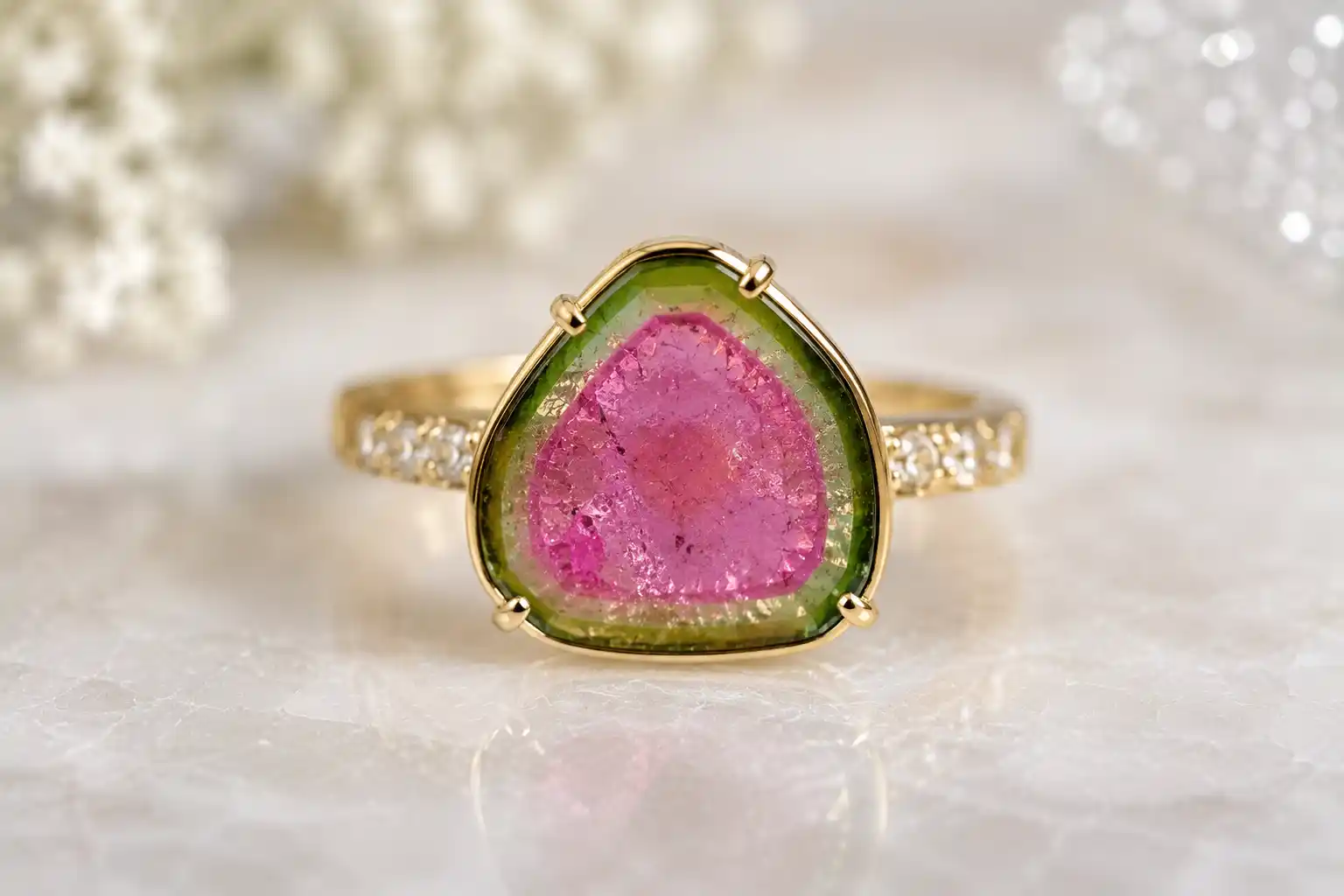
Watermelon Tourmaline Rings: Styles and Buying Tips
Watermelon Tourmaline rings place natural pink-and-green color zoning in the most visible jewelry position. A ring may use a cross-sectional slice showing a pink center and green rim, a longitudinal bicolor gemstone, a polished cabochon or a faceted crystal displaying two or more color bands.
The hand is also the most demanding location for this material. Tourmaline has useful hardness, but Watermelon Tourmaline is often included, and thin slices can fracture around their edges or drill holes. A ring therefore needs more protection than a pendant or pair of earrings made from comparable rough.
A good purchase balances color pattern, structural condition, cutting and setting design. Large size should not compensate for dangerous fractures, unsupported edges or a mounting that exposes the stone to daily impact.
Watermelon Tourmaline Rings at a Glance
| Feature | What to Consider |
|---|---|
| Gem family | Tourmaline |
| Defining appearance | Pink or red with green zoning in one crystal |
| Mohs hardness | Approximately 7–7.5 |
| Toughness | Fair |
| Common ring forms | Slice, faceted bicolor, cabochon, bezel, halo and cocktail ring |
| Safest setting | Low full bezel or reinforced protective frame |
| Main slice concern | Thin edges and surface-reaching fractures |
| Main faceted-stone concern | Exposed corners, windowing and dark orientation |
| Common treatments | Heating, irradiation and fracture filling |
| Daily-wear suitability | Careful wear in a strong low setting |
| Safest cleaning | Warm water, mild soap and a soft brush |
| Main repair concern | Heat, pressure and treatment uncertainty |
Is Watermelon Tourmaline Suitable for Rings?
Watermelon Tourmaline can be used in rings, but the specific stone and setting matter greatly.
Tourmaline’s hardness of approximately 7–7.5 provides reasonable resistance to scratching. Its toughness is only fair, and internal liquid-filled tubes or feathers can make individual stones more vulnerable.
Cross-section slices create another concern because their edges may be thin relative to their face-up size.
A compact faceted stone in a low protective mounting can tolerate careful regular wear. Thin slices, highly fractured cabochons and projecting natural crystals are better suited to occasional use.
The completed gemstone toughness-versus-hardness guide explains why hardness alone does not prevent breakage.
Slice Rings
Slice rings show the complete cross-sectional color pattern.
The Tourmaline may be round, oval, triangular or irregular. A centered pink core is visually familiar, but natural patterns can be asymmetrical.
The slice should have enough thickness to support its face-up size.
Inspect the perimeter for chips, knife-like edges and fractures extending from the center.
A slice mounted high above the finger is vulnerable because its broad surface can catch on surrounding objects.
Low framed or bezel-set designs are the most practical.
Bezel-Set Watermelon Tourmaline Rings
A full bezel provides the strongest conventional protection.
The metal surrounds the stone, supports the edge and creates a smooth profile that resists snagging.
The jeweler should close the bezel gradually and evenly. Excessive pressure can extend a fracture that was already present.
A broad backing plate can support a thin slice from below.
The bezel should not cover the entire green rim or hide the feature that creates the Watermelon appearance.
Partial bezels reveal more of the outline but leave selected edges exposed.
Framed Slice Rings
Some rings hold the slice inside a metal framework rather than a traditional bezel.
The frame may support the stone at several points or enclose it between a backing and upper rim.
The stone must not rattle or flex inside the construction.
Open areas should be small enough that a direct blow reaches the metal before the Tourmaline.
Decorative wire alone may not provide sufficient support.
A strong frame allows an irregular natural outline to remain visible without leaving every edge unprotected.
Prong-Set Rings
Prongs can hold thicker slices, cabochons and faceted bicolor Tourmalines.
Four-prong settings expose much of the stone but provide limited redundancy. Six prongs offer more security for larger ovals and rounds.
Each claw must contact a structurally sound area.
Thin slice edges can chip beneath concentrated prong pressure, so a bezel is often preferable.
Pointed pears, marquises and custom shapes require V-shaped or reinforced corner protection.
High thin prongs are unsuitable for heavy daily wear.
Faceted Bicolor Rings
Faceted Watermelon Tourmaline can show pink and green in elongated emerald cuts, cushions, ovals, pears and custom designs.
The color division should remain visible from the normal face-up direction.
Strong pleochroism can make the green section appear much darker from one crystal axis. Cutting orientation therefore affects both color and brilliance.
A shallow stone may show windowing, while excessive depth can retain weight without creating more visible size.
The setting should protect corners without hiding the color boundary.
The completed Watermelon Tourmaline buying guide provides the full quality evaluation.
Cabochon Rings
Cabochons suit translucent or included Watermelon Tourmaline that would not benefit from conventional faceting.
The dome can display color zoning while reducing the visual prominence of internal fractures.
A smooth low cabochon is generally safer than a thin flat slice with an exposed perimeter.
The polish should remain even across both colors.
A broad transparent area or uneven base may cause the stone to sit poorly in the setting.
Full bezels work especially well with cabochons.
Halo Rings
A halo surrounds the Tourmaline with smaller accent stones.
Colorless Diamond or Sapphire can make the pink-and-green center appear larger and brighter.
These accent gems are harder than Tourmaline and must not contact it directly.
A low halo may provide partial protection around the center. A tall double halo adds height and many small prongs without necessarily improving durability.
The center should remain visually dominant.
A halo cannot compensate for a severely fractured slice or weak supporting frame.
Three-Stone Rings
A three-stone design may use one Watermelon Tourmaline with separate pink and green side stones.
Alternatively, three bicolor Tourmalines can create a graduated pattern.
Harder side gems need enough metal separation to avoid direct girdle contact.
The complete color arrangement should remain balanced rather than making the center’s natural zoning difficult to read.
A wide three-stone ring can press against adjacent fingers, so comfort matters.
Low baskets and protected corners improve practical wear.
Cluster Rings
Cluster rings arrange several small Tourmaline slices, cabochons or faceted stones.
The design can use different pink-green ratios deliberately.
Every setting introduces another potential maintenance point. One loose stone can fall before the cluster looks visibly damaged.
Small slices should not overlap or strike one another.
A strong backing plate helps distribute pressure across the ring top.
Large raised clusters are best treated as occasional jewelry.
Cocktail Rings
Watermelon Tourmaline naturally suits statement and cocktail designs because of its unusual zoning.
Large slices and irregular crystals provide substantial face-up color.
Size also increases the probability of impact.
A cocktail ring needs a broad shank and enough structural support to prevent rotation.
The wearer should remove it before working with bags, doors, counters or equipment.
A large fractured specimen does not become a strong jewelry stone simply because its pattern is rare.
Watermelon Tourmaline Engagement Rings
Watermelon Tourmaline can be used in an engagement ring when the wearer accepts its limitations.
The color zoning offers a distinctive alternative to conventional single-color stones.
A compact faceted or cabochon gem in a low full bezel provides the most realistic daily-wear option.
Thin slices, drilled material and high exposed corners are poor choices for uninterrupted wear.
The ring should be removed for exercise, gardening, cleaning and manual work.
A separate activity ring can protect a meaningful Watermelon Tourmaline center.
Evaluating the Color Pattern
The classic pattern has a pink or red center and green exterior.
However, authentic material may contain white, colorless, yellow or additional green bands.
The zones should look integrated within one crystal.
A straight adhesive line, surface paint or separate layers indicates an assembled or imitation product.
Strong contrast improves visibility, but the pattern does not need to be perfectly centered.
The best arrangement depends on the ring design and how the stone sits on the finger.
Pink-Center Quality
Pink can range from pale blush to vivid magenta.
A center that is too pale may become difficult to see in a small ring.
Very dark red-pink can look nearly opaque, especially in a thick slice.
The color should remain attractive in ordinary indoor light.
Irradiation may strengthen pink or red color in Tourmaline. Treatment should be disclosed when known.
The completed Pink Tourmaline guide covers the wider pink variety.
Green-Rim Quality
The green area can be yellowish, forest green or blue-green.
Medium tone generally provides a clear rind around the pink center.
A nearly black green zone can hide the structure and make the stone look smaller.
Irregular green thickness is natural and may reflect changing crystal growth.
The green should extend through the material rather than exist only as a surface coating.
The completed Verdelite guide provides broader green Tourmaline context.
Clarity and Fractures
Watermelon Tourmaline commonly contains visible internal features.
Thread-like tubes, crystals, healed fractures and feathers may contribute to its appearance.
Structural position matters more than the mere presence of an inclusion.
A fracture reaching the perimeter, corner or prong position requires caution.
Inspect the stone from the side and beneath the setting.
Fracture filling with oil or resin can make cracks less obvious but does not restore the original strength.
Slice Thickness and Ring Durability
Thin slices may look bright because light passes through them easily.
They are also more vulnerable to bending stress and edge impact.
A thick slice provides greater support but may become dark and heavy.
Thickness should remain reasonably even around the perimeter.
One sharply tapered edge is a likely chip point.
A strong backing plate and surrounding frame can make a moderately thin slice safer without hiding its color.
Pleochroism
Tourmaline can display different colors or darkness when viewed from different directions.
Faceted bicolor stones may look bright from one angle and overly dark from another.
Rotate the ring under realistic light before purchase.
The main face-up direction should show the strongest balance of pink, green and brilliance.
Pleochroism is natural, but severe extinction should not be excused automatically.
The completed types of Tourmaline guide explains this optical property more broadly.
Treatments
Heating may lighten dark Tourmaline or alter certain colors.
Irradiation can create or strengthen pink, red and yellow.
Fracture filling may improve apparent clarity.
Treatment is not necessarily unacceptable, but it should be disclosed and reflected in price.
A repair jeweler also needs to know about treatment before applying heat, pressure or solvents.
The completed Tourmaline buying guide covers the family-wide treatment context.
Imitations and Assembled Stones
Glass can be produced with pink and green bands.
Resin may contain bubbles, glitter or molded inclusions.
Dyed Quartz and other stones can imitate the colors.
An assembled ring may join separate pink and green sections with adhesive.
Look for a straight joining plane, glue bubbles, surface color and identical repeated patterns.
The completed real-versus-fake Tourmaline buying guidance should be used when a valuable stone’s identity remains uncertain.
Evaluating Cut and Polish
A faceted stone should return light evenly across both zones.
Windowing, dark extinction and poor symmetry reduce beauty.
A slice or cabochon should have a uniform polish without broad scratches or cloudy grinding marks.
Edges need careful finishing.
Oil and wax can temporarily improve surface appearance, so inspect the stone dry.
Natural inclusions should not be used to excuse poor workmanship.
Setting Height
A low setting is safer because it keeps the stone near the finger.
High mountings catch clothing and expose the perimeter to impact.
The stone should not sit so low that its pavilion or backing presses against the finger.
A broad ring top requires stable shoulders.
Try ordinary movements such as typing, gripping a cup and putting on a jacket.
The ring should not rotate continually or collide with adjacent fingers.
Setting Pressure
Tourmaline can be damaged during setting.
A jeweler should inspect fractures before tightening prongs or closing a bezel.
Pressure must be distributed evenly.
Tension settings are risky because they depend on concentrated force against the gemstone.
Flush and channel styles can also stress thin edges if poorly designed.
Protective construction shields the stone; it should not crush it.
Choosing the Metal
Rose gold emphasizes the pink center and creates a warm contrast with green.
Yellow gold complements warmer pink and yellow-green zones.
White gold and platinum produce a crisp border around both colors.
Sterling silver can suit commercial slices, provided the frame and shank remain substantial.
Metal strength and setting quality matter more than color preference.
A delicate-looking setting should not rely on thin structural components around a large stone.
Ring Size and Stability
Obtain an accurate finger measurement using a band with similar width.
Wide rings fit more tightly than narrow shanks.
Large slices can make the ring top-heavy.
A broad lower shank, sizing beads or an internal stabilizing bar may reduce rotation.
The ring should remain comfortable throughout normal temperature changes.
A constantly rotating ring exposes the gemstone to more impacts.
Resizing and Repair
Simple metal shanks may be resized, but the Tourmaline may need removal before torch work.
Heat can alter color, expand fractures or damage fillers.
Complex halos, full eternity designs and large frames have narrower resizing limits.
Discuss alteration before purchase.
A custom-cut Watermelon Tourmaline can be difficult to replace if broken.
The repair jeweler should know the treatment and construction history before beginning work.
Price and Value
Watermelon Tourmaline prices depend on pattern, color contrast, transparency, structural condition, cut and size.
A large stone does not command a premium when heavily fractured or poorly oriented.
Faceted bicolor gems, clean cabochons and matched suites occupy different market levels.
A well-designed protective setting adds value through craftsmanship.
The completed Watermelon Tourmaline price guide owns detailed price intent.
Comparing Related Jewelry
The completed Watermelon Tourmaline bracelet guide covers stringing, fit and wrist impact.
The completed Watermelon Tourmaline earrings guide addresses matched pairs and weight.
The Watermelon Tourmaline necklace guide provides the safest format for large slices.
The broader Tourmaline ring guide compares other Tourmaline colors and ring styles.
Cleaning Watermelon Tourmaline Rings
Use warm water, mild soap and a soft brush.
Work gently beneath the setting, where lotion and soap collect.
Rinse briefly and dry thoroughly.
Avoid steam and ultrasonic cleaners. Heat, vibration, liquid inclusions, filling and glue can create risk.
Do not use abrasive compounds on polished slices.
The completed Watermelon Tourmaline jewelry-cleaning guide provides the full method.
Daily Wear
Remove the ring before exercise, cleaning, gardening and manual work.
Avoid striking it against stone, ceramic and metal surfaces.
Do not stack it tightly beside Topaz, Sapphire or Diamond bands.
A thin slice ring should generally be treated as occasional jewelry.
Inspect the frame, bezel or prongs after any noticeable impact.
A faint clicking sound can indicate movement within the setting.
Storage
Keep the ring in a separate padded compartment.
Do not allow harder gemstones to scratch its surface.
Prevent heavy jewelry from pressing against a thin slice.
Avoid high heat and prolonged intense light when treatment history is uncertain.
Watermelon Tourmaline appears in the crystals beginning with W and gemstones beginning with W directories.
Final Perspective
Watermelon Tourmaline makes an unusually expressive ring stone, but its natural zoning and frequent inclusions require disciplined design.
The best ring is not necessarily the one with the largest or most symmetrical slice. Structural soundness, protected edges and a stable low setting matter more.
A smaller bicolor gem that remains bright and secure will generally provide more lasting satisfaction than a dramatic fractured slice mounted high above the hand.
Frequently Asked Questions
1. Is Watermelon Tourmaline durable enough for rings?
It can be used in rings, but fair toughness, inclusions and thin slice edges require a protective setting and careful wear.
2. Which setting is safest?
A low full bezel or reinforced frame provides the strongest edge protection.
3. Can a Watermelon Tourmaline ring be worn every day?
Careful regular wear may be possible for a sound compact stone. Thin or fractured slices are better reserved for occasional wear.
4. Is a faceted stone safer than a slice?
A compact, sound faceted stone is often stronger than a thin slice, although exposed corners still need protection.
5. Can Watermelon Tourmaline be an engagement ring?
Yes, when the wearer accepts its care requirements and chooses a low protective setting.
6. Does the pink center need to be perfectly centered?
No. Natural zoning can be asymmetrical, and an attractive irregular pattern may still be valuable.
7. Can Watermelon Tourmaline be treated?
Yes. Heating, irradiation and fracture filling may occur.
8. How can a fake Watermelon Tourmaline ring be recognized?
Bubbles, mold seams, painted color, glued layers and repeated artificial patterns can provide clues.
9. Why do some Watermelon Tourmalines look dark?
Thickness, deep cutting, strong pleochroism and dark green zoning can reduce face-up brightness.
10. Can the ring be resized?
Many simple shanks can be resized after protecting or removing the stone. Complex frames and halos may have limited options.
11. Can Watermelon Tourmaline be cleaned ultrasonically?
No. Warm soapy water is safer because fractures, fillers and settings may be vulnerable.
12. How should the ring be stored?
Keep it separately in a padded compartment away from harder gemstones and heavy jewelry.