Identification
-

How to Spot Dyed Crystals: A Practical Guide
Dyed crystals often reveal color concentrated in fractures, pores, drill holes, grain boundaries, surface pits, or areas protected from polishing.…
Read More » -
Glass vs Crystal: Key Differences & How to Choose
Glass vs crystal sounds like a simple comparison until the word “crystal” is defined. In mineralogy and gemology, a crystal…
Read More » -
Black Tourmaline vs Obsidian: 7 Key Differences in Protection & Energy
Black tourmaline vs obsidian compares two dark stones that may look similar in jewelry and crystal collections but are fundamentally…
Read More » -
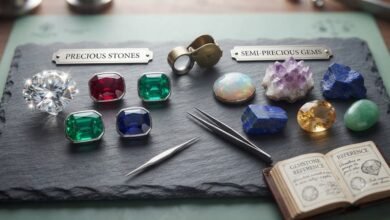
Precious vs Semi Precious Stones: 12 Major Differences & Meanings
Precious vs semi precious stones is a traditional way of dividing gemstones, but it is not a reliable scientific ranking…
Read More » -
Real vs Fake Opal: 9 Essential Ways to Spot Genuine Opal
Real vs fake opal identification is difficult because the market contains several categories that may all display convincing play-of-color. A…
Read More » -
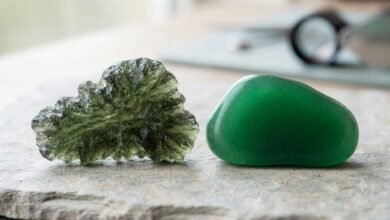
Is My Moldavite Real? How to Tell Genuine Moldavite from Fakes
A convincing green glass imitation can resemble Moldavite closely enough to pass casual inspection. Artificial etching can reproduce a rugged…
Read More » -
Jadeite vs Nephrite: Key Differences & How to Choose
Jadeite and nephrite are both legitimately called jade, but they are not the same mineralogical material. Jadeite belongs to the…
Read More » -
Real vs Fake Jade: 9 Essential Tests for Authentic Healing Stones
Real vs fake jade identification is unusually complicated because jade is not one simple mineral species. Gemologists traditionally use the…
Read More » -
Real vs Fake Turquoise: 10 Essential Tests for Authentic Native Stones
Real vs fake turquoise identification is more complicated than deciding whether a blue stone contains matrix. Genuine turquoise is a…
Read More » -
Real vs Fake Citrine: Natural Citrine or Heated Amethyst?
Natural citrine is transparent yellow-to-orange quartz whose color developed through geological processes. It is uncommon compared with the large volume…
Read More »