
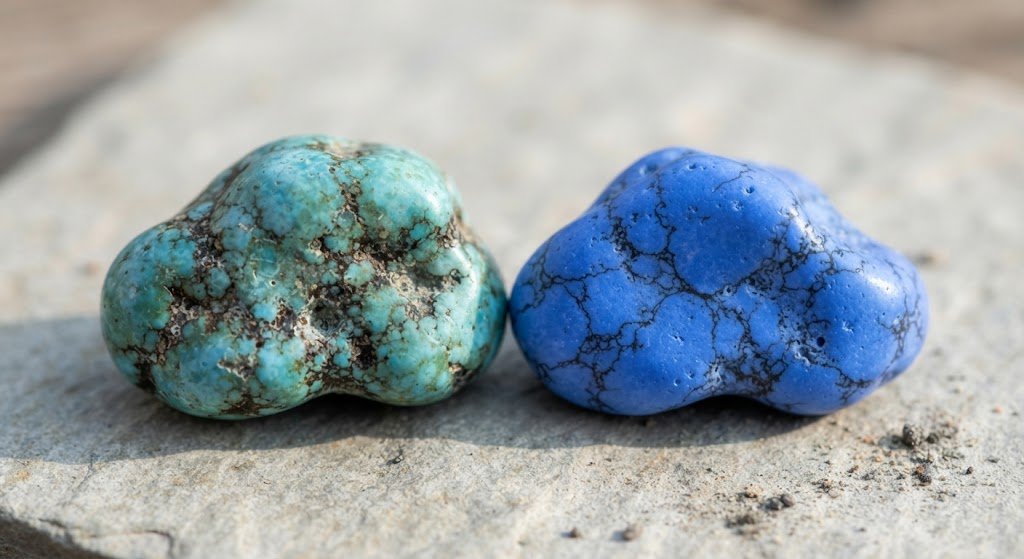
Real vs Fake Turquoise: Genuine Stone, Treatments and Imitations

Genuine turquoise is a naturally formed hydrated copper aluminum phosphate. It typically develops as opaque to semitranslucent vein fillings, nodules, crusts and compact masses in dry copper-bearing regions.
However, not every piece sold as turquoise represents the same product. The market includes untreated natural turquoise, waxed turquoise, stabilized turquoise, dyed natural turquoise, reconstructed material, laboratory-produced turquoise, dyed mineral substitutes, glass, ceramic and resin.
This distinction matters because a treated piece can still contain genuine natural turquoise. Stabilization, for example, introduces polymer into porous material to improve durability. A dyed howlite bead, by contrast, contains no turquoise even if its color and dark veining resemble the gem.
A reliable identification therefore asks four separate questions:
Is the material turquoise? Is it natural or manufactured? Has it been treated? Is the object one continuous stone or a bonded composite?
This article owns that direct authenticity workflow. Detailed enhancement methods and laboratory criteria remain within How to Spot Treated or Synthetic Turquoise.
Natural Turquoise, Treated Turquoise and Imitations Compared
| Feature | Untreated natural turquoise | Stabilized or dyed turquoise | Reconstructed turquoise | Dyed howlite or magnesite | Glass, ceramic or resin |
|---|---|---|---|---|---|
| Base material | Naturally formed turquoise | Naturally formed turquoise with treatment | Turquoise particles, other mineral powder or pigment bonded with resin | A different natural mineral | Manufactured material |
| Typical color | Blue, blue-green, green, gray-green or yellow-green | Any strengthened or altered blue or green | Highly controlled and often uniform | Dye-controlled blue or green | Any manufactured shade |
| Texture | Fine granular or compact mineral aggregate | Original texture may remain, but pores contain wax or polymer | Fragmented, powdery or molded structure | Host-mineral veins, pores or chalky texture | Homogeneous, cast, glazed or molded |
| Matrix | Natural host-rock remnants may occur | Matrix may be darkened or filled | Matrix may be printed, poured or created from pigment | Natural veins can imitate matrix | Artificial veins or surface pattern |
| Mohs hardness | Commonly 5–6 | Surface response may change with treatment | Binder affects surface behavior | Host-dependent | Material-dependent |
| Specific gravity | Variable, commonly around 2.6–2.9 | Polymer can lower apparent density | Highly variable | Host-dependent | Highly variable |
| Drill-hole clues | Mineral texture continues inward | Polymer or dye may concentrate around the hole | Binder, fragments or a different interior may appear | Intense dye often collects in pores | Coating, mold or core may become visible |
| Best confirmation | Microscopy, refractive index, density, FTIR, Raman or XRD | Treatment analysis in addition to mineral identification | Microscopy and compositional testing | Host-mineral identification and dye detection | Standard material testing |
Color alone cannot separate these categories. Modern stabilization and manufacturing can produce convincing texture, matrix and weight.
What Is Genuine Natural Turquoise?
The planned turquoise meaning guide owns the mineral’s formation, history, symbolism and general properties.
Turquoise forms when copper-bearing groundwater reacts with aluminum- and phosphorus-bearing minerals in dry environments. The material commonly occupies fractures and cavities rather than growing as large transparent crystals.
Its idealized composition includes copper, aluminum, phosphate, hydroxyl groups and water. Iron can substitute within the structure and contribute greener shades.
Because turquoise is porous and fine-grained, its color, density and hardness vary. Matrix minerals, weathering and treatment create further differences.
A genuine stone does not need to match one perfect robin’s-egg blue. Natural material also occurs in greenish blue, gray-blue, blue-green, green and yellow-green.
Natural Turquoise Color
Fine blue turquoise is traditionally valued highly, but color preference varies across markets and jewelry traditions.
Copper is associated with blue coloration. Increasing iron influence can shift the appearance toward green.
Some natural turquoise changes color gradually through oxidation, dehydration, skin oils, cosmetics or environmental exposure. This process can produce greener, darker or uneven areas.
Color that varies through the depth of a cabochon is generally more convincing than a thin artificial surface layer. Nevertheless, dye and polymer can penetrate deeply enough to conceal the original shade.
For that reason, a bright blue color should be treated as a quality observation rather than proof of authenticity.
The completed types of turquoise guide explains blue, green, matrix-bearing and locality-associated trade categories.
What Is Turquoise Matrix?
Matrix is the host rock or associated mineral material that remains within or around turquoise.
It may appear as brown, black, gray, tan, reddish or pale veins and patches. The pattern can be sparse, web-like, irregular or dense.
Natural matrix normally has depth. Lines may widen, branch, disappear beneath the surface or connect with mineral areas on the back.
A matrix pattern is not automatic proof of genuine turquoise. Manufacturers can print, paint, mold or pour dark lines into resin and reconstructed blocks.
Likewise, matrix-free material is not automatically fake. Cutters often select clean blue areas or remove unattractive host rock.
Spiderweb Turquoise
Spiderweb turquoise displays a fine network of intersecting matrix lines.
The web can be valuable when the pattern is natural, balanced and associated with desirable color.
Artificial products may imitate spiderweb matrix with ink, polymer, black cement or molded lines. Repetition across many cabochons is especially suspicious.
Under magnification, natural matrix should show mineral texture and irregular depth rather than a flat line sitting on the polish.
However, even a convincing natural-looking web cannot establish a mine locality. Labels such as Persian, Chinese, Tibetan or American spiderweb require provenance in addition to appearance.
Untreated or “Natural” Turquoise
In strict trade use, untreated natural turquoise has not been impregnated, dyed, reconstructed or coated.
Traditional light waxing may be treated differently by different sellers and disclosure systems, so the invoice should specify exactly what was done.
Untreated material often has a relatively dry, waxy or subdued surface rather than a plastic-like gloss.
Porosity varies substantially. Fine dense turquoise can polish well without stabilization, while chalky material may be too weak for ordinary jewelry.
Natural does not automatically mean high grade. Pale, porous or heavily fractured untreated turquoise can be less attractive and less durable than honestly disclosed stabilized material.
Stabilized Turquoise
Stabilization introduces polymer or another consolidant into porous turquoise.
The treatment can improve durability, deepen color and allow low-density material to take a better polish.
A stabilized piece still contains natural turquoise as its base. It should nevertheless be disclosed because the polymer affects rarity, value, repair and cleaning.
Under magnification, stabilization may reveal glossy material in pores, flattened bubbles, unusual luster or a slightly plastic-looking fracture.
Modern treatment can be subtle. FTIR spectroscopy is often more reliable than surface examination because it can detect organic polymer within the stone.
Waxed and Oiled Turquoise
Wax or oil may deepen color, improve luster and reduce the visibility of surface dryness.
The effect can be modest or substantial depending on the material and treatment amount.
Heat, detergents and solvents may remove or change the substance, causing the stone to appear paler or more porous.
Waxing does not create the same structural alteration as deep polymer impregnation. Therefore, waxed and stabilized should not be used as interchangeable terms.
The broader gemstone treatments guide explains impregnation, coating, dyeing and filling as separate processes.
Dyed Natural Turquoise
Pale turquoise can be dyed to create stronger blue, green or unusual colors.
Dye may concentrate in pores, cracks, matrix boundaries and drill holes. A chipped edge can reveal a lighter interior.
Some treatment penetrates deeply and leaves few obvious surface clues.
Dyed natural turquoise remains turquoise as its underlying mineral, but its color is artificially altered. The treatment should be stated clearly rather than hidden behind terms such as color enhanced or improved.
Solvent tests are unreliable. Stable dye may not transfer, while acetone can damage polymer, glue, coatings, stringing material and metal finishes.
Reconstructed or Reconstituted Turquoise
Reconstructed turquoise is manufactured from particles, chips or powder bonded with resin.
Some products contain genuine turquoise. Others combine a small amount of turquoise with chrysocolla, variscite, magnesite, pigment or other filler.
A few products marketed as reconstructed turquoise contain little or no turquoise at all.
Magnification may reveal angular fragments, resin-filled gaps, casting bubbles and pigment that flows around particles.
Reconstructed material can be attractive and durable when disclosed accurately. It should not be sold as one solid, naturally formed turquoise cabochon.
Block Turquoise
Block turquoise is a trade term commonly used for imitation material manufactured in blocks.
It may consist of colored resin, ceramic, mineral powder or a mixture designed to resemble turquoise and matrix.
The phrase does not guarantee that turquoise is present.
Repeated web patterns, perfectly uniform color, mold seams and a polymer-like interior are common warning signs.
A seller should state the actual composition rather than allowing block turquoise to sound like natural material cut from a mine block.
Synthetic Turquoise
True synthetic turquoise is laboratory-produced material with chemical and structural characteristics corresponding closely to natural turquoise.
Such material has been manufactured, but it is less common in ordinary inexpensive jewelry than resin, ceramic and reconstructed simulants.
A properly disclosed synthetic turquoise is not the same as dyed howlite or plastic.
Conversely, manufacturers sometimes use synthetic turquoise loosely for any man-made blue product. The exact composition and production method should be requested.
The completed laboratory-grown versus natural gemstones guide explains why synthetic counterparts and visual imitations are distinct.
Dyed Howlite
Howlite is one of the most familiar turquoise substitutes.
Natural howlite is white or cream with gray or black web-like veins. Its porosity allows it to absorb blue and green dye readily.
After treatment, the dark network may resemble turquoise matrix.
Inspect drill holes and chips. Dye often accumulates in the veins or reveals a pale interior beneath the surface.
Howlite is softer and has different optical and chemical properties. It remains a genuine natural mineral, but it should be sold as dyed howlite rather than turquoise.
Dyed Magnesite
Magnesite is another porous pale mineral that accepts dye well.
It may show a chalky, granular or veined structure. Strong polish and resin impregnation can make it appear more turquoise-like.
Color commonly concentrates in pores, pits and drill holes.
Some magnesite has natural brown matrix-like lines, making the imitation particularly convincing.
Refractive-index, Raman and infrared testing can identify the host without destructive scratching or acid.
Variscite
Variscite is a hydrated aluminum phosphate.
Its green to blue-green appearance can overlap turquoise, and some specimens contain attractive matrix.
Variscite generally lacks turquoise’s copper-rich composition and often leans greener or more yellow-green.
It is a legitimate gemstone rather than a fake. Misrepresentation occurs only when it is sold under the turquoise name.
Raman spectroscopy, chemistry and refractive properties provide a reliable separation.
Chrysocolla
Chrysocolla is a blue-to-green copper-bearing material associated with oxidized copper deposits.
Its softness and variable composition distinguish it from turquoise, although silica-rich chrysocolla can be harder and suitable for jewelry.
Mixed copper-mineral material may contain chrysocolla, turquoise, quartz and other phases together.
A dealer should describe such material as mixed or composite natural rock rather than assigning a pure turquoise identity from color alone.
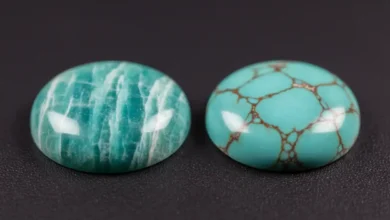
Amazonite
Amazonite is blue-green microcline feldspar.
It often displays white streaks, blocky cleavage and a different mineral texture.
The planned amazonite versus turquoise guide owns the complete comparison.
Amazonite is typically harder than turquoise and has feldspar optical properties. It is sometimes sold under misleading names containing jade or turquoise, but neither term establishes its identity.
Larimar
Larimar is blue pectolite from the Dominican Republic.
Its white fibrous, cloud-like and radial patterns differ from typical turquoise matrix.
The completed Larimar versus turquoise guide separates their mineral properties and visual effects.
Both may appear blue and opaque, but pectolite structure, density and refractive behavior distinguish Larimar.
Glass Imitations
Glass can reproduce blue color, matrix patterns and even a porous-looking surface.
Round bubbles, curved flow lines and mold seams provide easy clues when present.
Opaque glass may conceal bubbles. Devitrified or particle-filled glass can also develop a stone-like internal texture.
A chipped edge may reveal smooth glassy fracture rather than fine mineral grains.
Glass is normally more homogeneous than natural turquoise, but sophisticated products require refractive-index, density or Raman testing.
Resin and Plastic Imitations
Resin can be cast in turquoise blue and mixed with black or brown pigment to create matrix.
Common clues include mold seams, casting bubbles, repeated patterns, soft scratches and an unusually uniform interior.
Mineral powder can be added to increase weight and create a cooler touch.
Some resin objects contain genuine turquoise chips, making them composites rather than simple plastic imitations.
A hot-needle test should never be used. It causes permanent damage and can release irritating fumes.
Ceramic and Porcelain
Ceramic can be colored throughout or coated with a blue glaze.
A chipped area may expose a white, gray or granular body.
Glaze can collect in depressions and display tiny bubbles or an unusually glassy shine.
High-quality ceramic feels cool and substantial, so temperature is not a reliable test.
Raman spectroscopy and microscopy distinguish ceramic from turquoise without damaging the object.
Surface Coatings
A coating can make pale turquoise, another mineral or an artificial substrate appear brighter and more uniform.
Inspect facet edges, carving recesses, drill holes and worn corners. A clear film may peel or reveal a different underlying color.
A coated natural turquoise still contains genuine mineral, but its visible color and luster depend on treatment.
Repolishing and jewelry repair may damage or remove the coating.
Matrix Added with Ink or Cement
Dark matrix can be added deliberately to improve visual contrast.
Ink tends to collect in surface scratches and pores. Cement or resin may fill grooves carved into the stone.
Under magnification, artificial lines can have smooth borders, uniform color and no mineral texture.
A line that exists only on the front and disappears at the edge is particularly suspicious.
Natural matrix should connect convincingly with the host material through the depth of the object.
Weight and Temperature Tests
Turquoise often feels cool at first touch, but glass, ceramic and many stones do too.
Resin may warm more quickly, although size, room temperature and mineral filler affect the result.
Density varies naturally because porosity and matrix differ. Stabilization and reconstruction alter it further.
Hand weight can expose an extremely light hollow plastic bead but cannot authenticate valuable turquoise.
Refractive Index and Specific Gravity
Turquoise commonly provides a refractive-index range of approximately 1.61–1.65.
Specific gravity is variable, often around 2.6–2.9, because porosity, iron, matrix and treatment change the result.
Howlite, magnesite, variscite, glass and ceramic produce different combinations of readings.
A curved opaque cabochon generally requires a spot refractive-index measurement.
Stabilization does not necessarily erase the turquoise reading, so polymer detection remains a separate step.
Magnification
Begin with a clean 10× loupe.
Inspect drill holes, scratches, matrix boundaries, pits and chipped edges.
Look for mineral grains, natural porosity, dye concentration, polymer, bubbles, mold seams, paint and repeated patterns.
Compare the front, back and side. A convincing natural structure should continue through the object rather than existing as a printed face.
Magnification can expose obvious imitations, but treatment-free status may remain impossible to establish visually.
FTIR, Raman and X-Ray Testing
FTIR spectroscopy can detect polymer impregnation, wax, dye-related organic material and many resin products.
Raman spectroscopy identifies turquoise, howlite, magnesite, variscite, chrysocolla-related phases, glass and other substitutes.
X-ray diffraction establishes the crystalline phases in fine-grained, reconstructed or mixed material.
Chemical analysis confirms copper, aluminum and phosphate relationships and can identify pigments or unexpected fillers.
The completed gemstone certification guide explains when independent reports are useful. The guide to reading a gem-lab report helps determine whether the document addresses treatment or merely names the mineral.
Home Tests to Avoid
Do not scratch turquoise with a knife or steel point.
Avoid acetone, alcohol, bleach, vinegar, acid and household cleaners.
Do not use a hot needle, flame, boiling water or prolonged soaking.
These tests can damage genuine porous turquoise, dissolve wax, soften polymer, alter dye and harm jewelry settings.
A safe inspection should remain visual and non-destructive. The broader crystal-identification guide provides a practical sequence for unknown stones.
Buying Genuine Turquoise
The completed turquoise buying guide owns color, texture, matrix, provenance and seller evaluation.
The turquoise price guide explains why untreated dense material, documented locality and desirable color can command premiums.
Ask the seller to state one of the following clearly: untreated natural turquoise, waxed turquoise, stabilized turquoise, dyed turquoise, reconstructed turquoise, synthetic turquoise or imitation.
Request photographs of the exact object’s front, back, edges and drill holes.
Mine names should be supported by traceable provenance. Matrix style and color cannot establish a specific deposit.
For remote purchases, verify the return policy and preserve time for independent testing.
Turquoise Jewelry and Care
Turquoise is porous and comparatively soft.
A turquoise ring faces cosmetics, impact and household chemicals. A turquoise bracelet receives frequent contact with hard surfaces.
Turquoise earrings and a turquoise necklace are often better protected, although perfume and skin products remain concerns.
Use the completed turquoise jewelry cleaning guide rather than steam, ultrasonic cleaning, acids or prolonged soaking.
Belief-based methods remain within how to cleanse and charge turquoise and should avoid salt, chemicals and direct drinking-water preparation.
Turquoise’s calendar association appears in the planned December birthstone guide.
Frequently Asked Questions
1. What is genuine turquoise?
Genuine turquoise is naturally formed hydrated copper aluminum phosphate, whether untreated or subsequently treated.
2. Is stabilized turquoise real?
Yes. Its base is natural turquoise, but polymer has been introduced to improve durability or polish and must be disclosed.
3. Is dyed turquoise fake?
Dyed natural turquoise remains turquoise with treated color. Dyed howlite or magnesite is an imitation because the host mineral is different.
4. What is reconstructed turquoise?
It is a manufactured composite made from particles, powder or fragments bonded with resin or another material.
5. Does all reconstructed turquoise contain real turquoise?
No. Some products contain genuine particles, while others marketed under the term contain mainly imitation minerals, pigment and polymer.
6. Does dark matrix prove turquoise is natural?
No. Matrix can be painted, printed, molded or added with cement and resin.
7. How can dyed howlite be recognized?
Look for dark web-like veins, intense dye in drill holes and a pale interior at chips, then confirm the host mineral instrumentally.
8. Is green turquoise genuine?
Yes. Natural turquoise ranges from blue to green, often because of iron content and alteration.
9. Can acetone identify dyed turquoise?
It is unreliable and can damage dye, polymer, wax, glue and metal finishes.
10. Does a cool touch prove real turquoise?
No. Glass, ceramic and many natural stones also feel cool.
11. Which laboratory tests are most useful?
FTIR, Raman spectroscopy, X-ray diffraction, refractive index, density and chemical analysis can identify the material and major treatments.
12. When should turquoise receive a laboratory report?
Testing is worthwhile for expensive untreated claims, important mine provenance, major carvings, suspected reconstruction and high-value jewelry.
Turquoise authentication begins by separating natural mineral identity from treatment and construction. Stabilized turquoise, dyed howlite and resin block material may all share the same blue color, yet they represent fundamentally different products. A trustworthy purchase states the base material first, identifies every significant treatment and avoids relying on matrix, touch or one damaging home test.
Turquoise appears in Crystals That Start With T and Gemstones That Start With T.