Identification
-

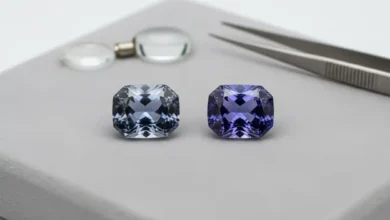
Iolite vs Tanzanite: Key Differences & How to Choose
Iolite and tanzanite can occupy remarkably similar visual territory. Both may appear violet-blue, bluish violet, or purple-blue, both are strongly…
Read More » -
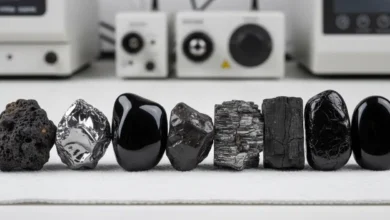
How to Spot Treated or Synthetic Shungite
Shungite is a carbon-rich geological material associated most famously with Paleoproterozoic rocks in Karelia, northwestern Russia. The term is used…
Read More » -
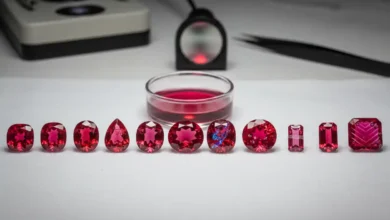
How to Spot Treated or Synthetic Ruby
Ruby is red corundum, a crystalline aluminum oxide colored mainly by chromium. Its treatment and synthetic market is one of…
Read More » -
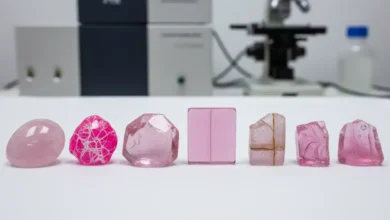
How to Spot Treated or Synthetic Rose Quartz
Rose Quartz is the massive translucent-to-cloudy pink variety of quartz. Its color commonly comes from microscopic aligned silicate fibers containing…
Read More » -
How to Spot Treated or Synthetic Pyrite
Pyrite is an iron disulfide mineral with the formula FeS₂. Its pale brass-yellow color, metallic luster, cubic crystals, striated faces,…
Read More » -
How to Spot Treated or Synthetic Pearl
Pearls are biological gem materials produced by mollusks. They can form naturally without deliberate human intervention or be cultured after…
Read More » -
How to Spot Treated or Synthetic Opal
Opal is a hydrated silica material whose appearance depends on its internal structure, water content, porosity, bodycolor, transparency, and—in precious…
Read More » -
How to Spot Treated or Synthetic Onyx
Onyx is a banded variety of Chalcedony traditionally defined by straight, roughly parallel layers. Natural bands may be black and…
Read More » -
How to Spot Treated or Synthetic Morganite
Morganite is the pink, purplish-pink, salmon, peach, and orange-pink variety of beryl. Manganese produces its color, while iron and the…
Read More » -
How to Spot Treated or Synthetic Moldavite
Moldavite is a natural green impact glass associated with the Ries impact event in Central Europe. It is already glass…
Read More »