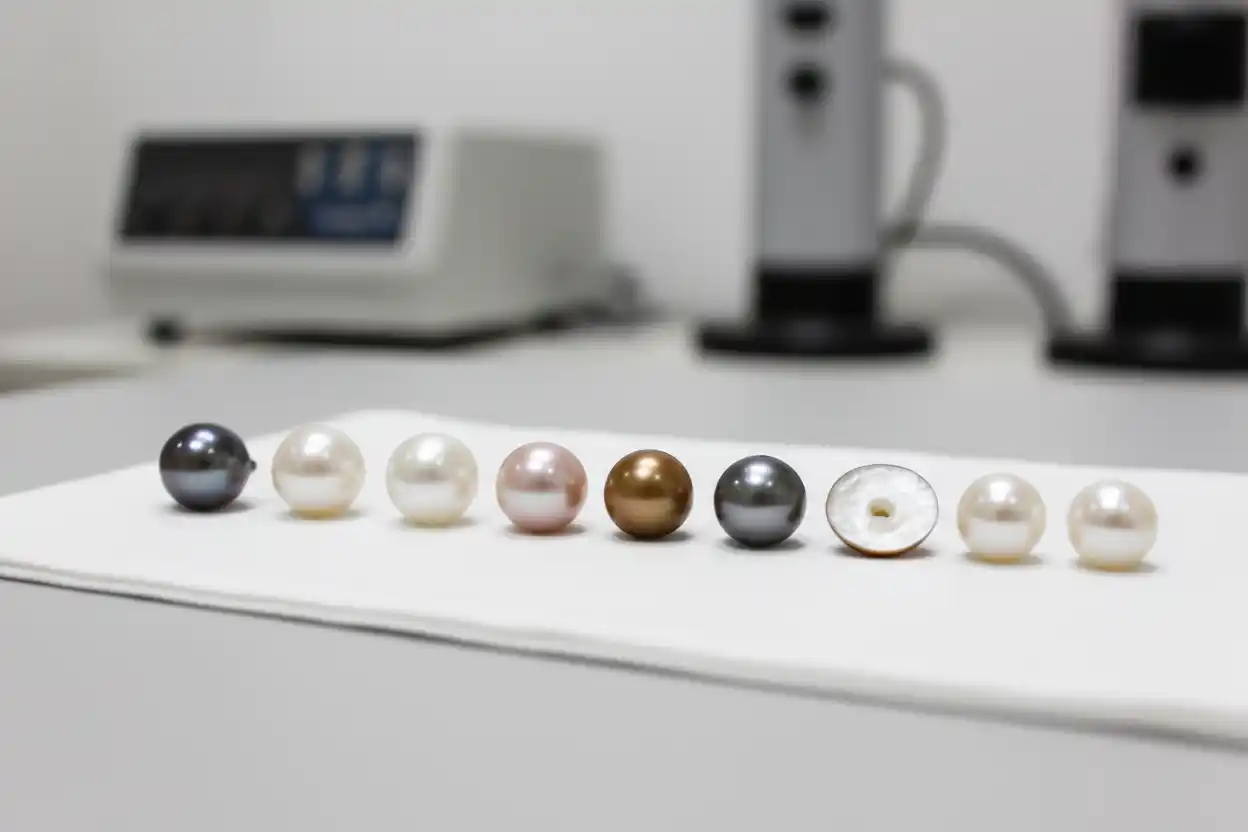
How to Spot Treated or Synthetic Pearl
Pearls are biological gem materials produced by mollusks. They can form naturally without deliberate human intervention or be cultured after a technician introduces tissue, a bead, or another nucleus into the animal.
Cultured Pearl is therefore not a synonym for synthetic Pearl. The mollusk still deposits the nacre or other shell material that creates the finished gem.
After harvesting, however, both natural and cultured Pearls may be cleaned, bleached, polished, subjected to maeshori luster enhancement, pinked, dyed, irradiated, heated, impregnated, coated, filled, or assembled.
Products marketed as synthetic Pearls are normally imitations made from glass, plastic, shell, ceramic, resin, or coated beads. They do not reproduce the biological growth process of a Pearl within a living mollusk.
Pearl treatment categories at a glance
| Product category | What it is | Common evidence | Correct description |
|---|---|---|---|
| Natural Pearl | Formed without deliberate human intervention | Natural internal growth structure on X-radiography | Natural Pearl |
| Cultured Pearl | Formed in a mollusk after human nucleation | Bead or tissue-cultured internal structure | Cultured Pearl |
| Bleached Pearl | Color lightened and made more uniform | Treatment may be difficult to detect directly | Bleached natural or cultured Pearl |
| Maeshori-treated Pearl | Surface and nacre processed to improve luster | Cleaner, brighter surface; specialized detection may be difficult | Luster-enhanced cultured Pearl |
| Pinked Pearl | Slight pink overtone introduced after bleaching | Pink concentrated near surface or treatment-related fluorescence | Pinking-treated Pearl |
| Dyed Pearl | Introduced color added to nacre or surface | Dye around drill holes, blemishes, cracks, and nacre layers | Dyed Pearl |
| Irradiated Pearl | Radiation used to create gray, blue, black, or related color | Color in nucleus or nacre, spectroscopic evidence | Irradiated Pearl |
| Heat- or chemically treated Pearl | Color modified through proprietary processes | Brown, chocolate, golden, or other altered appearance | Color-treated Pearl |
| Coated Pearl | Clear or colored film applied over the surface | Peeling, wear, film fluorescence, altered luster | Coated Pearl |
| Filled or impregnated Pearl | Cavities, drill holes, or porous areas contain foreign material | Resin, wax, bubbles, filled pits | Filled Pearl |
| Mabé or assembled Pearl | Cultured blister section completed with backing and filler | Layered construction visible through X-ray or side examination | Assembled cultured Pearl |
| Imitation “synthetic Pearl” | Glass, plastic, shell, ceramic, or resin bead with pearly coating | Manufactured core and surface layers | Imitation Pearl |
Natural and cultured Pearls
Natural Pearls grow without a technician deliberately introducing a nucleus or mantle tissue. They are rare in today’s jewelry market and many significant examples are antique.
Cultured Pearls form after human intervention, but the nacre or shell material is deposited biologically by a living mollusk.
The complete gem profile appears in Pearl: Meaning, Properties & Symbolism. Saltwater, freshwater, Akoya, South Sea, Tahitian, non-nacreous, bead-cultured, and tissue-cultured categories belong to Types of Pearl.
The distinction between natural and cultured origin is separate from treatment. A natural Pearl can be bleached or dyed, while a cultured Pearl can have natural color and receive no significant post-harvest color enhancement.
Why “synthetic Pearl” is usually incorrect
A strict synthetic gem reproduces the essential composition and structure of a natural material through laboratory growth.
Pearls do not form as simple crystals. They are complex biological structures assembled by mollusks from calcium carbonate, organic matrix, and species-specific shell components.
Glass, plastic, shell, ceramic, and resin beads can imitate Pearl luster after receiving a pearlescent coating. They remain imitation Pearls rather than synthetic Pearls.
The terminology distinction appears in Lab-Grown vs Natural Gemstones and Glass vs. Crystal.
The completed Real vs Fake Pearl page owns the full authentication workflow. This article focuses specifically on post-harvest processing and treatment.
Routine cleaning after harvest
Freshly harvested cultured Pearls can retain organic residue, staining, dirt, and uneven surface material.
Initial cleaning removes those substances and prepares the Pearls for sorting and further processing. Gentle cleaning may be regarded as normal preparation rather than a major enhancement.
More aggressive chemical cleaning can alter the surface or remove material. The exact boundary between routine processing and treatment depends on what was done and how strongly it changed appearance.
A seller should disclose processes that materially affect color, luster, durability, or value rather than hiding them behind the word cleaned.
Bleaching
Bleaching is one of the most widespread Pearl treatments, particularly for Akoya and freshwater cultured Pearls.
Hydrogen peroxide, often combined with controlled heat or light, can remove stains, lighten bodycolor, and create a more uniform white or cream appearance.
Bleaching may also prepare Pearls for subsequent pinking or dyeing.
The treatment is normally stable during ordinary wear, but excessive bleaching can weaken organic components, dehydrate nacre, or increase fragility.
Direct detection can be difficult because a well-processed Pearl may show no obvious microscopic evidence. Laboratories interpret fluorescence, spectroscopy, chemistry, and comparison with untreated reference material.
Bleaching does not make a Pearl artificial
The nacre or other Pearl material remains biologically formed.
Bleaching changes color and uniformity after harvest but does not replace natural or cultured origin.
A cultured Akoya strand can therefore be genuine cultured Pearl and routinely bleached at the same time.
The product description should still say cultured Akoya Pearls rather than simply Pearls, because cultured origin is commercially important regardless of bleaching.
Maeshori luster enhancement
Maeshori is associated with processes used to improve the surface appearance and luster of nacreous cultured Pearls.
The exact procedures can vary among producers. They may involve controlled solvents, heating, moisture, chemical cleaning, or other prepolishing steps that change how light reflects from the nacre surface.
A well-executed treatment can make reflections appear sharper and the surface look cleaner.
Overprocessing may dry or weaken nacre, while proprietary procedures can be difficult to identify after completion.
Maeshori should be distinguished from adding a thick transparent coating. One modifies or conditions the existing nacre surface; the other applies a separate film.
Polishing and tumbling
Pearls may be gently polished or tumbled with soft materials to improve luster and remove minor surface residue.
This process can reduce small irregularities without adding color.
Aggressive polishing may remove nacre, flatten high points, enlarge drill holes, or expose the bead nucleus in thinly nacred cultured Pearls.
Surface improvement does not change whether the Pearl is natural or cultured. However, major material removal can affect nacre quality and long-term durability.
The Pearl Buying Guide explains why luster, surface, nacre, matching, color, size, and shape must be judged together.
Pinking
White and cream cultured Pearls may receive a delicate pink overtone after bleaching.
Historically, organic colorants and vegetable-derived dyes were used. Modern producers may use proprietary coloring agents or optical-brightening systems.
The goal is usually subtle. A successful pinking treatment does not look like vivid pink dye; it creates a soft overtone considered attractive in portions of the Akoya market.
Color may be concentrated near the surface and can respond differently under ultraviolet light or spectroscopy from naturally pink nacre.
A slightly rosy appearance alone cannot prove treatment because natural orient and overtone can produce similar effects.
Optical brightening
Optical brighteners absorb ultraviolet energy and re-emit visible blue or violet light, making white Pearls appear brighter or less yellow.
These agents can be used alongside cleaning, bleaching, or luster enhancement.
Ultraviolet fluorescence may reveal unusually strong or uniform reactions, but natural nacre and other treatments can also fluoresce.
A laboratory evaluates fluorescence distribution, decay, spectroscopy, and known production patterns rather than declaring treatment from one blue glow.
Dyeing
Pearls can be dyed pink, purple, blue, green, black, gray, gold, red, brown, and other colors.
Dye often enters through drill holes, surface blemishes, cracks, nacre boundaries, and porous or damaged regions.
A dyed strand may show stronger color around each drill opening. Likewise, one Pearl may display dye concentrated within pits or along surface cracks.
Bright uniform colors not normally associated with the mollusk species deserve scrutiny, but sophisticated dye can imitate natural Tahitian, golden South Sea, lavender freshwater, or other desirable colors.
The safest buying practice is to request natural-versus-treated color disclosure in writing.
Silver-nitrate darkening
Silver compounds have historically been used to darken Pearls and imitate naturally black, gray, blue, or fancy-color material.
Silver ions can react within or beneath the nacre, creating gray-to-black coloration that may penetrate more deeply than ordinary surface dye.
The treatment may be detectable through X-ray methods, chemical analysis, ultraviolet-visible spectroscopy, and microscopic examination.
A dark color is not proof of treatment because Tahitian cultured Pearls and several natural Pearl types occur in naturally dark colors.
Species, internal structure, trace chemistry, and color distribution must be considered together.
Irradiation
Radiation can create gray, blue-gray, blackish, greenish, or other dark Pearl colors.
In some bead-cultured Pearls, the bead nucleus may darken and show through relatively thin nacre. In freshwater cultured Pearls, treatment can affect the nacre or internal organic components differently.
The finished appearance depends on Pearl structure, nacre thickness, manganese content, nucleus material, radiation type, dose, and any later processing.
Irradiated color can be stable under normal wear, although strong heat should still be avoided.
Laboratories use X-radiography, ultraviolet-visible spectroscopy, fluorescence, Raman analysis, and chemical methods to determine whether dark color is natural, dyed, or irradiated.
Chocolate and brown color treatments
Brown or chocolate cultured Pearls may be produced through proprietary combinations of bleaching, chemicals, heat, dye, and other color-modifying processes.
Not every brown Pearl is treated. Naturally brown and bronze colors occur in several mollusk species and cultured-Pearl types.
Treated chocolate Pearls can be difficult to identify visually because the resulting color may look uniform and plausible.
Spectroscopy and chemical analysis become more important than surface magnification when no obvious dye concentrations are present.
A seller should identify color as treated rather than relying on the attractive chocolate trade name alone.
Golden color treatments
Golden South Sea cultured Pearls form naturally in the gold-lipped Pinctada maxima oyster.
Other Pearls can be dyed, coated, or chemically treated to resemble their yellow-to-golden color.
Introduced color may concentrate around drill holes and blemishes, while coatings can create an even metallic surface.
A golden appearance should be evaluated against mollusk species, internal structure, nacre thickness, fluorescence, and chemical composition.
The Pearl Price Guide owns the value distinction among natural color, treatment, Pearl type, nacre, size, and quality.
Heat treatment
Heat may be used alone or within proprietary processing to modify Pearl color, improve luster, dry coatings, or change organic components.
Excessive heat can dehydrate nacre, discolor the Pearl, crack the surface, or weaken the internal structure.
A Pearl should never be exposed to a jeweler’s torch. Even treatment-stable color does not make the organic gem resistant to repair heat.
Coatings
Clear coatings may be applied to improve luster, seal a weak surface, increase durability, or conceal blemishes.
Colored coatings can produce black, pink, blue, golden, bronze, or iridescent appearances.
Possible clues include peeling, scratches through the film, colorless worn areas, bubbles, unusual gloss, coating collected near drill holes, and ultraviolet fluorescence different from the nacre beneath.
A hard coating may protect the surface temporarily but can crack or delaminate because the film and Pearl respond differently to impact, heat, and moisture.
FTIR and Raman spectroscopy can identify many coating materials.
Impregnation and filling
Wax, oil, resin, or another substance can enter surface pits, cavities, cracks, and drill openings.
Filling reduces surface irregularity and may improve apparent luster. Colored filler can also strengthen bodycolor.
Under magnification, the examiner may see bubbles, smooth material in a rough pit, shrinkage, different luster, or fluorescence.
Major filling changes the Pearl’s care requirements and should not be hidden as ordinary polishing.
Thin nacre and surface alteration
A bead-cultured Pearl contains a nucleus coated with nacre. If the nacre is thin, aggressive polishing, peeling, drilling, or wear can expose the bead underneath.
Treatment cannot compensate fully for inadequate nacre thickness. A highly lustrous coated Pearl may still have weak natural durability if its nacre layer is thin.
The complete quality assessment belongs to the Pearl Buying Guide, where nacre and luster are evaluated separately.
Mabé and assembled Pearls
A mabé Pearl is generally produced as a blister attached to the inner shell. After harvesting, the nacreous dome may be cut away, filled, and backed with Mother of Pearl.
The result is an assembled cultured-Pearl product rather than one solid free Pearl.
The construction is legitimate when disclosed and allows a large domed appearance at a lower weight and price.
Side examination, X-radiography, and internal imaging reveal the nacre dome, filler, and backing.
The assembled-gem framework appears in Gemstone Doublets and Triplets.
Mother of Pearl is not a Pearl treatment
Mother of Pearl is the nacreous inner shell layer of certain mollusks.
It can be used as a bead nucleus, backing, inlay, imitation-Pearl core, or decorative material, but it is not automatically a whole Pearl.
Its material profile appears in Mother of Pearl: Meaning, Properties & Symbolism, while species and color varieties belong to Types of Mother of Pearl.
A shell bead covered with artificial pearlescent coating is an imitation Pearl, even though its core came from a mollusk shell.
Shell Pearls
Shell Pearl is a commercial term commonly used for manufactured beads.
A shell or Mother-of-Pearl core may be ground into shape and covered with layers of pearlescent coating, lacquer, resin, or pulverized shell material.
The product can be attractive and durable enough for fashion jewelry but was not grown as a Pearl inside a mollusk.
It should be described as imitation Pearl or shell-based imitation rather than cultured Pearl.
Glass and plastic imitation Pearls
Glass beads can receive a coating made from fish-scale essence, synthetic pearlescent pigment, lacquer, or polymer.
Plastic and resin beads can be molded in many sizes and colors before receiving a similar surface finish.
Possible clues include peeling near drill holes, glass chips, mold seams, coating bubbles, identical surface patterns, and a visible boundary between core and film.
The direct authenticity workflow remains with Real vs Fake Pearl.
X-radiography and internal structure
X-radiography is central to Pearl identification because it reveals structures hidden beneath the surface.
Natural Pearls commonly show concentric growth structures, organic features, or internal cavities consistent with natural formation.
Bead-cultured Pearls show a round nucleus, nacre thickness, and possible growth features between bead and nacre. Tissue-cultured freshwater Pearls have different internal structures.
Mabé Pearls reveal their assembled components, while imitation beads may show homogeneous glass, plastic, or shell cores.
Advanced computed tomography provides three-dimensional views of internal structure.
Spectroscopy and chemistry
Raman spectroscopy identifies aragonite, calcite, pigments, polymer coatings, and filling materials.
Ultraviolet-visible spectroscopy helps evaluate natural versus treated color. X-ray fluorescence and trace-element analysis can reveal silver-based darkening, manganese patterns, and environmental chemistry.
Ultraviolet fluorescence and phosphorescence offer useful screening evidence, although bleaching, brighteners, dye, irradiation, species, and natural color all influence the reaction.
A complete conclusion combines internal imaging with surface microscopy, spectroscopy, and chemistry.
Laboratory reports
GIA and other specialist laboratories can determine whether a Pearl is natural or cultured and may identify mollusk environment, treatment, assembly, and other features within the service offered.
The completed Gemstone Certification Labs Compared explains report choices. How to Read a Gem Lab Report helps match count, dimensions, weight, color, structure, treatment comments, and photographs to the exact Pearls.
Natural-versus-cultured origin should never be inferred solely from age, family history, seller reputation, or surface appearance.
Before buying online, follow How to Buy Gemstones Online Without Getting Scammed.
Jewelry and care
Pearl has Mohs hardness around 2.5–3 and is easily scratched.
Perfume, cosmetics, hairspray, perspiration, acids, high heat, and dry storage can damage nacre and treatments.
Put Pearls on after applying personal-care products. Wipe them with a soft clean cloth after wear.
For occasional deeper cleaning, use lukewarm water, a very small amount of mild soap, and a soft cloth. Never use steam or ultrasonic cleaning.
Dyed, coated, filled, or heavily processed Pearls require especially gentle handling because color and surface films can change over time.
The complete maintenance workflow appears in How to Clean Pearl Jewelry Safely.
Pearl-specific style and wear considerations appear in Pearl Earrings: A Style Guide and Pearl Necklaces and Pendants Guide.
Pearl’s traditional calendar context belongs to June Birthstone: Pearl, Moonstone & Alexandrite, while traditional belief-focused material remains with Pearl Healing Properties.
Frequently Asked Questions
1. Are cultured Pearls synthetic?
No. Cultured Pearls are biologically produced by mollusks after human nucleation or tissue insertion.
2. Is bleaching common in Pearls?
Yes. Bleaching is routinely used on many cultured Pearls to lighten stains and improve color uniformity.
3. Does bleaching make a Pearl imitation?
No. The Pearl can remain natural or cultured, although its color was processed after harvest.
4. What is maeshori treatment?
It is a group of surface and luster-enhancement processes used on nacreous cultured Pearls before or during polishing.
5. What is pinking?
Pinking introduces or strengthens a delicate pink overtone, commonly after bleaching white cultured Pearls.
6. How can Pearl dye appear?
Dye may concentrate around drill holes, pits, cracks, blemishes, and nacre boundaries.
7. Can Pearls be irradiated?
Yes. Irradiation can create gray, blue, blackish, greenish, or other dark colors.
8. Are chocolate Pearls naturally brown?
Some brown Pearls are natural color, while others receive proprietary chemical, heat, dye, or related treatment.
9. Can Pearls be coated?
Yes. Clear or colored films may improve luster, add color, seal the surface, or increase apparent durability.
10. What is a shell Pearl?
It is usually a manufactured imitation with a shell-based core and pearlescent coating, not a cultured Pearl.
11. What is a mabé Pearl?
It is an assembled cultured blister-Pearl product commonly completed with filler and a Mother-of-Pearl backing.
12. When should Pearls receive laboratory testing?
Testing is important for claimed natural Pearls, rare natural colors, valuable strands, unusual treatments, mabé construction, and purchases whose price depends on origin.
Conclusion
Pearl treatment begins with routine post-harvest processing. Cleaning, bleaching, maeshori, polishing, and pinking can improve uniformity and luster without changing whether the Pearl is natural or cultured.
Dye, irradiation, heat, chemical color modification, coating, filling, and assembly create more commercially significant categories. Their stability and detectability vary.
The phrase synthetic Pearl usually hides an imitation made from glass, plastic, shell, ceramic, or resin. A genuine cultured Pearl was still formed by a mollusk.
Reliable identification combines X-radiography or computed tomography with microscopy, spectroscopy, fluorescence, and chemical analysis. Surface luster and a gritty feel cannot determine origin and treatment by themselves.