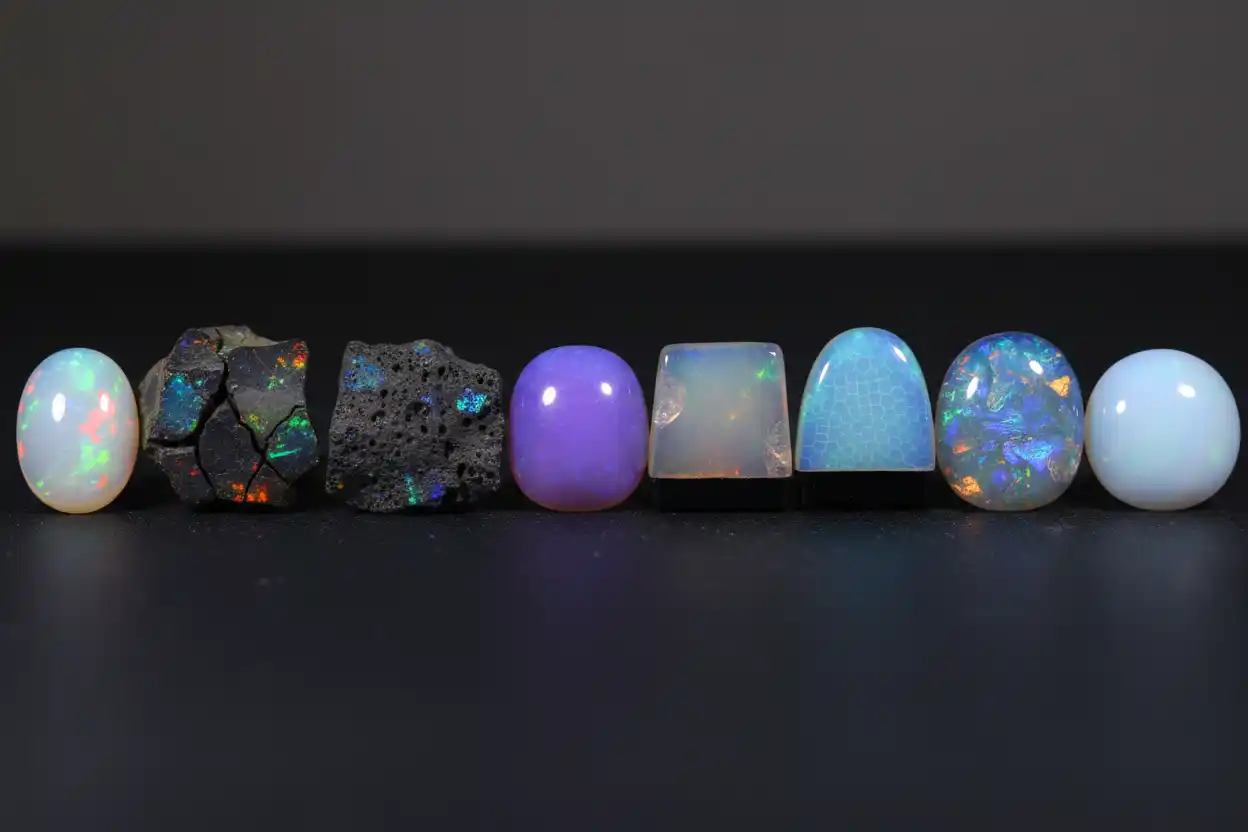
How to Spot Treated or Synthetic Opal
Opal is a hydrated silica material whose appearance depends on its internal structure, water content, porosity, bodycolor, transparency, and—in precious Opal—the orderly arrangement of microscopic silica spheres that produces play-of-color.
Its treatment market is unusually diverse. Porous Opal can be smoked, sugar treated, dyed, impregnated with oil, wax, or plastic, fracture filled, coated, backed, or incorporated into doublets and triplets.
Synthetic Opal is another distinct category. Manufacturers can reproduce an ordered silica-sphere structure that creates genuine diffraction-based play-of-color. Some laboratory-created products also contain polymer or another binder, so synthetic growth and impregnation may describe the same commercial stone.
A treated natural Opal, a synthetic Opal, an assembled doublet, and a plastic imitation are not interchangeable. Each requires its own identification and disclosure.
Opal treatment categories at a glance
| Product category | What it is | Common evidence | Correct description |
|---|---|---|---|
| Natural untreated Opal | Naturally formed hydrated silica | Geological structure, natural inclusions, Opal spectrum | Natural Opal |
| Smoke-treated Opal | Porous Opal darkened with smoke or carbon | Dark concentrations in pits, scratches, pores, and near the surface | Smoke-treated natural Opal |
| Sugar-acid-treated Opal | Sugar introduced and carbonized chemically | Peppery or speckled dark body, carbon within porous matrix | Sugar-treated natural Opal |
| Dyed Opal | Introduced color absorbed into porous or hydrophane material | Dye in pits, cracks, scratches, and drill holes | Dyed natural Opal |
| Oil- or wax-impregnated Opal | Liquid or wax introduced to improve transparency or hide fractures | Greasy luster, filling, temporary transparency change | Impregnated natural Opal |
| Polymer-impregnated Opal | Plastic or resin introduced into pores and fractures | Polymer fluorescence, bubbles, FTIR absorption | Polymer-treated Opal |
| Coated Opal | Clear, colored, or dark surface film | Peeling, worn edges, surface-only color | Coated Opal |
| Opal doublet or triplet | Thin Opal layer bonded to backing or cap | Straight joins, adhesive, separate layers | Assembled Opal |
| Synthetic Opal | Laboratory-created material reproducing Opal structure | Highly regular growth patterns, columns, polymer matrix, spectroscopy | Synthetic Opal |
| Opal imitation | Glass, plastic, resin, foil, or another material | Different structure and physical properties | Opal simulant |
What natural Opal is
Opal is composed mainly of hydrated silica rather than crystalline quartz. Its structure ranges from relatively disordered common Opal to organized sphere arrays capable of diffracting visible light.
The broader material profile appears in Opal: Meaning, Healing Properties & Uses. Its bodycolors, transparency categories, formation styles, geographic varieties, and play-of-color patterns belong to Types of Opal.
Natural Opal can be white, gray, black, brown, orange, yellow, red, blue, green, pink, colorless, or multicolored. Therefore, unusual bodycolor alone does not prove treatment.
Treatment evidence depends on how that color relates to pores, fractures, surface features, and the internal Opal structure.
Why porous Opal is easily treated
Some Opals contain interconnected pores that absorb water, oil, dye, smoke-related particles, and other liquids.
Hydrophane Opal can become more transparent after immersion because liquid replaces air inside its pores. It may return to its original appearance as the liquid evaporates.
Much Ethiopian Opal from Wollo is hydrophane, although not every specimen has the same absorption rate or porosity.
This property enables legitimate identification observations but also makes the material especially receptive to smoke, dye, oil, and polymer.
The focused material profile appears in Ethiopian Opal: Meaning, Properties & Symbolism, while quality and seller concerns belong to the Ethiopian Opal Buying Guide.
Smoke treatment
Smoke treatment darkens porous Opal by allowing fine carbon-rich particles to enter surface openings.
A darker body increases contrast with play-of-color, making spectral flashes appear brighter and more valuable.
Ethiopian hydrophane Opal responds particularly well because its connected pores absorb smoke-derived material readily.
Under magnification, the darkest color may collect around pits, scratches, cavities, cracks, and surface irregularities. The treatment can appear concentrated near the exterior rather than evenly distributed through the full thickness.
Some smoke-treated stones look mottled brown, gray, or black rather than uniformly dark.
The process leaves natural Opal underneath, but the bodycolor is treatment created.
Smoke treatment versus natural black Opal
Natural black Opal has a naturally dark bodycolor caused by its geological composition and inclusions.
The individual material profile appears in Black Opal: Meaning, Properties & Symbolism, while purchase decisions belong to the Black Opal Buying Guide.
A treated pale hydrophane Opal may imitate the contrast and apparent brightness of natural black Opal without sharing its geological bodycolor.
Surface-concentrated black or brown treatment, obvious darkening in scratches, rapid absorption behavior, and treatment-related spectroscopy support smoke treatment.
A dark appearance is not enough to determine locality, origin, or treatment. High-value black Opal requires laboratory testing.
Sugar-acid treatment
Sugar treatment is traditionally associated with porous Opal and matrix material, especially Andamooka matrix Opal.
The stone is soaked in a sugar solution, allowing sugar to enter its pores. Acid is then applied to dehydrate or carbonize the sugar, producing a dark deposit within the matrix.
As with smoke treatment, the darkened background increases contrast and makes play-of-color appear stronger.
Under magnification, treated material may show a peppery, speckled, granular, or uneven dark appearance. Carbon can collect in pores and around Opal-bearing areas.
The process may penetrate more deeply than a simple surface film, making it difficult to recognize from a polished face alone.
Sugar-acid-treated Opal remains natural Opal-bearing material, but its black background was created after mining.
Dyeing hydrophane Opal
Hydrophane Opal can absorb organic dyes in purple, blue, pink, red, green, black, and other colors.
GIA has documented dyed Ethiopian Opals represented as naturally colored Mexican material. Under magnification, color concentrated around pits and surface scratches revealed the treatment pathway.
Dye can also enter drill holes, fractures, cavities, and porous zones. A pale chipped interior may contrast with a saturated surface.
Stable dye may not rub off or bleed in ordinary water. Therefore, a negative cloth test proves little.
The natural color distribution should relate to mineral inclusions or body structure rather than only to liquid-access pathways.
Dye removal is not a safe home test
Laboratory experiments have reduced the visible color of dyed hydrophane Opal using hydrogen peroxide. That does not make peroxide a suitable consumer test.
Hydrophane Opal can crack or craze when immersed, especially if liquid absorption and evaporation occur unevenly.
Acetone, peroxide, bleach, alcohol, and other chemicals may damage dye, polymer, adhesive, coating, setting metal, or the Opal itself.
A destructive test can remove evidence without identifying whether the original stone was natural, synthetic, assembled, or imitation.
Microscopy and spectroscopy provide safer conclusions.
Oil and wax impregnation
Oil or wax can reduce the visibility of fractures, deepen bodycolor, and improve transparency.
When oil enters hydrophane pores, the Opal may appear clearer because the refractive contrast between air and silica is reduced. The effect can reverse as the oil migrates or evaporates.
Wax can fill shallow pits and create a smoother polish. Heat may soften it, while solvents can remove it.
Possible evidence includes a greasy surface, residue in cavities, temporary transparency changes, and different luster where filling reaches the exterior.
Polymer impregnation
Resin or plastic can strengthen fractured or porous Opal, improve transparency, fill cavities, and reduce the risk of breakage during cutting.
A polymer may penetrate much of a hydrophane specimen or remain concentrated around cracks.
Under magnification, bubbles, smooth filler, flash effects, and transparent material bridging fractures may appear. Ultraviolet fluorescence can reveal some polymers, though reactions vary.
FTIR spectroscopy is especially useful because organic polymer absorptions differ from natural hydrated silica.
Synthetic Opal may also contain polymer between manufactured silica spheres or columns. Therefore, detecting polymer does not by itself prove that the silica component formed naturally.
Fracture and cavity filling
Open cracks can be filled with oil, resin, wax, or another substance without impregnating the entire stone.
The filler makes the fracture less reflective and can improve apparent clarity. Colored filler may also alter bodycolor.
Possible clues include bubbles, incomplete filling, flow lines, a different surface luster, or flash colors visible as the stone rotates.
The underlying fracture remains present. Filling does not restore the original silica structure and may create additional heat or chemical sensitivity.
Coatings
A transparent coating can improve luster, protect a weak surface, or seal dye and oil.
Dark or colored coatings may create a black-Opal appearance over pale natural Opal, synthetic Opal, glass, or another material.
Inspect scratches, worn edges, the girdle, the pavilion, and protected areas beneath prongs. A coating may peel, reveal a lighter body, or display surface-only iridescence.
Some coatings are extremely thin and require surface spectroscopy or chemical analysis.
Doublets and triplets
A doublet commonly joins a thin precious-Opal layer to a dark backing. A triplet adds a transparent cap above the Opal.
The backing may be black Chalcedony, Obsidian, common Opal, glass, plastic, or natural host rock. The cap may be quartz, glass, plastic, or synthetic corundum.
These constructions allow thin natural precious Opal to be used in jewelry and can provide good value when disclosed.
They are not synthetic Opal because the color-bearing layer may be natural. They are assembled products whose durability and price differ from solid Opal.
The complete construction framework belongs to Real vs. Fake Opal and Gemstone Doublets and Triplets.
Boulder Opal and natural backing
Boulder Opal occurs naturally as seams or patches attached to ironstone or another host rock.
Its dark natural matrix should not be confused with an artificial doublet backing.
The host and Opal normally share irregular geological boundaries rather than one flat adhesive join.
The material profile appears in Boulder Opal: Meaning, Properties & Symbolism, while seller and quality considerations belong to the Boulder Opal Buying Guide.
Synthetic Opal
Synthetic Opal is laboratory-created material designed to reproduce Opal’s silica-based structure and play-of-color.
Commercial synthesis began decades ago and has produced white, black, fire-color, transparent, opaque, and multicolored products.
Some synthetic Opals contain orderly silica spheres with little or no polymer. Others use polymer or resin to bind, stabilize, or fill the space between silica structures.
The product should be identified as synthetic Opal rather than natural Opal, even when its play-of-color arises through true diffraction rather than a printed foil.
The distinction between laboratory-grown and imitation materials appears in Lab-Grown vs Natural Gemstones.
Synthetic growth patterns
Many synthetic Opals show highly regular columns or repeating color structures.
When viewed from above, the pattern may resemble lizard skin, snakeskin, chicken wire, or a mosaic of similarly sized cells. From the side, color patches may extend in columns through the material.
These features can be diagnostic when they are strongly regular.
However, pattern rules must be applied carefully. Digit-like structures once associated strongly with synthetic products also occur in some natural Ethiopian Opals.
No single geometric pattern should override the complete inclusion scene, structure, spectroscopy, and chemistry.
Polymer-bearing synthetic Opal
Certain synthetic products contain significant polymer.
The organic material improves durability, reduces porosity, and binds the manufactured silica array. It can also lower density and alter heat response.
FTIR detects the polymer, while microscopy reveals the regular manufactured structure.
A polymer-bearing synthetic Opal is not merely a plastic imitation when it contains an engineered silica arrangement responsible for play-of-color. Its exact classification depends on composition and manufacturing process.
Clear report wording is preferable to broad terms such as lab Opal or created Opal without further explanation.
Fire Opal synthesis and treatment
Fire Opal is transparent to translucent Opal with yellow, orange, or red bodycolor and may or may not show play-of-color.
The natural profile appears in Fire Opal: Meaning, Properties & Symbolism, while buying concerns belong to the Fire Opal Buying Guide.
Synthetic fire Opal has been manufactured, and colored glass can also imitate its transparency and bodycolor.
A bright orange stone with no play-of-color should first be confirmed as Opal before treatment or synthetic origin is investigated.
Plastic and glass imitations
Plastic Opal can show convincing play-of-color created by layered or ordered structures.
Some material has been marketed under the name Opalite, although that trade term is also widely used for translucent blue-white glass without natural Opal structure.
The tracker’s Opalite: What It Is, Meaning & Uses explains the modern glass product.
Slocum stone and other glass imitations use foil-like layers, thin films, or structured glass to reproduce spectral flashes.
Glass and plastic differ from Opal in hardness, density, thermal behavior, Raman spectrum, and microscopic structure. The general distinction appears in Glass vs. Crystal.
Professional testing
Microscopy examines pore-related treatment, carbon, dye, filler, coating, joins, synthetic columns, and imitation structures.
Raman spectroscopy identifies Opal, glass, plastic, resin, associated minerals, and some pigments.
FTIR detects water-related absorption and organic polymer, oil, wax, or resin. X-ray diffraction helps distinguish Opal-A, Opal-CT, synthetic structures, and crystalline silica components.
Ultraviolet-visible spectroscopy can identify dye and bodycolor mechanisms.
A laboratory may need to test several areas because one assembled Opal can contain a natural color layer, synthetic cap, dyed backing, and adhesive.
Reports and buying decisions
The Opal Buying Guide owns play-of-color, pattern, brightness, bodycolor, cut, treatment, and seller evaluation. The Opal Price Guide explains how treatment, construction, variety, size, and stability affect value.
Black-Opal-specific purchase questions belong to the Black Opal Buying Guide.
A laboratory report becomes worthwhile for high-value black Opal, unusual natural-color claims, synthetic disputes, major stones, and difficult assembled products.
The completed Gemstone Certification Labs Compared explains report services.
Care
Opal can craze or fracture through dehydration, high heat, and sudden temperature change.
Smoke, dye, oil, wax, polymer, coating, and adhesive introduce further care limitations.
The safest cleaning method is lukewarm water, mild soap, and a soft cloth. Avoid steam, ultrasonic equipment, prolonged soaking, solvents, acids, bleach, and aggressive drying.
The full maintenance workflow appears in How to Clean Opal Jewelry Safely.
Frequently Asked Questions
1. What are the most common Opal treatments?
Smoke treatment, sugar-acid treatment, dye, oil or wax impregnation, polymer impregnation, fracture filling, and coating are important categories.
2. How does smoke treatment improve Opal?
It darkens porous Opal, increasing contrast and making play-of-color appear brighter.
3. What is sugar-treated Opal?
It is porous Opal or matrix material impregnated with sugar and then chemically carbonized to create a dark background.
4. Can Ethiopian Opal be dyed?
Yes. Hydrophane Ethiopian Opal can absorb purple, blue, pink, black, and other dyes through its connected pores.
5. Does dye rubbing off prove treatment?
It can reveal unstable dye, but professionally dyed Opal may not transfer color during ordinary handling.
6. Can Opal be resin impregnated?
Yes. Polymer can fill pores and fractures, improve transparency, and strengthen fragile material.
7. Is an Opal doublet synthetic?
No. It is an assembled product that may contain a thin layer of natural precious Opal bonded to a backing.
8. Is synthetic Opal genuine Opal material?
It is laboratory-created silica-based material designed to reproduce Opal structure and play-of-color, but it did not form naturally.
9. Does a chicken-wire pattern always prove synthetic Opal?
Highly regular cellular patterns support synthesis, but no single pattern should be used without confirming structure and composition.
10. Can natural Opal show digit patterns?
Yes. Digit-like play-of-color patterns have been documented in natural Ethiopian Opal.
11. Is Opalite synthetic Opal?
Usually not. The common modern product called Opalite is translucent manufactured glass, though the name has also been applied inconsistently to other materials.
12. When should Opal receive laboratory testing?
Testing is advisable for expensive black Opal, unusual natural-color claims, synthetic disputes, smoke or sugar-treatment concerns, and assembled stones sold as solid Opal.
Conclusion
Opal’s porosity allows treatment methods that would not work as effectively on many crystalline gemstones. Smoke and sugar-acid processes create darker backgrounds, while dye, oil, wax, polymer, filler, and coatings modify color, transparency, or stability.
Synthetic Opal represents a separate laboratory-created material category. Doublets and triplets are assembled constructions, while glass and plastic products are imitations.
A dependable conclusion studies pores, surface concentrations, internal growth structure, polymer, joins, and spectroscopy. Play-of-color by itself proves neither natural origin nor untreated status.