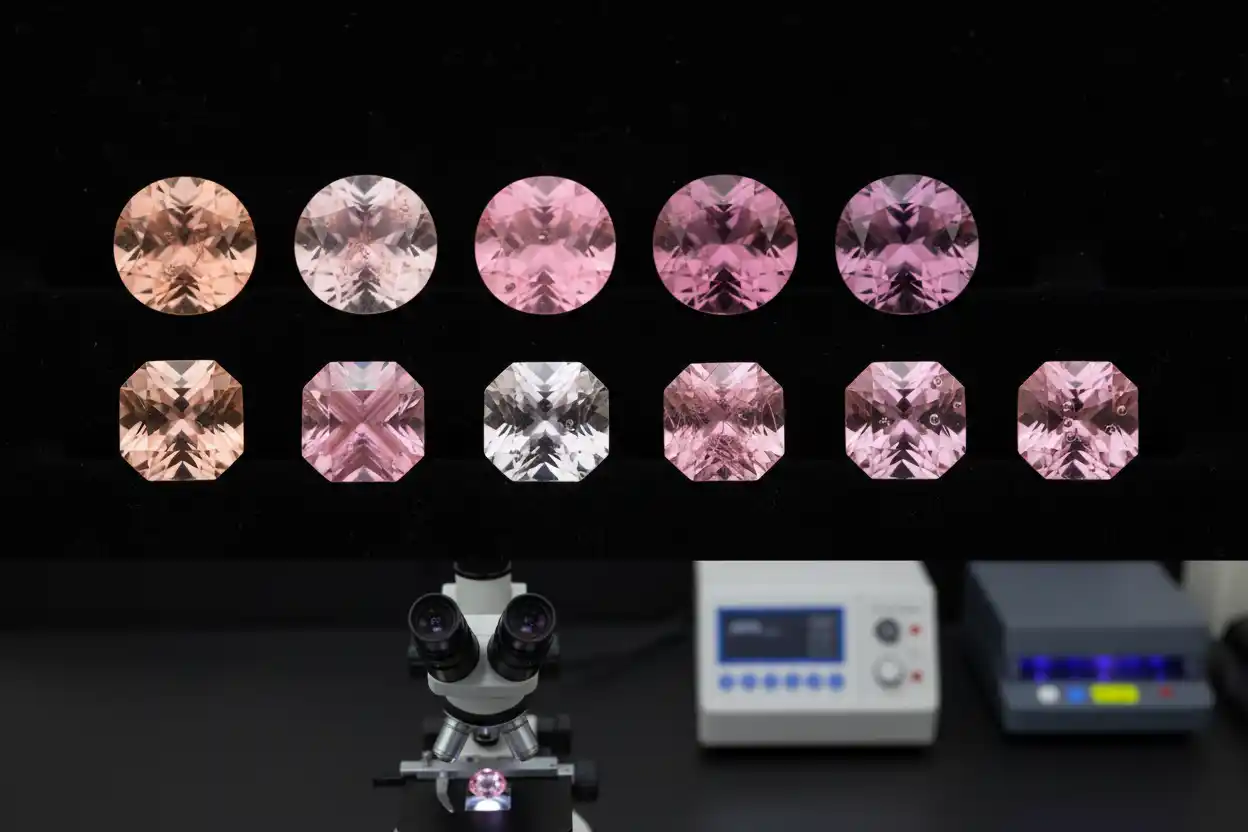
How to Spot Treated or Synthetic Morganite
Morganite is the pink, purplish-pink, salmon, peach, and orange-pink variety of beryl. Manganese produces its color, while iron and the oxidation state of trace elements influence whether the finished gem appears peachier, more orange, or more purely pink.
Heat treatment is routine. It commonly reduces yellow or orange components and leaves a cleaner pink or purplish-pink appearance. The resulting color is considered stable under ordinary wear, and the treatment is often difficult or impossible to prove through standard gemological examination.
Electron irradiation combined with heating has also entered portions of the modern Morganite market, particularly for strongly colored purplish-pink material. This newer color-enhancement route makes exact seller disclosure increasingly important.
Synthetic Morganite exists but is not produced in the same large commercial quantities as synthetic Sapphire, Emerald, quartz, or Diamond. Coatings, dye, fracture filling, glass, synthetic Spinel, pink Sapphire, and assembled stones provide additional identification challenges.
Morganite treatment categories at a glance
| Product category | What it is | Common evidence | Correct description |
|---|---|---|---|
| Natural unheated Morganite | Naturally formed pink-to-orange-pink beryl | Peach, salmon, orange-pink, or natural pink color | Natural Morganite |
| Heat-treated Morganite | Natural Morganite heated to reduce yellow or orange | Purer pink color; treatment often undetectable | Heated natural Morganite |
| Irradiated and heated Morganite | Natural beryl exposed to radiation and controlled heat | Strong purplish-pink color and treatment-related spectroscopy | Treated natural Morganite |
| Coated Morganite | Beryl or another gem covered with a pink film | Edge wear, peeling, surface-only color | Coated gemstone |
| Dyed beryl | Pale or fractured beryl containing introduced pink color | Dye in fractures, drill holes, and cavities | Dyed beryl |
| Fracture-filled Morganite | Open fissures containing resin, oil, wax, or glass | Flash effects, bubbles, filler spectrum | Filled Morganite |
| Synthetic Morganite | Laboratory-grown pink beryl | Synthetic growth structures and analytical evidence | Synthetic Morganite |
| Composite Morganite | Several bonded components | Join planes, backing, adhesive, separate layers | Assembled gemstone |
| Pink glass or synthetic Spinel | Different material imitating Morganite | Different optical properties and inclusions | Morganite simulant |
What natural Morganite is
Morganite belongs to the beryl mineral species, whose ideal composition is Be₃Al₂Si₆O₁₈.
Its relatives include Emerald, Aquamarine, Heliodor, Goshenite, and red beryl. The broader species relationship is explained in Morganite: Meaning, Healing Properties & Uses.
Natural Morganite commonly forms in granitic pegmatites. Crystals can grow large and transparent, which is why sizeable eye-clean faceted stones are more available than comparably clean large Emeralds.
The color often remains pastel. A small stone may appear nearly colorless, while a larger or deeper-cut gem can show stronger saturation.
Natural-color Morganite
Untreated Morganite can appear salmon, peach, orange-pink, pink, purplish pink, or slightly violet pink.
Peach and orange modifiers do not prove low quality or treatment absence. They reflect the original trace-element balance and crystal orientation.
Natural color may also be uneven. Growth zoning, pleochroism, and cutting direction can create slightly different pink intensities across the gem.
A seller should not claim that every peach stone is unheated or every pure pink stone is heated. These are market tendencies rather than conclusive tests.
Routine heat treatment
Morganite is commonly heated to reduce yellow or orange components and leave a purer pink.
The treatment is widely accepted because it is stable and does not introduce a foreign substance. The crystal remains natural beryl.
Heat treatment can make a peach or salmon stone appear pinker, but the exact result depends on trace chemistry, starting color, temperature, duration, and atmosphere.
The Morganite Buying Guide owns the broader balance among color, cut, clarity, size, treatment, and seller documentation.
Why heat may be impossible to detect
The color modification can occur without creating obvious damaged inclusions or a distinct surface feature.
A heated Morganite may retain normal beryl refractive index, density, pleochroism, spectrum, and natural inclusions.
GIA notes that the routine treatment may be undetectable. Consequently, a laboratory can confirm natural Morganite while remaining unable to prove whether its color was heated.
An unheated premium should therefore be approached cautiously. Unless a laboratory has defensible evidence, the claim may reflect seller assumption rather than measurable fact.
Color stability after heat
The pink produced through routine heat treatment is regarded as stable under ordinary wear and light exposure.
That does not mean Morganite should be exposed to a jeweler’s torch. High uncontrolled heat can damage inclusions, fractures, filler, coating, and the setting.
A stone’s stable everyday color and its ability to withstand repair heat are separate questions.
Electron irradiation
Recent trade reports have documented Morganite from Mozambique undergoing lengthy heating and electron irradiation to strengthen attractive purplish-pink color.
The process is not necessarily applied to every Morganite. It represents a developing enhancement route for selected material.
Electron irradiation offers a practical alternative to some neutron-based processes because it avoids the same concerns about induced residual radioactivity.
The color result depends on manganese-related defects, previous natural radiation, heating conditions, stone thickness, and treatment duration.
Irradiation and disclosure
Natural Morganite already develops part of its color through radiation-related changes involving manganese in the beryl structure.
Artificial irradiation can modify the same general defect system, which makes natural-versus-induced color history difficult to interpret visually.
A strongly saturated purplish-pink stone is not automatically irradiated. Natural vivid Morganite exists, and size can strengthen apparent color.
However, sellers offering batches of unusually intense stones should disclose whether radiation and heating were used.
The general treatment terminology appears in Gemstone Treatments Explained.
Neutron versus electron irradiation
Earlier irradiation approaches could use neutron sources. Modern commercial treatment has increasingly explored electron irradiation.
The distinction matters because the equipment, penetration depth, treatment duration, and safety-management requirements differ.
A consumer does not need to identify the radiation source visually. The important requirement is accurate treatment disclosure and confirmation that the product complies with applicable safety controls.
Does irradiation improve clarity?
Radiation primarily affects color centers rather than physically removing inclusions.
A treated parcel may look clearer because stronger color improves visual contrast, heating changes some inclusions, or cutters select cleaner stones for the process.
The seller should not describe irradiation as though it heals fractures or converts included beryl into structurally flawless material.
If apparent clarity depends on resin filling, coating, or fracture concealment, that separate treatment must also be disclosed.
Synthetic Morganite
Laboratory-grown Morganite is pink synthetic beryl.
It has the essential beryl composition and crystal structure, so hardness, density, refractive index, birefringence, and pleochroism overlap natural Morganite.
GIA confirms that synthetic Morganite is produced, although not in large commercial quantities.
Hydrothermal growth is an important method for producing rare synthetic beryls. Crystals develop from hot pressurized solutions on seed material rather than forming in pegmatites.
The origin distinction appears in Lab-Grown vs Natural Gemstones.
Synthetic growth clues
Hydrothermal synthetic beryl may show a seed boundary, chevron or zigzag growth, parallel growth structures, nail-head spicules, metallic particles, or unusual fluid inclusions.
Not every synthetic stone contains a visible diagnostic feature. Clean material can require spectroscopy and trace-element chemistry.
Natural Morganite may contain multiphase inclusions, mineral crystals, needles, growth tubes, veils, healed fractures, and internal zoning.
One inclusion should not carry the full conclusion. Its orientation and relationship to the beryl growth structure matter.
Natural versus synthetic spectroscopy
A refractometer can confirm beryl but cannot prove natural origin.
UV-visible spectroscopy examines manganese-related absorptions and the mechanisms producing pink or purplish-pink color.
FTIR studies water and other constituents within the structural channels of beryl. Natural and hydrothermal synthetic growth environments can create different infrared patterns.
Chemical analysis measures manganese, iron, cesium, lithium, sodium, potassium, chlorine, and other trace constituents that may support natural or synthetic origin.
Microscopy, spectroscopy, and chemistry provide the strongest result when interpreted together.
Coated Morganite
A pale beryl, synthetic stone, glass, quartz, or other transparent material can receive a pink coating.
Possible evidence includes stronger color on pavilion facets, scratches through the film, peeling, colorless facet edges, or different color beneath prongs.
A thin coating can also make a peach stone look more purely pink.
Modern films may be difficult to detect without surface analysis. The absence of obvious peeling does not prove that the bodycolor is intrinsic.
Dye
Morganite is not commonly dyed in the way that porous Agate, Turquoise, or Chalcedony can be.
However, fractured pale beryl, beads, and carvings can accept color through open fissures, tubes, cavities, and drill holes.
Dye may appear as intense pink or purple concentrated along liquid-access pathways.
Natural color zoning follows crystallographic growth rather than only surface-reaching damage.
Do not use solvents as a home test because they can damage dye, filler, coating, adhesive, and metal.
Fracture filling
Surface-reaching cracks can be filled with oil, wax, resin, polymer, or glass-like material.
The filler reduces optical contrast, making the fracture less visible. Colored resin can also improve apparent pink saturation.
Possible microscopic clues include blue, orange, purple, or yellow flash effects, bubbles, flow structures, incomplete filling, and different luster at the fracture opening.
Filling is not as central to Morganite as routine heat treatment, but its durability consequences are greater.
Coating versus irradiation
A coating creates color primarily at the surface. Irradiation changes color centers within the beryl.
An existing chip can expose a coating, while an irradiated color may continue through the stone. Nevertheless, penetration depth can vary, and visual inspection alone may not provide a complete answer.
Surface spectroscopy, immersion, and chemical mapping help distinguish the two processes.
Composite stones
A Morganite doublet may combine natural or synthetic beryl with glass, quartz, pink cement, or another gemstone.
From the side, look for a straight join, adhesive bubbles, color concentrated in one layer, and inclusions that stop at a boundary.
A composite can contain a genuine Morganite component without being one solid natural gem.
The general construction framework appears in Gemstone Doublets and Triplets.
Pink glass and synthetic Spinel
Pink glass can imitate Morganite’s pastel color and high clarity. Possible clues include bubbles, curved flow lines, mold seams, and an amorphous optical response.
Synthetic Spinel can also occur in pale pink or peach shades. It is singly refractive and has different density and refractive index from beryl.
The broad identification workflow belongs to Real vs Fake Morganite. The structural glass distinction appears in Glass vs. Crystal.
Natural lookalikes
Rose Quartz can resemble cloudy or pale Morganite, especially in beads and cabochons. The direct comparison belongs to Morganite vs Rose Quartz.
Kunzite can show pink, lilac-pink, or purplish-pink color but has perfect cleavage and stronger directional color. Its focused comparison appears in Kunzite vs Morganite.
Pink Sapphire, pink Tourmaline, Topaz, Goshenite with a coating, cubic zirconia, and glass can also overlap.
These materials are not fake when sold under their own names. Misrepresentation begins when their identity is replaced by Morganite.
Hardness and durability
Morganite ranks approximately 7.5–8 on the Mohs scale. It has useful scratch resistance but should still be protected from sharp impact and heavily included fractures.
Synthetic Morganite has the same general hardness because it is beryl. A scratch test cannot determine natural origin or heat treatment.
The Gemstone Hardness Chart explains abrasion resistance, while Gemstone Toughness vs Hardness separates scratching from structural damage.
Reports and buying
A report is worthwhile for unusually saturated Morganite, an unheated claim, irradiation disclosure, synthetic-origin concerns, major stones, or a purchase whose price depends on natural color.
The completed Gemstone Certification Labs Compared explains report services. How to Read a Gem Lab Report helps match dimensions, weight, photograph, identification, and treatment wording.
The Morganite Price Guide owns the value effects of color, size, cut, clarity, treatment, and documentation.
Before buying online, follow How to Buy Gemstones Online Without Getting Scammed.
Jewelry care
Warm water, mild soap, and a soft brush provide the safest routine cleaning method.
Steam should be avoided when the stone is fractured, coated, filled, or of uncertain treatment. Ultrasonic cleaning may disturb filler or worsen an open fissure.
High repair heat can affect coating, polymer, adhesive, inclusions, and possibly the color system.
The complete care workflow appears in How to Clean Morganite Jewelry Safely.
Ring-specific setting and maintenance considerations belong to Morganite Engagement Rings and Morganite Rings.
Frequently Asked Questions
1. Is Morganite commonly heat treated?
Yes. Heat treatment is routine and generally removes yellow or orange components to create a purer pink.
2. Is heated Morganite still natural?
Yes. The crystal formed naturally, while heat modified its color.
3. Can laboratories always detect Morganite heat treatment?
No. Routine heating can be difficult or impossible to detect conclusively.
4. Is heat-treated Morganite color stable?
The resulting pink color is generally considered stable under ordinary wear.
5. Can Morganite be irradiated?
Yes. Heating combined with electron irradiation has been reported for strongly colored purplish-pink material.
6. Does irradiation heal Morganite fractures?
No. Irradiation changes color centers rather than repairing structural breaks.
7. Is synthetic Morganite available?
Yes, but it is produced in much smaller commercial quantities than synthetic Emerald, Sapphire, or quartz.
8. Is synthetic Morganite real beryl?
It is laboratory-grown crystalline beryl but is not naturally mined.
9. Can a refractometer separate natural and synthetic Morganite?
No. Their standard beryl properties overlap.
10. Can Morganite be coated?
Yes. A pink surface film can strengthen color on natural beryl, synthetic beryl, glass, or another stone.
11. Can Morganite be fracture filled?
Yes. Resin, oil, wax, or glass-like filler may reduce the visibility of surface-reaching cracks.
12. When should Morganite receive laboratory testing?
Testing is useful for intense purplish-pink stones, unheated claims, irradiation questions, synthetic-origin concerns, coatings, filling, and high-value purchases.
Conclusion
Morganite’s primary treatment is routine heat, which commonly changes peach or orange-pink material into a cleaner pink. The effect is stable but often not detectable, so unsupported unheated claims deserve caution.
Electron irradiation combined with heating has added a newer treatment category for selected strongly colored stones. Synthetic Morganite also exists, although its commercial production remains limited.
A dependable examination confirms beryl, studies natural or synthetic growth, evaluates color mechanism, and checks separately for coating, dye, filler, and composite construction. Pastel pink color and high clarity alone cannot establish any of those conclusions.