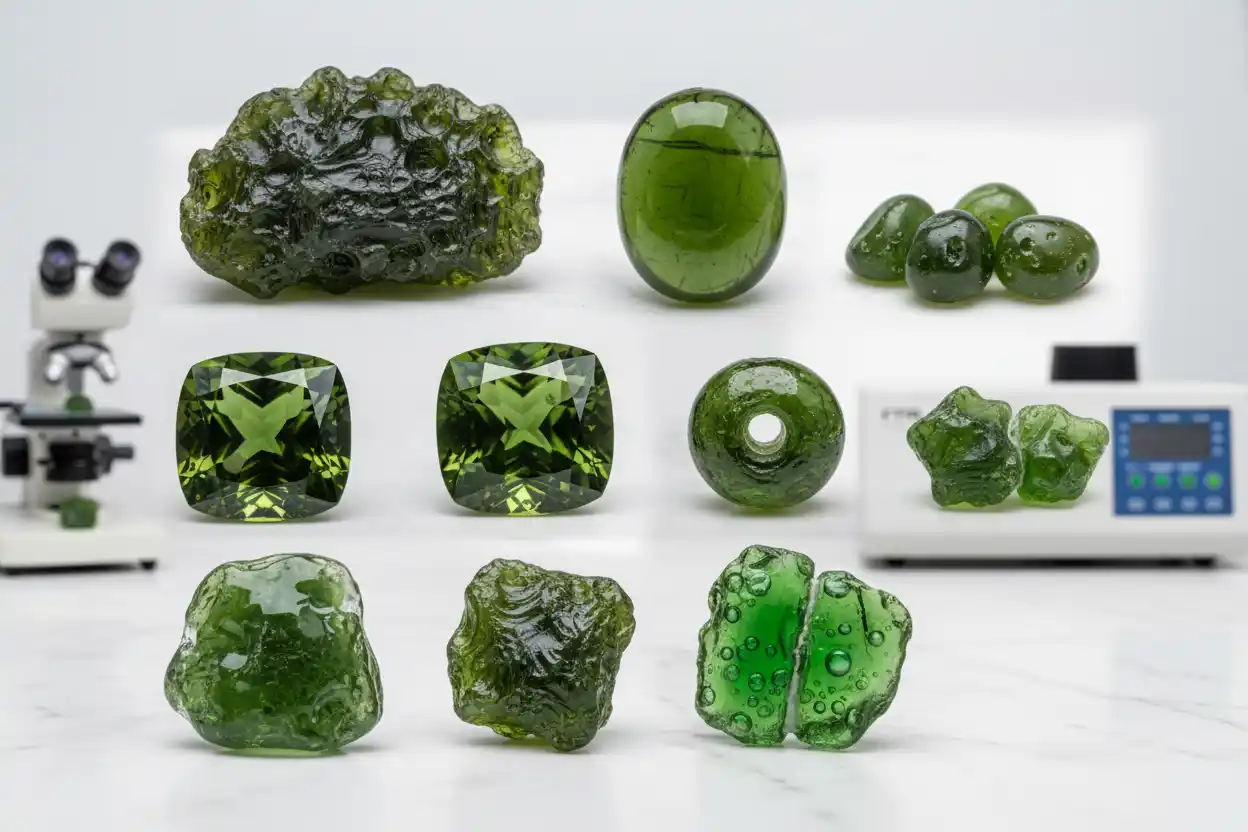
How to Spot Treated or Synthetic Moldavite
Moldavite is a natural green impact glass associated with the Ries impact event in Central Europe. It is already glass rather than a crystalline mineral, so its treatment market differs from those of Ruby, Sapphire, Emerald, or quartz.
Most genuine Moldavite does not require color enhancement. The commercially important alterations are polishing, tumbling, faceting, drilling, carving, surface oiling or coating, fracture filling, repair, and artificial etching intended to imitate or restore a rough natural appearance.
The phrase synthetic Moldavite is scientifically misleading. There is no ordinary laboratory-grown Moldavite equivalent comparable to synthetic Ruby or laboratory-grown Diamond. Manufactured green glass may imitate Moldavite, but it remains imitation glass because it lacks Moldavite’s natural impact origin and Central European geological history.
This page owns treatments and physical alterations only. A post-purchase owner checking one specific piece should use Is My Moldavite Real?. The educational profile of genuine natural material belongs to Real Moldavite, while direct natural-versus-manufactured-glass differences belong to Real vs Fake Moldavite.
Moldavite alteration categories at a glance
| Product category | What was changed | Main consequence | Correct description |
|---|---|---|---|
| Natural rough Moldavite | No deliberate reshaping beyond cleaning | Original sculptured surface retained | Natural rough Moldavite |
| Polished Moldavite | One or more surfaces ground and polished | Natural surface removed from polished areas | Polished natural Moldavite |
| Tumbled Moldavite | Edges and exterior rounded mechanically | Surface sculpturing largely lost | Tumbled natural Moldavite |
| Faceted Moldavite | Natural glass cut into a gemstone | Rough form and exterior removed | Faceted natural Moldavite |
| Drilled or carved Moldavite | Hole, groove, or decorative form added | Material removed and stress introduced | Modified natural Moldavite |
| Oiled or waxed Moldavite | Surface covered to deepen color or luster | Temporary wet look and hidden abrasion | Surface-treated Moldavite |
| Coated Moldavite | Clear or colored film applied | Appearance and care depend on coating | Coated Moldavite |
| Fracture-filled Moldavite | Resin or another substance placed in cracks | Fracture visibility reduced | Filled natural Moldavite |
| Repaired Moldavite | Broken sections joined with adhesive | Structural integrity and collector value affected | Repaired Moldavite |
| Artificially etched material | Surface chemically or mechanically sculpted | Natural-looking pits can be manufactured | Etched glass requiring identification |
| “Synthetic Moldavite” | Manufactured glass sold under Moldavite terminology | No natural impact origin | Moldavite imitation |
Natural rough Moldavite
Rough Moldavite may preserve pits, grooves, ridges, channels, sharp projections, rounded depressions, and other sculptured forms.
Much of this exterior developed after deposition as groundwater and soil chemistry etched the glass over geological time. The surface is therefore not simply a frozen splash pattern from atmospheric flight.
Shape and sculpturing vary with locality, transport, breakage, burial environment, chemical composition, and time spent in the deposit.
The broader formation, localities, composition, physical properties, and natural forms belong to Moldavite: Meaning, Healing Properties & Uses. This treatment page focuses on what happens after the material enters human hands.
Polishing
Polishing removes scratches, pits, weathered glass, and natural exterior texture from selected areas.
A partially polished specimen may retain rough sculpturing on one side while exposing transparent internal flow features on another. This can be useful for study and display.
A fully polished piece has a smoother, brighter surface and may show its internal bubbles and flow structure more clearly. However, it no longer retains an untouched natural exterior.
Polished Moldavite is still genuine Moldavite when the underlying glass is authentic. The seller should describe it as polished rather than imply that the smooth surface is naturally water worn.
Tumbling
Tumbling rounds edges and repeatedly abrades the entire exterior.
The process usually removes most natural sculpturing, producing pebble-like shapes with soft curves and a consistent polish.
Tumbled Moldavite can be comfortable for beads, pockets, and jewelry. Nevertheless, collectors who value natural morphology generally prefer material retaining its original etched surface.
A rounded form should not automatically be called fake because genuine fragments can be tumbled intentionally. At the same time, a smooth green pebble cannot be authenticated through surface texture because the identifying exterior has been removed.
Faceting
Transparent Moldavite can be faceted into conventional gemstone shapes.
Cutting removes the natural rough surface and reveals the internal glass. A well-cut stone may show olive, bottle-green, yellow-green, or brownish-green color with internal flow structures and bubbles.
Faceted Moldavite is a legitimate natural-glass gemstone, not a treated fake.
However, faceting also makes ordinary manufactured green glass easier to substitute because the natural exterior is gone. Refractive index, density, inclusions, chemistry, and FTIR become more important.
The purchase and cutting-quality questions belong to the Moldavite Buying Guide.
Drilling and carving
A bead hole, pendant groove, carving, or polished window is a human modification.
Drilling introduces stress and can create small chips or radiating fractures around the opening. Aggressive pressure can break the brittle glass.
A seller should not present a drilled point or decorative form as an untouched natural specimen.
For collector-grade material, the location and quality of drilling matter because unnecessary removal of a rare natural surface can reduce appeal.
Natural sculpturing versus artificial etching
Natural Moldavite sculpturing developed through prolonged geological weathering and chemical interaction.
Manufacturers can imitate that appearance by casting green glass in textured molds and then applying mechanical or chemical surface treatment. Artificial pits may therefore look impressively irregular.
Peer-reviewed research has shown that artificial hydrofluoric-acid etching can create glass surfaces resembling natural Moldavite sculpturing. The Moldavite Museum in Český Krumlov likewise warns that imitation glass may be cast, mechanically worked, and chemically treated to produce a convincing exterior.
Artificial etching can also be applied to polished glass to expose or emphasize flow structure. Consequently, an etched surface is not proof of natural impact glass.
Artificial etching of genuine Moldavite
A genuine polished fragment can theoretically be re-etched to restore texture, highlight flow lines, or create a more dramatic exterior.
The resulting object remains Moldavite in material identity but no longer has an untouched geological surface.
This alteration should be disclosed because the texture may otherwise be mistaken for natural sculpturing tied to a particular locality or collector grade.
The treatment can also make later authenticity work more difficult by mixing genuine internal composition with human-created external features.
Molded imitation texture
A mold can reproduce grooves, spikes, and pits from an original specimen.
Repeated pieces from the same mold may share identical ridges, depressions, and defects. Comparing several seller photographs can reveal duplicated surface patterns.
Chemical or abrasive finishing can soften mold seams and make the texture less obviously manufactured.
The complete side-by-side fake-detection workflow remains with Real vs Fake Moldavite rather than this treatment article.
Oiling
Oil can deepen green color, create a wet appearance, reduce the visibility of fine scratches, and make a dry or abraded surface seem more transparent.
The effect is temporary. Oil can migrate, collect dust, become patchy, or disappear during cleaning.
Residue may accumulate in pits, drill holes, deep grooves, or repaired areas. Under magnification, the surface can show unusual gloss that does not match fresh glass.
An oiled specimen remains genuine Moldavite when the base material is authentic, but the treatment should be disclosed if it materially changes appearance.
Waxing
Wax performs a similar role by increasing luster and filling shallow surface irregularities.
It may make heavily etched material appear darker or smoother. Heat can soften it, while solvents and polishing can remove it.
Wax is particularly important when judging photographs because the surface may look richer and less matte than it does after the treatment wears away.
Clear coatings
A transparent polymer coating can strengthen surface gloss, reduce abrasion visibility, seal unstable oil, or make a weak imitation look more glass-like.
Possible clues include peeling, scratches through the film, bubbles, pooling in depressions, or a plastic-like surface.
A coating may also cover a repaired seam or fracture filler.
FTIR and Raman spectroscopy can distinguish organic surface material from the underlying natural glass.
Colored coatings
A pale glass or weakly colored imitation may receive a green coating.
Color concentrated only at the surface, beneath protected wire, or inside deep pits can reveal the treatment. An existing chip may expose a different bodycolor.
Because Moldavite is naturally green, coating detection must focus on where the color resides rather than whether green is present.
Fracture filling
Surface-reaching fractures can be filled with resin, oil, wax, or another transparent substance.
Filler reduces optical contrast, making the crack less visible. Colored filler can also deepen the local green appearance.
Under magnification, possible evidence includes bubbles, smooth foreign material within a rough crack, flash colors, incomplete filling, or differing luster at the surface.
The fracture remains structurally present. Filled Moldavite should receive gentler cleaning and a lower value than a comparable sound untreated piece.
Repairs and glued specimens
Broken Moldavite fragments can be rejoined with transparent adhesive.
Repairs may be performed to preserve an unusual shape, restore jewelry, or reconstruct a larger specimen.
Possible clues include a straight or curving glue line, bubbles, yellowing, mismatched flow structures, ultraviolet fluorescence, and a surface seam that interrupts natural sculpturing.
A repaired specimen can still contain only genuine Moldavite, but it is not one intact natural piece.
The general assembled-material framework appears in Gemstone Doublets and Triplets.
Heat is not a normal enhancement
Moldavite does not receive routine heat treatment comparable to Sapphire, Ruby, Tanzanite, or Citrine.
Strong heat can soften, deform, crack, devitrify, or permanently alter glass. It can also damage coatings, adhesive, filler, wire, and settings.
Do not use a flame, hot needle, kiln, or torch as an authenticity test. Such methods can destroy genuine material and release fumes from treatments or jewelry components.
Irradiation and diffusion are not normal Moldavite treatments
Commercial Moldavite does not depend on routine irradiation or lattice diffusion to create its green color.
A seller using terminology such as irradiated Moldavite, diffusion-treated Moldavite, or lab-grown Moldavite should provide precise independent evidence.
In most ordinary retail cases, manufactured green glass or coating is more plausible than a sophisticated treatment reproducing natural Moldavite.
Why “synthetic Moldavite” is an imitation
Synthetic gemstone terminology normally applies to a laboratory-grown product that reproduces the essential composition and structure of a natural gem.
Moldavite is an amorphous impact glass whose identity includes its natural formation during the Ries impact and deposition in the Central European strewn field.
Manufactured glass can imitate its color, chemistry, bubbles, flow lines, and etched surface. It still lacks the natural impact origin required by the Moldavite name.
Therefore, synthetic Moldavite is better described as artificial glass imitating Moldavite.
The wider terminology appears in Lab-Grown vs Natural Gemstones and Glass vs. Crystal.
Professional testing after alteration
Polishing and faceting remove the natural exterior but leave the internal glass available for analysis.
Microscopy can examine stretched bubbles, flow structures, inclusions, repairs, filler, and coating. These observations must be interpreted carefully because artificial glass can also contain bubbles and flow lines.
FTIR spectroscopy can distinguish natural Moldavite from manufactured glass through characteristic spectral differences. Raman spectroscopy and chemical analysis provide additional composition data.
Several surface and interior areas may require testing when a piece has been coated, repaired, or partially polished.
The broader consumer examination sequence appears in How to Identify Crystals.
Treatment and value
An untouched natural specimen with attractive sculpturing generally receives more collector interest than a comparable tumbled or heavily polished piece.
Faceted Moldavite occupies a different value category. Its price depends on color, transparency, size, cut quality, internal features, and confidence in natural origin rather than natural exterior sculpturing.
Oiling and wax usually add little legitimate value. Undisclosed coating, filler, artificial etching, or repair can reduce trust and price substantially.
The Moldavite Price Guide owns detailed market factors rather than this treatment page.
Buying disclosure
Ask whether the piece is rough, polished, tumbled, faceted, drilled, etched, coated, filled, or repaired.
A seller should also distinguish a natural polished surface from a human-created imitation texture.
Photographs should show the front, back, sides, drill holes, chips, and any polished windows. A certificate supplied by the retailer is not equivalent to independent laboratory analysis.
The completed Gemstone Certification Labs Compared explains report services, while How to Read a Gem Lab Report helps evaluate the resulting document.
Before ordering, follow How to Buy Gemstones Online Without Getting Scammed.
Care
Use lukewarm water, mild soap, and a soft brush or cloth. Clean deep pits gently rather than forcing metal tools into them.
Avoid steam, sudden temperature changes, abrasive powders, acids, and household solvents. Ultrasonic cleaning is unsuitable when the piece is fractured, filled, coated, repaired, or wire set.
The tracker’s How to Cleanse and Charge Moldavite page owns non-damaging traditional handling rather than physical treatment detection.
Frequently Asked Questions
1. Is polished Moldavite still genuine?
Yes. Polishing removes the natural exterior but does not change authentic Moldavite into manufactured glass.
2. Is tumbled Moldavite fake?
No. Genuine fragments can be tumbled, although the process removes most collector-relevant surface sculpturing.
3. Can Moldavite be faceted?
Yes. Transparent material can be faceted into conventional gemstone shapes.
4. Does faceting make Moldavite harder to authenticate?
It can, because the natural rough surface is removed and manufactured green glass can look similar after cutting.
5. Can genuine Moldavite be artificially etched?
Yes. A polished genuine piece can be re-etched, but the resulting texture is no longer an untouched natural surface.
6. Can fake glass be chemically etched?
Yes. Manufactured glass can be mechanically and chemically treated to imitate natural Moldavite sculpturing.
7. Can Moldavite be oiled or waxed?
Yes. Oil or wax can deepen color, increase gloss, and conceal fine abrasion temporarily.
8. Can Moldavite be resin coated?
Yes. A clear or colored polymer can alter luster, color, and care requirements.
9. Can Moldavite fractures be filled?
Yes. Resin, oil, wax, or another substance can reduce the visibility of surface-reaching cracks.
10. Is synthetic Moldavite a true laboratory-grown gem?
No. Manufactured glass lacks Moldavite’s natural impact origin and is an imitation rather than a true synthetic counterpart.
11. Does artificial etching prove a piece is fake?
No. Genuine Moldavite can also be re-etched, so the base glass must be identified separately.
12. Which alterations reduce Moldavite value most?
Undisclosed artificial etching, coating, fracture filling, major repair, and reconstruction usually have the greatest negative effect.
Conclusion
Moldavite treatment is primarily physical rather than color based. Polishing, tumbling, faceting, drilling, oiling, coating, filling, repair, and re-etching change how the natural glass looks and how it should be valued.
Artificial etching creates the greatest confusion because it can give manufactured glass a convincing natural-looking surface or give polished genuine Moldavite a false untouched appearance.
The term synthetic Moldavite should not be used as though a true laboratory-grown equivalent exists. The correct material distinction remains natural Central European impact glass versus manufactured imitation glass, followed by a separate disclosure of every human alteration.