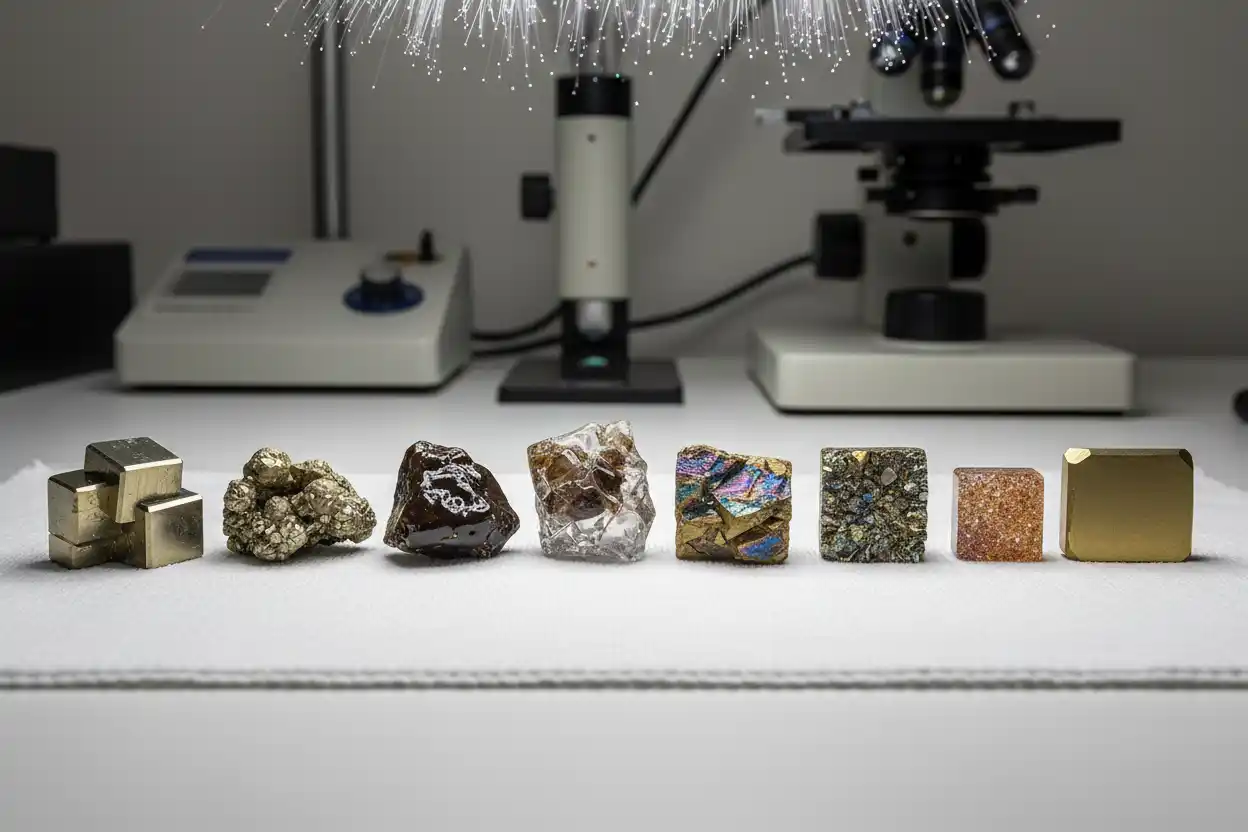
How to Spot Treated or Synthetic Pyrite
Pyrite is an iron disulfide mineral with the formula FeS₂. Its pale brass-yellow color, metallic luster, cubic crystals, striated faces, and dense mineral feel give it the familiar nickname fool’s gold.
Unlike Ruby, Sapphire, Emerald, or Topaz, Pyrite does not have a major commercial treatment market intended to improve transparent gemstone color or clarity. Most collector cubes, clusters, suns, concretions, and tumbled pieces are sold with their natural metallic appearance.
Treatments still occur. Oils, waxes, lacquers, acrylic films, silicone products, and resins may be used to deepen luster, slow oxidation, strengthen friable aggregates, seal porous matrix, repair broken crystals, or bond fragments into decorative objects. Heat and chemicals can also create artificial tarnish or iridescent surfaces.
Laboratory-made Pyrite exists, particularly as microcrystals, nanocrystals, powders, films, and research materials. However, large synthetic collector cubes and jewelry stones are not a routine retail category. Products advertised vaguely as synthetic Pyrite are more likely metallic glass, resin, ceramic, reconstructed mineral fragments, Chalcopyrite, Goldstone, or another imitation.
Pyrite alteration and treatment categories at a glance
| Product category | What it is | Common evidence | Correct description |
|---|---|---|---|
| Natural untreated Pyrite | Naturally formed FeS₂ mineral | Cubic or pyritohedral habit, striations, metallic streak and Pyrite spectrum | Natural Pyrite |
| Oiled or waxed Pyrite | Surface treatment used to deepen luster or reduce moisture exposure | Greasy film, residue in recesses, uneven shine | Surface-treated Pyrite |
| Lacquered or polymer-coated Pyrite | Clear protective film applied over the mineral | Peeling, scratches through film, bubbles or plastic-like gloss | Coated natural Pyrite |
| Resin-stabilized Pyrite | Fragile aggregate or matrix impregnated with polymer | Resin between crystals, fluorescence, bubbles, filled pores | Stabilized Pyrite specimen |
| Repaired Pyrite | Broken crystals or matrix rejoined with adhesive | Glue line, misaligned crystal faces, contrasting fluorescence | Repaired specimen |
| Reconstructed Pyrite | Chips, powder, or small crystals bonded into a manufactured object | Binder between particles, molded body, repeated texture | Composite containing Pyrite |
| Artificially tarnished Pyrite | Surface chemically or thermally altered | Iridescent film, color restricted to exterior | Surface-altered Pyrite |
| Laboratory-made Pyrite | Human-produced FeS₂ material | Synthetic microstructure, controlled morphology, analytical confirmation | Synthetic Pyrite |
| Pyrite imitation | Glass, resin, ceramic, Goldstone, Chalcopyrite, or another material | Wrong structure, density, streak, spectrum, or texture | Pyrite simulant |
What natural Pyrite is
Pyrite is the cubic form of iron disulfide. It can form cubes, pyritohedra, octahedra, combinations of those forms, granular masses, radiating aggregates, concretions, replacement fossils, and microscopic framboids.
Its broader mineral identity, geology, and traditional uses appear in Pyrite: Meaning, Healing Properties & Uses.
Natural cubes commonly show fine parallel striations across their faces. Adjacent cube faces may carry striations in different directions because of the mineral’s crystal symmetry.
Pyrite can also occur without visible cubic form. Massive, granular, nodular, radiating, and sedimentary material may look less geometric while retaining the same FeS₂ composition.
The full mineral-authentication decision tree belongs to Real vs Fake Pyrite. This page is narrower: it addresses what may have been added to, removed from, or manufactured around genuine Pyrite.
Routine color treatment is uncommon
Natural Pyrite already has a strong metallic luster and recognizable brass-yellow appearance. Consequently, ordinary specimens do not need dye to become marketable.
A vivid golden color is not proof of coating. Freshly broken or well-preserved Pyrite can appear bright and reflective without enhancement.
Likewise, a dull, brown, gray, or iridescent surface is not necessarily artificial. Natural oxidation, weathering, mineral films, and storage conditions can change the exterior over time.
The relevant question is whether the surface appearance developed through natural alteration or through a deliberately applied film, chemical, oil, wax, heat treatment, or pigment.
Oiling
A thin oil film can make Pyrite look darker, smoother, and more reflective. It may also reduce direct contact with humid air temporarily.
Residue can collect in crystal intersections, cavities, drill holes, matrix pores, and recessed parts of a carving. Dust may adhere to those oily areas.
The treatment is not permanent. Oil can migrate, evaporate, become sticky, discolor, or require renewal.
An oiled specimen remains natural Pyrite when the underlying mineral formed naturally. However, the seller should disclose the treatment if it noticeably changes the luster or conceals surface deterioration.
Waxing
Wax may be rubbed over a polished cabochon, bead, carved object, or crystal cluster to create a smoother shine and reduce surface exposure.
The wax can fill microscopic pits and make a rough surface look more coherent. Heat may soften it, while solvents or vigorous cleaning can remove it.
A waxed Pyrite object may feel slightly greasy or show cloudy residue around edges. Yet touch alone is not a reliable test because natural metallic surfaces, skin oil, and previous handling create similar sensations.
FTIR spectroscopy can confirm many organic waxes more reliably than visual inspection.
Lacquer and acrylic coatings
Clear lacquer, acrylic resin, and related coatings may be applied to slow contact with oxygen and moisture.
The film can also keep loose grains attached, prevent staining of nearby surfaces, and make tarnished material look more uniform.
Possible clues include peeling, scratches that expose a different luster beneath, bubbles, pooling between crystals, transparent bridges over cavities, or an unusually plastic-like gloss.
A good coating can be difficult to see, especially over a complex cluster. Ultraviolet light may reveal contrasting fluorescence, although some polymers remain inert.
Coating does not make unstable Pyrite permanently safe. Moisture can enter through scratches, the underside, matrix, or areas where the film did not penetrate.
Silicone and conservation coatings
Museums and conservators have investigated silicone, acrylic, fluorinated, and related protective films for oxidation-prone iron-sulfide specimens.
These products may reduce exposure when applied under controlled conditions, but no coating can reverse oxidation that has already progressed through a specimen.
A sealed surface can also trap moisture or acidic alteration products if the Pyrite was not dry and stable before treatment.
Collector pieces described as professionally stabilized should therefore include information about the coating, preparation, and storage recommendations rather than only a glossy appearance.
Resin stabilization
Fragile Pyrite can occur as microscopic crystals within shale, coal, fossils, porous rock, or crumbly sedimentary matrix.
Clear resin may be introduced to hold the specimen together, reduce flaking, or prevent delicate crystals from detaching during cutting and polishing.
Under magnification, the polymer may appear between grains, over natural pits, within cracks, or as a continuous layer beneath a group of crystals. Bubbles and fluorescence can provide additional clues.
A stabilized specimen may be easier to handle, but its structure depends partly on resin. Heat, solvents, ultraviolet exposure, and aging can yellow or weaken the polymer.
Fracture filling
Open cracks in polished Pyrite, matrix pieces, cabochons, or decorative slabs can be filled with clear, dark, or metallic-looking resin.
The filler may conceal a fracture, level the surface, strengthen a thin section, or create the appearance of continuous mineral.
Possible signs include smooth material across a rough break, round bubbles, shrinkage gaps, different reflectivity, or a line where the filler meets Pyrite.
The original fracture remains present. Filling does not recreate the cubic FeS₂ lattice or restore the object to one naturally coherent crystal.
Repairs
Individual cubes can break away from a cluster during mining, shipment, or handling. A dealer or collector may glue them back into position.
Repairs are not necessarily deceptive when disclosed. They can preserve an attractive specimen that would otherwise remain damaged.
Examine the base of apparently isolated cubes, crystal contacts, matrix fractures, and areas where striation directions suddenly fail to align.
Adhesive may fluoresce, contain bubbles, yellow with age, or create a glossy seam between naturally rough surfaces.
A repaired Pyrite cluster should not be represented as completely intact natural growth.
Reconstructed Pyrite
Small crystals, chips, metallic powder, and mineral fragments can be bonded with resin into spheres, skulls, pyramids, cabochons, beads, and decorative blocks.
The object may contain genuine Pyrite but did not form as one natural mineral mass.
Under magnification, individual grains may sit inside transparent binder. Repeated particle size, mold seams, bubbles, a smooth polymer skin, or crystals that stop abruptly at the exterior support reconstruction.
A correct description should use terms such as composite, resin-bonded, reconstructed, or reconstituted Pyrite.
Artificially created rainbow surfaces
Pyrite can develop iridescent blue, purple, green, bronze, red, or orange tarnish through oxidation and thin surface films.
Similar colors may be created deliberately through heat or chemical exposure. A treated surface can imitate naturally weathered rainbow Pyrite or the iridescence associated with some other sulfides.
The strongest clue is color confined to the outermost layer. A scratch, chip, or fresh break may expose ordinary brass-yellow Pyrite beneath.
Do not scratch a valuable specimen to test this. Microscopy, reflectance, Raman analysis, and surface chemistry can determine whether the film is an oxidation product, coating, or another mineral.
Heat treatment
Heating Pyrite can alter its sulfur content, oxidize its surface, create iron oxides, and change color or luster.
The result is generally deterioration or surface modification rather than a stable fine-gem enhancement.
High heat may crack the specimen, release sulfur-containing fumes, damage resin, or transform parts of the mineral into other iron compounds.
A heated or torched specimen should not be described as naturally rainbow-colored without evidence.
Never use flame as an authenticity test.
Pyrite oxidation and “Pyrite disease”
Pyrite can oxidize when oxygen and moisture interact with reactive surfaces, especially in fine-grained, framboidal, porous, fractured, or impurity-rich material.
Deterioration may produce white, yellow, greenish, or brown sulfate crusts, a sulfurous or acidic odor, cracking, swelling, powdering, and damage to nearby labels, boxes, fossils, or minerals.
This process is often called Pyrite disease in conservation contexts. It is alteration, not a desirable treatment.
Large clean crystals can remain stable for many years, while a fine-grained fossil replacement may deteriorate rapidly. The difference reflects texture, impurities, microcracks, humidity, and storage rather than the Pyrite name alone.
Keep vulnerable specimens dry, isolated, and away from repeated humidity changes.
Protective coating versus active oxidation
A shiny coating can temporarily conceal powdering or dark alteration beneath it.
Inspect the underside, matrix, crystal contacts, and any uncoated areas. Active oxidation may continue beneath a polymer layer if oxygen or moisture entered before sealing.
A treatment that hides deterioration without stabilizing the cause can make later conservation more difficult.
Collectors purchasing expensive fossils or large aggregates should request recent photographs and information about storage history, odor, powdering, and previous consolidation.
“Marcasite” jewelry is usually Pyrite
Marcasite and Pyrite share the composition FeS₂ but have different crystal structures.
The material historically called marcasite in jewelry is generally cut Pyrite rather than true orthorhombic Marcasite. The separate mineral appears in Marcasite: Meaning, Properties & Symbolism.
Small faceted Pyrites may be set into silver in pavé-like arrangements. Adhesives, foil backs, plating, tarnish removers, and metal coatings can complicate their treatment history.
A marcasite jewelry label is traditional trade usage. It should not be interpreted as proof that the stones are the mineral Marcasite.
Chalcopyrite and Peacock Ore
Chalcopyrite is copper iron sulfide with a warmer yellow color and lower hardness than Pyrite.
Its natural or artificially enhanced tarnish can create vivid purple, blue, green, and gold surfaces. The mineral profile appears in Chalcopyrite: Meaning, Properties & Symbolism.
Some material sold as rainbow Pyrite or Peacock Pyrite is actually treated Chalcopyrite. Others may be Bornite, mixed sulfide rock, or coated Pyrite.
Raman spectroscopy and chemical analysis separate the minerals more reliably than color.
Goldstone and metallic imitations
Goldstone: What It Is, Meaning & Uses is a manufactured glass containing reflective metallic crystals. It can imitate sparkling Pyrite in beads, carved shapes, and decorative objects.
Goldstone normally shows many evenly distributed glitter points inside a glassy body rather than natural cubic Pyrite crystals.
Metallic resin can contain Pyrite powder, brass flakes, iron particles, glitter, or pigment. Ceramic and electroplated plastic can create additional imitations.
The structural distinction appears in Glass vs. Crystal.
Hematite and coated metallic stones
Hematite has a steel-gray to black metallic appearance and a red-brown streak. Its broader identity appears in Hematite: Meaning, Healing Properties & Uses.
Coated Hematite, synthetic magnetic material, and metallic glass may receive golden finishes that resemble Pyrite.
A golden surface over a dark chip or red-brown streak does not fit ordinary solid Pyrite.
Do not perform a destructive streak test on jewelry or finished objects. Raman, XRD, density, and chemical testing provide safer confirmation.
Is synthetic Pyrite real?
Laboratories can produce FeS₂ Pyrite through hydrothermal, solvothermal, microwave-assisted, vapor-growth, high-pressure, and other methods.
Most reported synthetic products are powders, films, nanocubes, microcrystals, nanowires, or small research crystals designed for batteries, solar energy, catalysis, sensors, and materials science.
They are genuine synthetic Pyrite in a strict compositional sense.
However, this does not mean that large perfect retail cubes are routinely laboratory grown. Natural Pyrite is abundant and already forms attractive geometric crystals, so industrial synthesis does not offer the same commercial incentive found with Ruby, Emerald, or Diamond.
A seller claiming laboratory-grown collector Pyrite should provide independent XRD, Raman, chemical, and growth documentation.
Professional identification
The How to Identify Crystals workflow begins with crystal habit, luster, streak, hardness, density, and associated minerals.
X-ray diffraction confirms cubic Pyrite and separates it from Marcasite and other iron sulfides. Raman spectroscopy provides rapid phase identification.
Scanning electron microscopy reveals synthetic microstructure, coatings, oxidation products, and reconstructed particles. FTIR identifies resin, wax, oil, and organic film.
X-ray fluorescence or electron-based chemical analysis confirms iron and sulfur while revealing copper, nickel, arsenic, cobalt, or coating elements.
A single surface measurement may identify only the coating. Several areas and a fresh analytical spot may be needed.
Buying and reports
The seller-focused workflow appears in Where to Buy Real Pyrite.
Ask whether the specimen has been lacquered, stabilized, repaired, glued, artificially tarnished, or reconstructed. For fossils and fine-grained matrix pieces, ask about storage humidity and any history of powdering.
A major laboratory report is rarely economical for an ordinary cube. It becomes useful for unusual synthetic claims, valuable repaired specimens, museum-quality fossils, reconstructed objects, or disputed mineral identity.
The completed Gemstone Certification Labs Compared explains testing scope. Use How to Read a Gem Lab Report to match the material, treatment, dimensions, photograph, and tested areas to the specimen.
Before purchasing from an unfamiliar marketplace, follow How to Buy Gemstones Online Without Getting Scammed.
Durability and care
Pyrite has Mohs hardness around 6–6.5 but is brittle. Its position appears in the Gemstone Hardness Chart.
The relationship between abrasion and breakage is explained in Gemstone Toughness vs Hardness and Gemstone Cleavage Explained.
Avoid prolonged water contact, steam, ultrasonic cleaning, salt, acids, bleach, and high humidity. Water can enter fractures and porous matrix, while chemicals may attack oxidation products, coatings, adhesives, or metal settings.
Dust with a soft dry brush or microfiber cloth. Traditional nonwater handling appears in How to Cleanse and Charge Pyrite.
Frequently Asked Questions
1. Is Pyrite commonly treated?
Routine color enhancement is uncommon, but oil, wax, lacquer, resin stabilization, repair, artificial tarnish, and reconstruction can occur.
2. Why is Pyrite coated?
A coating may improve luster, hold loose grains together, reduce staining, or slow contact with oxygen and moisture.
3. Does lacquer stop Pyrite disease permanently?
No. Moisture or oxygen can enter through cracks, matrix, or uncoated areas, and active oxidation may continue beneath a film.
4. Can Pyrite be resin stabilized?
Yes. Fragile clusters, fossils, porous aggregates, and matrix specimens may be impregnated or consolidated with polymer.
5. What is reconstructed Pyrite?
It is a manufactured composite made from Pyrite fragments, crystals, or powder held together with resin, glass, cement, or another binder.
6. Can Pyrite be made rainbow colored?
Heat, chemicals, coatings, and oxidation can create iridescent surface films, although natural tarnish also occurs.
7. Is “marcasite” jewelry made from Pyrite?
Most jewelry sold under the traditional marcasite name uses faceted Pyrite rather than the mineral Marcasite.
8. Is Peacock Ore treated Pyrite?
It may be naturally or artificially tarnished Chalcopyrite, Bornite, mixed sulfide material, or occasionally altered Pyrite. Testing is needed.
9. Can scientists grow synthetic Pyrite?
Yes. FeS₂ has been synthesized as films, powders, nanocubes, microcrystals, and other research materials.
10. Is synthetic collector Pyrite common?
No. Natural Pyrite is abundant, and large laboratory-grown collector crystals are not a routine jewelry or mineral-shop category.
11. Can ultraviolet light reveal resin?
It may show contrasting fluorescence, but some polymers are inert and natural matrix can also fluoresce.
12. When should Pyrite receive laboratory testing?
Testing is useful for claimed synthetic crystals, expensive repaired specimens, reconstructed objects, unusual iridescent surfaces, and disputed Pyrite-versus-Marcasite identity.
Conclusion
Pyrite usually reaches the market with its natural brass-yellow metallic appearance. Treatment is more likely to address preservation, luster, structural weakness, or decorative surface color than to alter a transparent gem.
Oil, wax, lacquer, resin, filler, repair, and reconstruction can all change how a specimen looks and survives. Artificial tarnish can imitate natural iridescence, while traditional marcasite jewelry generally uses Pyrite under a historic trade name.
Synthetic FeS₂ is scientifically well established, but it is mainly produced as small crystals, powders, films, and engineered materials. A retail synthetic-Pyrite claim deserves analytical documentation rather than acceptance based on geometric perfection.
Safety note: Do not burn, acid-test, grind, lick, or intentionally powder Pyrite. Oxidation and destructive testing can create acidic residues, sulfur-containing fumes, and dust that should not be inhaled or ingested.